You're Not Just a Handyman: Stop Quoting Like One
QLD carpenters capping quotes under the QBCC threshold are leaving money on the table. Here is how RPL helps unlock your licence.

The ceiling is not a regulation; it is a choice
You know the number. There is a domestic building work threshold in Queensland, a dollar figure below which you can work without a QBCC licence. If you have been in the trade for any length of time, you probably know exactly where that line sits. Some carpenters have built their entire business model around staying under it.
That is not ignorance. It is pragmatism. Keeping quotes below that threshold means no licence application, no QBCC scrutiny, and no paperwork. The work gets done, the client is happy, and the money comes in.
But here is what that pragmatism actually costs you over time.
Every job you cap to stay under the threshold is a job priced below its real value. Every client who would have paid more for a larger scope, a more complex finish, or a full structural fit-out is a client you have either turned away or undercharged. The ceiling is not a regulation; it is a choice. It is a choice that compounds, job by job and year by year.
The real question to ask is not how to stay under the threshold. It is what your business would look like if that threshold did not apply to you.
What a QBCC carpenter licence actually unlocks
A QBCC carpenter licence is not a bureaucratic hurdle; it is a major commercial asset.
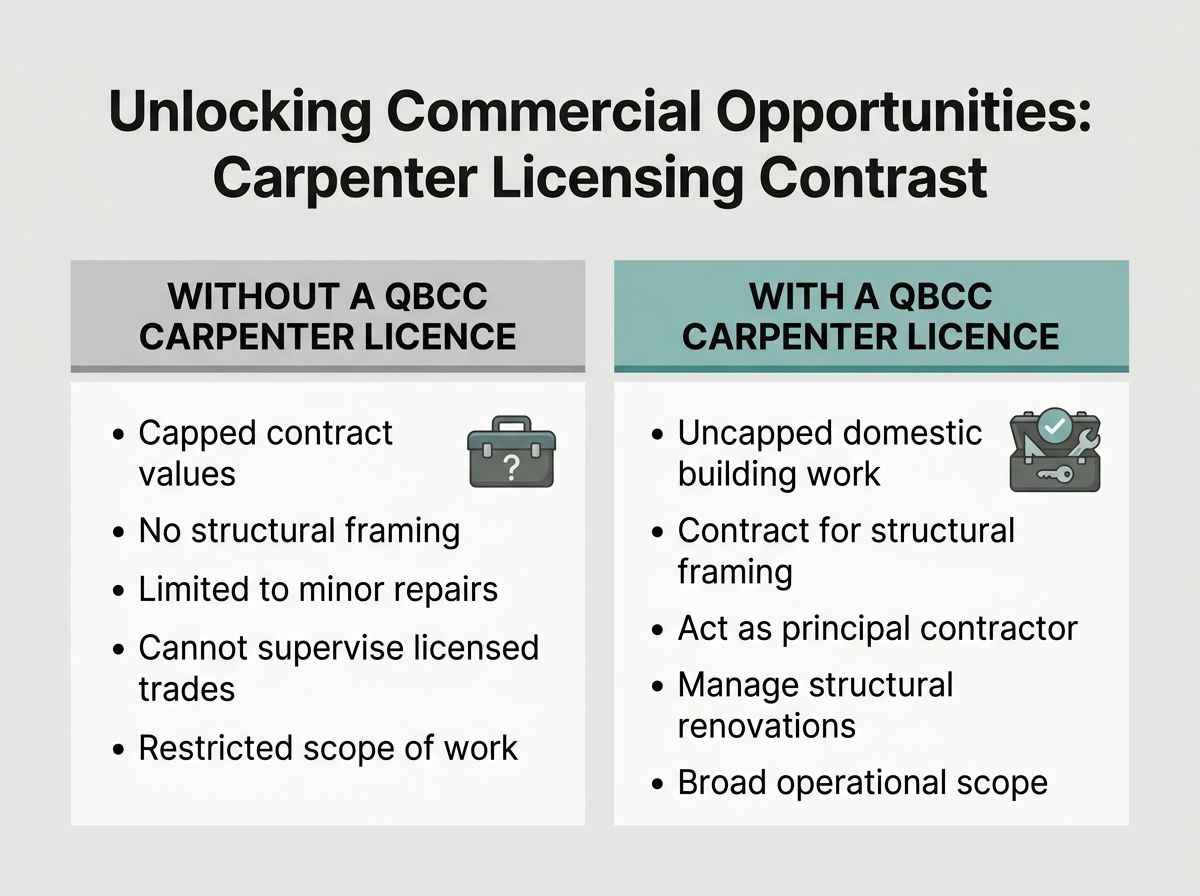
Without a licence, your work is limited by the domestic building threshold. You operate within the narrow margins permitted for unlicensed operators, which means smaller jobs, lower contract values, and a limited scope of work.
With a QBCC carpenter licence, those limits disappear. You can quote and contract for domestic building work above the threshold. You can take on structural carpentry, framing, and fit-out work as a principal contractor. You can tender for jobs that require a licensed tradesperson on the paperwork, which covers most of the higher-value residential and light commercial market.
The licence does not change what you can build. You already know how to do the work. It changes what you can charge, what you can contract for, and who will hire you.
The identity problem: why skilled carpenters call themselves handymen
Here is the part of the trade that is rarely discussed.
The 'handyman' label is not just a marketing choice. For many experienced carpenters, it is an identity. It developed over time because it kept things simple, avoided scrutiny, and bypassed a licensing pathway that felt unclear or disruptive to a busy working week.
The label was useful and kept things simple, but it has a clear ceiling.
Carpenters who call themselves handymen often do work that is indistinguishable in quality, complexity, and skill from the work of licensed tradespeople. The difference is not in what they can do; the difference is in what the system formally recognises.
That gap between capability and recognition is a documentation problem, not a skills problem. The skills exist and the experience is real. What is missing is a formal assessment that translates years of on-the-job expertise into a credential the QBCC accepts.
The same pattern appears across other trades. Experienced workers in concreting, welding, plumbing, and HVAC face this exact dynamic: deep practical competence that formal systems fail to see because it lacks the right paperwork.
How much is the ceiling actually costing you?
The financial cost of staying under the threshold is real, but it is easy to underestimate because it is invisible. You do not see the jobs you did not quote, nor the contracts you could not take. You see only the work you did.
Consider this as an illustrative scenario, not a guaranteed figure: if you complete a significant number of residential carpentry jobs each year and cap each quote to stay under the domestic building threshold, you are pricing every one of those jobs at a fraction of what a licensed operator could charge for the same scope.
The gap is not just in the per-job rate; it is in the type of work you can access. Licensed carpenters can take on full structural fit-outs, larger renovation contracts, and principal contractor roles. These are higher-value jobs and represent a different category of work entirely. The ceiling does not just limit your price; it limits your market.
We cannot give you a precise dollar figure for what the ceiling is costing you without knowing your specific situation. But if you have been in the trade for several years and are still pricing around the threshold, the gap is almost certainly larger than it feels.
What the QBCC requires and what you probably already have
The QBCC carpenter licence has distinct eligibility requirements, including qualification, experience, and financial standards. We are not going to reproduce the full QBCC requirements here; they are specific, they can change, and you should verify them directly with the QBCC before making any decisions.
What we can say is this: for most experienced carpenters, practical competence is not the gap. The gap is simply documentation.
QBCC licensing typically requires a formal qualification in carpentry, a nationally recognised credential that demonstrates competency against the relevant training package. For many carpenters, that means a Certificate III in Carpentry (CPC30220). If you completed an apprenticeship, you may already hold this. If you came up through the trade informally, working under experienced carpenters, learning on the job, and building your skills over years of real work, you may not have the formal credential, even though your practical competency is equivalent.
That is the gap that Recognition of Prior Learning is designed to address. It focuses on documentation, not the skills.
The specific QBCC requirements, including which qualifications are accepted, what experience evidence is required, and what the application process involves, are available directly from the QBCC. Verify the current requirements before you begin any pathway.
RPL: having your experience assessed, not repeated
Recognition of Prior Learning (RPL) is a formal assessment pathway within the Australian vocational education and training system. It is not a shortcut, and it is not a workaround. It is a rigorous process by which a registered training organisation (RTO) assesses your existing skills and knowledge against the requirements of a qualification.
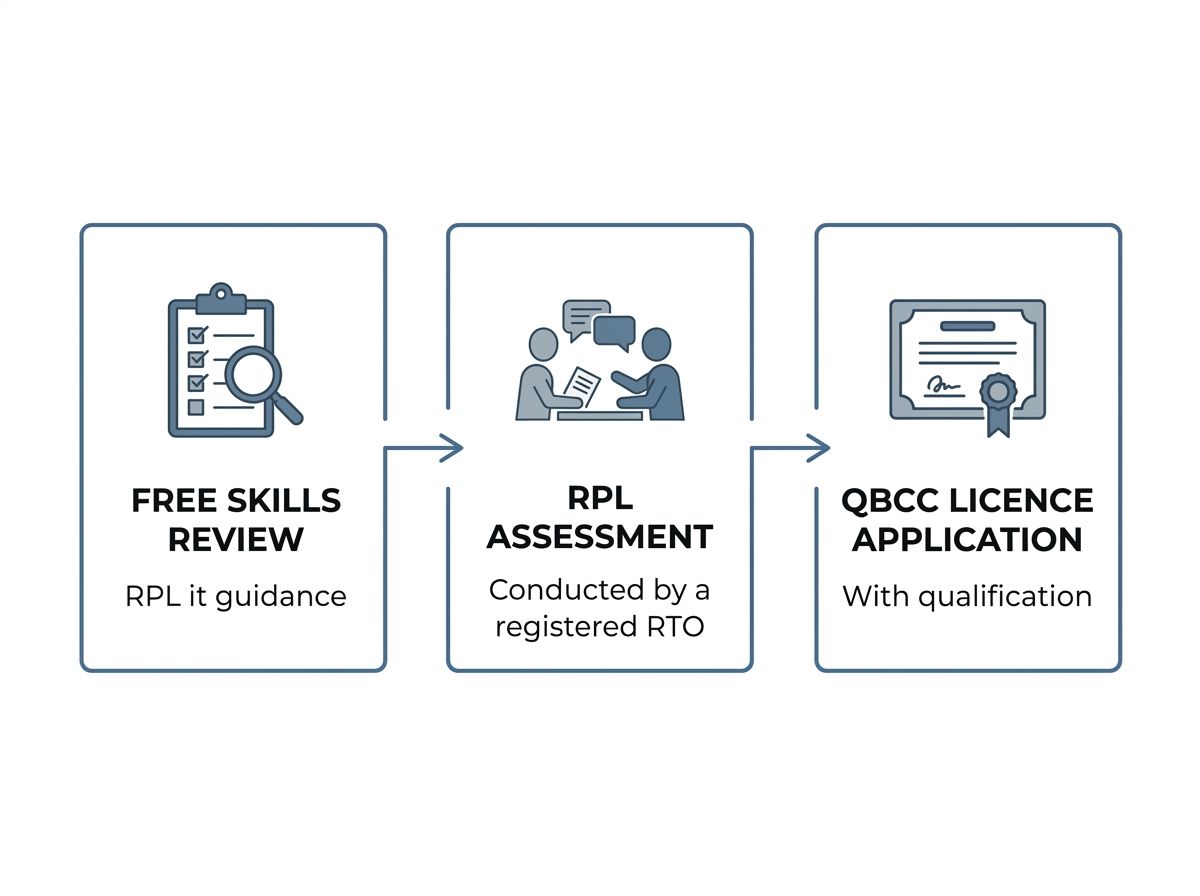
If you have been working as a carpenter for years, you have almost certainly developed the competencies that the Certificate III in Carpentry covers. RPL gives you the opportunity to demonstrate that through evidence, not through sitting in a classroom repeating things you already know.
What does that evidence look like? Typically, it includes items like photographs of completed work, references from employers or clients, records of jobs you have managed, documentation of the tools and techniques you use, and any prior training records you hold. The specific evidence requirements depend on the RTO conducting the assessment and the units being assessed.
The assessment is conducted by a qualified assessor from the delivering RTO. RPL it guides you through the process, helping you understand what evidence to gather, how to present it, and what to expect, but the assessment itself is conducted by the RTO. The qualification, if awarded, is issued by the RTO and is nationally recognised because the assessment is genuine.
Gap training may be required. If the assessment identifies areas where your evidence does not fully demonstrate competency, gap training is provided to address those areas. This is a normal part of the process, not a failure of it.
How long does it take? That depends on how ready your evidence is and the RTO's assessment schedule. We present any timeframe as indicative, not promised. What we can say is that the process is designed to respect the experience you already have, not to make you repeat a journey you have already taken.
The same experience-to-evidence gap appears across other trades. Mechanics, plant operators, and other tradespeople face the same dynamic: years of practical competency that formal systems have not yet seen.
The decision is yours
You have the skills. You have the experience. You have been doing this work, probably for years.
The question is not whether you are capable. The question is whether your capability is formally recognised so you can quote without a ceiling, contract without a threshold, and build the business your skills deserve.
A QBCC carpenter licence does not make you a better carpenter. You are already that. What it does is remove the constraint limiting what you can charge and who you can work for.
RPL is not the right pathway for everyone. Some carpenters have gaps that require more than an evidence portfolio. Some already hold the qualification they need. The only way to know is to have your situation honestly assessed.
That is what the Free Skills Review is for. It is free. There is no commitment. We will tell you honestly whether RPL is the right pathway for your situation, and if it is not, we will tell you that too.
The decision is yours.
Ready to Get Recognised?
Start with a free skills review to find out if RPL is right for you.