You're Not Going Back to School: What RPL for Commercial Cookery Actually Involves
Think RPL means going back to TAFE? Here is what gathering workplace evidence for a Certificate III in Commercial Cookery actually looks like.

The assumption that keeps experienced chefs stuck
You have worked in commercial kitchens for years. You know how to manage a service, handle stocktakes, deal with difficult head chefs, and run a kitchen that is three staff short on a busy Saturday night. You know your job. But somewhere along the line, you were probably told that getting a formal qualification requires going back to TAFE. That means sitting in a classroom, being taught things you already do in your sleep, and being surrounded by students who have never worked a real double shift.
That assumption is understandable. It is also the main reason experienced kitchen workers stay stuck. They remain unrecognized by the formal systems that dictate who gets promoted, who gets hired, and who is taken seriously. The assumption is wrong, and once you understand why, the path forward is straightforward.
What RPL actually is (and what it is not)
Recognition of Prior Learning (RPL) is a formal assessment pathway within the Australian vocational education and training system. It is not study, and it is not coursework. It does not require you to attend regular classes, sit exams, or repeat training for skills you already use on the job.
The RPL process requires you to demonstrate that you already meet the competency standards of the qualification. The actual assessment is conducted by a qualified assessor from a Registered Training Organisation (RTO), rather than by RPL it. RPL it guides you through identifying, gathering, and presenting your evidence. The RTO then assesses this evidence against the national standards and issues the qualification if those standards are met.
RTOs must conduct RPL with the same rigour, fairness, and validity as any other assessment method. Because of this, the qualification you receive carries the exact same standing. It is not a shortcut. It is simply a different way to show your skills, starting from what you already know rather than from zero.
What the SIT30821 competency standards actually cover
The Certificate III in Commercial Cookery (SIT30821) contains 25 units of competency, comprising 20 core units and 5 elective units. These units outline the specific skills and knowledge expected of a competent commercial cook. When you read these requirements in everyday kitchen language, you will likely recognize your daily work.
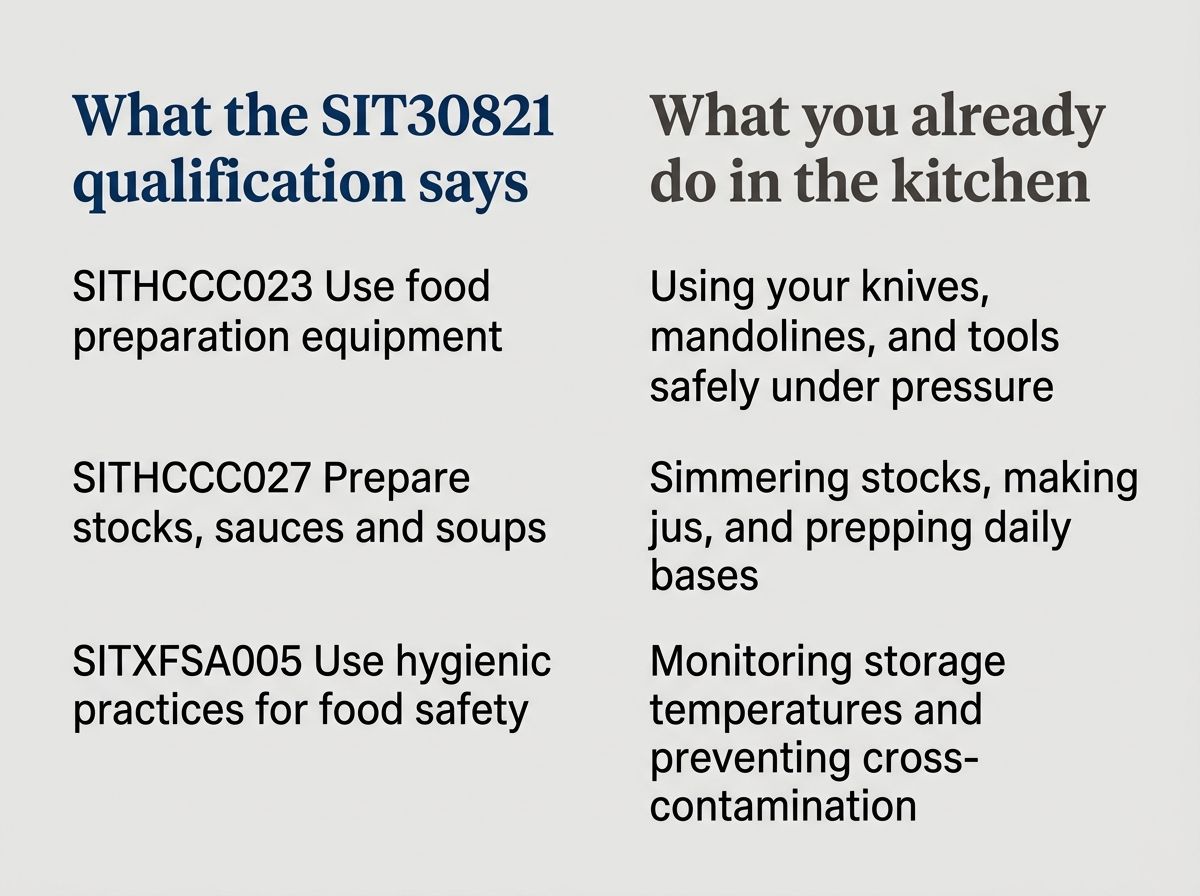
- Using food preparation equipment safely and correctly, including knives, mandolines, and other tools you handle daily
- Preparing fundamental stocks, sauces, and soups in a commercial kitchen environment
- Cooking poultry, seafood, meat, and vegetables using methods like grilling, braising, roasting, and frying
- Preparing pastry, cakes, and yeast-based products, depending on the electives selected
- Working safely in commercial kitchens by managing food hygiene, temperature control, and cross-contamination
- Implementing food safety practices that keep the kitchen compliant and the team protected
- Working effectively with team members, coordinating with front-of-house, and managing preparation work under pressure
- Participating in safe food handling practices, which involves applying HACCP principles directly to your work
The assessment does not require you to recite academic theory. It requires you to show you meet these standards using evidence from your actual work. For most experienced commercial kitchen workers, the difference between their daily routine and what the qualification describes is smaller than they realize.
You can find further details about the Certificate III in Commercial Cookery (SIT30821) and the RPL process on our qualification page.
What gathering evidence looks like in a commercial kitchen
Evidence for an RPL assessment consists of documentation from your daily work rather than essays or exams. The types of evidence relevant for a commercial cookery assessment include:
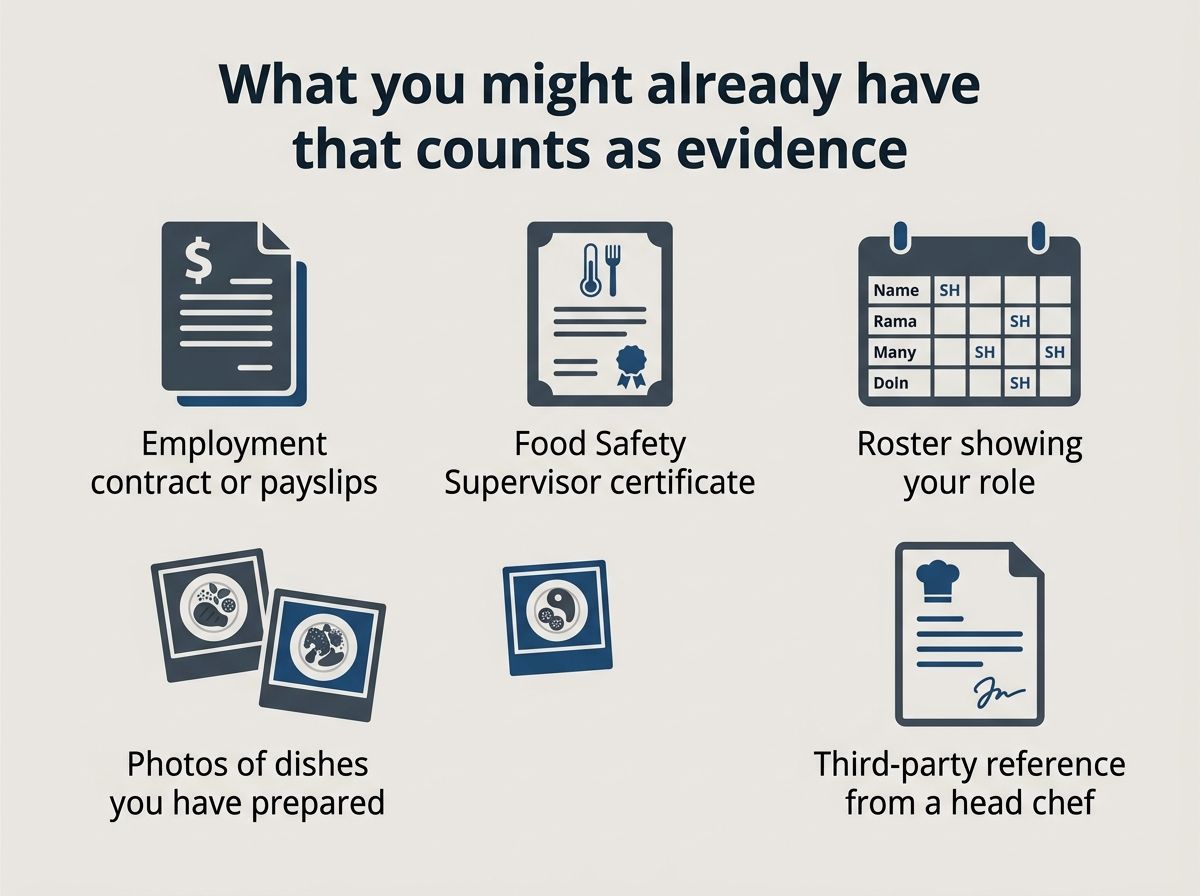
- Employment records, such as payslips, employment contracts, or letters from employers confirming your work history
- A third-party report or professional reference from a head chef, kitchen manager, or employer who knows your skills
- Existing food safety certificates, including a Food Handler Certificate or a Food Safety Supervisor certificate
- Workplace rosters or timesheets that verify your role and the specific shifts you have worked
- Photographic evidence or records of dishes, menu plans, and kitchen preparation you have completed
- A structured technical discussion with the assessor to describe your industry experience and daily kitchen procedures
- A practical demonstration where the assessor observes your skills directly in a commercial kitchen setting
The exact evidence you need depends on the RTO conducting your assessment. The underlying principle remains identical: your evidence must be current, authentic, valid, and sufficient to prove you meet the national standards. RPL it helps you identify the records you already have and format them correctly.
Many candidates discover they already possess evidence they had not considered before. This might include a written reference from a head chef you worked with for years, a food safety certificate stored away, or historical payslips confirming your role as a cook rather than a kitchen hand. This guided process makes your existing experience visible.
The part that surprises most experienced chefs
Your workplace experience serves as direct evidence. This is the core principle of the RPL process. For many experienced chefs, realizing they already have most of the required documentation is the exact moment the process stops feeling overwhelming. They see they do not have to start from scratch.
You do not need to create new materials. You are simply collecting and organizing evidence you have already generated during your career. A qualified assessor from the delivering RTO reviews this portfolio against the SIT30821 standards. RPL it assists you during this preparation phase to ensure your submission is clear and comprehensive.
What happens if there are gaps
Honest advice on suitability is central to how RPL it operates. If the assessment identifies areas where your workplace evidence does not meet the benchmark, gap training is provided. This is not a failure; it is a standard part of a rigorous assessment process. The qualification is nationally recognized because the standards are real.
RPL it will tell you directly if RPL is not the most suitable pathway for your specific experience. We prefer to point candidates toward the right option rather than enrolling them in a program that does not fit. This straightforward approach ensures you can trust the process.
Is RPL the right pathway for you?
RPL for the Certificate III in Commercial Cookery suits experienced kitchen staff who currently work in commercial environments and can prove their skills through workplace documentation. It is not the right fit for everyone, and we assess suitability transparently before any enrollment takes place.
RPL does not rely on a fixed timeframe or a specific number of years in the kitchen. What matters is whether your current skills match the elements and performance criteria in the SIT30821 units. A cook with two years of intensive commercial kitchen experience might be an excellent candidate, while someone with ten years in a restricted role might not qualify. The Free Skills Review is where we make that determination.
Frequently asked questions
Do I need to attend any classes for RPL?
No. RPL does not require classroom attendance, coursework, or scheduled study. The assessment relies entirely on evidence of your existing skills and experience, which a qualified assessor from the delivering RTO reviews. If you need gap training in specific areas, we will discuss this with you, but the process starts with your current knowledge.
What if I do not have formal employment records?
Formal employment records are just one way to prove your work history. Third-party reports from supervisors, practical demonstrations, technical conversations with the assessor, and other supporting files are also highly relevant. If your kitchen experience is informal or casual, you should discuss your situation with RPL it before assuming you are ineligible. Requirements vary between RTOs, and the Free Skills Review is the best place to start.
Is an RPL qualification the same as one from TAFE?
Yes. The Certificate III in Commercial Cookery (SIT30821) is a nationally accredited qualification under the Australian Qualifications Framework. Whether you earn it through classroom study or an RPL assessment, you receive the same qualification recognized across all Australian states and territories. ASQA, the national VET regulator, ensures that all accredited qualifications meet identical standards, giving employers, government bodies, and the community complete confidence in their integrity.
What happens if I do not meet all the competency standards?
If the assessment process identifies areas where your evidence does not fully meet the required standard, gap training is provided. This is a normal part of a rigorous assessment process rather than a disqualification. RPL it will be clear about any gaps and explain what is needed to address them. If RPL is not the correct path for you, we will tell you directly.
How long does the RPL process take?
Timeframes depend on the specific RTO, how quickly you compile your evidence, and whether you require any gap training. RPL it provides an estimated timeline during your Free Skills Review. We do not guarantee a specific completion date because assessment outcomes rely entirely on the independent professional judgment of the RTO assessor.
The Western Australian Government RPL fact sheet explains that RPL must be conducted with the same rigour and validity as any other assessment method, which ensures the resulting qualification carries full official recognition.
ASQA, the national VET regulator, confirms that accredited qualifications are nationally recognized across all states and territories, regardless of whether you completed traditional classes or an RPL pathway.
NCVER research confirms that RPL sits formally within the Australian Qualifications Framework as a recognized assessment pathway within the national vocational system rather than an informal workaround.
Ready to Get Recognised?
Start with a free skills review to find out if RPL is right for you.