The one question that decides whether RPL will work for you
Not sure if RPL qualifications apply to your experience? Use this simple diagnostic question to clarify your eligibility across trades and professions.
By RPL it Australia9 min read
Most people ask the wrong question about RPL
You have the experience. You have been doing the work for years, possibly decades. Somewhere along the way, someone told you that Recognition of Prior Learning might be worth looking into. So you searched. You read. And you came away with one nagging question: am I eligible?
Here is the problem. That question is too vague to be useful. 'Am I eligible for RPL?' is like asking 'am I good at sport?' The answer depends on the sport, the level, and what you want to prove. RPL qualifications work the same way. Eligibility is not a single threshold you either clear or fail. It is a match between your actual work history and what a specific qualification requires.
Most people who look into RPL start with the wrong question. The right question is far more specific, and once you know it, your next steps become clear.
The one question that actually matters
Here is the question that cuts through the confusion:
Do you have demonstrable, evidenced experience in the work the qualification covers?
That is the diagnostic. If you can answer yes to that question, and you have something to show for it, then RPL is a pathway worth exploring. If the answer is no, or not yet, that is also useful information. It tells you exactly what to do next.
The question has three parts, and each one matters. Let us look at them individually.
What 'demonstrable' actually means (and what it doesn't)
Demonstrable does not mean perfect. It does not mean formally documented. You do not need a supervisor's sign-off from ten years ago, a training record that no longer exists, or a performance review from a job you left in 2016.
Demonstrable means you can show it, describe it, and point to it. You can walk an assessor through what you did, how you did it, and what resulted from your work.
If you have managed a team for eight years, you can demonstrate that. If you have been laying concrete for a decade, you can demonstrate that. If you have been running a commercial kitchen, you can demonstrate that. The question is not whether your experience was gained formally, but whether it was real and whether you can show it.
Many people assume their experience does not count because they learned on the job rather than in a classroom. That assumption is incorrect. RPL exists because on-the-job experience is real experience. The assessment process evaluates what you can do, rather than where you learned to do it.
What 'evidenced' means in practice
Evidence is not a single document. It is a collection of proof that your experience is real, current, and relevant to the qualification you want. Think of it as a portfolio built from the work you have already done.
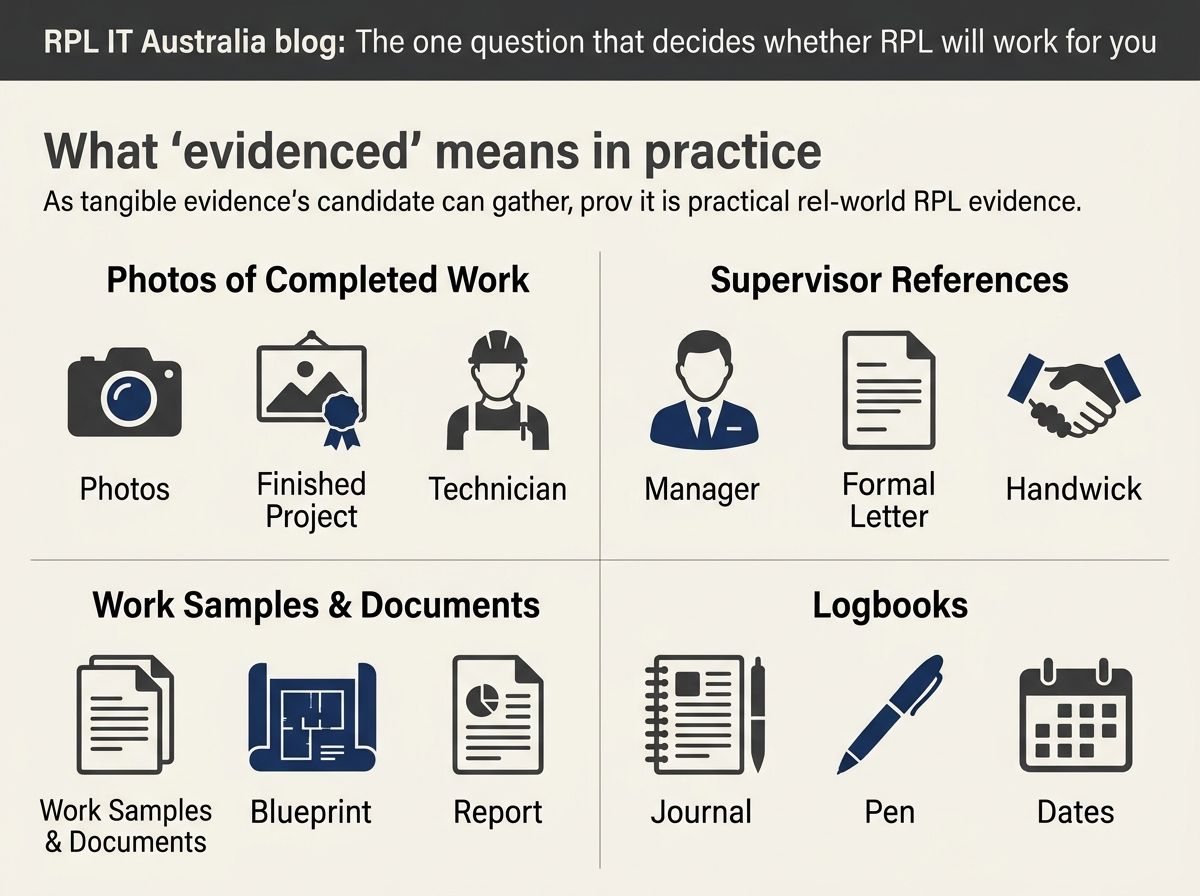
Evidence can take many forms. Common types include:
- Photos or videos of completed work, such as finished joinery, a completed landscaping project, or plated dishes
- References from employers, supervisors, or clients who can verify your competency
- Work samples, including reports you have written, plans you have developed, or systems you have built
- Logbooks or records, such as shift logs, maintenance records, clinical notes, or project documentation
- Third-party reports, including statements from colleagues or managers who have observed your work
- Professional conversations, which are structured discussions with an assessor where you explain your experience in detail
The evidence does not need to be formal; it must be real. A photo of a retaining wall you built is evidence. A reference from a head chef who worked with you for three years is evidence. A project plan you developed and implemented is evidence. The goal is to build a clear picture of your competency, and most experienced workers already have more evidence than they realise.
For a closer look at how one industry approaches this, see how IT professionals document years of on-the-job experience in our article on the Diploma of Information Technology RPL pathway.
What 'the work the qualification covers' means
This is where many candidates trip up, and where honest guidance is most important.
RPL qualifications are assessed against specific units of competency. Each qualification in Australia's national training framework consists of units that describe particular tasks, skills, and knowledge areas. The question is not whether you have worked in the industry, but whether you have done the specific work this qualification covers.
A Certificate III in Carpentry, for example, covers specific carpentry tasks like framing, fixing, formwork, and related work. It does not cover general construction. A Diploma of Business covers specific management and business functions, including planning, financial management, and operational oversight. It does not cover simply working in business.
The practical implication is that before you apply the diagnostic question, you need to know what the qualification actually covers. The national register at training.gov.au lists every qualification and its units of competency. You can search for any qualification by name or code, open the qualification detail page, and read through the units. Each unit has a title and a description of what it covers, which is the benchmark your experience will be measured against.
Some people look at a qualification's unit list and immediately recognise their own work. Others look and realise the qualification they were thinking of is not quite the right match, and that a different qualification in the same field might be a better fit. Both outcomes are useful, and both save time.
The diagnostic in action: examples across trades and professions
Here is how the diagnostic question plays out across different industries. These examples are illustrative. You should confirm the specific units of competency for each qualification against training.gov.au for your situation.
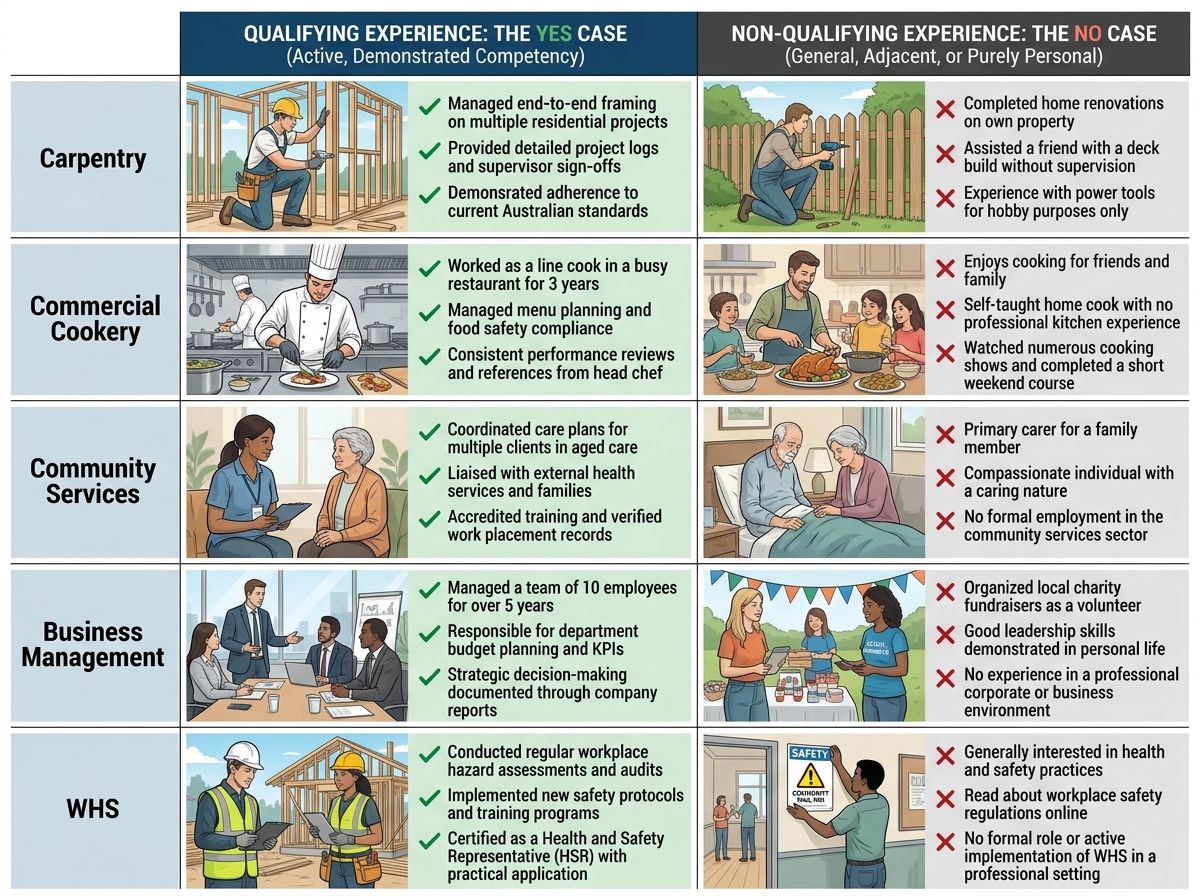
Carpentry: Certificate III in Carpentry (CPC30220)
The diagnostic question: Do you have demonstrable, evidenced experience in carpentry work, including framing, fixing, formwork, and related structural and finishing tasks?
A 'yes' looks like: Ten years working as a carpenter on residential and commercial sites, with photos of completed work, references from builders you have worked under, and the ability to describe your methods and problem-solving in detail.
A 'no' looks like: General labouring experience on construction sites, including some carpentry-adjacent tasks, but without sustained, hands-on carpentry work across the range of tasks the qualification covers.
Commercial cookery: Certificate III in Commercial Cookery (SIT30821)
The diagnostic question: Do you have demonstrable, evidenced experience working in a commercial kitchen, including preparing and cooking food across a range of methods, working to industry standards, and operating as part of a kitchen team?
A 'yes' looks like: Five years working as a cook or chef in a restaurant or catering environment, with references from head chefs, records of the menus and dishes you have prepared, and the ability to describe your kitchen practices in detail.
A 'no' looks like: Extensive home cooking experience, or occasional catering for events, without sustained work in a professional commercial kitchen environment.
Community services: Certificate IV in Community Services (CHC42021)
The diagnostic question: Do you have demonstrable, evidenced experience providing support, advocacy, or case coordination to individuals or groups in a community services context?
A 'yes' looks like: Several years working in a community organisation, disability support, or social services role, with documentation of the clients you have supported, the services you have coordinated, and references from supervisors or managers.
A 'no' looks like: Volunteer work or informal support for family members, without a sustained professional role in a recognised community services setting.
Business management: Diploma of Business (BSB50120)
The diagnostic question: Do you have demonstrable, evidenced experience in business operations, including managing teams, overseeing operational functions, and contributing to planning and financial oversight?
A 'yes' looks like: Years in a management or senior operational role, with records of the teams you have led, the decisions you have made, and references from colleagues or senior leaders who can speak to your management capability.
A 'no' looks like: Years of experience as a skilled individual contributor in a business environment, without direct management or operational oversight responsibilities.
Work health and safety: Advanced Diploma of Work Health and Safety (BSB60619)
The diagnostic question: Do you have demonstrable, evidenced experience in WHS management, including developing systems, conducting risk assessments, leading safety culture, and advising at a senior level?
A 'yes' looks like: A decade or more in a WHS role, with documented safety management systems you have developed, incident investigations you have led, and references from organisations where you have held WHS responsibility.
A 'no' looks like: Solid site-level safety awareness and compliance experience, but without the strategic and systems-level WHS work the advanced diploma covers.
For a deeper look at how safety professionals apply this diagnostic, see our article on breaking the WHS paper ceiling.
When the answer is yes: what happens next
You have the experience. You have the evidence. The work you have done maps to the qualification you are considering. What is the next step?
The RPL process generally begins with a skills review, which is a structured conversation about your experience and what you can demonstrate. From there, your evidence is gathered and organised into a portfolio. A qualified assessor from a registered training organisation (RTO) evaluates that evidence against the qualification's units of competency. The assessor determines whether you have demonstrated competency in each unit. The RTO, not RPL it, conducts the assessment and issues the qualification.
It is worth being clear about one thing: the assessment is genuine. RPL is not a rubber stamp. The assessor's job is to determine whether your experience meets the standard, and that determination is theirs to make. If your evidence is strong across most units but gaps exist in some, gap training may be required to address those areas. Where gap training is needed, it is provided at no additional cost.
The outcome, when competency is demonstrated, is a nationally recognised qualification. This is the same qualification issued to someone who completed the course in a classroom. Because the assessment is genuine, the qualification carries the same weight.
When the answer is no (or not yet): what that means
Answering no to the diagnostic question is not a dead end. It is useful information.
If your experience does not yet match the qualification you were considering, there are several directions worth exploring. A lower-level qualification in the same field might be a better match for your current experience, and completing that qualification could open the pathway to the higher-level credential later. Alternatively, there may be a different qualification in the same industry that more closely reflects the work you have actually been doing. In some cases, the gap between your current experience and the qualification's requirements is small enough that targeted gap training could bridge it relatively quickly.
None of these are consolation prizes; they are honest pathways. The goal is to find the qualification that genuinely reflects your capability, rather than enrolling you in a program that does not fit.
Recognition should not require starting over, but it does require starting in the right place.
Find out where you stand: the Free Skills Review
You have run through the diagnostic. You have thought about your experience, your evidence, and the work the qualification covers. Now the question is: what does your specific situation look like?
That is what the Free Skills Review is for. It is a no-obligation conversation, rather than an enrolment or a sales call. This structured discussion focuses on your experience and how it maps to RPL qualifications. You will come away knowing whether RPL is a realistic pathway for you, which qualifications are the closest match, and what evidence you would need to gather.
If you are not sure which qualification applies to your trade or profession, you can browse the full list of RPL qualifications to see what is available across industries.
Explore the full range of RPL qualifications available across trades and professions.
Your skills speak. We help them be heard. The final decision is yours.
General information only, current at the date shown. Licensing rules change, so check the current requirements with the relevant regulator before you rely on them. RPL it Australia is a student support service, not a Registered Training Organisation; qualifications are assessed and issued by our partner RTOs.