What stonemasons learn the hard way about Queensland licensing
Queensland stonemasons are discovering licensing rules that halt tenders and insurance. Learn how to resolve the gap with RPL.
By RPL it Australia8 min read
The moment it stops being about skill
You submitted a quote. The principal contractor asked for your licence number, but you did not have one. Perhaps it was an insurance renewal; the underwriter asked for your trade credentials and you realised you had never formalised them. Or a site manager flagged that subcontractors must hold a current licence before they can continue on the job.
For many experienced stonemasons in Queensland, the licensing requirement arrives as a sudden halt rather than a warning. After decades of laying sandstone, shaping marble, constructing arches, and restoring heritage facades, you find that the system does not question your skill. It questions your paperwork.
This is a recognition gap, not a skills gap. It is also far more common in the masonry trade than many realise.
Why Queensland requires a licensing process for stonemasons
In Queensland, you need a stonemasonry licence to perform stone-related work valued at more than $3,300, including labour and materials. The Queensland Building and Construction Commission (QBCC) administers this licence under the Queensland Building and Construction Commission Act 1991 and the Queensland Building and Construction Commission Regulation 2018.
The scope of work under this licence includes finishing, laying, machining, renovating, and shaping stone. It also covers constructing stone arches, fireplaces, stairs, and walls, along with concrete work, setting out and anchoring facades, and installing waterproofing and damp-proofing for stonemasonry. This list is not exhaustive, and the QBCC advises applicants to confirm that the licence class covers their specific intended work.
The licensing system protects consumers and establishes clear contractor accountability, ensuring that building work meets formal industry standards. The licence is not a test of whether you can do the work on site. It is simply the formal recognition the state regulator demands before they will acknowledge your trade skills.
Three moments when experienced masons discover the licensing gap
The licensing requirement rarely announces itself in advance. For most experienced stonemasons, it surfaces at one of three distinct points. Each of these moments acts as a firm barrier to business, not a mere suggestion.
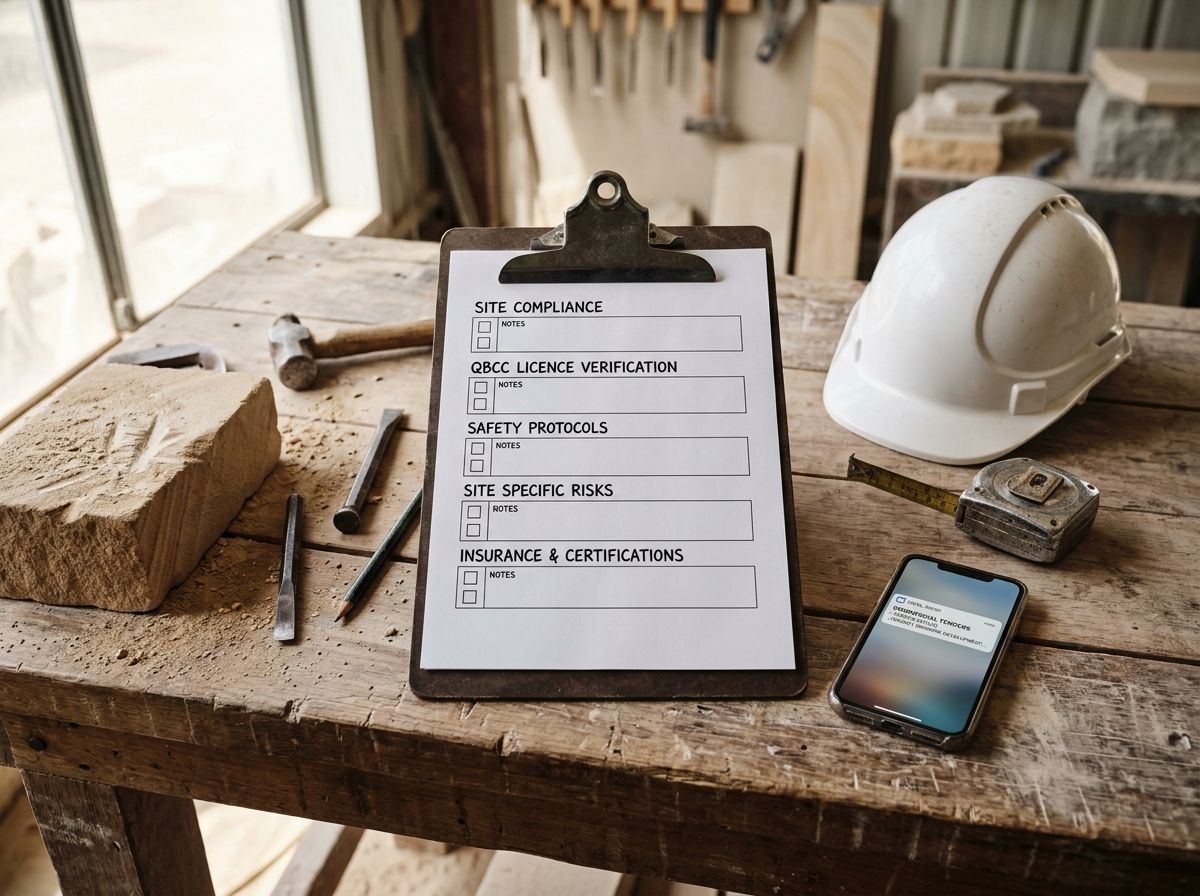
- A tender or quote request requires proof of a QBCC licence number, halting the bidding process if you cannot provide one.
- An insurance renewal or new policy application asks for trade credentials, meaning the underwriter requires formal qualification before issuing cover.
- A principal contractor or site manager demands that subcontractors hold a current licence, which can disrupt work already underway.
The QBCC actively enforces licensing compliance across Queensland. According to the QBCC's 2024–25 Annual Report, unlicensed contracting was the most common offence identified through active investigations, accounting for 46 per cent of cases. The regulator also conducted targeted site inspections to find unlicensed operators and contractors working outside their approved scope.
Queensland businesses must operate with correct licences and permits, as operating without them leads to serious penalties. QBCC compliance activity shows that enforcement is a daily reality rather than a theoretical risk.
These scenarios are not unique to stonemasons. However, they are highly disruptive for tradespeople who have spent years working under informal arrangements, such as subcontracting under another contractor's licence, focusing on smaller jobs below the $3,300 threshold, or operating unaware that the regulation applied to them.
What the licence actually requires
You can apply for a Queensland stonemasonry licence as an individual contractor, a company, a nominee supervisor, or a site supervisor. A contractor-type licence allows you to perform, supervise, and sign contracts for building work. Each licence category has distinct eligibility requirements spanning technical, managerial, and financial criteria.
The technical qualification is usually where experienced stonemasons find a gap. The QBCC accepts certificates from Registered Training Organisations, including qualifications completed through recognition of prior learning, as proof of technical skill. The standard qualification associated with this trade is the CPC32320 Certificate III in Stonemasonry.
The CPC Construction, Plumbing and Services Training Package notes that the CPC32320 qualification is designed for stonemasons working with sandstone, limestone, marble, and other stone products to produce monuments, buildings, and building components. It serves as the standard qualification for the trade.
The QBCC sets licensing requirements in Queensland. The training package notes that state and territory jurisdictions may have different licensing, legislative, regulatory, or certification requirements, meaning you should consult the relevant regulatory authorities to confirm local rules. Before applying, verify current qualification and experience criteria directly with the QBCC.
How recognition of prior learning works for experienced stonemasons
Recognition of Prior Learning (RPL) is a formal assessment that evaluates whether your existing experience meets national qualification standards. It is a rigorous process conducted by a Registered Training Organisation (RTO), offering a practical pathway for tradespeople who already do the work but lack formal paperwork.
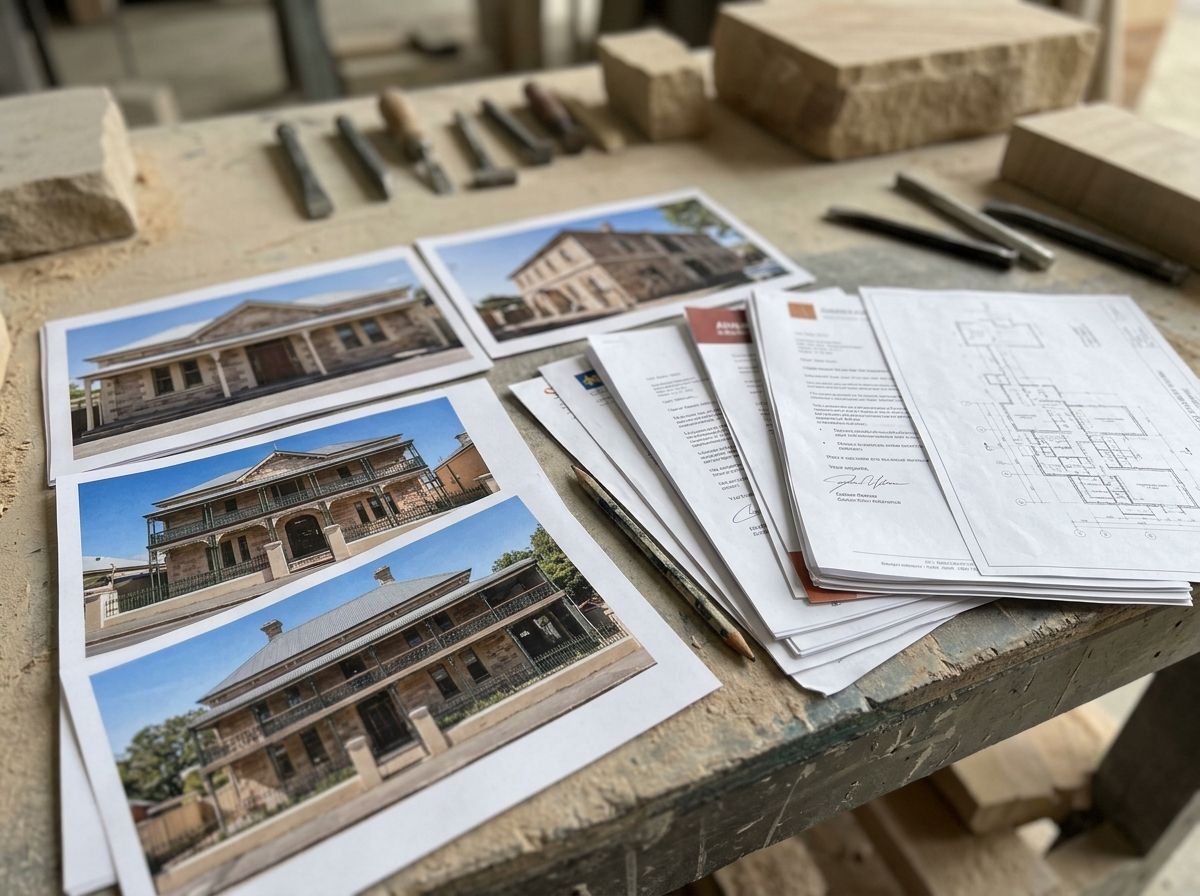
Your years on the job count as evidence, but the regulator requires that evidence to be formally assessed.
For a Certificate III in Stonemasonry, the qualification covers 30 units, split into 21 core and 9 elective units. Core units address the practical tasks of the trade: identifying and handling stone products, using tools and machinery, splitting stone manually, dressing and moulding stone, shaping solid stone, laying and finishing stone, and cutting lettering.
An RPL assessor reviews your skills against specific competency units. This involves performance evidence, which are tasks you must demonstrate, and knowledge evidence, which covers the underlying technical concepts you need to explain. This is a structured assessment against formal standards, rather than a simple resume review.
Since Australian vocational training is competency-based, experienced tradespeople can be assessed against individual units and receive a Statement of Attainment without sitting through classroom training for skills they already use daily, provided they can prove their competency to the assessor.
RPL evidence can include past study, workplace training, or hands-on experience. Accepted evidence types are set by the individual RTO's policies and qualification kits. Depending on the RTO and the units involved, the assessment may require practical demonstrations, knowledge tests, or a combination of both.
A qualification issued through RPL is nationally recognised and holds the exact same status as one earned through a traditional apprenticeship. Your certificate will not mention RPL; it is the standard Certificate III in Stonemasonry.
The national training register lists the CPC32320 Certificate III in Stonemasonry under the CPC Construction, Plumbing and Services Training Package.
What happens after the assessment
After the RTO completes your assessment and issues the Certificate III in Stonemasonry, you can use the qualification to back your QBCC licence application. The QBCC reviews all submissions and decides whether to grant the licence.
A QBCC trade contractor application requires your formal qualification certificate, proof of identity, and financial documents showing compliance with the Minimum Financial Requirements, though exemptions exist for certain licence types. You may also need to provide a completion certificate for an approved business managerial course. Required documentation varies based on your licence class and individual circumstances.
You can submit your application in person at a QBCC service centre, by mail, or via email. The QBCC notes that processing times vary. Applications take longer if the regulator needs to analyse complex financial information, map your qualifications, or verify your industry experience. The QBCC will contact you directly if they require further documentation.
Once approved, the QBCC mails out your physical licence card and an official letter detailing your licence number and approved scope of work.
While some training providers estimate the process takes around six to eight weeks, the QBCC notes that actual processing times vary. You should treat any timeframe as an estimate and check current processing queues directly with the QBCC.
The QBCC website hosts a dedicated stonemasonry licence page where you can confirm current licensing scopes, application types, and administrative requirements.
Is RPL the right pathway for you?
RPL is not suited to every situation. It requires solid, documented experience across the specific units in the Certificate III in Stonemasonry. A mason who has only worked in a highly specialised niche might lack evidence for every required unit. Conversely, those with broad experience in residential, commercial, and heritage stonemasonry generally possess the evidence needed for a successful application.
If the assessment reveals any gaps, you may need to complete targeted gap training. This is a standard part of the process to ensure full competence. Clear guidance before you enrol is far more valuable than unrealistic promises that experience alone guarantees a qualification.
The first step is a Free Skills Review. This is a complimentary, no-obligation consultation to evaluate whether your background fits the RPL criteria and to map out your options. It requires no commitment to enrol, serving simply as a practical starting point.
Your work is already evidence
Queensland's licensing regulations are here to stay. Discovering this requirement during a missed tender, an insurance delay, or a site compliance check is no reflection on your actual trade skills. It simply reflects a regulatory system that demands formal verification of your existing capabilities.
You can bridge the gap between your on-site skills and official recognition. The work you have already completed is your foundation. RPL assesses this foundation to award a nationally recognised qualification, which you can then submit with your QBCC licence application.
Getting qualified should not mean starting your training from scratch. It should simply be a matter of proving the work you have already delivered.
General information only, current at the date shown. Licensing rules change, so check the current requirements with the relevant regulator before you rely on them. RPL it Australia is a student support service, not a Registered Training Organisation; qualifications are assessed and issued by our partner RTOs.