You've been the IT person for years — why doesn't that show up anywhere official?
You have built infrastructure, solved outages, and managed systems for years. RPL IT lets you convert that experience into a nationally recognised IT diploma.
By RPL it Australia8 min read
The IT professional's invisible resume
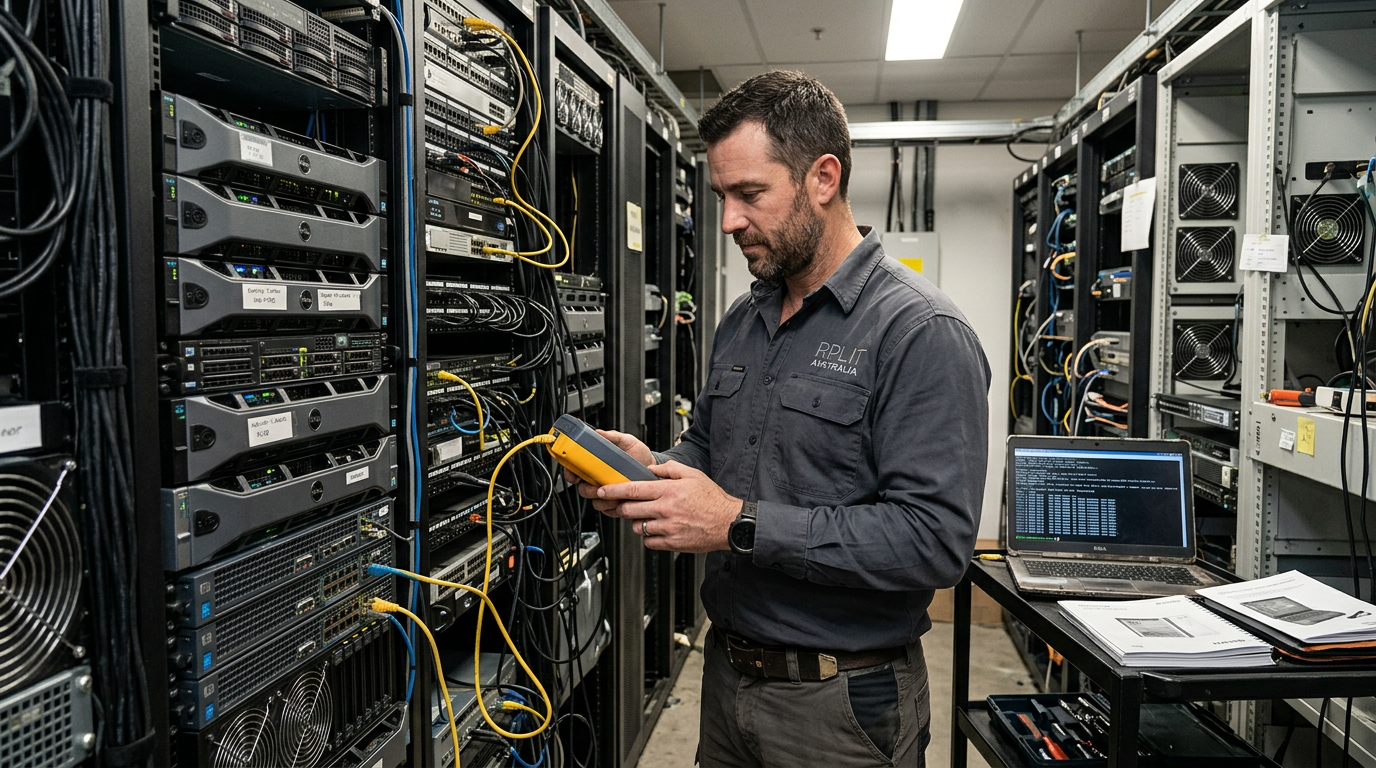
It is 2:00 am. You are logging in remotely to a server that has taken down three departments. You find the fault, apply the fix, and have everyone back online before the morning shift starts. Nobody files a formal report. Nobody updates your employment record. The job simply gets done because you are the person who knows how to do it.
You have been the IT person for years. You have worked as a systems administrator, network administrator, or the general technician people call when things break. You have migrated infrastructure, configured firewalls, managed user accounts, onboarded new staff, and kept aging hardware running past its expected lifespan. You have also trained junior colleagues who now hold job titles above yours.
Yet, when you open a job listing for the role you currently perform, or the next step up, the first requirement is often a formal IT qualification. The hiring system is looking for a formal credential rather than your years of practical experience.
This is the IT invisibility problem. Your capability is real, documented in uptime logs, completed support tickets, and the reliance of colleagues who know you can resolve their issues. However, in formal systems such as HR filters, application portals, and procurement frameworks, that capability remains invisible because it exists in a format these systems are not designed to read.
Two currencies in one job market
Australia's IT job market operates on two distinct currencies. The first is demonstrated capability, which is your practical ability to configure networks, manage servers, implement security protocols, or direct IT projects. The second is formal credentials, such as a certificate, diploma, or degree that an automated recruitment system can scan, filter, and verify against a checklist.
It is common to have substantial capability in the first currency while remaining invisible in the second. This is not a personal failure but a structural gap. This gap affects many IT workers in Australia, especially those who entered the industry through self-teaching, career changes, or hands-on training instead of a traditional university pathway.
Practical experience is not inferior to formal education; it is simply a different form of evidence. The difficulty is that recruitment and procurement systems require evidence in a specific format. If your practical record does not match that format, the system cannot process your skills, regardless of your actual competency.
In the local job market, capability is your primary asset, but credentials are the metric that automated systems measure. RPL IT is designed to help you translate your practical experience into the formal credentials required by employers.
What RPL IT means and why it differs from returning to study
Recognition of Prior Learning (RPL) for Information Technology is a formal assessment pathway. It allows experienced IT professionals to have their existing skills assessed against the requirements of a national qualification without requiring traditional classroom study. For senior technicians in Australia, the primary qualification is the Diploma of Information Technology (ICT50220), which is an AQF Level 5 qualification issued by registered training organisations (RTOs).
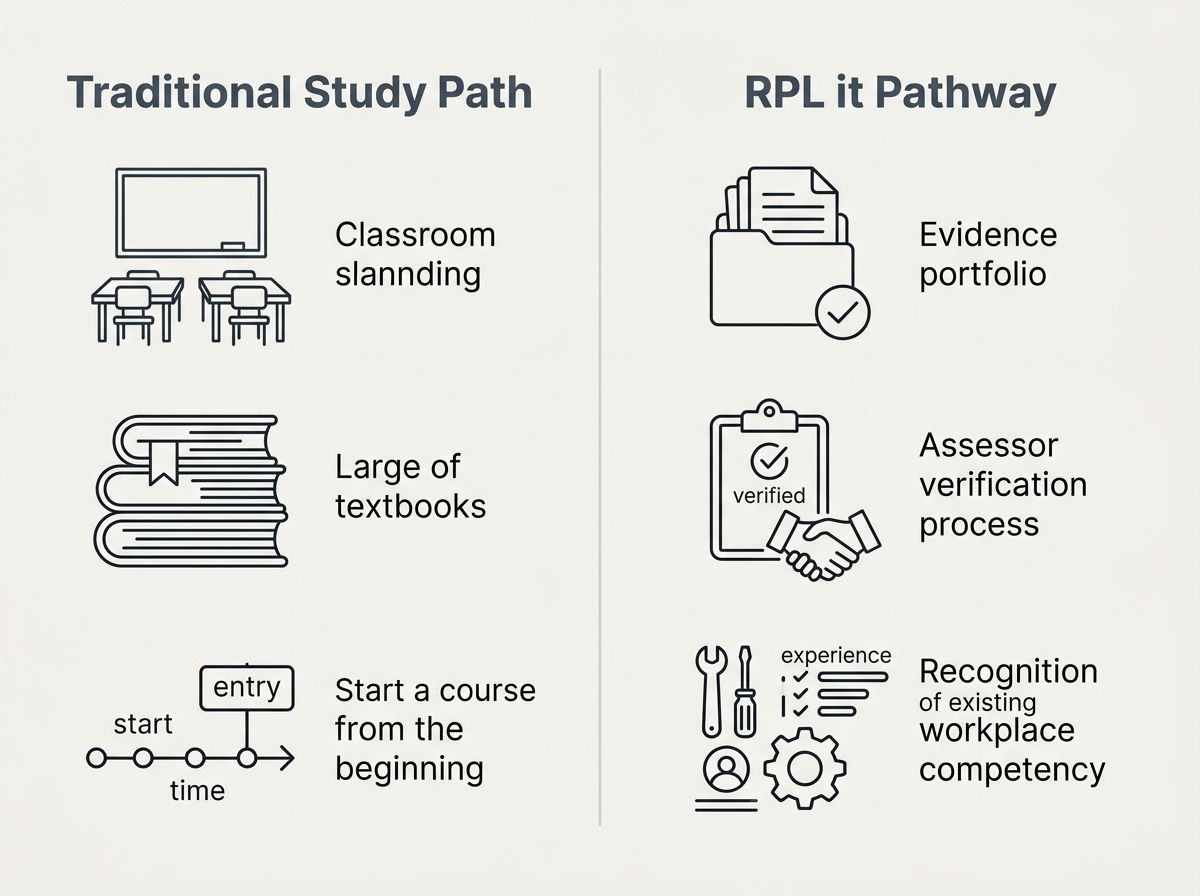
RPL is a rigorous, evidence-based assessment process rather than an automated shortcut. It evaluates whether your practical experience matches the competency standards of the national qualification. If an assessor verifies your evidence, the RTO issues the qualification. This qualification is nationally recognised because the assessment process adheres to strict national training standards.
The distinction from classroom education is clear. Traditional study requires you to learn new concepts and complete assignments from the beginning. RPL requires you to show evidence of skills you already use daily in your career. If you have worked in the industry for years, you do not need to start over; you simply compile evidence of your existing work.
It is important to be practical about this pathway. RPL is not suitable for every candidate, and the formal assessment may highlight skill gaps that require extra training before a qualification can be granted. A Free Skills Review is the first step to confirm if your experience matches the current national requirements.
The work that counts as evidence for your qualification
The Diploma of Information Technology (ICT50220) covers several core technical areas. While exact unit requirements must be confirmed through a formal skills review, the typical work activities that contribute toward this qualification include:
- Managing network infrastructure, including configuring routers, switches, and firewalls, monitoring network performance, and resolving connectivity issues
- Administering server environments by installing, configuring, and maintaining hardware and operating systems, as well as managing backups and disaster recovery plans
- Providing desktop and system support, resolving technical issues, managing helpdesk queues, and documenting solutions
- Managing user accounts and access control through Active Directory or similar platforms, and maintaining security policies
- Deploying cybersecurity measures, including patch management, endpoint protection, and incident response
- Managing IT projects by planning and executing hardware upgrades, cloud migrations, or system rollouts
- Creating technical documentation, network diagrams, and standard operating procedures for the organisation
- Training and mentoring colleagues, onboarding staff, and providing informal technical instruction to team members
If these tasks match your weekly schedule, you already possess the practical knowledge required. A Free Skills Review compares your daily work with the formal qualification criteria, giving you a clear assessment of your standing without any financial cost or obligation.
Why a formal IT diploma opens doors that experience alone cannot
In the Australian IT sector, formal qualifications act as administrative filters that experience alone often cannot bypass. Senior roles like IT manager, infrastructure lead, systems architect, or enterprise support specialist frequently list a Diploma of Information Technology as a mandatory requirement. Additionally, government tenders and corporate procurement policies often specify that project staff must hold formal qualifications, while HR scanning software screens out candidates without the necessary credentials.
Jobs requiring a formal qualification often offer higher salary ranges than those that do not. This is rarely because the credentialed candidate is more capable; indeed, self-taught professionals are often highly skilled. Rather, the qualification serves as a standardized measure of competence for corporate systems that lack the technical resources to evaluate hands-on skills during initial screening.
For professionals planning Australian skilled migration, formal IT qualifications at AQF Level 5 or higher are useful for skills assessments. Candidates should verify these requirements directly with the Australian Computer Society (ACS) or their relevant assessing authority, as specific criteria depend on your visa pathway and occupation.
Your skills are real, but the primary question is whether they are formally documented. Having your experience recognised can help you access opportunities that require official credentials.
The RPL process for IT professionals
The RPL pathway for the Diploma of Information Technology involves four stages. Knowing what is required helps you prepare your documentation and decide if this is the right approach for your career.
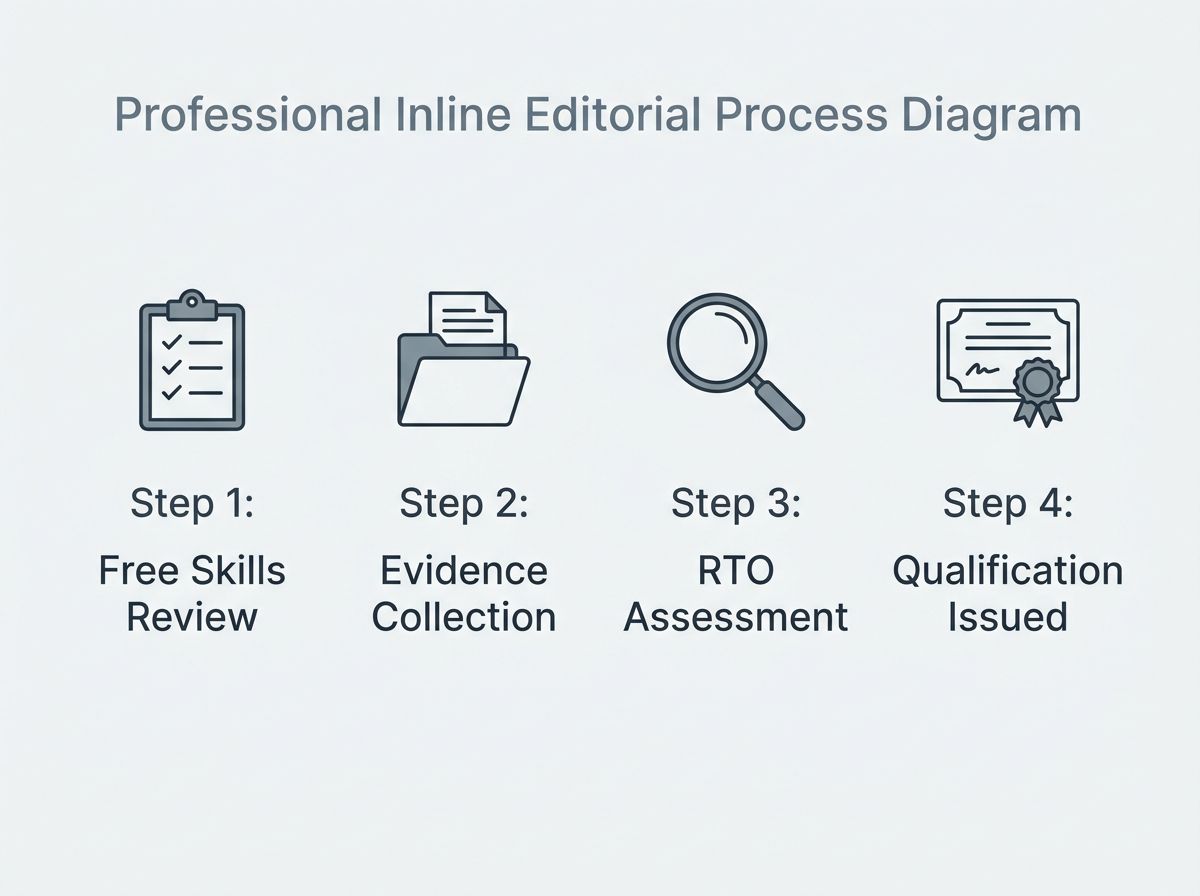
- Free Skills Review: A preliminary review to check if your IT experience corresponds with the qualification standards. This tells you if you are a suitable candidate for RPL before you make any commitment or spend any money.
- Evidence Gathering: If you are eligible, you work with a specialist to collect evidence of your technical career. This can include system configurations, project plans, work samples, references, and records of past training. The documentation must prove your competency in specific technical tasks rather than just stating your job title.
- RTO Assessment: An assessor from a partner registered training organisation (RTO) evaluates your portfolio against national standards. The assessor makes an independent decision on whether your skills are verified. While RPL it supports you through the preparation, the partner RTO is responsible for the formal assessment.
- Issuing the Qualification: If your evidence meets the unit requirements, the RTO issues the formal Diploma of Information Technology (ICT50220). If the assessor identifies any areas that require further evidence or training, those options are provided to help you complete the process.
The timeline for completing your RPL depends on how quickly you can compile your work history and the processing times of the assessing RTO. Gathering clear evidence of your career history requires thorough preparation, but it avoids the need to attend classes to study material you have already mastered.
Is RPL suitable for all IT professionals?
The direct answer is no, and it is important to clarify why.
This pathway is best suited for individuals with several years of practical experience in roles that align with the Diploma of Information Technology. This includes systems administrators, network engineers, IT support officers, and technical coordinators who can provide clear documentation of their daily responsibilities.
RPL is generally not suitable for junior staff, technicians with highly specialized but narrow duties that do not cover the broader units of the diploma, or those who cannot produce verifiable proof of their past work. For these candidates, a standard course of study or a Certificate-level qualification is often a more appropriate route.
The Free Skills Review is designed to address this specific question. It provides a straightforward assessment of your background before you enrol, make any payment, or commit to any process. Our goal is to ensure you select the correct pathway for your career development.
Translating your IT experience into recognized credentials
You have spent years working in server rooms, managing helpdesk tickets, resolving overnight system outages, and training team members. That practical work is valuable.
The difficulty is not a lack of technical capability; it is that your skills are not currently formatted in the way that HR departments and enterprise clients require.
Your daily work can serve as the primary evidence for your qualification. The Diploma of Information Technology (ICT50220) is the national standard that converts your existing skills into an official credential. RPL provides a structured way to complete this translation through independent assessment and professional guidance that values your prior career achievements.
The choice of how to advance your career is yours.
General information only, current at the date shown. Licensing rules change, so check the current requirements with the relevant regulator before you rely on them. RPL it Australia is a student support service, not a Registered Training Organisation; qualifications are assessed and issued by our partner RTOs.