Stop starting from scratch: how Defence RPL translates military service into civilian credentials
ADF experience does not disappear when you leave service. Defence RPL translates military skills into civilian qualifications.

The civilian career ladder doesn't start at the bottom unless you think it does
You have the experience. Years of it. Operational deployments, technical training, leadership under pressure, and logistics at scale. Then someone hands you a job description with a qualification requirement you do not hold, and the immediate assumption is that you need to go back to the beginning.
That assumption is wrong. It is also understandable, because the civilian qualification system was not designed with ADF service in mind. The skills are real. The problem is translation, not competence.
Thousands of ADF personnel separate from service each year. Many carry more than a decade of practical experience across logistics, communications, health, engineering, training, and leadership. What they often lack is not capability. It is a piece of paper that civilian systems can read.
Recognition should not require starting over. For most transitioning ADF members, it does not have to.
What civilian HR actually sees when they look at your service record
The ADF recruitment and assessment process is built around military-specific criteria. Psychological interviews assess how candidates will cope in a military environment, whether their values are compatible with ADF culture, and whether they will be effective in their chosen role. Officer candidates attend selection boards where they are evaluated by panels of officers and psychologists through group and individual activities.
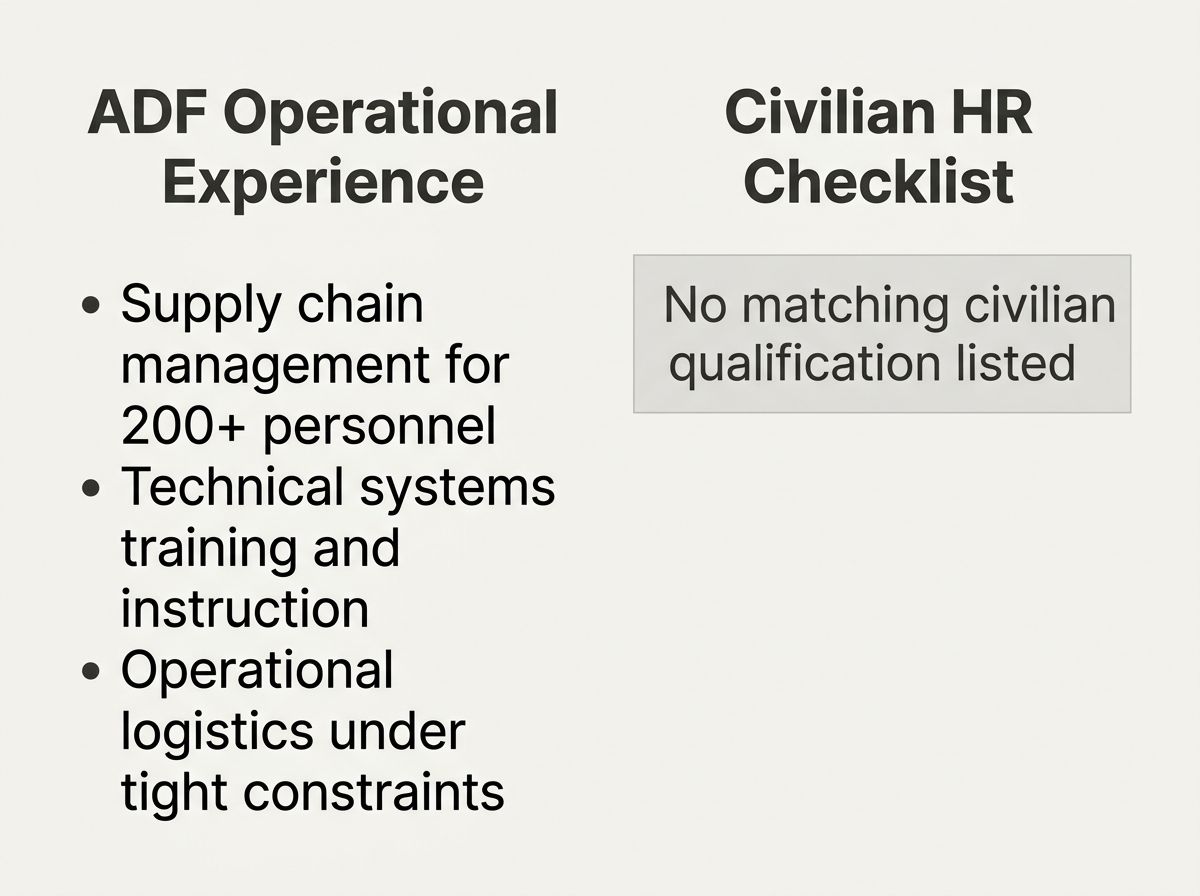
These are rigorous, meaningful assessments, but they are not the language of civilian HR. When a hiring manager looks at a service record, they see rank, posting history, and training certificates, rather than the unit-by-unit competency framework that civilian qualifications use. The skills are present, but the translation is missing.
Consider what a logistics sergeant actually does: managing supply chains for a deployed unit, coordinating procurement under operational constraints, supervising personnel, and maintaining accountability for equipment worth millions of dollars. On a civilian qualification checklist, that experience may appear as a blank space next to a Diploma of Logistics or a Certificate IV in Supply Chain Operations.
The same gap appears for signals operators, field medics, combat engineers, training instructors, and intelligence analysts. The work is real. The formal record does not reflect it yet.
Defence RPL is not a shortcut, it is a translation service
Defence RPL, or Recognition of Prior Learning applied to military service, is the formal process of presenting your ADF experience as evidence against a civilian qualification standard. It does not give you credit for things you have not done. Instead, it provides a structured, assessor-reviewed pathway to demonstrate that your experience meets the competency requirements of a nationally recognised qualification.
Think of it this way: your service is the source text. The qualification is the translated document. The content is the same, but the language has changed.
RPL is a genuine assessment process. A qualified assessor from a registered training organisation (RTO) reviews the evidence you provide, such as your service records, performance appraisals, training certificates, and position descriptions, then evaluates it against the units of competency required for the qualification. If the evidence demonstrates competency, the qualification is awarded. If gaps are identified, targeted training is available to address them.
This is not a workaround. It is the legitimate, nationally recognised pathway for experienced workers whose skills exist in a form that formal systems have not yet counted.
What military experience actually translates to
The translation is more direct than most transitioning ADF members expect. Here is how common service categories map to civilian qualification pathways.
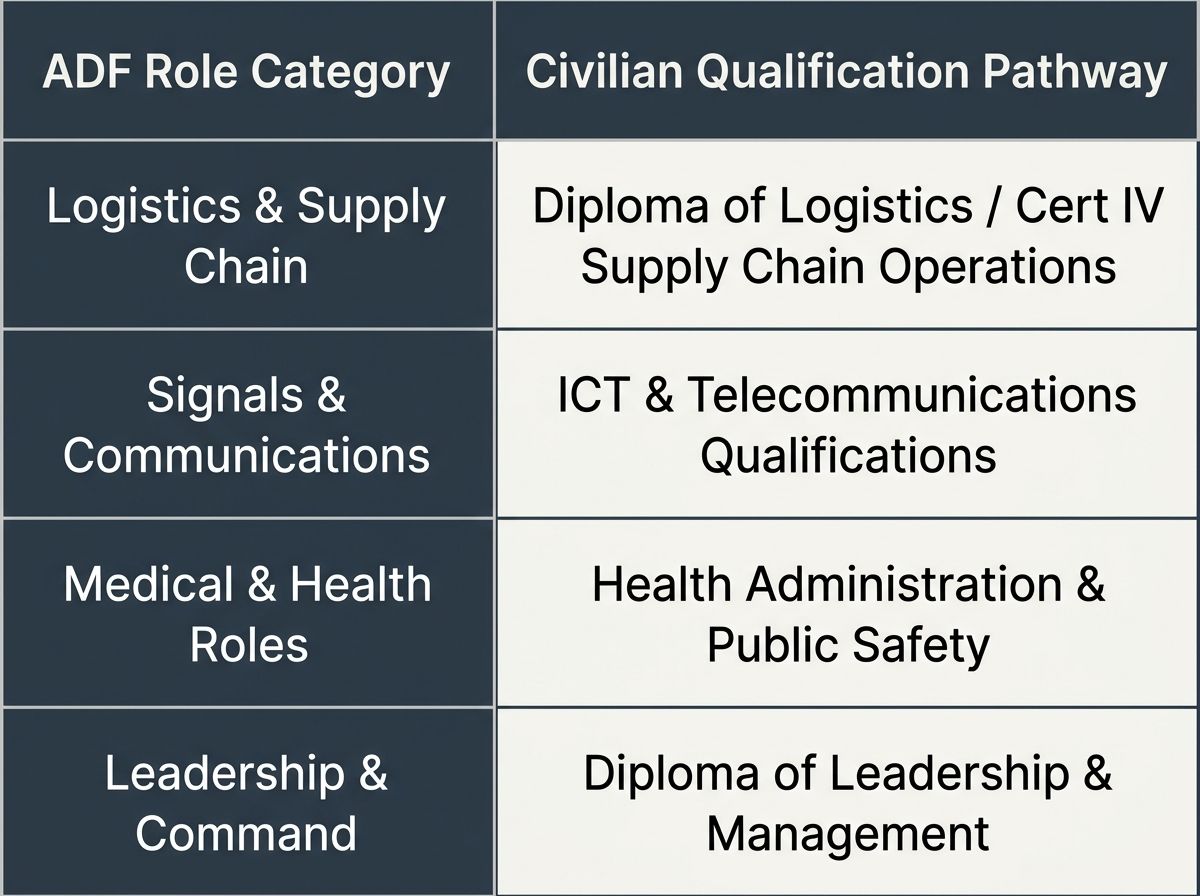
- Logistics and supply chain roles → Diploma of Logistics, Certificate IV in Supply Chain Operations
- Signals and communications → ICT qualifications, telecommunications certifications
- Medical and health roles → Health qualifications, Certificate IV in Health Care
- Training and instruction → Certificate IV in Training and Assessment (TAE40122)
- Leadership and command → Diploma of Leadership and Management (BSB50420)
- Emergency management and operations → Diploma of Public Safety (Emergency Management) (PUA50120)
The evidence that supports these pathways is typically documentation you already hold. One RTO that specialises in ADF RPL assessments accepts service records, HR employment records, training and qualification certificates, performance appraisals, rank certificates, position descriptions, and documentation of completed projects, reports, or tasks.
Another RTO describes the process as using 'standard, readily available documentation', meaning the paperwork that follows you through a military career, not files you need to create from scratch.
The specific evidence requirements vary by RTO and by qualification. But the principle is consistent: your service history is the evidence base. The RPL process structures how that evidence is presented and assessed.
How the Defence RPL process works
The RPL process follows a clear sequence. Knowing what to expect removes the uncertainty that stops many transitioning ADF members from starting.
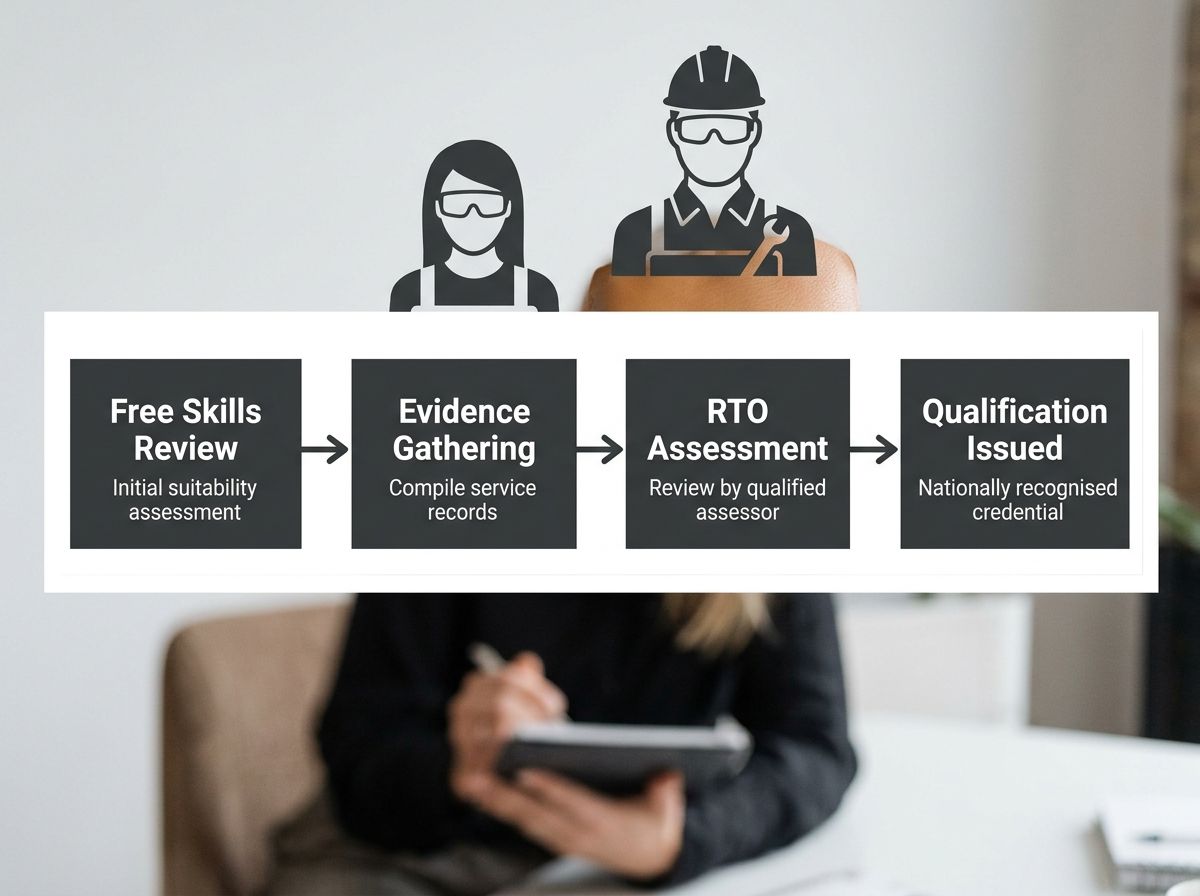
- Step 1: Free Skills Review. An initial, no-obligation assessment of your experience against the qualification standard. This step identifies which qualifications your service is likely to support and flags any areas where evidence may be thin.
- Step 2: Evidence Gathering. With guidance from RPL it, you compile the documentation that supports your competency claims. For ADF members, this typically draws on existing service records, training certificates, and performance appraisals.
- Step 3: Assessment. A qualified assessor from a registered training organisation reviews your evidence against the units of competency required for the qualification. Some RTOs use assessors with ADF backgrounds who understand how military experience maps to civilian standards.
- Step 4: Qualification. If the assessment confirms competency across all required units, the qualification is issued. It is nationally recognised because the assessment is genuine, not because the process was easy.
The RTO conducts the assessment and issues the qualification. RPL it guides you through the process, helping you understand what evidence is needed, how to present it, and what to expect at each stage.
The qualifications that matter most for transitioning ADF personnel
Several qualifications are particularly well-suited to ADF experience. The most relevant depends on your service category and the civilian role you are moving toward.
The Diploma of Public Safety (Emergency Management) (PUA50120) is one of the most directly relevant for personnel with operational, emergency response, or command experience. It comprises ten units of competency: five core and five elective.
The five core units focus on inter-agency liaison, emergency management exercise design, working within an emergency management context, project management, and coordinating resources for a multi-agency incident, which are all areas where ADF operational experience is directly applicable.
The qualification has no formal entry requirements, and the packaging rules allow at least two of the five elective units to be drawn from other endorsed training packages, which means the qualification can be customised around specific service backgrounds.
The qualification is designed for personnel undertaking emergency management responsibilities at an incident, emergency, or disaster, including the coordination of resources, personnel, and entities across organisations.
Beyond PUA50120, the Diploma of Leadership and Management is relevant for officers and senior NCOs with command experience. The Certificate IV in Training and Assessment is a natural fit for ADF instructors and training staff. Logistics and supply chain qualifications map directly to ADF logistics roles. The specific pathway depends on your service history and your civilian career direction.
The official qualification record for PUA50120 on training.gov.au sets out the full unit structure, packaging rules, and entry requirements.
What happens if there are gaps
RPL is a genuine assessment. That means it is possible for gaps to be identified between your experience and the qualification standard. This is not a failure; it is information.
If gaps are found, targeted gap training is available to address the specific units where evidence is insufficient. This does not mean starting the qualification from scratch. It means completing the components that your service history does not already cover.
The Free Skills Review at the start of the process is designed to identify potential gaps before you commit to anything. Honest suitability guidance is part of how this process works, because enrolling someone in a pathway that is not right for them serves no one.
Your service deserves to be counted
You spent years developing skills that most people will never have. You led people in difficult conditions, managed complex systems under pressure, trained others, coordinated resources, and made decisions that mattered.
The civilian qualification system was not built with your career in mind, but it does have a mechanism for recognising what you already know. Defence RPL is that mechanism.
Your work deserves to be counted. Experience can be used as evidence, and recognition should not require starting over.
The ADF Careers website describes the military-specific assessment process that ADF personnel go through, which is a process that civilian HR systems are not typically equipped to interpret.
CLET, an RTO that offers military transition RPL, notes that its assessment team includes former and current ADF members who review military workplace experience, knowledge, and skills.
A Free Skills Review is the first step. It takes the guesswork out of whether your service translates and which qualifications it maps to. It requires no commitment and no obligation.
Ready to Get Recognised?
Start with a free skills review to find out if RPL is right for you.