You Don't Need to Go Back to School to Break the Paper Ceiling
If you've been managing teams, budgets, and strategy for years, an RPL Diploma of Business recognises what you've already done — no classroom required.

The assumption that's costing you the promotion
You have been running the operations. Managing the budget. Leading the team. Making the calls that keep the business moving. And yet, when the senior role opens up, the conversation turns to qualifications — and suddenly, years of demonstrated capability aren't enough.
The assumption most experienced business professionals carry is this: getting a Diploma of Business means going back to a classroom. Sitting through units you already understand. Completing assignments on concepts you apply every day. Starting over.
That assumption is wrong. And it is the reason capable people stay stuck.
The real barrier isn't the qualification. It's the belief that 'qualification equals study'. Recognition of Prior Learning — RPL — exists precisely because that belief is incomplete. Your experience is not less than education. It is a different form of evidence. The question is whether it has been formally recognised.
What a Diploma of Business actually measures
The BSB50120 Diploma of Business is a nationally recognised AQF Level 5 qualification. It requires 12 units — 5 core and 7 elective — and the core units cover competencies that experienced business professionals exercise routinely.
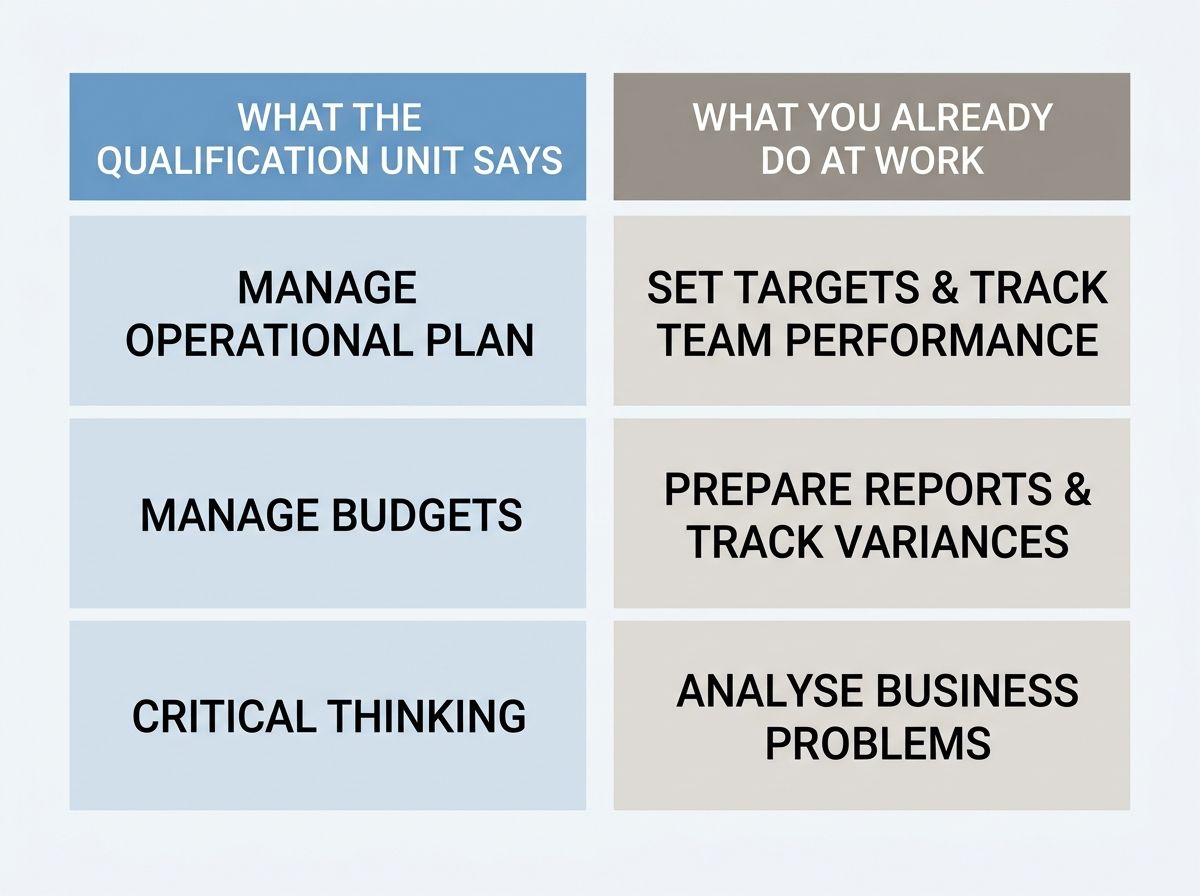
Here is what those units actually describe in plain language:
- Critical thinking applied to business problems — the kind of structured analysis you bring to every operational decision
- Financial management — preparing, monitoring, and reporting on budgets and financial performance
- Managing business resources — allocating people, time, and assets to deliver outcomes
- Sustainability in operations — embedding responsible practices into how the business runs
- Workplace communication — leading conversations, managing information, and influencing outcomes across teams
If you have been in a management, operations, finance, or team leadership role for several years, these are not things you need to learn. They are things you already do. The qualification is a framework that describes your existing capability — not a syllabus you need to complete.
This is the core reframe: a Diploma of Business is not a course you enrol in. It is a recognition of the business work you have already done. Translating your experience into a credential — not acquiring new knowledge.
Recognition of Prior Learning: the mechanism that changes everything
Recognition of Prior Learning is the formal assessment process that allows a registered training organisation (RTO) to evaluate your existing competence against the qualification standard. It is not a shortcut. It is a rigorous assessment pathway — one that uses your work history, documentation, and demonstrated capability as evidence rather than coursework and exams.
RPL is formally accepted under the Australian Qualifications Framework (AQF) — the national policy framework that governs all regulated qualifications in Australia, from school certificates through to VET and higher education. A qualification issued following a successful RPL assessment carries national recognition under the same framework.
The assessment is conducted by a qualified assessor from the delivering RTO. RPL it guides you through the process — helping you understand what evidence is needed, how to document your experience, and what to expect at each stage. The assessor's professional judgement determines the outcome. We support the candidate; the RTO conducts the assessment.
It is also worth understanding that RPL is an established pathway in Australian VET. Research from the National Centre for Vocational Education Research (NCVER) shows that RPL has been used across the VET system for decades, with a meaningful proportion of subjects completed via RPL rather than traditional study — particularly in non-apprenticeship arrangements.
NCVER research on recognition of prior learning in Australian VET provides useful context on how RPL operates across the national training system.
What counts as evidence in a business RPL assessment
The evidence used in an RPL assessment for a business diploma is not academic. It is operational. The documents you have produced in the course of doing your job are the portfolio.
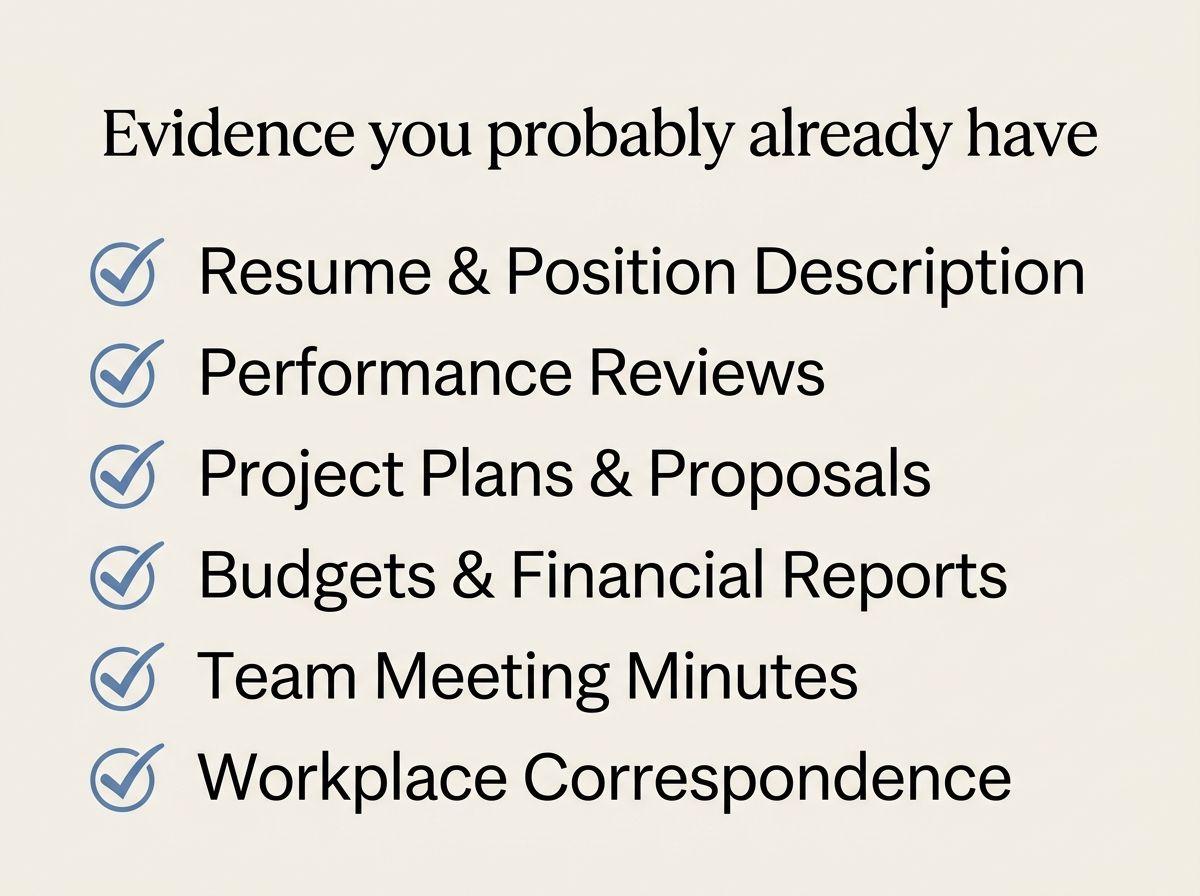
Evidence commonly accepted in RPL assessments for the BSB50120 Diploma of Business may include:
- Your resume and current position description — establishing your role, responsibilities, and scope of authority
- Performance reviews and KPI documentation — demonstrating how your outcomes have been measured and recognised
- Financial reports, budgets, or forecasts you have prepared or contributed to — evidencing financial management competence
- Project plans, proposals, or post-implementation reviews — showing how you plan, resource, and deliver outcomes
- Policies, procedures, or operational guidelines you have developed or updated
- Staff management records, team meeting minutes, or correspondence showing how you lead and communicate
- Reference letters or statutory declarations from supervisors or colleagues who can verify your experience
- Training certificates or records of professional development relevant to the qualification units
The exact evidence required depends on your specific role and work history. The goal is to demonstrate that your experience maps to the outcomes of the qualification — and the assessor will guide you on what is needed for your particular situation.
RPL is also an interactive process. Beyond document submission, it may involve a competency conversation with your assessor — a structured discussion where you explain how you have applied your skills in practice. If additional evidence is needed at any point, you will be asked to provide it.
Who this pathway is — and isn't — for
RPL for a Diploma of Business suits professionals with substantial, documented experience in business operations, management, finance, or strategy. If you have been in a relevant role for several years and can point to real work outputs that demonstrate your competence, RPL is worth exploring.
It is not the right pathway for everyone. If your experience is limited, recent, or difficult to document, a full RPL assessment may identify gaps. Where gaps are found, gap training is provided to address them — this is a normal part of the process, not a failure. The assessment outcome may be the full Diploma, a Statement of Attainment for partial recognition, or a recommendation for further study.
Honest suitability assessment before enrolment is the foundation of a credible RPL process. We would rather tell you early that RPL may not be the right fit than guide you into an assessment that doesn't serve you. The decision is always yours.
The difference between studying for a diploma and being recognised for one
Traditional study for a Diploma of Business typically involves 12 to 18 months of coursework, assignments, and scheduled learning. The timeline is set by the course calendar.
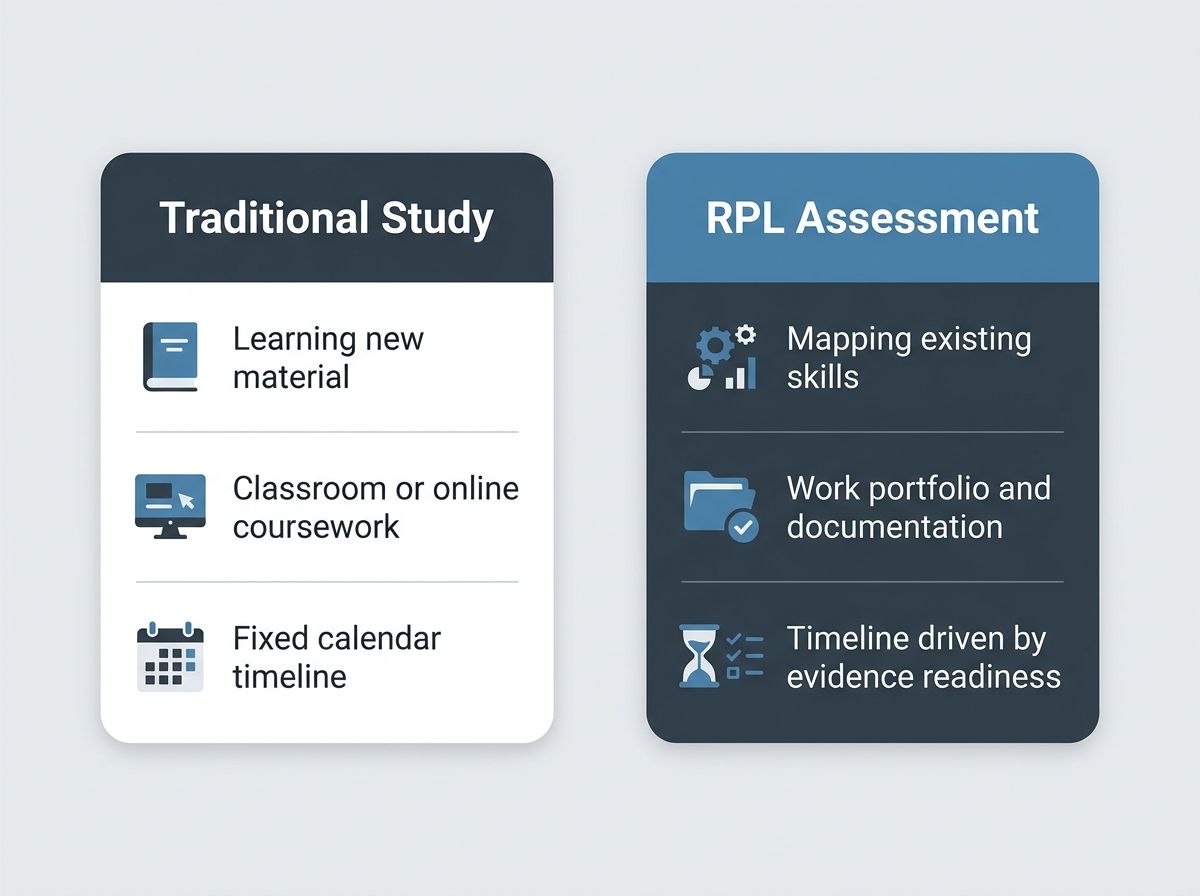
RPL assessment works differently. The timeline is determined primarily by how quickly you can compile and submit your evidence — not by a course schedule. RTO-published guidance indicates that RPL assessment at diploma level typically takes somewhere between two and twelve weeks, with the single biggest variable being evidence readiness.
For the BSB50120 Diploma of Business specifically, one RTO publishes a minimum application completion time of 28 days — structured as an initial 14-day eligibility review followed by a 14-day formal assessment period, though the initial review may take longer depending on application volumes.
These are indicative figures, not guarantees. Actual timeframes vary by RTO, the complexity of your application, and whether gap training is required. What they do illustrate is that RPL assessment is often significantly faster than traditional study — because you are not learning the material, you are demonstrating that you already know it.
Published RTO guidance on RPL timelines for diploma-level qualifications provides useful indicative context, though individual timeframes will vary.
Recognition, not repetition. The qualification issued is the same nationally recognised BSB50120 Diploma of Business — the pathway to it is different.
What happens when you start a Free Skills Review
The first step is a Free Skills Review. It is not an enrolment. It is not a commitment. It is a no-obligation conversation that maps your experience against the BSB50120 Diploma of Business standard and gives you an honest assessment of your suitability for RPL.
After the review, you will have a clear picture of whether your experience aligns with the qualification, what evidence you would need to gather, and whether RPL is the right pathway for you. If it isn't, we will tell you that too.
The decision is always yours. The review simply gives you the information to make it.
Frequently asked questions: RPL for a Diploma of Business
**Does RPL give me the same qualification as traditional study?** Yes. The BSB50120 Diploma of Business issued following a successful RPL assessment is the same nationally recognised AQF Level 5 qualification as one issued via traditional study. The assessment pathway is different; the qualification is the same.
**Who conducts the RPL assessment?** A qualified assessor from a registered training organisation (RTO) conducts the assessment and issues the qualification. RPL it guides you through the process — helping you prepare your evidence and understand what to expect — but the assessment itself is conducted by the RTO.
**How long does RPL take for a Diploma of Business?** Timeframes vary by RTO, evidence readiness, and qualification complexity. Published RTO guidance suggests diploma-level RPL assessments typically take between two and twelve weeks. One RTO publishes a minimum of 28 days for the BSB50120 specifically. These are indicative figures, not guarantees.
**What if I don't have enough experience?** If your experience doesn't fully cover the qualification's requirements, the assessment may identify gaps. Where gaps are found, gap training is provided to address them. The outcome of an RPL assessment may be the full Diploma, a Statement of Attainment for partial recognition, or a recommendation for further study.
**What kind of experience do I need?** RPL for a Diploma of Business suits professionals with substantial experience in business operations, management, finance, or strategy. There is no legislated minimum, but assessors at diploma level generally expect meaningful, documented experience in relevant roles. A Free Skills Review will give you an honest assessment of your suitability before you commit.
**Is the qualification nationally recognised?** Yes. The BSB50120 Diploma of Business is a nationally recognised AQF Level 5 qualification. RPL is a formally accepted assessment pathway under the AQF framework.
**What if I'm not sure whether my experience qualifies?** That is exactly what the Free Skills Review is for. It maps your work history against the qualification standard and gives you an honest picture of your suitability — at no cost and with no obligation to proceed.
For more on how RPL evidence and assessment works in practice, the CLET published process for the BSB50120 Diploma of Business provides a useful illustration of what the assessment stages typically involve.
For more on why the qualification matters to employers — and what changes when you hold it — read our article on being passed over for the promotion because of an HR checkbox.
Ready to Get Recognised?
Start with a free skills review to find out if RPL is right for you.