Why paying for another IT course is the wrong move when you already do the job
Comparing RPL costs to an IT degree? If you already work in IT, the real numbers may surprise you. Here is what experienced professionals need to know.

The default assumption costing IT professionals thousands
You have been doing the job for years. You manage infrastructure, write code, run networks, or lead the IT projects that keep businesses running. Somewhere along the line, you were told you need a piece of paper to prove it.
The default response, which the industry has trained you to accept, is enrolling in another course. A diploma, a degree, or a certification with a classroom, a strict timetable, and a fee that makes you wince. This assumption is so deeply embedded that most experienced IT professionals never stop to question it. They believe that if they want a qualification, they must go back to study.
That assumption is worth examining. For a large proportion of working IT professionals in Australia, the traditional classroom pathway is not the only option, and it is rarely the right one. Recognition of Prior Learning, or RPL, exists specifically for people who already do the work. Understanding the RPL certificate cost compared to traditional university or TAFE fees is the starting point for making an informed decision.
You have the experience. The question is whether you have documented it.
What IT professionals actually spend to get qualified
Before making a comparison, it is best to be clear about what traditional study actually costs. This includes both upfront tuition fees and the cost of your time and missed opportunities.
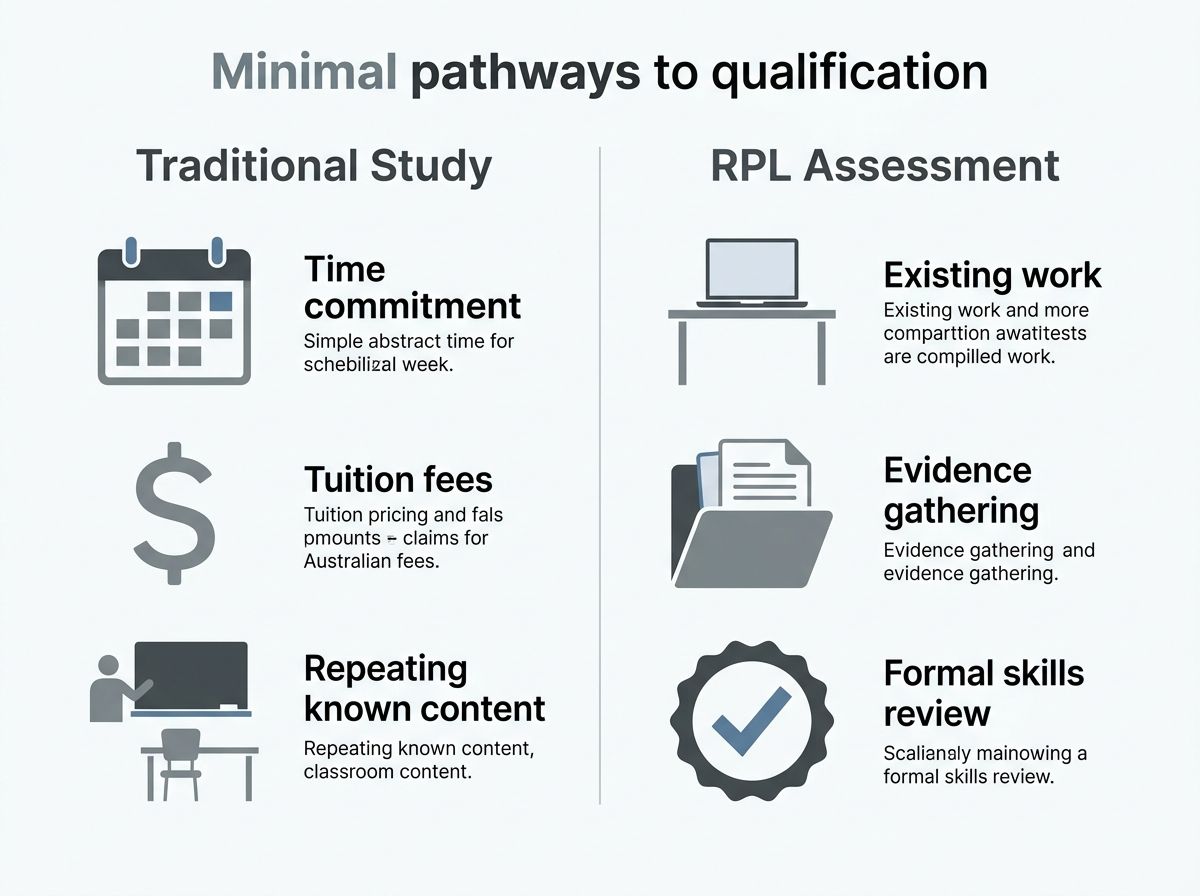
A Bachelor of Information Technology at an Australian public university typically takes three years of full-time study. For domestic students studying part-time while working, that often stretches to four or five years. Fee-HELP eligible tuition costs vary by institution and course structure, but a full IT degree represents a large financial commitment over that period. This cost accumulates quietly through FEE-HELP or HECS debt rather than arriving as a single upfront invoice.
TAFE diplomas and certificates are more affordable, but they still require a significant time commitment. A Diploma of Information Technology typically takes one to two years of part-time study, depending on the delivery mode and your prior credit. Private RTO courses vary in price and duration. Some are structured as intensive programs, while others are self-paced over twelve to eighteen months.
None of these figures include the hidden costs. There is the time spent studying material you already apply daily at work, the reduced capacity to take on extra projects or responsibilities, and the mental load of balancing student and professional roles simultaneously.
For someone who already does the job, classroom learning is a large investment in content they already master. RPL recognises what you have achieved without forcing you to repeat the training.
The reality: the system assesses what you can do, not what you studied
Most experienced IT professionals miss a fundamental point: Australian qualification frameworks assess competency rather than study history.

The Australian Qualifications Framework (AQF), which is the national policy governing qualifications in Australia, recognises RPL as a legitimate pathway to a formal qualification. Under the Standards for Registered Training Organisations, RTOs must offer RPL to all applicants. A qualified assessor from the delivering RTO conducts the assessment. The qualification issued is nationally recognised because the assessment process is genuine and rigorous.
In practice, the pathway you took to develop your skills is not what is being assessed, whether that was a formal course, an apprenticeship, or ten years of hands-on IT work. The competency itself is what matters. The system that seems to reward formal study actually rewards demonstrated skill.
Your experience is evidence. This is not a marketing line; it is how the framework is designed.
For an IT professional who has spent years managing systems, developing software, or leading technical teams, this changes the calculations. The question is not whether you need to learn the content, but whether you can demonstrate that you already know it.
What the RPL certificate cost covers and what it does not
The RPL certificate cost is not a tuition fee. It is a guided assessment and documentation process. Understanding what you are paying for is essential to making an honest comparison.
RPL fees typically cover the skills review process, support with gathering and structuring your evidence, the formal assessment conducted by a qualified assessor, and any gap training identified during assessment. This last point is important. Where gaps in competency are identified, gap training is provided at no additional cost. This is a standard provision under the RPL process, and honest providers make it clear upfront.
The RPL fee does not cover teaching you content you already know. You are not paying for a course. You are paying for a structured process that translates your existing competency into the format required by the formal system.
Indicative RPL costs vary by qualification level, the delivering RTO, and the complexity of the assessment. They are generally a fraction of the cost of the equivalent qualification obtained through traditional study. Specific figures differ between providers, so you should make comparisons using current, verified pricing from the RTOs you are considering. We encourage you to ask any provider directly what their RPL fee includes, and what happens if gaps are identified.
The real question to ask yourself is not 'how much does RPL cost?' but 'does my experience meet the competency requirements?' A Free Skills Review can answer that question before you commit to anything.
The calculations for IT professionals: time, money, and existing knowledge
To look at a concrete example, the Diploma of Information Technology (ICT50220) and the Certificate IV in Information Technology (ICT40120) are two qualifications commonly pursued by experienced IT professionals seeking formal recognition. Both are listed on training.gov.au and are available through RPL via registered RTOs.
The competency units within these qualifications map to the work experienced IT professionals do every day. This includes systems administration, network configuration, cybersecurity fundamentals, project coordination, technical support, and software development. For someone who has spent years in a hands-on IT role, these units reflect work they already perform routinely.
The RPL evidence process for IT qualifications typically involves a portfolio of workplace evidence, such as project documentation, system configurations, employer references, and records of work completed. This is combined with a professional conversation with an assessor. The process is not a test of memory. It is a structured demonstration of what you already know and do.
This is a very different proposition from sitting in a classroom for two years to learn content you already use daily at work.
The paper ceiling that blocks experienced IT professionals is not about skill. It is about the format in which your competency is presented.
When another course is the right choice, and when it is not
RPL is not suitable for everyone, and we would rather tell you that clearly than enrol you in the wrong pathway.
If you are moving into a new specialisation, such as transitioning from general IT support into cybersecurity or data science, and you lack hands-on experience in that domain, study is likely the right path. RPL assesses existing competency; it cannot create it. If the competency is not there, the assessment will identify gaps, and you will need gap training to address them.
Similarly, if your IT experience is narrow or recent, such as a year or two in a junior role, or a highly specialised function that does not map broadly to a qualification's competency units, RPL might not be the most efficient pathway for you.
However, for the experienced IT professional who has spent years across a range of technical responsibilities, including managing infrastructure, supporting users, developing systems, and leading projects, the central question is whether your experience already meets the competency requirements. In many cases, it does. In other cases, there are small gaps that you can address through targeted gap training without repeating an entire qualification.
The only way to know is to have your experience assessed. That is the purpose of a Free Skills Review. It does not sell you an outcome, but instead gives you an accurate picture of where you stand.
Your experience has already earned this qualification. The question is whether you have documented it.
You have done the work. You have solved the problems, built the systems, supported the users, and kept the infrastructure running. That work is real, and the competency it represents is also real.
The formal system does not question whether you are capable. It requires that capability to be presented in a format it can assess. RPL guides your existing expertise through the recognition process, so that what you already know can be formally assessed and acknowledged by a registered training organisation.
Recognition does not require starting over. For IT professionals who already do the job, it does not have to.
If you are working in IT and have put off the qualification question because the thought of going back to study feels wrong, it might indeed be the wrong path for you. The RPL Australia cost is worth understanding, and the pathway is worth exploring. The starting point is a direct conversation about whether your experience qualifies.
Explore IT qualifications available through RPL in Australia.
Your skills speak for themselves. Find out how we can help them be recognised.
Ready to Get Recognised?
Start with a free skills review to find out if RPL is right for you.