The invisible chef: When your kitchen skills outgrow your official title
Run the kitchen but your payslip says cook? Learn how RPL recognises your commercial cookery skills formally without making you go back to TAFE.

The title on your payslip doesn't match the job you're actually doing
You write the specials. You call the suppliers when stock runs short. You show the apprentice how to break down proteins correctly, how to manage mise en place under pressure, and how to read a service to adjust. You have been doing this for years, sometimes even decades. Yet, when the roster goes up or the payslip arrives, your official title still reads: cook.
This is the invisible chef condition. It is not a personal failure on your part, but a structural gap between the actual expertise you carry every shift and the formal recognition the system requires to see it. Your skills are real and your experience is deep. But in the language of formal employment and qualification frameworks, invisible expertise is treated as no expertise at all.
If you have felt the quiet frustration of doing a chef's job on a cook's classification, of being the person everyone turns to while someone with a certificate gets the title, you are not imagining it. You are not alone.
What the invisible chef condition actually costs you
The title gap affects more than your professional pride. It has a practical cost that compounds over time.
Under Australia's Hospitality Industry (General) Award, kitchen workers are classified by levels that carry different pay rates. A cook and a chef are not on the same classification level. If your duties exceed your classification, the gap between what you are paid and what you are doing represents real money, shift after shift, year after year.
Beyond the wage, there is a career ceiling. Many venues, particularly larger operations, hotels, and institutional kitchens, require formal qualifications for senior kitchen roles. Head chef positions, executive kitchen roles, and catering management positions increasingly list a Certificate III in Commercial Cookery or its equivalent as a minimum requirement. Without that credential, your application may not pass the first filter, regardless of how many years you have spent running sections.
Then there is the experience that goes unrecognised in another way: the training. If you have spent time bringing up apprentices and junior cooks, you already know the feeling of watching someone you mentored advance past you because they completed their TAFE modules. That specific frustration of training the person who ends up outranking you is its own category of invisible cost.
If that last point sounds familiar, read more about these kitchen dynamics.
Why the qualification gap exists, and why it is not about your skills
The formal qualification system in Australia was designed primarily for people entering the industry, not for people who learned by doing the work. TAFE programmes and apprenticeships are built around structured delivery with a set number of hours, a set sequence of units, and a set assessment schedule. That model works well for school-leavers starting from zero.
It was not designed with you in mind.
When you learned to cook, you learned in a kitchen. You learned from a head chef who showed you once and expected you to get it right. You learned from service pressure, from mistakes, and from the accumulated weight of thousands of shifts. That learning is real. It is often more rigorous than a classroom equivalent, but it exists in the wrong form for formal recognition.
Experience can be evidence. The challenge is that experience alone does not speak the language that formal systems require. That is not a reflection of your competence, but a structural mismatch that Recognition of Prior Learning addresses.
We examine the assumption that legitimate learning only happens in a classroom.
What RPL for chefs actually means
Recognition of Prior Learning (RPL) is the formal process by which your existing skills, knowledge, and experience are assessed against qualification standards. For kitchen workers, the relevant qualification is typically the Certificate III in Commercial Cookery (SIT30821), which is the nationally recognised credential for professional chefs in Australia.
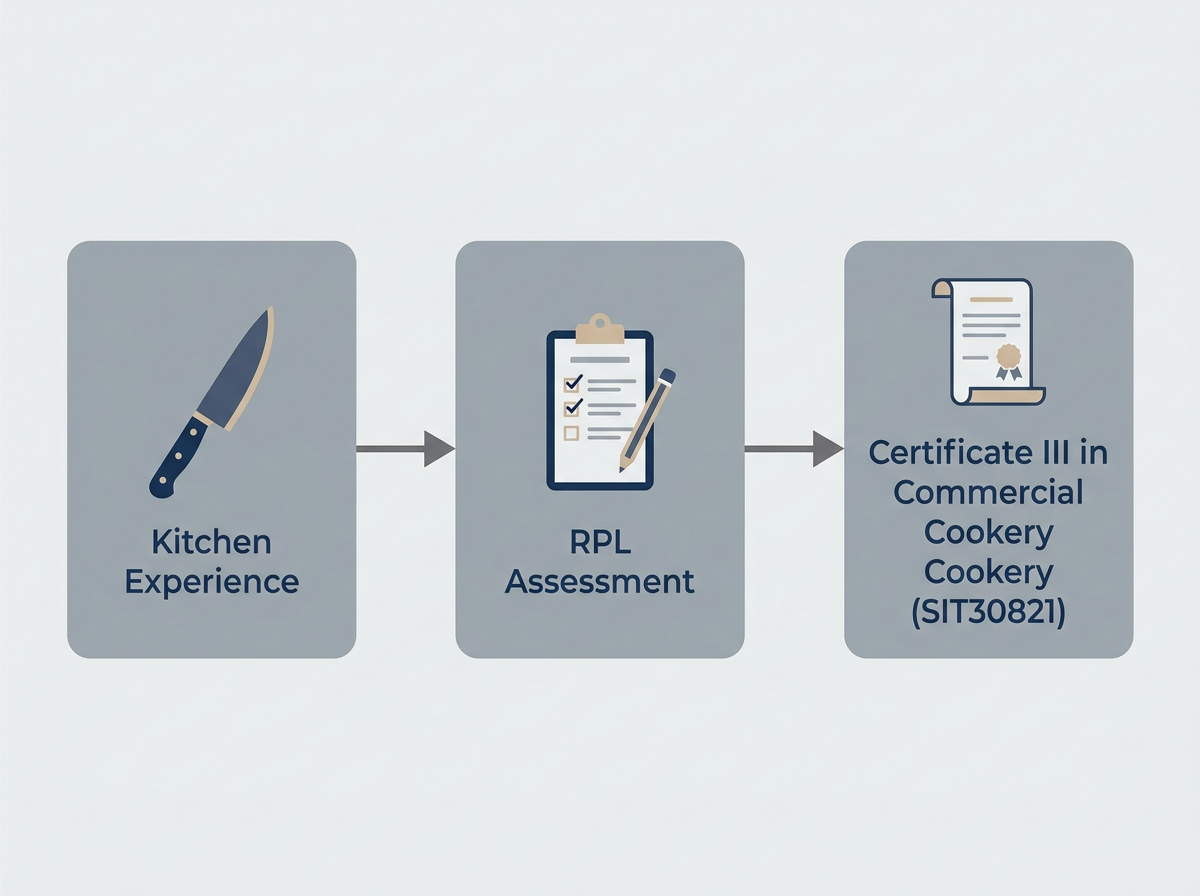
In plain terms, an RPL assessment looks at what you already know and do, measuring it against what the qualification requires. If your experience demonstrates competency across the required units, you can be formally recognised without repeating training you have already completed in practice.
This is not a shortcut or a workaround. RPL is a legitimate, nationally recognised assessment pathway within the Australian VET system, existing because on-the-job learning produces genuine competence. The qualification resulting from a successful RPL assessment carries the same standing as one earned through traditional study because the assessment standards are identical.
The assessment is conducted by a qualified assessor from a registered training organisation (RTO). RPL it guides candidates through the process, helping you gather and present your evidence, but the assessment and qualification issuance are the RTO's responsibility. That distinction is important because it is what makes the outcome meaningful.
Mapping your existing skills to the assessment criteria
A commercial cookery RPL assessment evaluates competency across the core areas of professional kitchen work. Without citing specific unit codes that we cannot verify here, the broad competency areas typically covered in a Certificate III in Commercial Cookery include food preparation and cooking methods for various cuisines, kitchen hygiene and food safety practices, stock control and ordering, menu planning and costing, and the supervision and coordination of kitchen staff.
If you run a section, you demonstrate food preparation and cooking competency every service. If you manage mise en place and call orders, you demonstrate kitchen coordination. If you are responsible for stock takes and supplier orders, you demonstrate stock control. If you train junior staff, you demonstrate the supervisory competencies required by the qualification.
This goes beyond general experience; it is direct evidence. The RPL process is the guided work of translating what you already do into a format that a qualified assessor can formally evaluate. Evidence typically includes references from head chefs or employers, records of your kitchen responsibilities, examples of menus or dishes you have developed, and in some cases a practical demonstration or a structured conversation with an assessor.
The question is not whether you have the skills, but whether your specific experience maps strongly to the qualification's requirements and whether you can demonstrate it in the way the assessment requires.
What the RPL chef pathway looks like
The RPL pathway for commercial cookery generally moves through several distinct stages, though the specifics depend on the RTO conducting the assessment.
- Initial skills review: Before any formal process begins, a suitability check determines whether your experience maps to the qualification requirements. This is where honest guidance matters, as not every kitchen worker is a strong RPL candidate, and knowing this early saves both time and money.
- Evidence gathering: If the initial review suggests a strong match, you will begin gathering and organising evidence of your competency. Guided support makes a significant difference here, helping you understand what evidence is needed, in what format, and how to present it.
- Formal assessment: A qualified assessor from the RTO reviews your evidence and may conduct a structured interview or practical observation. The assessor makes the determination about competency, independent of candidates or third parties.
- Qualification issuance: If the assessor determines that you have demonstrated competency across the required units, the RTO issues the qualification. If they identify gaps in specific units, gap training may be required, which is typically provided at no additional cost.
The process involves real assessment, which is what makes the qualification meaningful. It is not a rubber stamp, and we do not present it as one. For the right candidate, it is a rigorous and supported pathway to formal recognition of existing expertise.
Is RPL right for every kitchen worker?
The honest answer is no.
RPL is designed for people whose experience genuinely maps to the competency requirements of the qualification. A kitchen worker who has spent two years doing basic prep in a café is in a different position to someone who has spent a decade running sections, managing stock, supervising staff, and contributing to menu development.
The depth of your experience matters, alongside the range of kitchen environments you have worked in, the level of responsibility you have held, and whether your work has covered the full scope of what the qualification assesses.
We would rather guide someone to the right pathway than enrol them in the wrong one. This is a core principle, not a disclaimer. If your experience is a strong match, the RPL pathway is a meaningful route to formal recognition. If it is not, there are other pathways to explore, and an honest skills review will show you which direction makes sense.
Your skills are real, and your recognition should be too
The invisible chef condition is not permanent. It exists because your expertise is currently in the wrong form for formal systems to recognise, not because you lack ability.
The RPL chef pathway exists to bridge that gap by translating what you do every shift into formal evidence that a qualified assessor can evaluate. This turns years of kitchen knowledge into a nationally recognised credential that officially confirms the skills you have been demonstrating for years.
Recognition does not require starting over or sitting in a classroom to learn things you already practice daily. Instead, it requires demonstrating what you already know in the right format with the right support.
Your skills speak for themselves, but they need to be heard. The decision to find out is yours, and the first step costs nothing.
Ready to Get Recognised?
Start with a free skills review to find out if RPL is right for you.