Training the Apprentice Who Ends Up Being Your Boss
You trained them. Now they outrank you. RPL turns your kitchen experience into a Certificate III without making you repeat what you already know.

The moment every experienced cook recognises
You showed them how to hold a chef's knife. You showed them how to read a busy service. You walked them through the daily mise en place, explained the specific rhythm of the pass, and covered for them when the kitchen pressure hit. You did what experienced kitchen workers always do. You passed on the knowledge that took you years of hard work to learn.
And then they got the title.
This did not happen because they cooked better than you. It was not because they managed their section with more calm, or because the head chef trusted their judgement more. They received the promotion because they completed their TAFE modules. They possessed the qualification code, and you did not.
If you have worked in commercial kitchens for any length of time, you know this scenario is not hypothetical. It is an ongoing pattern. The frustration it produces is entirely reasonable, because the system that created it was simply not designed with an experienced cook in mind.
Why a TAFE module outranks five years on the line
Formal qualification systems in Australia are set up to process paper evidence. When an employer considers a promotion, or when a recruitment filter screens applicants, the central question is not about how many covers you have run. The system is looking to see if you hold the formal qualification code.
In commercial cookery, that code is SIT30821, the Certificate III in Commercial Cookery. It appears in job listings for sous chef roles, in enterprise agreements, and in employer requirements. It is the formal currency the system recognises.
Your five years on the line, including the double shifts, the service recoveries, and the training you have provided to others, exist in a format the formal system cannot read. This is not a reflection of your competence. It is a structural design issue. The qualification system was built for school-leavers entering the workforce, rather than people who have already been doing the job for years.
The apprentice did not know more than you. They simply had the code.
What RPL commercial cookery actually is
RPL in commercial cookery, which stands for Recognition of Prior Learning, is a formal assessment pathway. It allows experienced kitchen workers to have their existing skills and knowledge assessed directly against the units of the Certificate III in Commercial Cookery (SIT30821), without repeating training they already know.
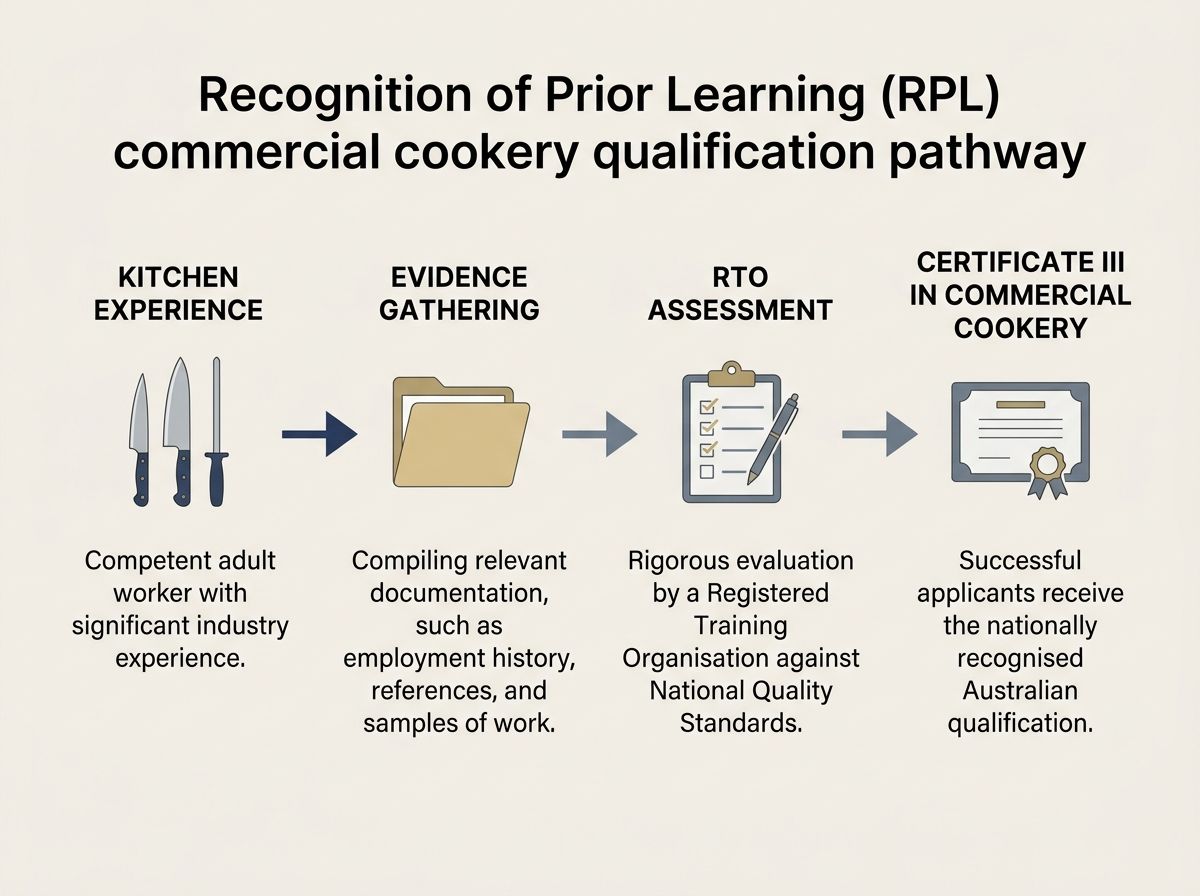
That is the direct answer. Here is what it means in practice.
The Certificate III in Commercial Cookery covers several core competency areas. These include food preparation and cooking techniques, kitchen operations, food safety and hygiene, and working effectively in a commercial kitchen environment. If you work in commercial kitchens, you demonstrate these competencies on every shift. RPL is the process that makes this daily demonstration visible to a formal assessor.
The assessment is conducted by a registered training organisation (RTO). RPL it guides candidates through the process of gathering and presenting their experience as evidence, then supports them through the assessment with the RTO. If the qualification is awarded following a successful assessment, it is the same nationally recognised Certificate III in Commercial Cookery that any other candidate receives. It carries the same qualification code, is issued by the same registered training organisations, and is not a lesser version.
We should be direct here: RPL is a rigorous assessment process rather than a shortcut. If gaps in your skills are identified during the assessment, you may need to complete gap training. The goal is the genuine recognition of actual competence, rather than a rubber stamp.
If you want to understand how the qualification system works and why experienced workers are often invisible to it, this article on the experience penalty that holds veteran workers back is worth reading.
You can also explore the Certificate III in Commercial Cookery (SIT30821) product page to see what the qualification covers and how RPL it supports the process.
What counts as evidence in a commercial kitchen
Many experienced kitchen workers assume that RPL requires formal documentation they do not have, such as logbooks, performance reviews, or certificates from previous training. This is the kind of paperwork that gets filed and forgotten, or never existed in the first place.
In reality, evidence of commercial kitchen competence is often highly accessible. It includes employment records, payslips, and references from head chefs or restaurant managers who can verify your skills. You can also use records of the kitchens you have worked in and the roles you have held. Evidence that you have trained others, supervised sections, or managed service is highly valuable. The work itself, including your dishes, menus, and kitchen environments, can be documented to support your RPL assessment.
What counts as evidence and how it maps to the specific units of the Certificate III in Commercial Cookery depends entirely on your individual history. This is an honest answer rather than a vague one. The mapping is specific to your career, and it requires a clear assessment of where your experience is strong and where gaps might exist.
The best first step is to find out rather than guess.
The qualification you already earned on paper
Recognition, not repetition.
This is the core principle behind RPL. The Certificate III in Commercial Cookery awarded through a successful RPL assessment is the same nationally recognised qualification, at the same AQF level, as the one issued to traditional students. It is not a secondary option or a lesser qualification for people who could not complete the classroom course.
The difference is that the assessment recognises your current knowledge instead of teaching it to you from scratch. Your years in commercial kitchens are not a substitute for the qualification. Instead, they are the actual evidence used to demonstrate that you already meet the standards the qualification represents.
Your work deserves recognition, and the formal pathway to secure it exists.
Is RPL commercial cookery right for you?
RPL suits kitchen workers who have genuine, demonstrable experience across the core competency areas of the Certificate III in Commercial Cookery. If you have worked in commercial kitchens in a substantive cooking role, rather than as a kitchen hand or in a highly restricted capacity, and you have done so for a significant period, RPL is a viable pathway.
It is not suitable for everyone. If your kitchen experience is limited or concentrated in a single area, the assessment may identify gaps that require training before the qualification can be awarded. This is a practical outcome rather than a failure. Gap training, where required, is simply part of the process.
The clearest way to find out whether RPL fits your situation is a Free Skills Review. This is a direct assessment of how your experience maps to the qualification, completed before you invest time or money. It is not a sales call or a commitment to enrol.
If RPL is not the right option for you, the review will tell you directly. That clarity is the point.
You trained them. Now it's your turn.
You have the experience, the evidence, and a clear pathway forward.
The system that let a less experienced cook outrank you because they held the qualification code was not built to recognise your actual skills. RPL commercial cookery exists to correct this imbalance, giving your years of kitchen experience the formal standing they deserve.
The decision is yours, and the first step costs nothing.
Ready to Get Recognised?
Start with a free skills review to find out if RPL is right for you.