Why 15 years of industry experience still won't get you into the classroom without the TAE40122
You have mastered your trade. Without the TAE40122, you cannot legally deliver accredited training in Australia. Here is how experienced professionals adapt.
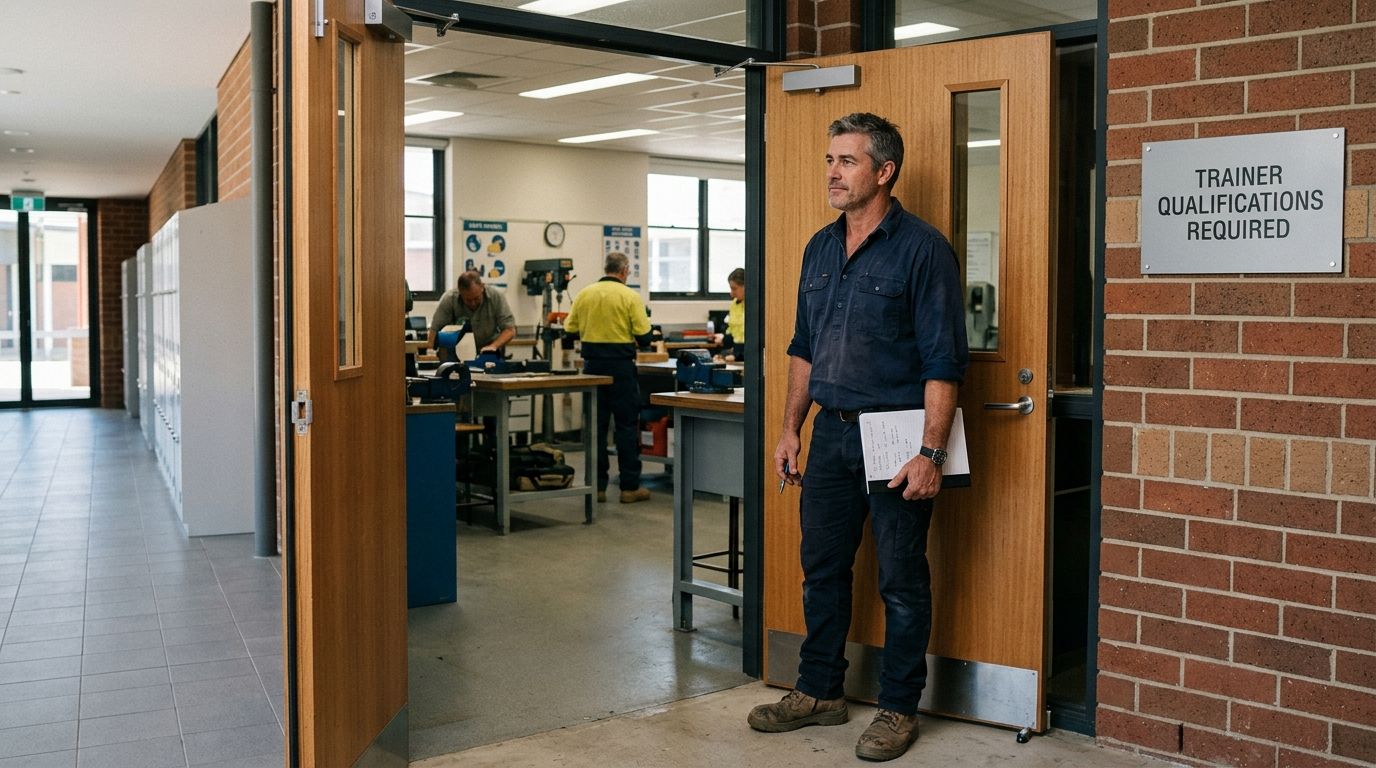
The moment the door closes
You have the experience. You have spent fifteen years, or perhaps even longer, working at the sharp end of your industry. Over those years, you have trained new starters, mentored junior staff, designed workplace inductions, and delivered safety briefings. People in your workplace come to you when they need to understand how things actually work. Now, you want to formalise that role. You want to step into a formal training position, deliver accredited programs through a Registered Training Organisation (RTO), or help prepare the next generation of practitioners in your field.
Then the door closes. This does not happen because anyone questions your industry knowledge or doubts your practical experience. It happens because you do not hold the TAE40122 Certificate IV in Training and Assessment. Without this specific credential, you cannot legally deliver or assess nationally recognised training through an RTO in Australia.
The frustration is understandable. You have spent decades proving your competence on the ground. This qualification barrier is not a challenge to your occupational ability. Instead, it is a requirement for a credential that sits adjacent to your trade or professional expertise, rather than inside it. That distinction is important, and you should understand it before deciding on your next professional step.
How industry experts face the same credential barrier
This is a common experience. It is a pattern that repeats across trades, healthcare, community services, hospitality, and information technology. The sequence of events is highly consistent.
- An industry expert is recognised for their expertise and invited, formally or informally, to train others.
- They learn that delivering accredited training through an RTO requires the TAE40122 or an equivalent credential.
- They look into the qualification and find it covers training methodology, such as how to design, facilitate, and assess learning, rather than their specific trade or profession.
- They are advised they must study to learn how to teach, rather than what to teach.
- They feel frustrated at being asked to prove competence in a secondary domain that sits alongside their primary area of expertise.
The TAE40122 itself is not a new barrier. It supersedes the older TAE40116 Certificate IV in Training and Assessment. The Australian Skills Quality Authority (ASQA) has confirmed that the trainer and assessor qualification requirements have remained unchanged through this transition. Existing trainers who already hold the TAE40116 or an equivalent qualification do not need to upgrade to the TAE40122. This situation applies primarily to industry experts who have never held a formal training and assessment credential, and who are discovering the regulatory requirement for the first time.
This credential requirement is a long-standing rule in the vocational education and training (VET) sector. Long before the TAE40122 was introduced, trainers delivering accredited programs without this qualification could not independently determine assessment outcomes. They had to work under direct supervision. For industry experts who want to step into independent, unsupervised training roles, this qualification gap is a real structural barrier.
Why the TAE40122 exists and why it does not doubt your expertise
The TAE40122 Certificate IV in Training and Assessment is the foundation credential of Australia's vocational education and training sector. Under the Standards for Registered Training Organisations 2025, which took effect on 1 July 2025, anyone who delivers and assesses nationally recognised training must hold a formal training and assessment credential alongside their current industry skills and knowledge.
These credential requirements are set out in the Credential Policy within the Standards' quality framework. When RTOs assess whether an applicant's qualification meets this requirement, official guidance indicates they look for content equivalent to the TAE40122 as the minimum benchmark.
The requirement exists because performing a job and teaching that job are different competencies. Training design, facilitation, and assessment methodology are distinct skills. Within a nationally recognised training system, the quality of assessment directly affects learners, employers, and the integrity of qualifications. The TAE40122 is not a barrier designed to question your industry knowledge. It is a regulatory checkpoint to confirm you can transfer your knowledge, design structured learning, and assess others fairly and consistently.
This perspective is important. The requirement is not a judgment on your trade skills. It is a recognition that vocational teaching is its own professional discipline. The VET sector must ensure that the people assessing student competence are equipped to do so rigorously and in line with national standards.
How 15 years of industry experience translates to the TAE40122
This is where your career history becomes highly relevant. The TAE40122 assesses competencies across three main areas: designing training programs, facilitating learning, and conducting assessments. If you have spent years working in your industry, you have likely performed work that aligns with all three, even if you used different job titles or workplace terms.

- Mentoring new staff and explaining complex processes, which aligns with facilitation of learning.
- Designing workplace inductions or onboarding programs, which aligns with developing training programs.
- Conducting performance reviews or competency checks, which aligns with assessment practice.
- Delivering safety briefings or toolbox talks, which aligns with facilitating vocational training.
- Creating reference guides, checklists, or standard operating procedures for training purposes, which aligns with developing learning resources.
- Providing feedback on the work of others and identifying skill gaps, which aligns with assessment judgement.
The difference between your daily work and what the TAE40122 assesses is often smaller than it seems. The issue is not that your experience lacks value, but that it exists in a format that cannot be directly recognized. It has not yet been documented, mapped to specific training units, or reviewed by a qualified assessor.
This is the specific challenge that Recognition of Prior Learning is designed to solve.
The RPL pathway: how experienced professionals get the TAE40122 without starting over
Recognition of Prior Learning (RPL) is a formal assessment pathway for the TAE40122. It is not a shortcut or a workaround. It is a rigorous, legitimate process where a qualified assessor from an RTO evaluates your current experience against the official competency requirements of the qualification.

The process requires you to compile an evidence portfolio that demonstrates your competency across the units of the qualification. Assessment guidance shows that RPL evidence for training and assessment qualifications typically includes documented training logs, work samples like session plans and assessment tools, learner assessments, marking guides, feedback reports, third-party verification from an employer, and a competency interview with your assessor.
Government assessment guidance confirms that supplementary evidence like logbooks, workplace records, and third-party reports can verify the volume and frequency of your experience when direct observation is not possible. This evidence helps confirm the authenticity and sufficiency of an RPL assessment.
RPL guidelines state that third-party reports and professional references must be signed, dated, and contain the referee's contact details and credentials. Every document in your portfolio must be labelled and mapped to the relevant competency unit. The RTO will provide its own RPL kit or checklist. You should follow this checklist carefully, as exact requirements vary between different training providers.
If the RPL assessment identifies gaps where your evidence does not fully demonstrate a required competency, you can complete targeted gap training to cover those specific units. This is a focused process rather than a full re-study of the qualification. A qualified assessor from the RTO conducts the evaluation. RPL it helps candidates prepare and organise their evidence, while the partner RTO evaluates the submission and issues the qualification.
The time required for an RPL assessment depends on the provider, the quality of your documented evidence, and the assessor's current workload. You should contact RTOs directly for current indicative timeframes instead of relying on general estimates, which vary significantly.
Who this pathway is and is not for
The TAE40122 RPL pathway is designed for professionals with actual, documented experience in training design, facilitation, and assessment. It is not suitable for people who have only worked in an industry without training others. Industry expertise alone, without any experience delivering training, is rarely enough to secure a full RPL outcome.
If you have delivered training in any capacity, whether formally or informally, this pathway is worth exploring. If your career has been entirely operational, with no involvement in training, mentoring, or assessment, a full RPL is likely not the right starting point. In those cases, a partial RPL combined with targeted gap training is often a more practical option.
It is also useful to clarify the scope of this requirement. The TAE40122 credential applies specifically to trainers delivering nationally recognised training through RTOs. For non-accredited corporate training or workplace learning that does not lead to a national qualification, requirements differ and are set by employers or industries rather than by ASQA. If you deliver, or plan to deliver, accredited VET programs, the TAE40122 remains the standard.
Our priority is to direct you to the correct pathway rather than enrol you in an unsuitable process. This means offering an honest assessment of your suitability before you begin.
The first step: finding out where you stand
You have the practical experience. The next step is to determine whether your background, when properly documented, is sufficient for a TAE40122 RPL application. You do not have to figure this out alone, and it costs nothing to explore your options.
The situation that blocks industry experts from training roles is common across many sectors. Whether you work in trades, healthcare, community services, or another field, the credential barrier is a structural feature of the Australian VET system, not a reflection of your competence. Turning undocumented experience into formal qualifications is the main purpose of the RPL process.
ASQA's Standards for Registered Training Organisations 2025, which commenced on 1 July 2025, establish the framework for trainer and assessor credential requirements. Understanding this regulatory framework is essential to identifying your pathway forward.
Your skills are valuable. We help you document them. The choice to proceed is entirely yours, but the first step is free and carries no commitment.
Ready to Get Recognised?
Start with a free skills review to find out if RPL is right for you.