The truth about trying to fast track your Cert IV in Training and Assessment
Searching for a fast track Cert IV in Training and Assessment? Here is what weekend course providers will not tell you and what actually works.

Why everyone wants to fast track the TAE40122
The desire to complete the Certificate IV in Training and Assessment as quickly as possible is entirely understandable. Perhaps you have a new role at an RTO, an approaching compliance deadline, or you are transitioning into a training career and need the credential to begin working. The urgency is real, and the market has responded with a flood of weekend courses, online-only programs, and 'accelerated' offerings that promise completion in days.
The TAE40122 is the nationally recognised qualification required for trainers and assessors delivering accredited training in Australia. Without it, you cannot meet the credential requirements that registered training organisations must satisfy under national standards. This means the pressure to get it done quickly is not impatience; it is a professional necessity.
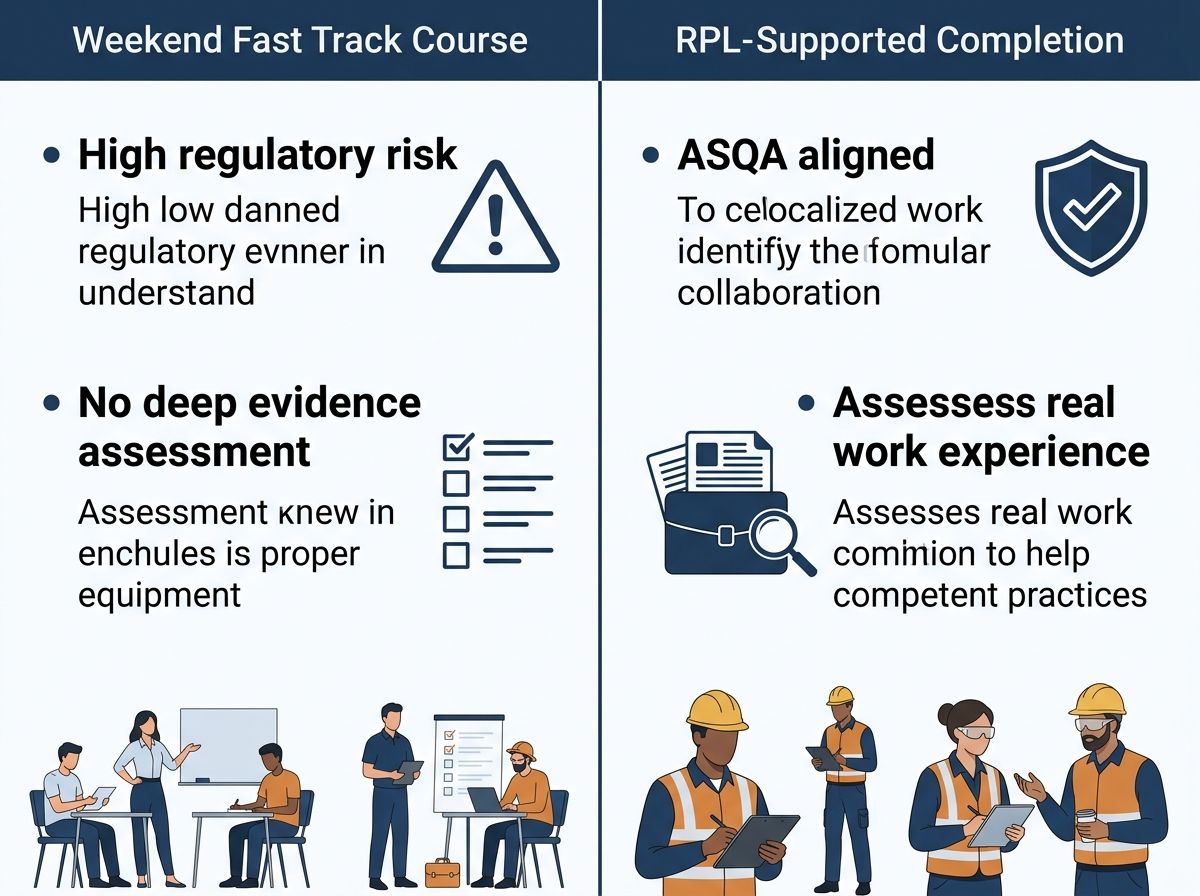
But here is what the weekend course providers will not tell you: the term 'fast track' covers two fundamentally different approaches in the VET sector. One is legitimate. One is not. The difference matters for your career, the learners you will train, and the RTO that employs you.
What 'fast track' actually means in the VET sector
In the TAE40122 market, 'fast track' is used loosely. Some providers use it to describe RPL-supported completion, which is a formal assessment process for people who already hold substantial training experience. Others use it to mean compressed classroom delivery, such as a two-day workshop, an online module completed over a weekend, or a self-paced course with minimal assessor contact.
These are not the same. They carry different regulatory implications, demand different evidence, and lead to very different outcomes for the people who complete them.
The Australian Skills Quality Authority (ASQA) is the national regulator for most RTOs in Australia. It sets and enforces the standards governing how training qualifications are delivered and assessed. ASQA monitors provider compliance and, where providers are critically non-compliant, takes regulatory action, including cancelling registrations, to protect the integrity of the VET sector.
ASQA's corporate plan states that its regulatory focus includes safeguarding student welfare and VET quality, using data to inform priorities, and taking compliance action where providers fail to meet requirements.
This regulatory environment matters when you are choosing a TAE40122 pathway. A qualification issued through a non-compliant process is not one that will hold up to scrutiny, and the consequences fall on you, not just the provider.
The regulatory reality: why genuine VET competency takes more than a weekend
The TAE40122 is a competency-based qualification, not a simple knowledge test. ASQA standards require that trainers and assessors delivering accredited training hold credentials reflecting genuine, current competency, rather than just attendance at a course.
The qualification comprises six core units and six elective units. The core units include TAEASS412 Assess competence, TAEASS413 Participate in assessment validation, TAEDEL411 Facilitate vocational training, TAEDES411 Use nationally recognised training products to meet vocational training needs, TAEDES412 Design and develop plans for vocational training, and TAEPDD401 Work effectively in the VET sector.
Several of these units, particularly those covering training delivery and competency assessment, require performance evidence. This means demonstrating in practice that you can design and deliver training and assess learner competency. You cannot genuinely demonstrate this by completing an online quiz or attending a two-day workshop; the evidence must reflect real capability.
The 2025 RTO Standards reinforce this: Outcome Standard 3.2 requires training and assessment to be delivered by credentialled people with current skills and knowledge in training and assessment, rather than simply by individuals holding a certificate issued through a compressed program.
This is why the weekend course model is problematic. It is not that providers are operating in bad faith. It is simply that the qualification's own structure is competency-based and performance-evidenced. Requiring demonstrated delivery and assessment practice means it cannot be genuinely satisfied in a compressed timeframe by someone who has not already done the work.
An RTO employing a trainer whose TAE40122 was issued through a non-compliant process carries real regulatory risk. ASQA compliance audit data shows that in 2024–25, around 2.3% of providers subject to an audit received an adverse decision, up from 1.5% the previous year. Trainer qualification compliance remains a key audit focus.
Who actually qualifies for a legitimate fast track
There is a legitimate fast-track pathway for the TAE40122. It is Recognition of Prior Learning (RPL), a nationally recognised assessment pathway under the Australian Qualifications Framework. RPL assesses your existing competency against the qualification unit requirements. It does not shortcut the assessment; it simply starts from where you already are.
The key word is 'existing'. RPL for the TAE40122 is appropriate for those who already hold substantial, demonstrable training experience, rather than those who are new to training and want to avoid formal study. It is designed for professionals who have genuinely been doing the work.
Candidates typically suited for TAE40122 RPL include experienced workplace trainers who design and deliver induction or skills training without a formal qualification; subject matter experts who regularly facilitate workshops, coaching, or structured on-the-job learning; VET practitioners working in training support roles who can demonstrate involvement in assessment; and professionals who have trained others in their industry for years but have never formalised that experience.
RPL is not appropriate for someone who has merely attended a few training sessions as a participant, or who plans to start training once they have the qualification. The evidence must reflect what you have already done, not what you intend to do.
What RPL for the TAE40122 actually involves
RPL is not a rubber stamp. It is a genuine assessment process conducted by a qualified assessor from a registered training organisation, who reviews your evidence against each unit. The RTO conducts the assessment and issues the qualification. What changes with RPL is the starting point: your existing competency, rather than starting from zero.
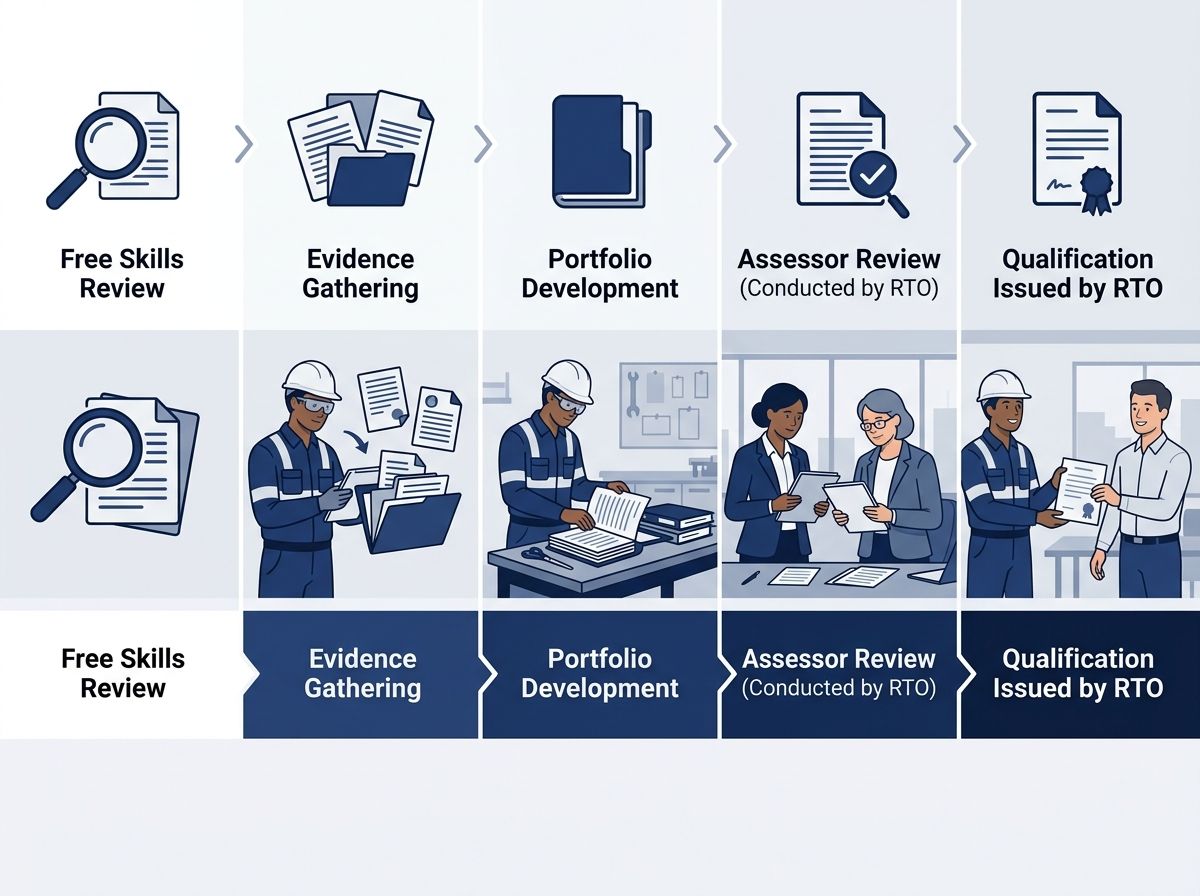
The process typically involves an initial skills review to map your experience against the TAE40122 units, followed by evidence gathering. This includes training plans, session materials, assessment tools you have designed, records of delivery, and third-party reports from supervisors or colleagues. From there, an assessor reviews your portfolio and may conduct an interview or observation to confirm competency.
Gap training may be required if your evidence does not fully cover all units. This is not a failure; it is the assessment process working as it should. Any gap training is typically targeted to the specific units where evidence is insufficient, rather than requiring you to repeat content you have already demonstrated.
Timeframes vary. At least one RTO publishes a six-month window for RPL candidates to complete their interview and submit all required evidence, noting that candidates may complete the process earlier. The actual duration depends on how well-prepared your evidence is and on assessor availability. An RTO citing ASQA volume of learning guidance notes the TAE40122 typically involves 600 to 2,400 hours of learning, a range reflecting the variation in prior experience candidates bring.
For a well-prepared candidate with organised, documented evidence of genuine training delivery and assessment practice, the RPL process can move considerably faster than a full course. However, speed depends on the quality of your evidence, not on a calendar promise. No legitimate provider can guarantee a specific completion date.
How to know if you are a genuine candidate before you commit
The most important step before pursuing any TAE40122 pathway, whether RPL or coursework, is an honest suitability assessment. Ask yourself these questions.
- Have you designed and delivered structured training sessions, planning learning outcomes, sequencing content, and facilitating skill development rather than just presenting information?
- Have you assessed learner competency against defined criteria, making and documenting judgements about whether someone has met a standard rather than just observing performance?
- Can you produce evidence of this work, such as training plans, session outlines, assessment tools, learner records, or third-party confirmation from a supervisor or colleague?
- Is your experience current, occurring within the last few years in a context relevant to the TAE40122 units?
- Are you prepared to engage with a genuine assessment process, including an interview and possible gap training, rather than looking for a certificate with minimal scrutiny?
If you answered yes to most of these, RPL may well be the most efficient legitimate pathway available to you. If you answered no to several, formal study is likely the more appropriate route. That is not a setback; it is honest guidance that saves you time and money in the long run.
The fastest legitimate pathway starts with an honest assessment of where you are now. A Free Skills Review offers a clear picture of whether your experience maps to TAE40122 competencies, before you commit to anything.
The TAE40122 qualification document on training.gov.au details the full unit structure and packaging rules. This provides useful context if you want to map your experience against the specific competencies before speaking with anyone.
Ready to Get Recognised?
Start with a free skills review to find out if RPL is right for you.