The motor mechanic licence gate nobody explains until you hit it
Years of experience, then a sudden job rejection. Learn what the motor mechanic licence gate is and how RPL helps you prove your existing skills.
By RPL it Australia7 min read

The moment the gate appears
You have the experience. You have spent years diagnosing faults, replacing parts, and keeping vehicles on the road. You know the work inside out. Then, without warning, the gate appears.
It might arrive as a job advertisement that lists the 'Certificate III in Light Vehicle Mechanical Technology (AUR30620)' as an essential requirement. It might arrive when a workshop manager apologises and says they cannot let you work on the floor without a formal qualification. It might come from an insurer who refuses to cover your work without documented credentials. Or it might appear as a commercial tender requirement you did not know existed until you tried to bid.
The motor mechanic licence gate is the moment a skilled, experienced mechanic discovers that practical capability, however deep or proven, does not automatically translate into the formal standing needed to work, be hired, or be insured. The issue is not whether you can do the job. It is whether a formal system has assessed and verified that you can.
Nobody announces the gate in advance. It appears when you hit it, and the shock is real.
What the licence gate actually is (and why nobody warned you)
The gate is not a single rule. It is a combination of requirements from employers, insurers, and state licensing bodies that all point to the same thing: a nationally recognised qualification in automotive mechanical technology.
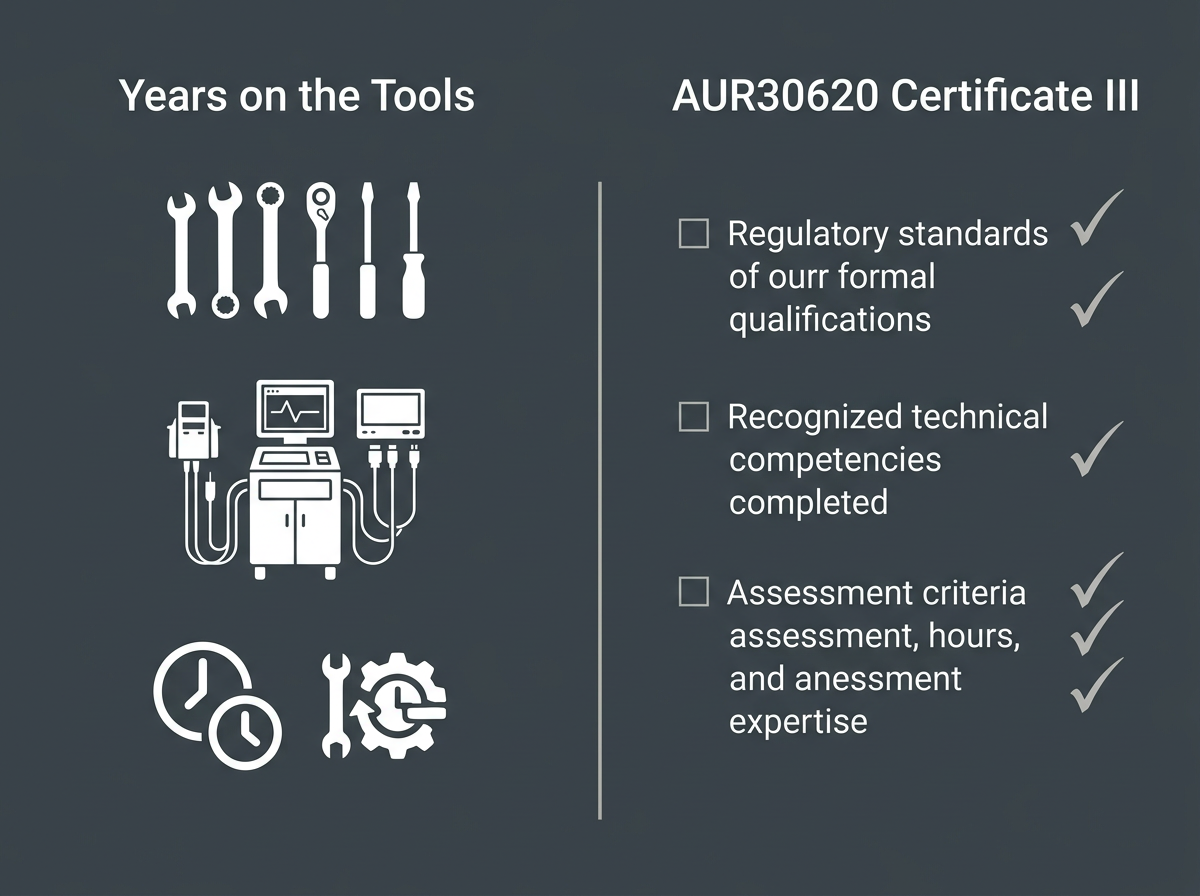
For light vehicle mechanics, the relevant qualification is the Certificate III in Light Vehicle Mechanical Technology (AUR30620). This nationally recognised vocational qualification covers the skills required to diagnose, service, and repair light vehicles. Employers use it as a hiring standard. Insurers require it for coverage. In some states, you need it alongside a formal trade licence.
This qualification exists because employment, insurance, and regulatory systems require documented proof of competency, not just practical capability. A workshop owner who has watched you work for three years knows exactly what you can do. Their insurer does not. An HR manager writing a job advertisement does not. A state licensing authority does not. The gate is the gap between what people who know you understand about your skills, and what these formal systems can verify.
Nobody warned you because the gate is invisible until you reach it. Most mechanics learn the trade on the tools through uncompleted apprenticeships, years of informal work, or overseas training that does not map directly to Australian standards. The assumption is that the work speaks for itself. In many workplaces, it does. Until it doesn't.
Three trigger events that reveal the gate
The gate does not announce itself. It reveals itself through specific moments. These are the three most common trigger events for motor mechanics in Australia.
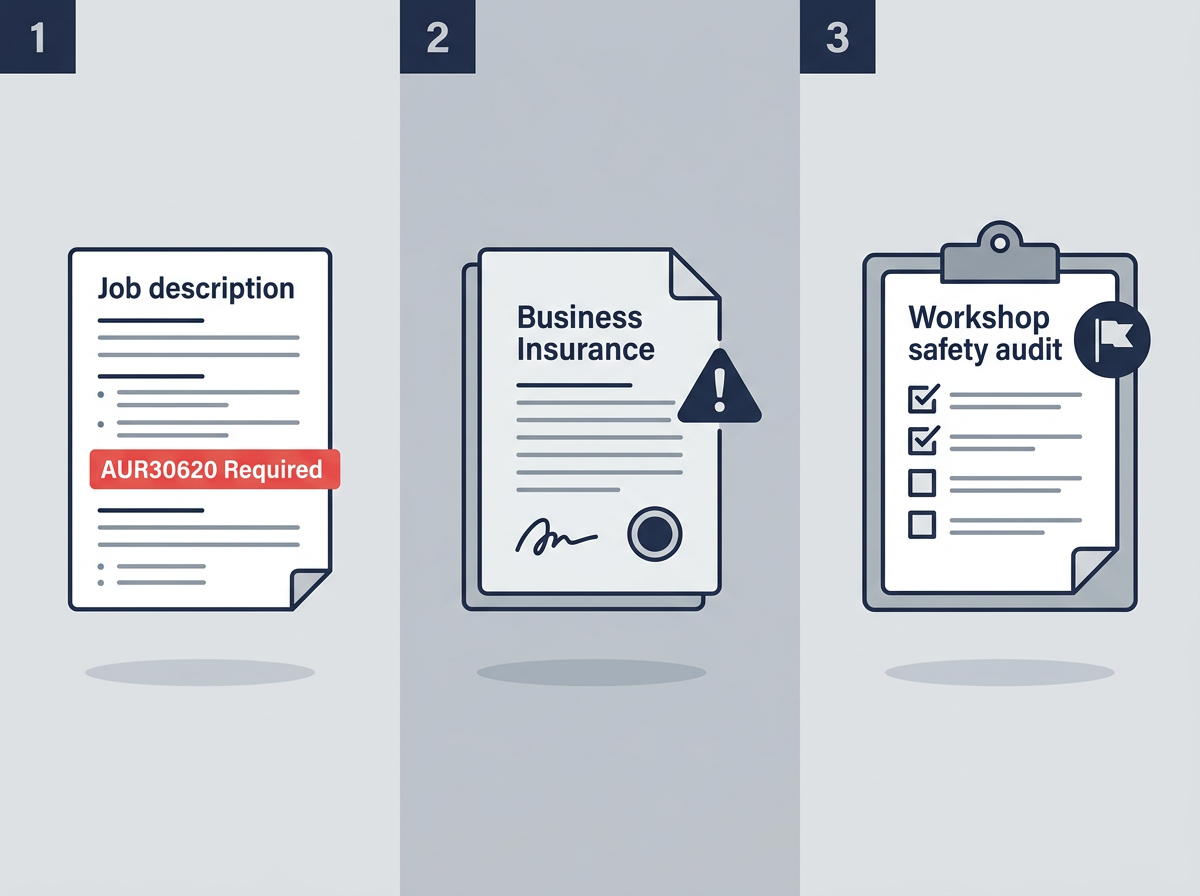
- Job application rejection. You apply for a position at a dealership, a fleet workshop, or a specialist service centre. The role is well within your capability, but the rejection comes back with a standard note: the position requires a Certificate III in Light Vehicle Mechanical Technology or an equivalent Australian trade qualification. Your years of experience are not in question. The credential is.
- The workshop insurance requirement. A workshop owner wants to hire you, or you want to operate your own workshop, and the business insurer requires documented qualifications for all mechanics performing diagnostics or repairs. Without that formal qualification, the coverage does not apply, or it comes with conditions that make the arrangement unworkable.
- The employer compliance audit. A larger employer—such as a dealership group, a fleet management company, or a government contractor—conducts a compliance review of their workforce credentials. Mechanics without formal qualifications are flagged. The requirement to obtain the Certificate III becomes urgent and non-negotiable.
If one of these situations brought you here, you are not alone, and there is a practical pathway forward.
Why years of experience do not satisfy the gate
Experience is real. The gate is also real. Both of these facts are true.
The employers, insurers, and licensing bodies that control this gate are not questioning whether you can do the work. They are asking whether a qualified assessor has formally evaluated your skills against a defined national standard. These are two different questions, and proving the first does not automatically answer the second.
The Certificate III in Light Vehicle Mechanical Technology (AUR30620) is a nationally recognised qualification that sits within Australia's vocational education and training (VET) framework. To hold it, a candidate must have their competency formally assessed against the qualification's specific units by a registered training organisation (RTO). That assessment can occur through traditional study, an apprenticeship, or, for experienced mechanics, through Recognition of Prior Learning (RPL). But it must take place. The qualification cannot be self-declared or assumed based on your years of work alone.
This is not a judgement on your competence; it is simply how formal recognition works. Experience is not worth less than education, but it is a different form of evidence. The real question is whether that evidence has been formally assessed and acknowledged, and if not, how to resolve that.
The RPL pathway: What it actually means for an experienced mechanic
Recognition of Prior Learning (RPL) is the formal process where a registered training organisation (RTO) assesses your existing skills, knowledge, and experience against a qualification. For an experienced motor mechanic, this means assessment is based on what you already know and can demonstrate, rather than repeating training you have completed on the job.
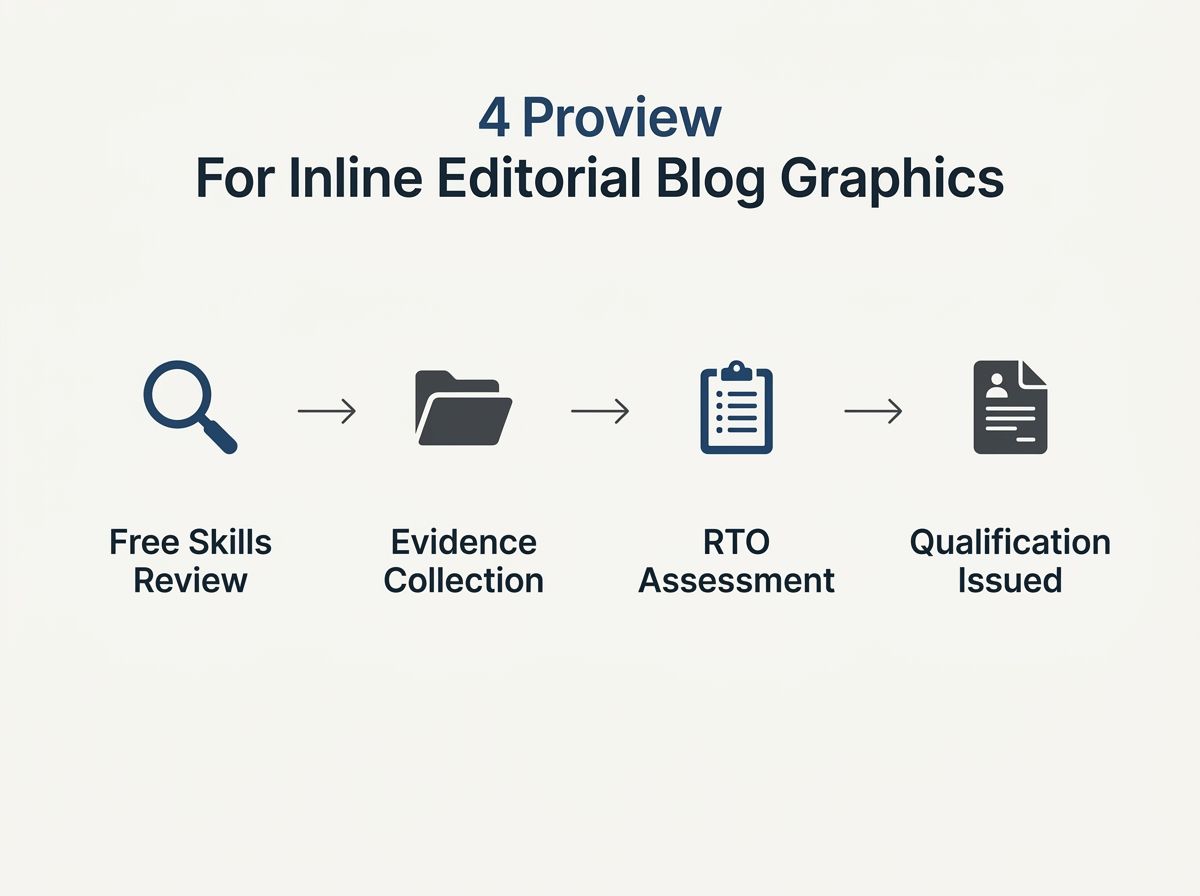
The RPL process for a qualification like AUR30620 typically involves gathering evidence of your existing competency. This can include records of your employment history, employer references, statutory declarations, documentation of the specific types of vehicles and mechanical systems you have worked on, and sometimes a practical demonstration or technical interview with an assessor. The specific evidence requirements are determined by the delivering RTO, not by RPL it. The role of RPL it is to guide you through the process of identifying, organising, and presenting that evidence clearly.
Where gaps are identified—meaning areas of the qualification where your documented experience does not yet fully meet the standard—gap training may be required. This is not a failure of the process; it is the process working honestly. Gap training is provided to address specific areas, not to make you repeat the entire qualification. The goal is the formal recognition of what you already know, with targeted support for any areas that need to be filled in.
To be clear on how this works: RPL it is a guide, not an assessor. Your qualification is issued by a registered training organisation. Our role is to help you understand the process, gather your evidence, and navigate the pathway so you are fully prepared for the RTO assessment.
Learn more about the Certificate III in Light Vehicle Mechanical Technology (AUR30620) and what the RPL process involves.
Is RPL right for your situation?
RPL is not suitable for everyone. Honest advice on suitability matters more than enrolment numbers, and that principle shapes how we present this pathway.
RPL for AUR30620 typically works well when you have substantial hands-on experience working on light vehicles in a professional or semi-professional context, can provide documentation or references that support your experience, and have a work history covering a reasonable range of the competencies the qualification addresses. This includes engine systems, braking, steering, and electrical diagnostics. The stronger and more comprehensive your documented experience, the more straightforward the assessment process is likely to be.
RPL may not be the right fit if your experience is very limited, concentrated in a narrow area, or if you have no way to document or verify your work history. It is also unsuitable if your background is primarily in a different type of vehicle or mechanical context that does not map closely to light vehicle technology. In those situations, a traditional study pathway is usually more appropriate, and a good guide will tell you that honestly.
If you hold overseas qualifications, these may need to be assessed separately before or alongside the RPL process. Requirements vary depending on the specific qualification and the RTO.
The most reliable way to assess your suitability is through a structured skills review. This is not a sales call, but a realistic assessment of your background against the qualification requirements.
The Free Skills Review: Where to start
The Free Skills Review is the no-commitment starting point. It is a way to find out whether RPL is a viable pathway for your specific situation before making any decisions about enrolment or investment. This review helps you understand where you stand without any pressure.
You have the experience. The question is whether that experience, once properly documented and assessed, can be converted into the formal recognition you need to progress. The Free Skills Review is how you find out where you stand.
The decision is yours.
General information only, current at the date shown. Licensing rules change, so check the current requirements with the relevant regulator before you rely on them. RPL it Australia is a student support service, not a Registered Training Organisation; qualifications are assessed and issued by our partner RTOs.