You can diagnose a fault faster than most qualified technicians. Why can't you get hired as one?
You diagnose faults faster than qualified techs. But without a Certificate III, employers won't hire you. Here is how to fix this.
By RPL it Australia8 min read
The diagnostic gap nobody talks about
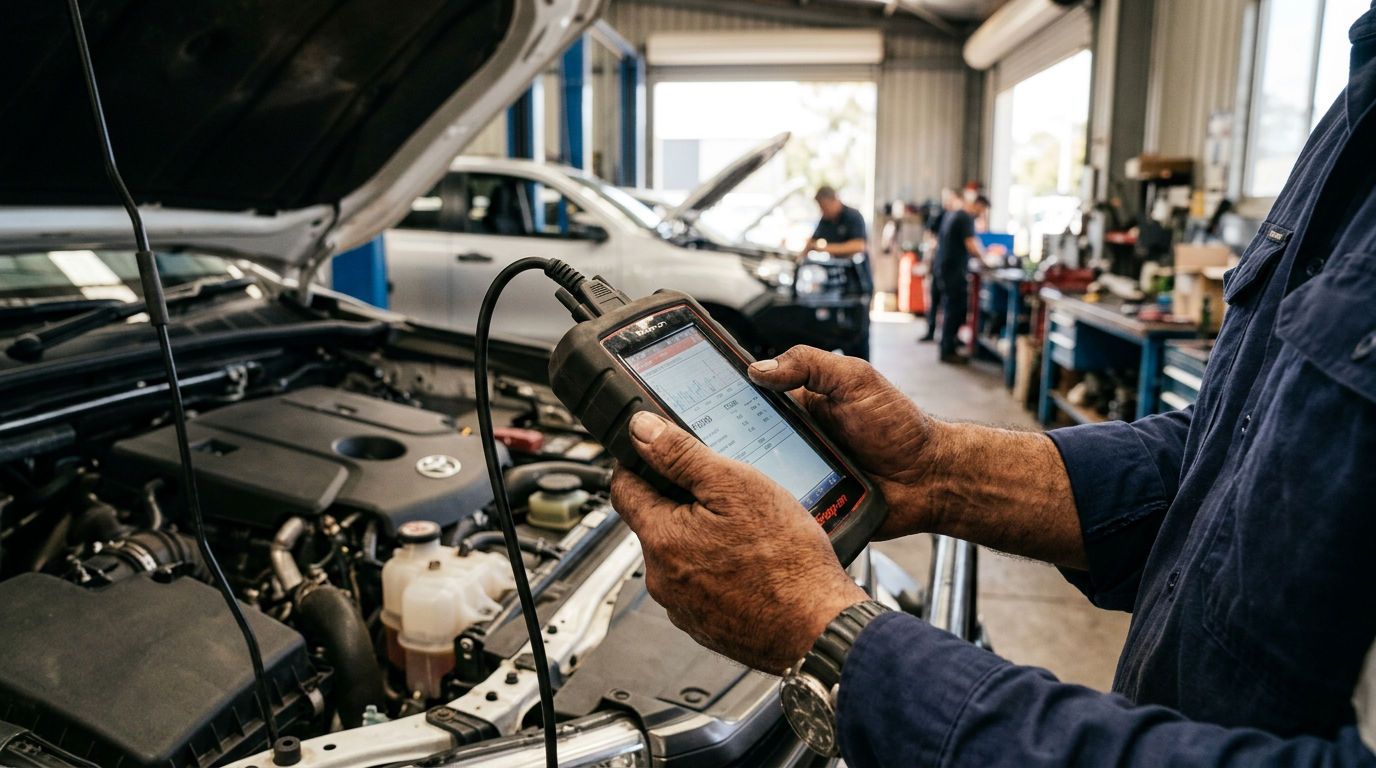
You diagnose faults that stump the apprentice with the fresh cert. You rebuild systems that the workshop manual says require a specialist. You know what a misfire sounds like before the scanner confirms it. Yet the job ads still demand a Certificate III. The workshop down the road won't touch your application. The insurance broker asks for your qualification number. The answer is always the same: you need the ticket.
This is the diagnostic gap nobody in the automotive industry talks about openly. There is a clear difference between what a skilled, experienced light vehicle technician can do and what the formal employment system recognizes. The industry claims to hire on skill, but its systems are built entirely around credentials.
That credential is the Certificate III in Light Vehicle Mechanical Technology (qualification code AUR30620). It is the nationally recognized standard for light vehicle mechanical work in Australia. Without it, the doors to formal employment, insurance coverage, and trade licensing in some states stay closed, regardless of what you can actually do under the bonnet.
What the industry actually requires (and why skill alone is not enough)
The automotive employment and insurance system is not designed to assess your competence directly. It uses the Certificate III as a proxy. This is not malicious; it is structural. Employers cannot independently verify that every applicant can safely diagnose and repair a modern light vehicle. Insurers cannot assess every technician's skill level before issuing a policy. So the system relies on a credential that a Registered Training Organisation has already assessed.
The qualification is not a test of your ability. It is a signal the system can read.
That distinction matters. It means the barrier you face is not about your competence; it is about the form your competence takes. Your skills exist. They are real. They are simply not in a form the system can process.
In some states, the credential requirement goes further than employment and insurance. Automotive technician trade licences, which govern who can legally operate as a qualified technician in certain jurisdictions, reference formal qualifications as part of their eligibility criteria. The specific requirements vary by state and territory, so you should check the licensing authority in your jurisdiction if this applies to you.
The three doors that stay closed without a Certificate III
Understanding the structural problem is one thing. Knowing what it costs you is another. Three specific doors stay closed without AUR30620.
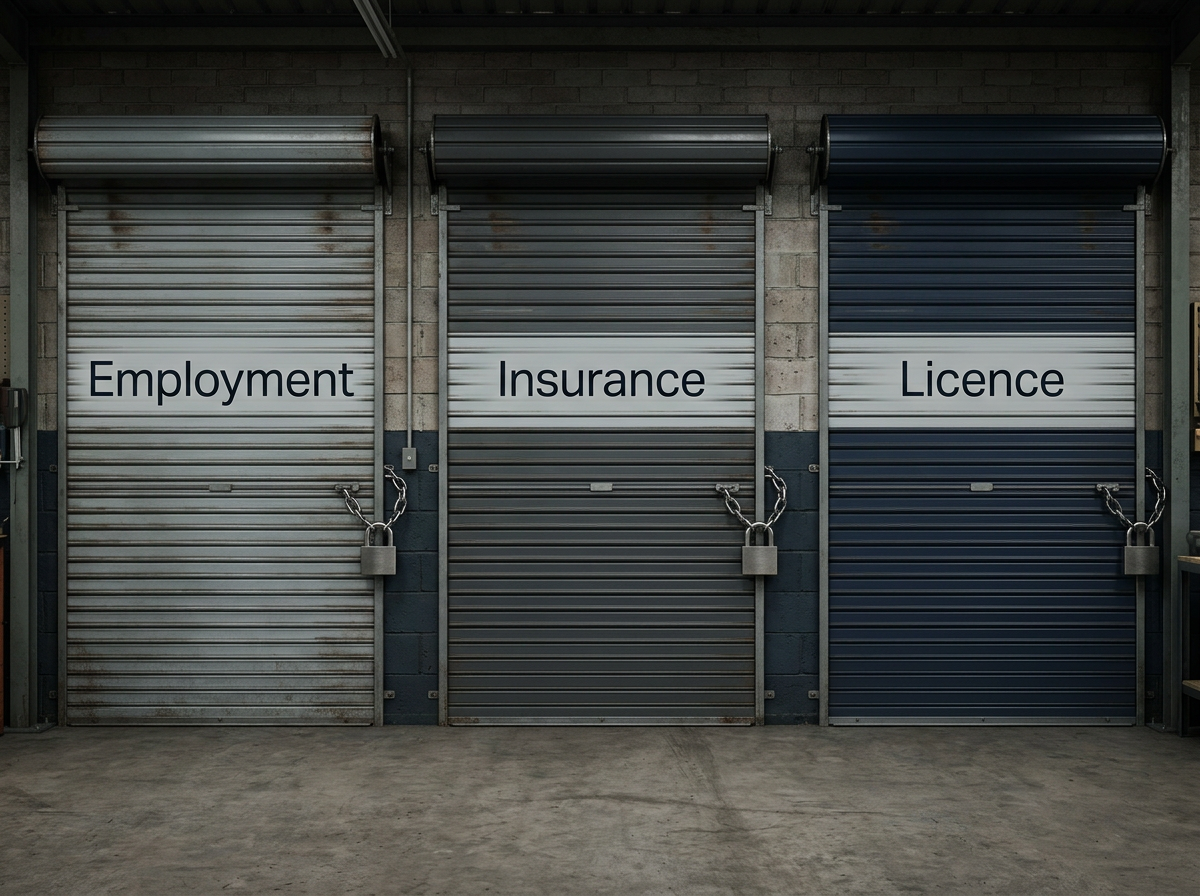
- Employment at qualified technician pay rates. Under the Vehicle Manufacturing, Repair, Services and Retail Award (the Modern Award that covers most automotive workshop employees in Australia), pay classifications strictly distinguish between qualified and unqualified workers. Without a Certificate III, you are classified below the qualified technician level, regardless of your practical capability. This classification difference directly restricts your pay rate, your official job title, and your career advancement.
- Insurance coverage as a qualified technician. Automotive workshops carry professional indemnity and public liability insurance that covers work performed on customer vehicles. Many insurers structure their coverage terms around the formal qualifications of the technicians doing the work. Without a formal credential, your work may not be covered under the standard policy terms, and many employers will not take that risk. This is a common and practical constraint that affects who workshops are willing to hire.
- Trade licence eligibility in states that require it. In some Australian states and territories, working as an automotive technician legally requires a formal trade licence. Those licences reference qualification requirements as part of their eligibility criteria. Without the underlying qualification, you cannot obtain the licence, and without the licence, the work is not legal. The specific rules and state requirements differ, but if you live in a jurisdiction with licensing, the credential is not optional.
Three doors. Each one is real, and each one is closed by the same missing qualification.
Why getting the certificate is easier said than done
The obvious response is to just go and get the qualification. If you are twenty years old with no major commitments and a full-time apprenticeship offer, that is reasonable advice.
If you are thirty-five, working full-time, supporting a family, and already doing the job at a qualified level, it is not.
The Certificate III in Light Vehicle Mechanical Technology through a traditional TAFE or apprenticeship pathway typically takes several years to complete. This timeline is designed for someone learning the trade from the beginning. It is not built for someone who already knows the job.
The financial cost is real. The time away from paid work is real. Sitting through classes that cover skills you have been applying for a decade is frustrating.
Recognition should not require starting over. The traditional pathway asks experienced workers to repeat a journey they have already completed, at their own expense and in their own time, simply to satisfy a system that cannot see what they already know.
What recognition of prior learning does and does not do
Recognition of Prior Learning (RPL) is a formal assessment process conducted by a Registered Training Organisation. It evaluates whether your existing skills and experience meet the competency standards of a qualification. If they do, the RTO issues the qualification. That qualification is nationally recognized and identical to one earned through traditional study because the assessment is genuine.
RPL is neither a workaround nor a shortcut. It is a rigorous assessment of what you already know and can do, measured against the exact same competency standards that govern the qualification itself.
What RPL does is allow your existing experience to be assessed as evidence of competency, rather than requiring you to re-learn those skills through classroom instruction.
What RPL does not do is guarantee a qualification. If your experience does not cover all the required competency units, or if it is not sufficiently recent or documented, gap training may be required. That gap training is provided at no additional cost if you are enrolled through RPL it's partner RTOs, but honest guidance means acknowledging it as a real possibility.
The qualification issued through RPL is the same AUR30620 that any other qualified light vehicle technician holds. It carries the same recognition with employers, insurers, and licensing authorities. Because the assessment is real, the credential is real.
What the RPL process looks like for a light vehicle technician
The RPL process for AUR30620 is built around evidence of your existing competency. Evidence that supports an automotive RPL application includes records of your work history, employer or supervisor references, photographs or documentation of specific jobs you have completed, logbooks or service records, and in some cases, a practical demonstration or structured conversation with an assessor.
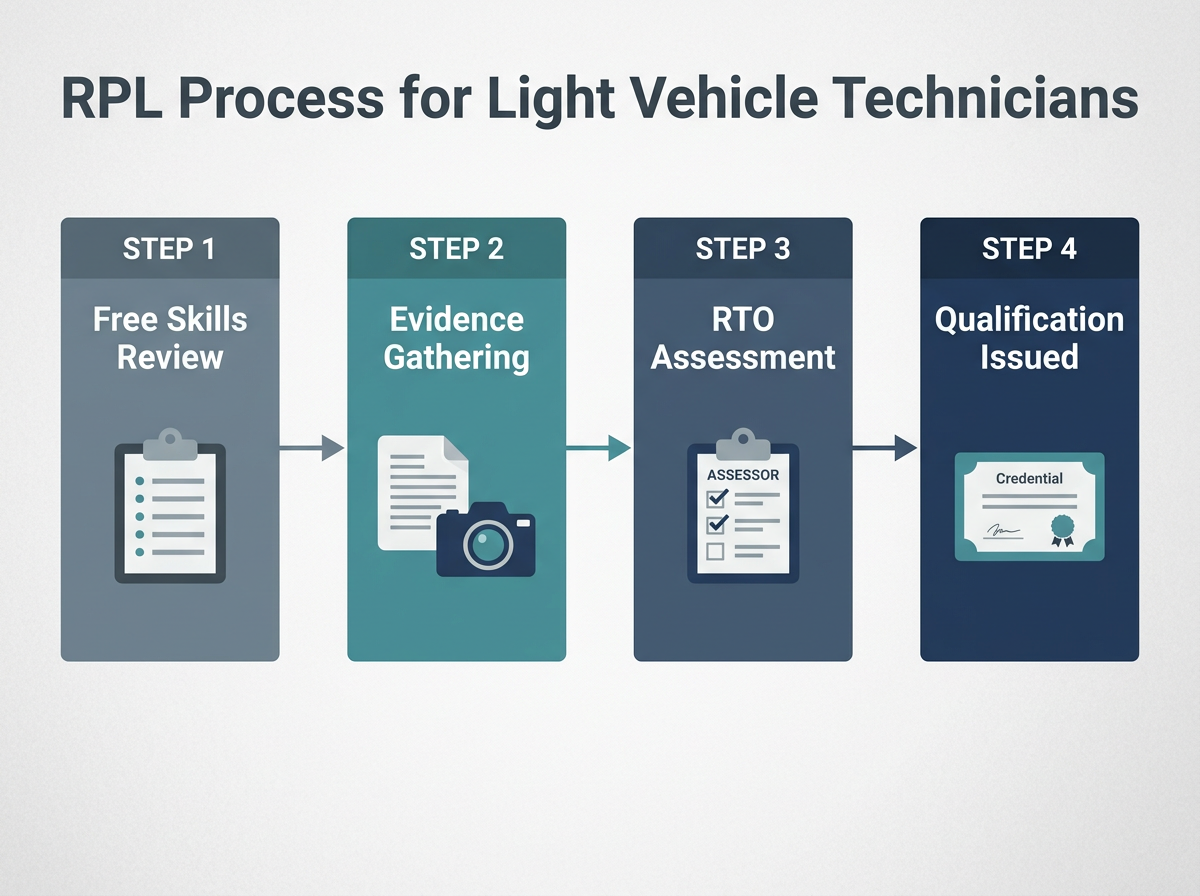
The process is guided. You are not handed a list of requirements and left to figure it out yourself. RPL it works with you to identify what evidence you have, what gaps might exist, and how to present your experience in a form the assessing RTO can evaluate.
The assessment itself is conducted by a qualified assessor from the delivering RTO, not by RPL it. Our role is to guide and support you through the process by helping you understand what is required, assisting with evidence preparation, and supporting your application throughout. The RTO's assessor makes the competency determination.
If gap training is identified in areas where your documented experience does not fully cover the required competency units, that training is provided as part of the process. It is targeted directly to the gaps, rather than repeating what you already know.
Is RPL right for you? The honest answer
Not everyone is suitable for RPL. That is the honest answer, and it is worth stating clearly.
RPL is most suitable for technicians with broad, recent, and documented experience across the core competency areas of AUR30620. If you have been working in a light vehicle workshop for several years, across a range of vehicle systems and fault types with evidence of that work available, you are likely a strong candidate for assessment.
If your experience is narrow, focusing on a single system or limited in scope, gap training may be required to cover the areas your work history does not address. This is not a disqualification. It is an honest assessment of where you are relative to where the qualification requires you to be.
If your experience is very limited, outdated, or largely undocumented, traditional study may be the more appropriate pathway. RPL it will tell you that honestly, because enrolling in the wrong pathway wastes your time and damages trust.
The way to find out which category you fall into is not to guess. It is to have your skills reviewed by someone who knows what the qualification requires.
The first step: A Free Skills Review
You have the experience. The question is whether it meets the standard, and whether the evidence to demonstrate it is available.
A Free Skills Review is the starting point. It is a no-obligation conversation about your background, your experience, and whether RPL is a suitable pathway for you. This is not a sales pitch. It is a practical assessment of where you stand.
If RPL is suitable, you will understand what the process involves and what evidence you need to gather. If it is not, you will know that too, giving you a clearer picture of what your options are.
The decision is yours. Start with a Free Skills Review, which is free and carries no obligation.
General information only, current at the date shown. Licensing rules change, so check the current requirements with the relevant regulator before you rely on them. RPL it Australia is a student support service, not a Registered Training Organisation; qualifications are assessed and issued by our partner RTOs.