The Hidden Cost of Working as an IT Professional Without a Qualification
Missed promotions, lost tenders, and visa setbacks: the real cost of working in IT without a formal qualification, and how RPL can help.
By RPL it Australia10 min read

You are the most capable person in the room, and the first one filtered out
You have the experience. You have built the infrastructure, managed the outages, trained the new hires, and kept systems running that the business depends on. Your capability is real and your track record is demonstrable. Yet, when the next opportunity appears, whether it is a promotion, a contract, or a visa pathway, your experience remains invisible to the people making decisions.
This does not reflect your competence; it reflects how formal systems work. In Australia's job market, government procurement frameworks, and skilled migration pathways, a formal qualification is more than a credential: it is a filter. If you do not hold one, you are often screened out before anyone reads a single line of what you have actually done.
The credential gap is not a personal failure, but a structural reality. It has a measurable cost in promotions missed, contracts lost, and pathways closed. This analysis identifies those costs across three specific scenarios that experienced IT professionals encounter regularly.
Scenario one: The promotion that went to someone with less experience and more paper
You applied. You were qualified in every practical sense, but you did not get the role. It went to someone with fewer years in the field, less hands-on experience, and a Diploma of Information Technology that you do not hold.
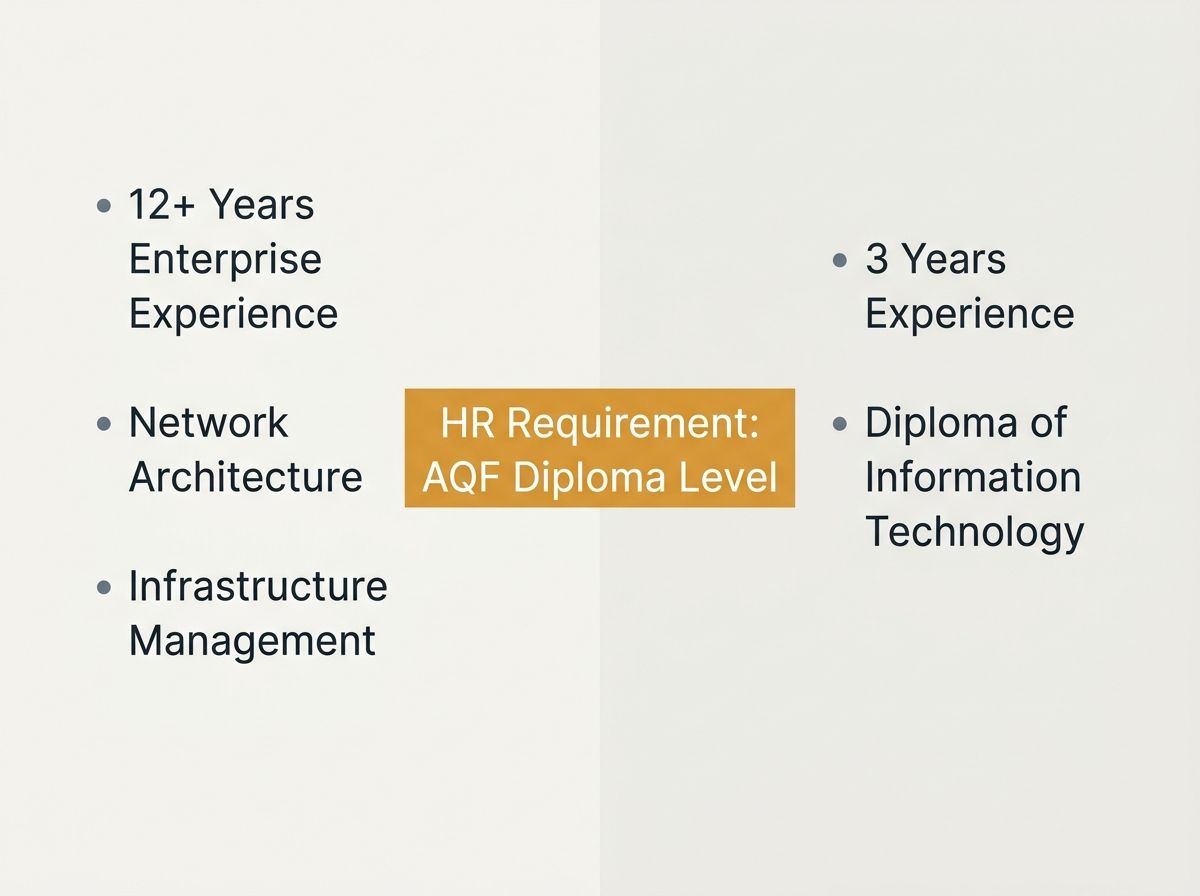
This is a common outcome. In many organisations, senior IT roles carry a formal qualification requirement. This is not because the hiring manager doubts your capability, but because HR compliance, position descriptions, and applicant tracking software are built around credential checkboxes. Before a human reads your resume, a system has already decided whether you meet the minimum requirements. If a diploma is listed as a prerequisite and you do not have one, your application is often filtered out, regardless of what your experience demonstrates.
The frustration is real. The system is designed to assess what your resume says rather than what you can actually do. For experienced IT professionals who built their skills on the job, through self-directed learning, or in roles without formal training pathways, this gap between capability and credential is where careers stall.
The credential ceiling is not unique to IT, but it is particularly sharp in a sector where technical skills evolve faster than formal education can track. Many of the most capable practitioners learned by doing rather than by studying. If this situation sounds familiar, you may find it useful to read about why your IT experience does not show up officially, and how formal systems view your background.
Scenario two: The government tender your company could not win because of your resume
The credential gap does more than affect your personal career; it can limit your employer's ability to win work, and in some cases, to bid at all.
Government and enterprise IT contracts in Australia frequently specify qualification requirements for key personnel. A tender document may require that the lead IT professional, systems architect, or project manager named in the bid holds a formal qualification at a specified level. If you are that person and you do not hold the required credential, your employer's bid may be assessed as non-compliant, or scored lower than competitors whose personnel meet the requirements.
This is a commercial consequence that extends beyond your own career trajectory. Your employer bid and lost. The reason was on page four of the tender requirements. The person central to that outcome, through no fault of their own, was the most experienced IT professional on the team, whose capability was never in question, but whose credential was.
For IT professionals working in consulting, managed services, or any environment where employers regularly bid for government or enterprise contracts, the credential gap is a commercial liability rather than just a personal ceiling. Organisations that recognise this often support their experienced staff in pursuing formal qualifications, because the return on that investment shows up directly in tender eligibility.
Scenario three: The visa pathway that required a qualification you do not have
For IT professionals on skilled migration pathways, or those planning to apply, the credential gap can affect more than career progression. It can impact your ability to remain in Australia, or to transition from a temporary to a permanent visa.
Skilled migration pathways for IT occupations in Australia typically require a skills assessment by a recognised assessing body. For most IT roles, that body is the Australian Computer Society (ACS). Skills assessment processes evaluate both qualifications and experience, but the weight given to each and the specific requirements can vary. In some cases, the absence of a formal qualification may affect how an application is assessed, even when your practical experience is extensive.
This is a high-stakes scenario that deserves clear framing. RPL is not a guaranteed solution to a visa challenge, and migration outcomes depend on many factors beyond a single qualification. However, holding a nationally recognised IT qualification, particularly one that aligns with your occupation and experience level, can strengthen a skills assessment application. For IT professionals who have the experience but not the credential, RPL may be a pathway worth exploring as part of a broader migration strategy.
If you are navigating a skilled migration pathway, the practical step is to seek advice from a registered migration agent while exploring whether your IT experience qualifies for RPL. The two options work together, and understanding your position on both fronts keeps you informed.
Why the system works this way, and why it is not going to change
Understanding why the credential gap persists does not mean excusing it. It means recognising the structural reality so you can navigate it effectively.
Australia's formal qualification system, the Australian Qualifications Framework (AQF), provides a nationally consistent standard for education and training. Qualifications issued under the AQF carry legal and compliance weight because they are assessed against defined standards by registered training organisations. When an employer, procurement body, or migration authority specifies a qualification, they use the AQF as a proxy for competence: a shorthand to assess capability without directly evaluating every candidate's complete work history.
The system is designed to be scalable rather than unfair. But for experienced practitioners who built their skills outside formal education pathways, it creates a persistent structural disadvantage. HR departments filter by qualification because their systems are configured that way. Procurement frameworks specify credentials because they require a defensible standard. Migration authorities require skills assessments because they cannot individually evaluate every applicant's capability.
The system will not change, but your position within it can. The paper ceiling is not unique to IT; it affects experienced professionals across industries. A formal pathway exists to close this gap based on the evidence you have already created through your everyday work.
The paper ceiling is not unique to IT; it affects experienced professionals across industries.
What RPL actually does for IT professionals
RPL, or Recognition of Prior Learning, is the formal process by which your existing IT experience is assessed as evidence of competency against the units of a nationally recognised qualification. It is not a shortcut or a rubber stamp. It is a rigorous assessment pathway that recognises a simple truth: your experience is valid evidence.
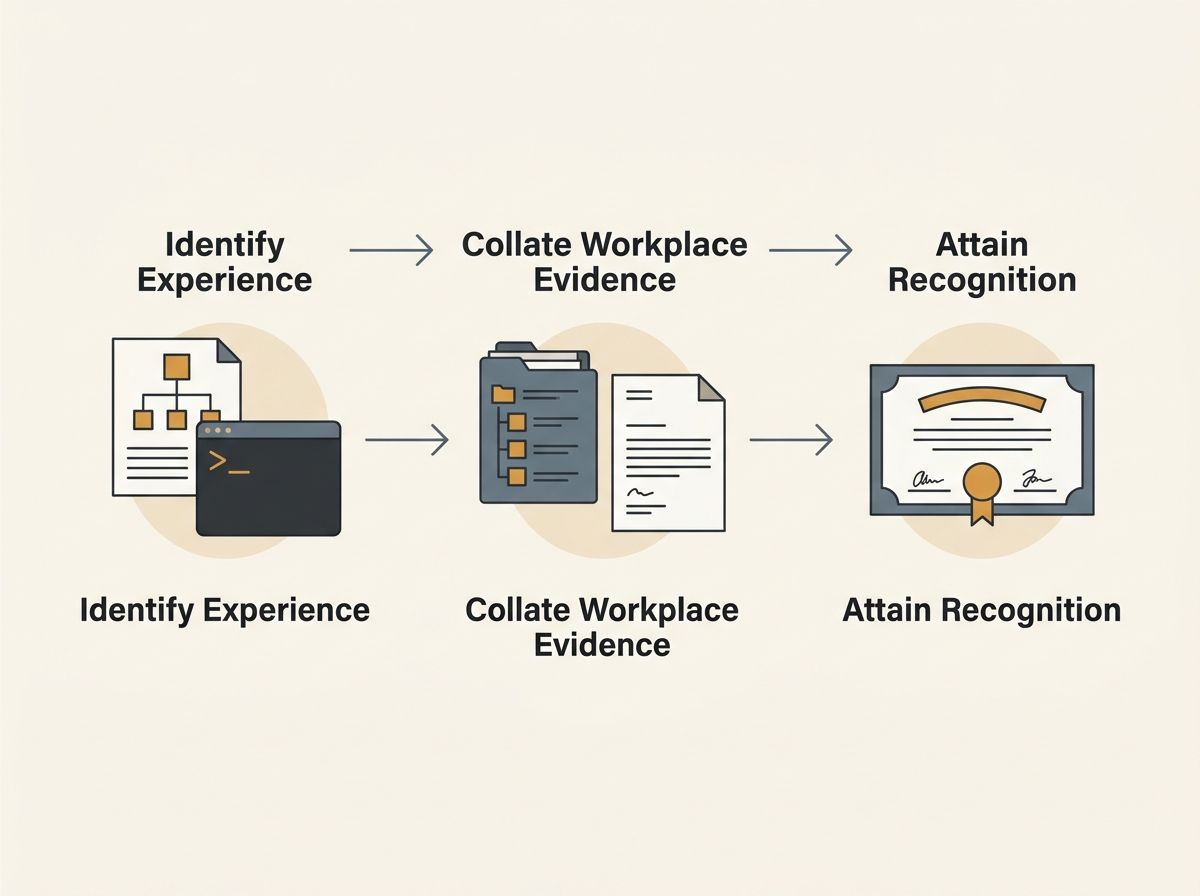
For experienced IT professionals, the relevant qualification is typically the Diploma of Information Technology (ICT50220), a nationally recognised credential covering the technical and professional competencies you demonstrate in your daily work. Through an RPL assessment, your existing experience is evaluated against the competency standards of this qualification. Where your experience demonstrates competency, it is recognised. Where gaps exist, a registered training organisation (RTO) will identify them and may offer gap training to address them.
RPL requires you to provide practical evidence of your experience: documentation, references, work samples, and other materials that demonstrate your competency against the qualification standards. An assessor from the delivering RTO evaluates that evidence to make a professional judgement. RPL it guides you through this process, helping you identify, organise, and present your evidence. The assessment itself is conducted by the RTO.
The outcome of an RPL assessment is not guaranteed. The process offers a guided, supported pathway designed to give your experience the best opportunity to be formally recognised.
Learn more about the Diploma of Information Technology and what the RPL pathway involves.
The evidence you already have, and probably have not thought to use
The evidence required for an IT RPL assessment already exists in your working life. The challenge is not creating new files, but identifying, organising, and presenting your current work so it maps to the required competency standards.
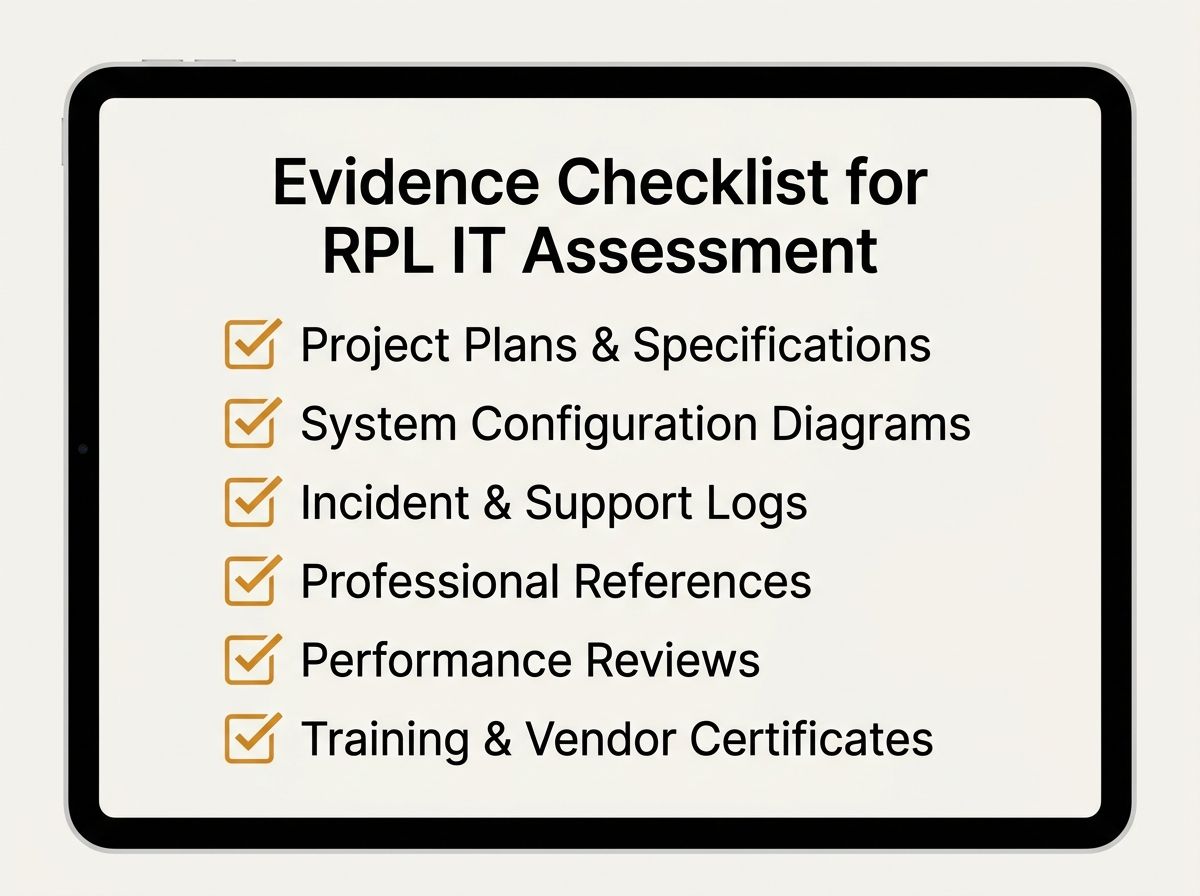
Assessors evaluating IT RPL applications look for evidence drawn from your professional history. The materials that are commonly relevant include:
- Project documentation: plans, scope documents, technical specifications, or post-implementation reviews from IT projects you have led or contributed to
- System and network documentation: configurations, architecture diagrams, or technical records you have produced or maintained
- Incident and problem records: documentation of issues you have diagnosed and resolved, including the approach taken and outcomes achieved
- Employer or supervisor references: written statements from people who can attest to your technical capability and professional conduct in IT roles
- Client or stakeholder correspondence: communications that demonstrate your professional engagement and the outcomes you delivered
- Training records and professional development: any formal or informal learning you have completed, including vendor certifications, short courses, or self-directed study
- Performance reviews or role descriptions: documents that describe the scope and complexity of your IT responsibilities
You do not need to have every item on this list. You need enough evidence across key competency areas to support an assessor's professional judgement. This guided process is designed to help you identify what you have, address gaps, and present your evidence clearly.
Is RPL the right pathway for you?
RPL is not suitable for everyone, and we believe in giving you clear, direct guidance.
RPL is a strong fit if you have substantial, demonstrable experience in IT roles. This typically means several years of hands-on work across the competencies covered by the qualification you are seeking. It suits professionals who built their skills on the job, through self-directed learning, or in roles without formal training pathways. If you can point to real work, such as projects delivered, systems built, or problems solved, and you can provide evidence of that work, RPL is worth exploring.
RPL may not be the right option if your experience is limited, if it is concentrated in a narrow area that does not align with the competency requirements, or if you cannot provide adequate evidence of your work. An honest suitability assessment before you make a commitment is the best first step.
That is the purpose of the Free Skills Review. It is a straightforward conversation that provides an honest picture of whether your experience supports an RPL assessment. There is no cost or obligation involved. If RPL is not the right fit, we will tell you directly, because finding the right pathway matters more than enrolling in an unsuitable program.
Frequently asked questions
What is RPL for IT professionals?
RPL, or Recognition of Prior Learning, is a formal assessment process that evaluates your existing IT experience against the competency standards of a nationally recognised qualification. If your experience demonstrates the required competencies, you can receive formal recognition without completing traditional classes.
What evidence do I need for an IT RPL assessment?
Evidence typically includes project documentation, system records, employer references, incident logs, performance reviews, and records of professional development. The required items depend on the qualification and its specific competency units. A guided RPL process helps you identify your existing documentation and present it clearly.
Can RPL help with a visa skills assessment?
Holding a nationally recognised IT qualification can strengthen a skills assessment application for skilled migration. However, migration outcomes depend on many factors, and RPL is not a guaranteed solution to visa challenges. If you are navigating a skilled migration pathway, seek advice from a registered migration agent while exploring your RPL options.
Is RPL suitable for self-taught IT professionals?
RPL is well-suited to self-taught IT professionals with substantial, demonstrable experience, provided you can verify that experience through documentation, references, or other professional records. Suitability depends on the depth and breadth of your experience rather than how you acquired it.
How long does IT RPL take?
The time required for an RPL assessment depends on the qualification, the available evidence, and whether you need gap training. RPL it does not provide fixed timeframes, as the duration is indicative and depends on individual circumstances. A Free Skills Review can give you a clearer picture of what to expect for your situation.
General information only, current at the date shown. Licensing rules change, so check the current requirements with the relevant regulator before you rely on them. RPL it Australia is a student support service, not a Registered Training Organisation; qualifications are assessed and issued by our partner RTOs.