Pivoting to Smash Repairs: How Industrial Painting Skills Map to Automotive Spray Painting
Prepped and painted marine fibreglass or aircraft panels? You already have the core skills for an automotive spray painting course. Here is how they map.
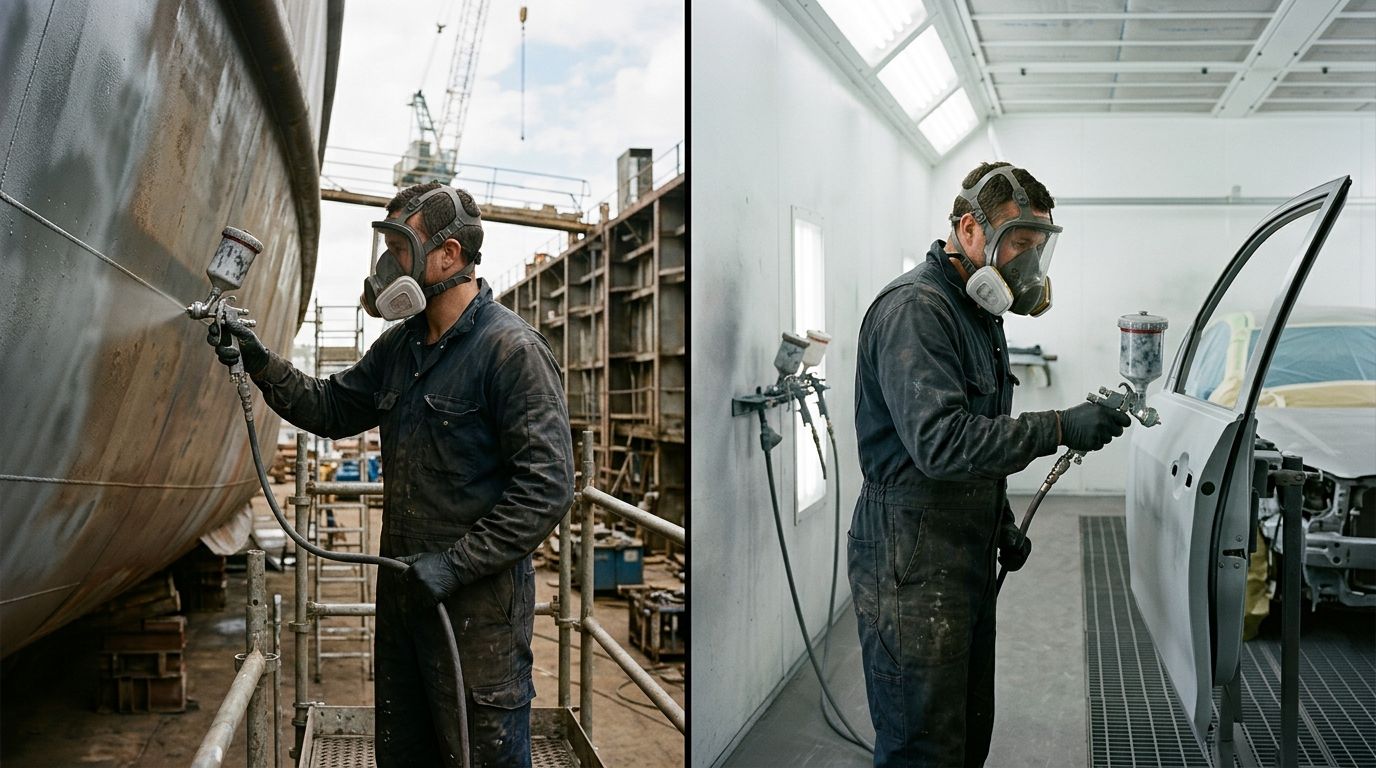
The conversation that keeps happening in smash repair workshops
You have spent years working with spray equipment. You know surface preparation thoroughly, from abrasive blasting and solvent wiping to profile assessment. You understand coating chemistry, pot life, film thickness, and the consequences of applying product in wrong atmospheric conditions. You have worked to exacting standards on vessels, aircraft, or industrial infrastructure where a coating failure is a structural or safety risk, rather than a simple cosmetic issue.
Then you approach the automotive refinishing industry, only to find that you are treated as unqualified.
This pattern repeats across Australia. In workshops and training provider offices, skilled industrial, marine, or aviation coating professionals face this when trying to pivot into smash repairs. The system defaults to treating them as beginners. This occurs not because their skills are absent, but because those skills were acquired in another sector. The experience exists; it is simply documented in a format that formal automotive systems do not readily recognise.
NCVER research on the automotive repairs and service trades shows that the sector has faced ongoing difficulties recruiting and retaining skilled staff, with key pressures around upskilling the existing workforce and attracting suitable new entrants. The skills are needed. The people with adjacent competencies exist. The problem is a recognition gap, not a skills gap.
Why the automotive industry sees a beginner where you see a professional
Automotive refinishing qualifications are structured around automotive-specific unit descriptors. The national qualification, AUR32420 Certificate III in Automotive Refinishing Technology, comprises 30 units: 18 core and 12 elective. Each unit is assessed against defined elements and performance criteria that specifically reference vehicle surfaces, panels, and spray equipment.
Without the credential, formal training systems have no mechanism to evaluate what you actually know. The assessor's job is to match competency against a defined standard. If you have never been assessed against that standard, you remain unassessed on paper. Being unassessed is not the same as being incompetent; it is simply a gap in formal recognition.
Fortunately, nationally recognised qualifications like AUR32420 include a Recognition of Prior Learning pathway. RPL is a formal assessment method. It determines whether you have acquired, through formal or informal learning, the skills and experience consistent with the competency standards of the qualification. Your experience, regardless of where you gained it, can be presented as evidence.
The skill map: what industrial coating experience actually covers
This is where the pattern breaks down. When you look at what AUR32420 actually requires and compare it to the daily work of industrial, marine, and aviation coating professionals, the overlap is substantial. The substrate changes, but the skills do not.
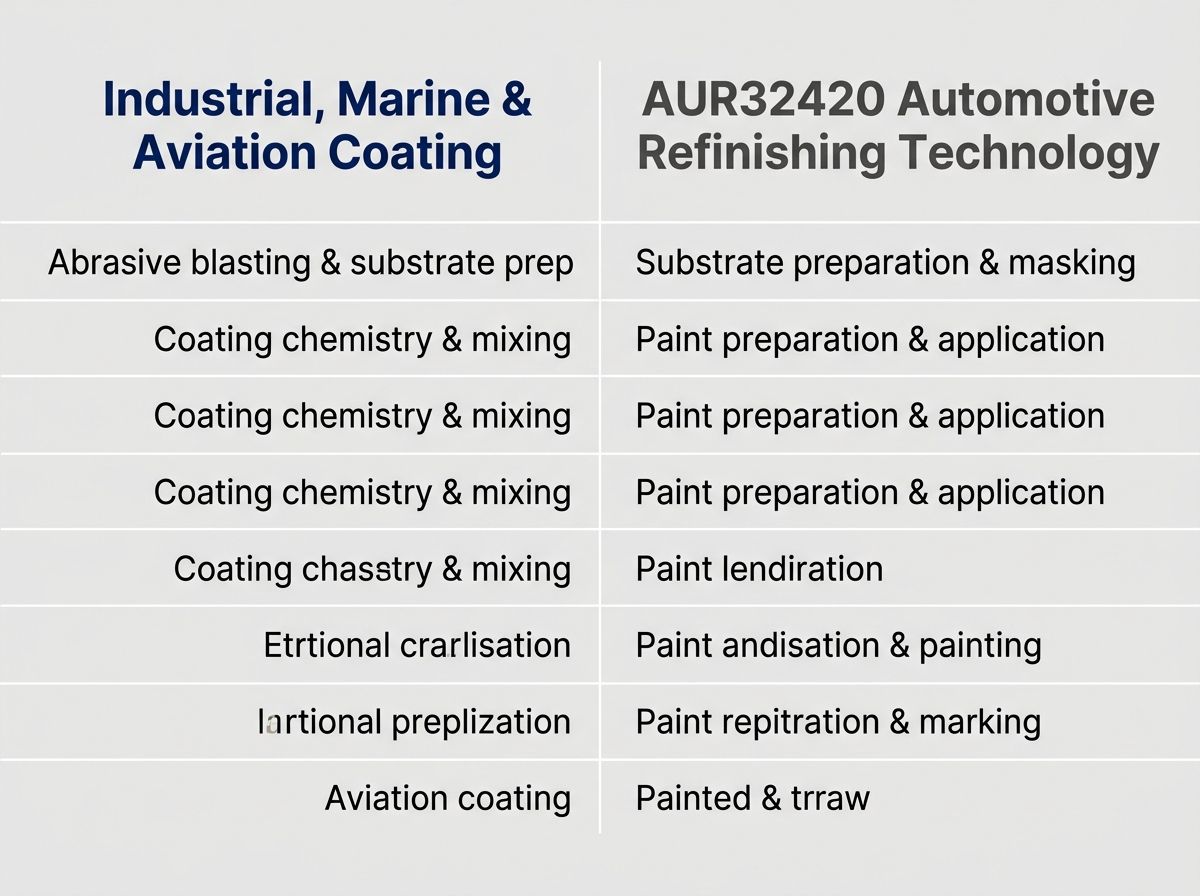
According to the national training register, the core units of AUR32420 include masking vehicle panels and components, applying refinishing primers to vehicle surfaces, preparing and painting plastic and composite vehicle surfaces, de-nibbing, buffing, and polishing painted surfaces, removing paint from vehicle painted surfaces, and preparing vehicle spray painting equipment for use.
Consider what industrial and marine coating professionals do in practice. Surface preparation to defined standards, such as abrasive blasting to a specified profile, solvent cleaning, or mechanical preparation, is a core daily competency. Spray application using airless, conventional, or HVLP equipment is standard practice. Selecting and mixing coating products to specification, understanding pot life and application windows, managing environmental conditions during application, and inspecting finished surfaces for defects are all routine. Safety compliance involving respiratory protection, confined space awareness, and hazardous materials handling is non-negotiable.
The AUR32420 core units addressing surface preparation, primer application, spray equipment preparation, and surface finishing describe these same underlying competencies. A vehicle panel is a different substrate from a ship hull or a structural steel beam, and the coating systems differ. However, your professional knowledge of surface preparation, coating application, and defect rectification is directly transferable.
For aviation coating professionals, the connection is even more explicit. The Certificate IV in Aircraft Surface Finishing (MEA40922), a qualification for employees of aircraft repair and overhaul organisations, includes two core AURVTP-coded units: AURVTP112 'Apply air dry and polyurethane refinishing materials' and AURVTP103 'Prepare vehicle spray painting equipment for use'. These automotive refinishing units are embedded directly in an aviation qualification, showing how closely these competencies align across sectors.
This pattern shows that the automotive industry has not invented a new category of coating skill. It has simply applied existing skills to a vehicle-specific context. If you can prep and paint marine fibreglass, you already hold the foundational competencies for automotive refinishing.
Where the differences actually are (and why they matter less than you think)
Honest directness matters here. There are genuine differences between industrial or marine coating work and automotive refinishing, and there is no value in pretending otherwise.
The most significant differences are automotive-specific. Colour matching to manufacturer codes, which involves spectrophotometers, tinting systems, and blending techniques to achieve an invisible repair, is largely unique to automotive refinishing. Panel repair integration, where the refinishing technician works alongside or after a panel beater, requires an understanding of substrate conditions post-repair, filler application, and the interaction between repair materials and topcoat systems. Vehicle-specific masking to protect trim, glass, rubber seals, and mechanical components also has its own conventions. Finally, automotive clear coat systems, including the two-stage base coat/clear coat process that dominates modern vehicle refinishing, may differ from the coating systems used in industrial or marine contexts.
These are real gaps, but they are specific and manageable. In an RPL process, when genuine gaps are identified, targeted gap training is provided by the provider. The gaps do not define the entire qualification; they simply represent the specific areas where your existing experience does not yet meet the standard. For most industrial and marine coating professionals, this gap is usually much smaller than the areas your experience already covers.
The qualification carries no licensing or entry requirements at the time of publication. However, requirements can change, so you should confirm the current details on training.gov.au before proceeding.
How RPL works for an automotive spray painting course
RPL is a formal assessment method used to determine whether you have acquired, through formal or informal learning, the skills and experience required for a qualification. It is not a shortcut. It is a rigorous, legitimate assessment pathway that recognises your existing capabilities.
One key principle is that RPL is not time-referenced. There are no fixed limits on when your skills were acquired. What matters is that your competencies are current and map to the performance criteria of the units being assessed. Skills gained a decade ago in a marine coating role are as valid as skills gained last year, provided you can still demonstrate them today.
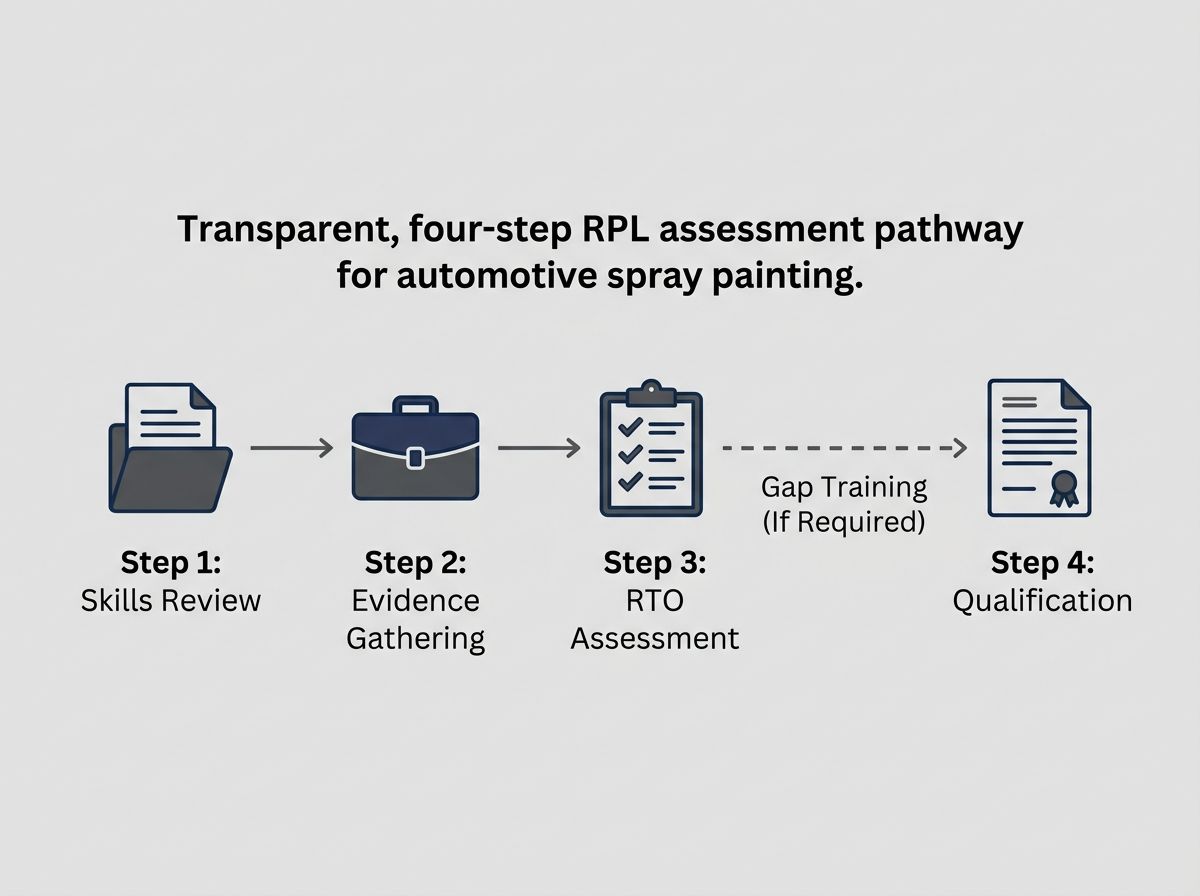
The process typically involves several stages. First, a skills review provides an assessment of where your experience aligns with the qualification and where gaps exist. Second, you collect documentation that demonstrates your competency. Third, a qualified assessor from a Registered Training Organisation (RTO) conducts a formal assessment. Fourth, if gaps are identified, targeted training is provided. The RTO conducts the assessment and issues the qualification, while RPL it supports you through the process.
Evidence for an RPL assessment can draw on previous study, paid or unpaid work experience, and life experience, regardless of where or how you developed those skills, including overseas. One Australian RTO describes RPL as acknowledging skills and knowledge acquired through previous training, work, or life experience, which may be used to grant credit in a subject regardless of how or where those skills were attained.
Assessment methods at different RTOs may include written questions, portfolios, work samples, direct observation, practical tasks, and third-party feedback. These methods and evidence requirements vary between RTOs, so you should confirm the specific requirements with your chosen provider.
Timeframes for RPL assessment vary by RTO and individual circumstances. There is no fixed national timeframe. However, RPL is a faster, more direct process than completing the full qualification through traditional delivery, which at one RTO is structured as a three-year apprenticeship.
You can explore the Certificate III in Automotive Refinishing Technology and the RPL pathway in detail on the qualification page.
The qualification is listed on the national training register at training.gov.au, where you can review the current unit list and confirm RPL pathway availability.
What evidence you already have (and what to start collecting)
The RPL process requires you to present your experience as evidence. For industrial, marine, and aviation coating professionals, this evidence base is often more substantial than it first appears.
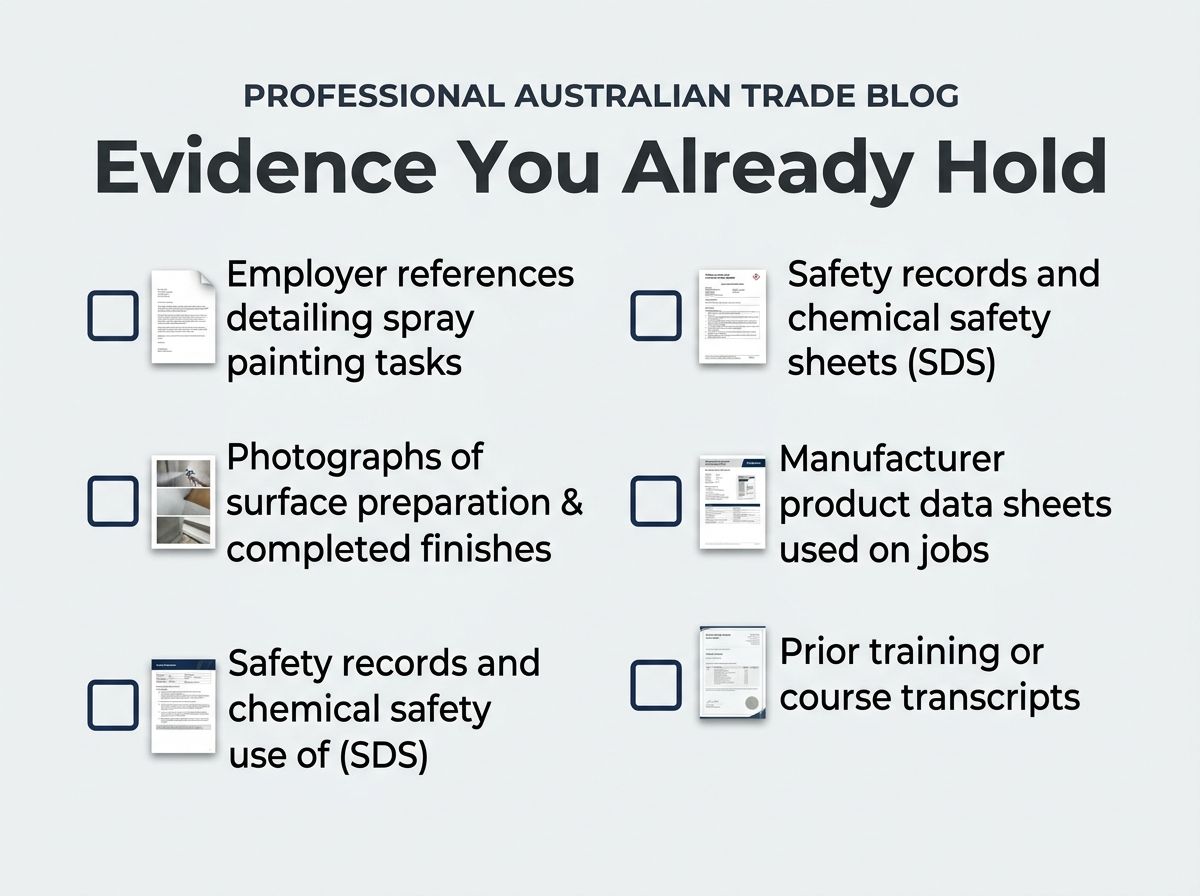
Evidence that you may already hold includes:
- Employer references or statements from supervisors describing the coating work you have completed
- Photographs or videos of completed projects showing prepared surfaces, applied coatings, and finished work
- Safety records, site induction logs, and hazardous materials handling records
- Product data sheets and technical specifications for coating systems you have applied
- Training records, toolbox talk attendance sheets, or workplace training certificates
- Compliance documentation showing work completed to AS/NZS or other industry standards
- Statements of attainment or formal qualifications from previous studies, including overseas credentials
Evidence must be current, meaning your skills are active today rather than just historically held. If you have been working in coating roles recently, your recent work history forms your primary evidence base. If you have had a break from the tools, consider how to demonstrate currency through recent projects or professional development.
RPL is not time-referenced regarding when skills were acquired, but the skills themselves must be current and map to the specific performance criteria of each unit. The assessor determines whether your competency meets the standard today rather than whether you met it in the past.
You should also start collecting documented evidence of any automotive-specific work you have completed, even informally. If you have assisted in a smash repair workshop, worked on vehicle restoration, or applied automotive coatings in any capacity, document it. This evidence is highly relevant to the units where the automotive context is most specific.
NCVER research on RPL in the Australian VET system notes that each RPL assessment is tailored to the individual, requiring assessment tools and experiences different from traditional classroom methods, making the evidence you bring critical to the outcome.
The pattern breaks here
The pattern is familiar. A skilled coating professional from an adjacent industry approaches the automotive sector, only for the formal training system to default to treating them as unqualified. The cycle repeats.
RPL is the mechanism that interrupts this cycle. This is not because it lowers the standard; it does not. The assessment is rigorous, the competency requirements are real, and the qualification is nationally recognised because the evaluation is thorough. RPL simply asks a more practical question: not where you learned your trade, but whether you can demonstrate that you know it.
You have the experience. Your skills speak for themselves. The RPL process helps them be heard, ensuring they are assessed against the national standard, formally recognised, and documented in a qualification that employers accept.
The same principle applies across trades. Cross-industry skills transfer works the same way whether you are moving from heavy machinery into light vehicles or from marine coating into automotive refinishing.
Experience can be evidence. The decision about what to do with that is yours.
Ready to Get Recognised?
Start with a free skills review to find out if RPL is right for you.