You have managed a venue, a team, and a P&L: that is Advanced Diploma territory, on paper or not
If you run venues, manage staff, and own a P&L, you may already meet Advanced Diploma criteria. Learn how RPL recognises your experience.
By RPL it Australia8 min read

The job description nobody wrote down
You are the person who takes the 6am call from the supplier. You rewrite the roster at 9pm because two staff members called in sick. You sit with the weekly revenue report on Monday morning, working out where the margin went and what needs to change before the weekend.
Nobody gave you a formal title that captures all of that. Venue Manager, Operations Manager, or General Manager. The words vary, but the scope does not.
You manage people across multiple departments, not just a single team. You manage money, oversight of a full profit and loss sheet rather than a simple budget line. You manage compliance, including liquor licensing, food safety, WHS, and rostering laws. You manage the guest experience at a level that requires you to understand every moving part of the operation simultaneously.
That is not just a job description. It is a qualification that has not been written down that way yet.
What the Advanced Diploma of Hospitality Management actually covers
The Advanced Diploma of Hospitality Management (qualification code SIT60322) is the highest vocational qualification in the Australian hospitality training framework. Most experienced hospitality managers have never looked at what it formally assesses. When they do, the reaction is usually the same: this is a description of my daily work.
The qualification covers competency areas including financial management, business planning, operational management across departments, human resources, workforce leadership, compliance, risk management, and strategic service quality. These are operational realities of running a venue with real accountability, rather than abstract academic concepts.
Financial management means reading and acting on a P&L. Operational management means coordinating kitchen, floor, bar, and events simultaneously. Human resources means hiring, developing, and managing the performance of a team. Compliance means holding a liquor licence, maintaining food safety standards, and keeping the business on the right side of workplace law. Service quality means the systems you've built to make sure the guest experience is consistent even when you're not in the room.
To review the full qualification structure, the Advanced Diploma of Hospitality Management (SIT60322) product page outlines how this RPL pathway works.
The pattern: What you do vs. what the qualification requires
Here is the pattern that repeats across Australian hospitality venues. Experienced managers who have been running venues for five, ten, or fifteen years perform at the Advanced Diploma level every single day. This qualification exists to formally assess exactly what they do, though nobody has ever pointed that out to them in their careers.
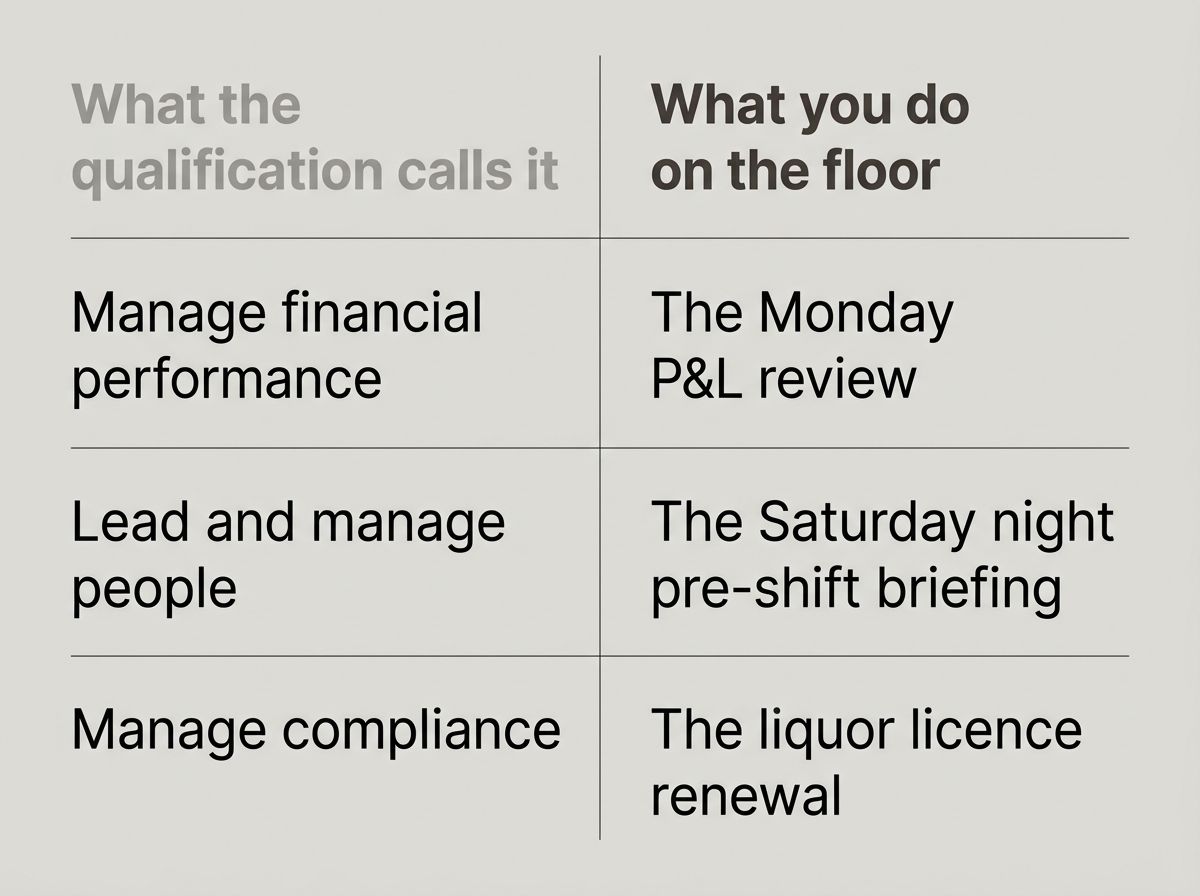
The qualification requires demonstrated competency in managing financial performance. You know this as the Monday P&L review, the quarterly forecast, and the conversation with the owner about why labour costs are running high.
The qualification requires demonstrated competency in leading and managing people. For you, this is the performance review you prepare for, the team meeting before a busy Saturday night shift, and the decision to dismiss staff members who are not working out.
The qualification requires demonstrated competency in managing operational plans. For you, this is the weekly event run sheet, the supplier negotiation, and the decision to adjust your opening hours based on what the numbers indicate.
The qualification requires demonstrated competency in managing compliance. For you, this means the liquor licence renewal, the food safety audit, and the incident report you file after a near-miss in the kitchen.
The gap between what you do and what the qualification requires is not a skills gap. It is a documentation gap. The work has already been done; it simply has not been formally assessed yet.
Why the credential gap exists and why it matters now
Most people who reach senior hospitality management did not learn their trade in a traditional classroom. They developed their skills directly on the floor, starting as a waiter, bartender, or supervisor. They were capable at their work, so they were given more responsibility. They handled that well, so they received more again. The industry rewarded practical performance over formal paperwork.
For a long time, that was sufficient. The credential gap did not matter to your career because your practical work spoke for itself.
It matters now. Senior hospitality roles, including area manager, regional operations director, and general manager of a hotel group, increasingly list formal qualifications as a requirement or preference. Tender applications for venue management contracts ask for evidence of credentials. Some visa pathways for skilled migration require a recognised Australian qualification at a specific level, and salary negotiations are more challenging when you lack the formal paper counterpart to your skills.
The credential gap is not a reflection of your capability. It is a structural feature of an industry that built its leadership pipeline through experience, then changed the standards for what counts as proof. The difficulty this creates is real, but a clear, direct pathway through it is available.
How RPL converts practical experience into a qualification
Recognition of Prior Learning (RPL) is a formal assessment pathway within Australia's national vocational education and training system. It allows a qualified assessor from a registered training organisation (RTO) to evaluate your existing skills and practical experience against the competency requirements of a qualification. If your evidence demonstrates competency, the qualification is awarded. The qualification is nationally recognised because the assessment process is genuine and rigorous.
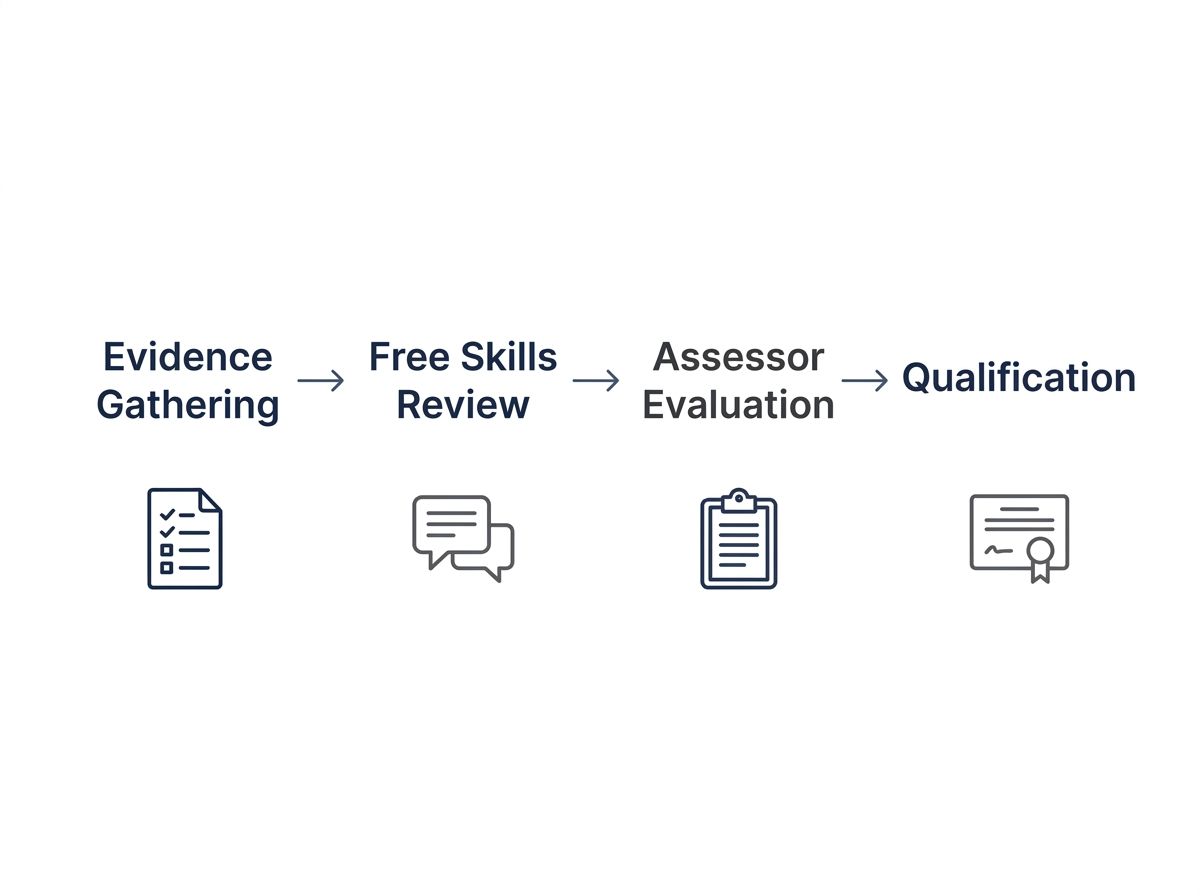
For the Advanced Diploma of Hospitality Management, the RPL process typically involves gathering evidence of your existing experience—including the documents, records, and references that show you have been performing at the required level—and having that evidence reviewed by a qualified assessor. The assessor may also conduct a structured interview to discuss your experience in more depth.
If the evidence demonstrates competency across all required units, the qualification is issued by the RTO. If gaps are identified in specific areas, gap training is provided to address those areas before the qualification is awarded. The assessment is conducted by the RTO's assessor, not by RPL it. Our role is to guide you through the process, help you gather and present your evidence effectively, and ensure you understand what to expect at each stage.
The qualification you receive is identical to one earned through traditional study. It is issued by a registered training organisation, recognised nationally, and carries the same standing with employers, licensing bodies, and migration authorities.
The RPL pathway for the Advanced Diploma of Hospitality Management is outlined on the product page.
What counts as evidence when running a venue
The most common objection at this point is that you do not have formal paperwork. That is rarely true in practice. The documentation of daily venue management is precisely the evidence base RPL assessors work with, and you probably have access to most of it already.
Evidence that typically supports an Advanced Diploma RPL application in hospitality includes:
- Profit and loss statements or financial reports you have prepared, reviewed, or acted on
- Staff rosters, scheduling records, and workforce planning documents
- Supplier agreements, purchase orders, or procurement records
- Staff performance reviews, disciplinary records, or development plans
- Compliance records, including liquor licence documentation, food safety audit results, and WHS incident reports
- Event run sheets, operational plans, or venue management procedures you have authored or implemented
- References from owners, area managers, or industry peers who can verify your scope of responsibilities
- Training records or professional development you have completed or delivered to your team
You do not need to provide all of these items. You only need enough to demonstrate competency across the qualification's key areas. The evidence gathering process is structured, and we guide you through what is needed and how to present it. The goal is not to create a perfect portfolio from scratch, but to organise the documentation that already exists.
Is this the right pathway for you?
RPL is not suitable for everyone. The Advanced Diploma of Hospitality Management is a senior-level qualification. This pathway is appropriate for people whose experience genuinely maps to that level, representing a direct description of what they are already doing in their work rather than an aspiration.
The Advanced Diploma level is typically appropriate if your current or recent role involves venue-level or multi-venue accountability. This includes responsibility for financial performance (P&L ownership, not just budget management), leadership of multiple teams or departments, compliance accountability at a venue or business level, and operational planning with real consequences.
If your experience is primarily at team supervisor or department manager level—running a kitchen, managing a floor team, or supervising a bar—the Certificate IV in Hospitality is the more appropriate starting point. The distinction matters because the assessment is genuine, and an honest suitability check before you begin is far more valuable than discovering a mismatch partway through.
The Free Skills Review is designed for exactly this moment. It is a conversation with no obligation that helps you understand whether your experience maps to the Advanced Diploma level, what evidence you are likely to have, and what the process would look like for your specific situation. There is no enrolment pressure, and the decision remains yours.
The qualification your experience has earned
You have the experience. The Advanced Diploma of Hospitality Management is the formal name for what you have been demonstrating, week after week, in a busy venue with real stakes.
The credential gap does not reflect your actual capability. It is a documentation gap—a gap between the work you have already completed and the formal system that recognises it. RPL exists to close that gap.
This process focuses on recognition rather than repetition. Your work history counts, and your practical experience is your evidence.
The Advanced Diploma of Hospitality Management (SIT60322) is available through the RPL pathway. If you are ready to understand what that looks like for your specific experience, the next step is straightforward.
Explore the Advanced Diploma of Hospitality Management (SIT60322) RPL pathway.
General information only, current at the date shown. Licensing rules change, so check the current requirements with the relevant regulator before you rely on them. RPL it Australia is a student support service, not a Registered Training Organisation; qualifications are assessed and issued by our partner RTOs.