Running a kitchen or front of house for years: how to turn your experience into a Certificate IV
If you have managed a kitchen or front of house team, you likely meet the Certificate IV standard already. Here is how RPL makes that official.
By RPL it Australia8 min read

The qualification you have been performing without the paperwork
You have the experience. You call the orders, build the rosters, brief the team before service, manage supplier relationships, sign off food safety logs, and handle complaints that never reach the venue owner. You have done this work, likely for years, without a Certificate IV in Hospitality to show for it.
Your practical capability is clear; you are simply missing the official paperwork.
The Certificate IV in Hospitality (SIT40422) is a nationally recognised qualification covering the management and operational skills needed to lead a team, plan and supervise service, manage compliance, and support venue performance. For experienced head chefs and front-of-house managers in Australia, these are not skills you need to learn. They represent what you already do on every shift.
Recognition of Prior Learning (RPL) is the formal process that converts your practical experience into a qualification. It is a structured assessment of your existing skills, not a shortcut. For experienced hospitality professionals, the evidence of these skills is already there. It simply needs to be compiled and presented in the correct format.
What the Certificate IV in Hospitality covers and why it will sound familiar
The SIT40422 Certificate IV in Hospitality is structured around the daily operational and management demands of running a venue. Its core units cover areas you manage every working day. Here is what the qualification requires and how it translates to your daily shift.
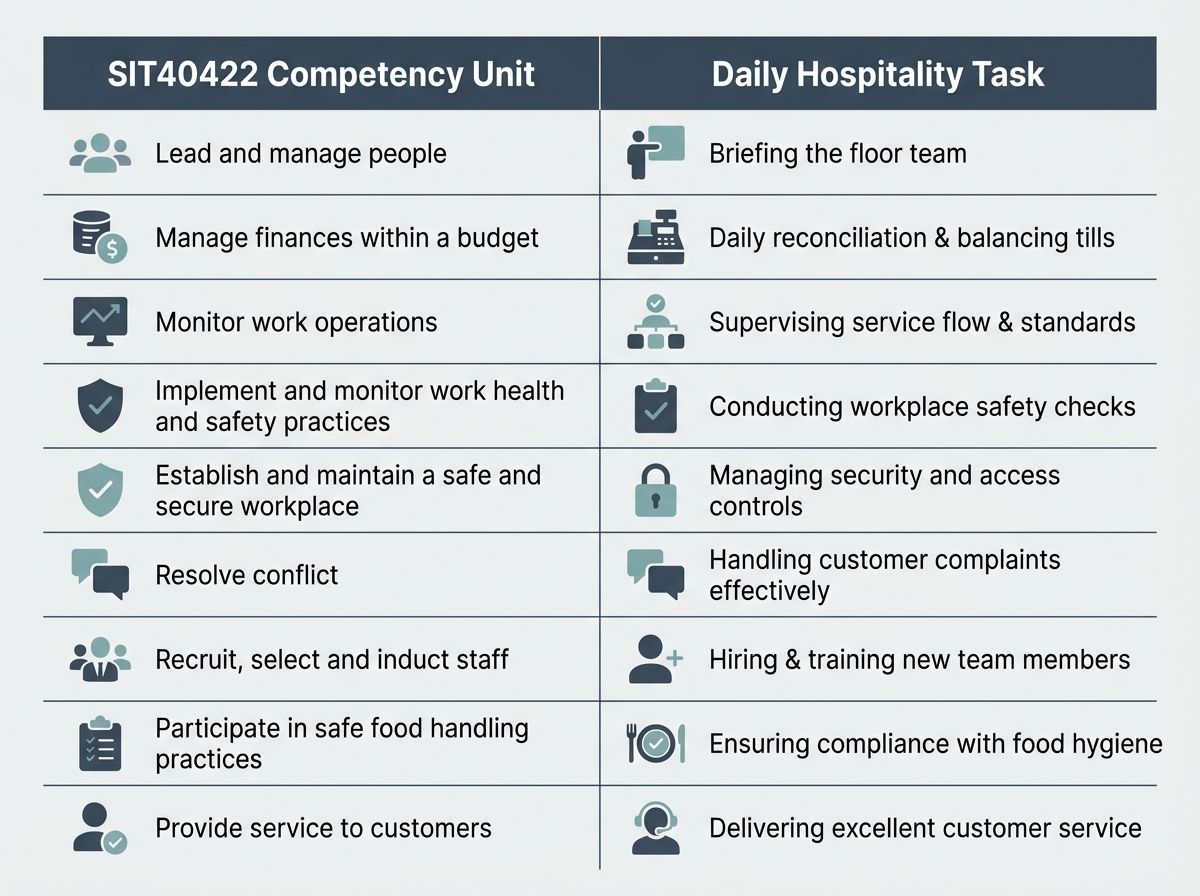
- Lead and manage people: You know this as running the team. This involves briefing staff before service, managing performance, training new team members, and resolving conflicts on the floor or in the kitchen.
- Monitor work operations: You call this keeping service running. This includes identifying problems mid-service, adjusting staffing on the fly, and maintaining venue standards under pressure.
- Implement and monitor work health and safety practices: You call this keeping the venue safe and compliant. You manage WHS obligations, handle incident reporting, ensure food safety compliance, and oversee allergen management.
- Manage finances within a budget: You call this watching the labour cost and food cost. This means monitoring spend against targets, adjusting orders, and reporting figures back to ownership.
- Enhance customer service experiences: You call this looking after guests. You manage this by handling complaints, training staff on service standards, and resolving difficult customer situations with professionalism.
- Develop and implement a food safety program: You call this keeping the food safety log. This includes managing temperature checks, cleaning schedules, and the supplier documentation you sign off every week.
- Coordinate hospitality operations: You call this running the venue. This requires coordinating the kitchen and floor, managing bookings and covers, and planning for events and peak trading periods.
The pattern is consistent: what the training framework calls a competency unit, you call a Tuesday shift. The formal terminology is different, but the daily work is identical.
How senior hospitality professionals build skills without formal qualifications
The progression is usually the same. You started as a kitchen hand, a commis chef, or a junior front-of-house team member. You watched how things worked and learned on the job. When the sous chef was sick, you stepped up. When the manager needed help with ordering, you took it on. When a new starter arrived, you trained them.
Over time, you became the person running the section, then the kitchen, and eventually the venue. Nobody handed you a qualification because nobody needed to. You were capable of doing the job, so you did it.
This pattern plays out across the Australian hospitality industry every year. Capability grows through daily shifts, but formal recognition does not follow automatically. The qualification is a formal structure, but you were doing the work long before you considered getting the paperwork.
This leaves many experienced, capable managers without formal credentials beyond a Certificate II or III. It is not due to a lack of skill; the role simply never required the paperwork. That changes when a promotion, a venue ownership opportunity, or an employer's hiring process suddenly demands formal qualifications.
This is when the lack of formal qualifications becomes a barrier.
How RPL processes your existing experience
Recognition of Prior Learning (RPL) is a formal assessment pathway within the Australian national training system. A qualified assessor from a registered training organisation (RTO) reviews your existing skills and knowledge against qualification standards, using real evidence from your work instead of classroom study.
For a Certificate IV in Hospitality candidate, your years of managing a kitchen or front-of-house team are assessed against the SIT40422 units. Your evidence, which includes employment records, references, and workplace documentation, is evaluated by an assessor. Once you demonstrate competency, the RTO issues the qualification.
RPL it does not assess or award qualifications directly; that remains the role of the partner RTO. Instead, RPL it guides you through the entire process. We help you identify and organise your evidence, understand the assessor's expectations, and navigate the formal pathway with support at every step.
RPL is not a shortcut or a way to bypass assessment. It does not guarantee a qualification. If an assessor identifies gaps in your evidence, you may need to complete gap training. With RPL it, this additional training is provided at no extra cost. The qualification is nationally respected because the assessment standard is rigorous.
Your experience is real, the evidence is already there, and the pathway is fully guided.
To understand how RPL assessment works across different industries and why the process varies by trade, this article outlines the main differences.
The evidence you already have without realising it
Many experienced hospitality professionals assume they have no documentation when they first hear about RPL. This is rarely the case. The records exist; you simply have not had to think of them as evidence before.
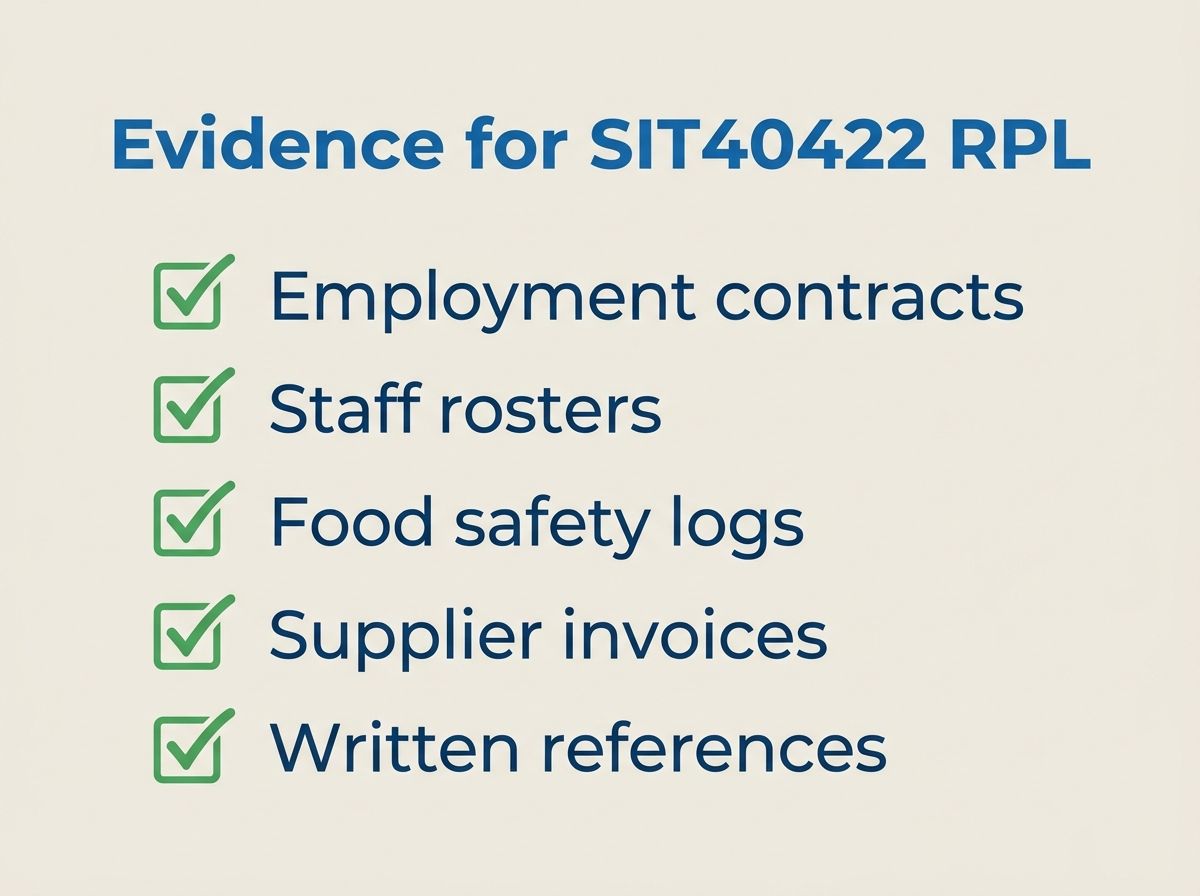
Below are the types of evidence typically used for a Certificate IV in Hospitality RPL assessment. You likely have access to most of these documents already.
- Employment records: payslips, employment contracts, or official letters confirming your role and specific responsibilities as a head chef, kitchen manager, or senior front-of-house manager.
- References: formal statements from current or former employers, venue owners, or general managers who can confirm your management duties and the scope of your role.
- Staff rosters: weekly rosters or schedules you have built, which demonstrate your responsibility for team planning, shift structuring, and labour cost management.
- Food safety and compliance logs: daily temperature logs, cleaning schedules, and allergen management documentation you have reviewed and signed off.
- Supplier records: invoices, ordering sheets, and delivery dockets showing your responsibility for purchasing, stock control, and supplier relationships.
- Training materials: induction checklists, standard operating procedures, or training guides you created to help develop new staff members.
- Menus: lists, specials sheets, or recipe cards you developed or contributed to, showing your kitchen or venue management skills.
- Financial reports: budget summaries, labour cost tracking reports, or gross profit sheets showing your involvement in cost management.
- Event documentation: function sheets, run sheets, or post-event reviews from services or private bookings you have managed.
- Customer feedback: records of complaints resolved or positive customer reviews demonstrating your management of service quality.
This is not an exhaustive list, and you do not need every single item. The guided process helps you identify which documents you have and how to present them. Your evidence almost certainly exists; it just needs to be gathered and organised.
Is this the right qualification for your career stage?
The Certificate IV in Hospitality (SIT40422) is designed for professionals who manage teams, supervise service, and handle compliance and venue performance. If this matches your current or recent role, this qualification is likely the right fit for your experience.
If you are in your first or second year of hospitality work, or if your experience is primarily in a supporting role rather than a management one, the Certificate IV may not yet match your skills. RPL is a thorough assessment process, and it requires experience that matches the qualification standards.
If your experience goes beyond the Certificate IV level (such as managing multiple venues, leading senior managers, or working as a general manager) the Diploma of Hospitality Management may be a better fit.
If you are unsure where your experience fits, the Free Skills Review provides a clear assessment of your standing before you commit to the process.
The pathway from experience to qualification
The guided process starts with a Free Skills Review. This is a conversation with no commitment that maps your experience against the qualification requirements to show you where you stand.
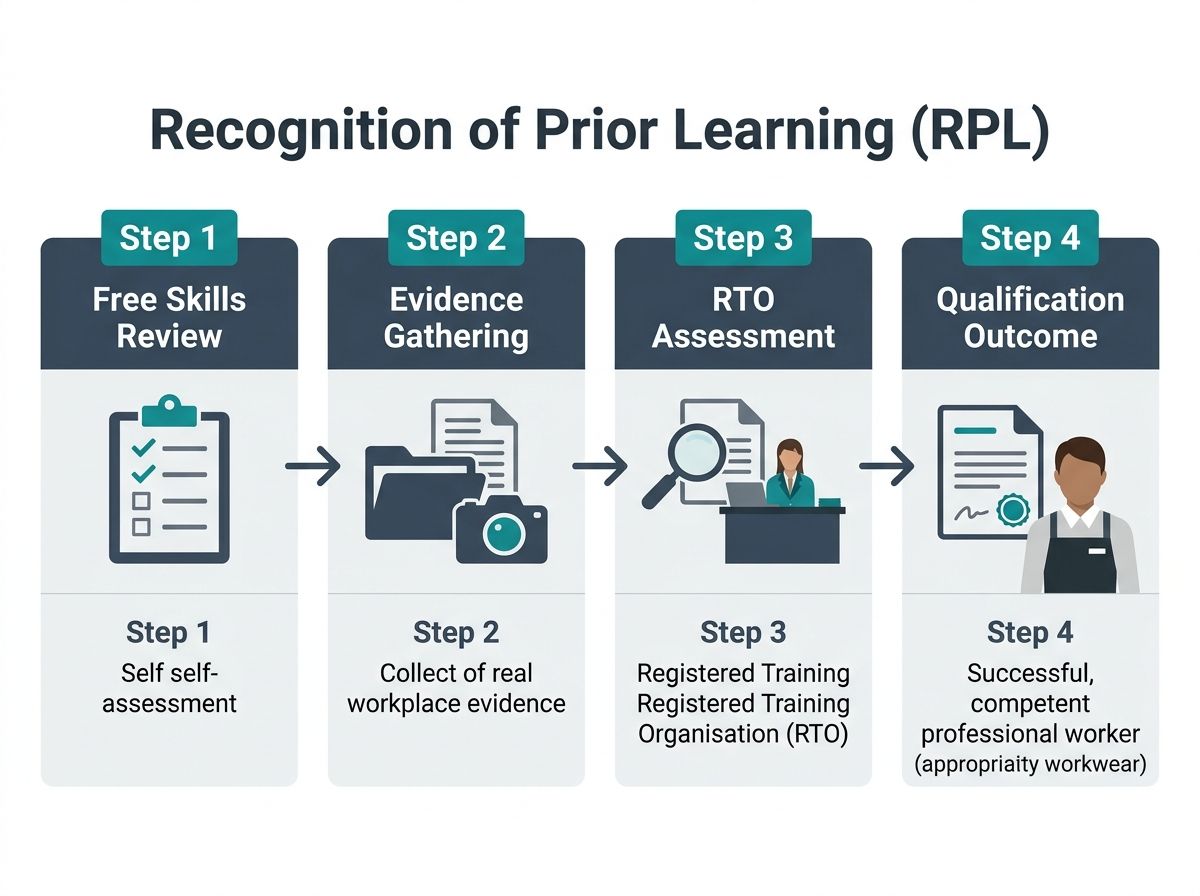
After that, the process moves through four distinct stages.
- Free Skills Review: An honest evaluation of your experience against the SIT40422 requirements. This is free with no commitment, helping you decide if the pathway fits you.
- Evidence gathering: With personal support, you collect and organise the documents that show your capability. We help you understand what evidence is relevant and how to present it.
- RTO assessment: A qualified assessor from a registered training organisation reviews your documents against the SIT40422 units. This is a thorough review, not a formal tick-box exercise.
- Qualification outcome: Once competency is demonstrated, the partner RTO issues your Certificate IV in Hospitality. If any gaps are found, gap training is provided at no extra cost before the qualification is awarded.
Timeframes depend on how quickly you can gather your evidence and the assessment schedule of the issuing RTO. The process is straightforward, but it is not instant. It takes time to evaluate your experience properly.
You have already done the hard work. The next step is organizing it into evidence. We guide you through that exact process.
The decision to get your experience recognised is up to you.
General information only, current at the date shown. Licensing rules change, so check the current requirements with the relevant regulator before you rely on them. RPL it Australia is a student support service, not a Registered Training Organisation; qualifications are assessed and issued by our partner RTOs.