The promotion block: why your operational experience doesn't count without a Diploma of Public Safety
Blocked from formal promotion despite acting in higher duties? Learn how RPL turns your public safety experience into a formal diploma.

You have done the role, but HR says you lack the qualification
You have the experience. Years of it. Operational deployments, incident command, and team leadership under pressure. You stepped up when it mattered, and you delivered. You may have been acting in a senior role for months, or possibly longer, covering responsibilities well above your substantive classification.
Then the promotion comes up. HR returns with the same answer: you need the Diploma of Public Safety.
You do not need a performance review or a reference from your commander; you need a specific qualification. Your operational record, however extensive, does not automatically replace this credential.
This is the promotion block. Rather than a personal failing, it is a structural reality of how Australian public safety organisations manage compliance, liability, and career progression. It affects experienced police officers, firefighters, SES personnel, corrections officers, and defence members across the country.
If you recognise this situation, this article is for you. It explains why the system works this way, what the Diploma of Public Safety is, and how Recognition of Prior Learning (RPL) translates your operational service into formal recognition without requiring you to return to a classroom.
What is the Diploma of Public Safety, and why does it keep coming up?
The Diploma of Public Safety is a nationally recognised vocational qualification under Australia's Public Safety Training Package (PUA). It sits at AQF Level 5 and has multiple specialist streams, each aligned to a specific area of public safety work.
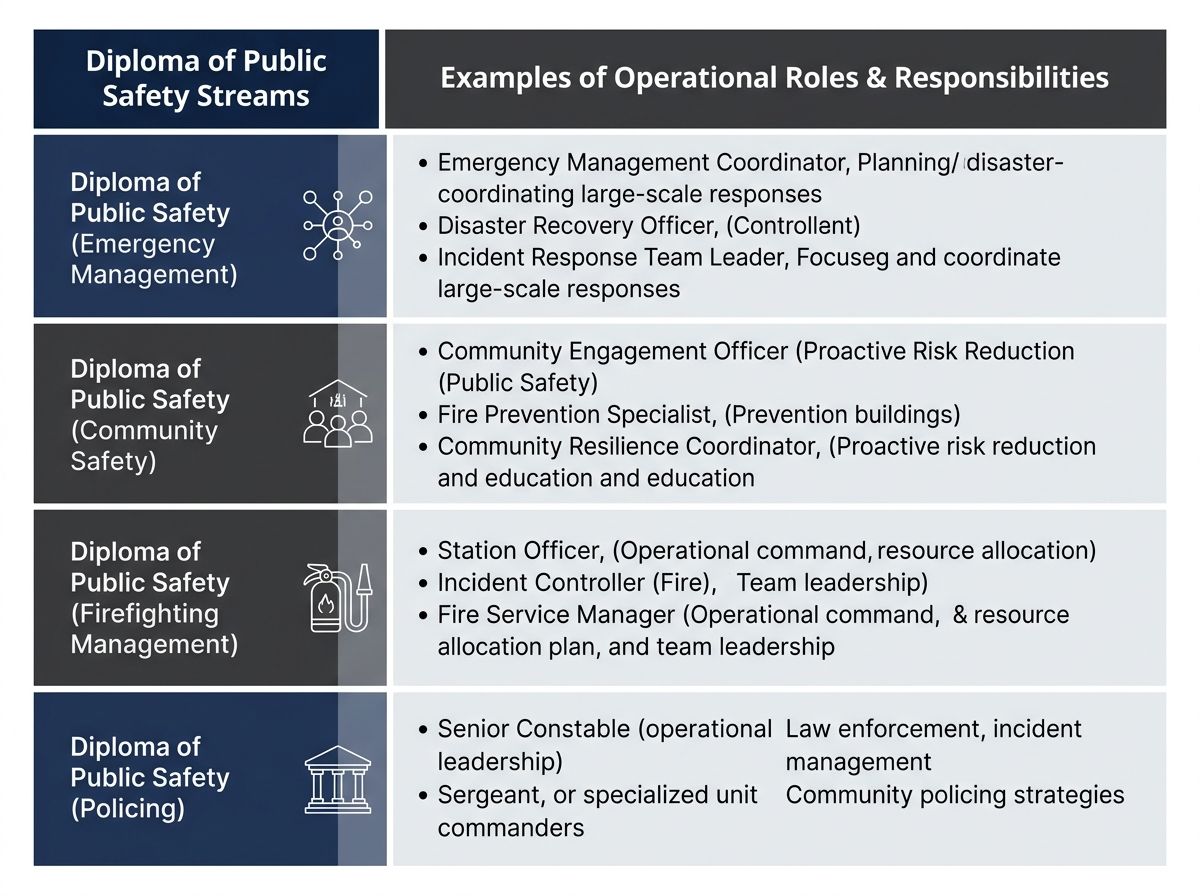
The Public Safety Training Package includes diploma-level qualifications in specialist policing areas like Human Source Management, Mounted Policing, Police Dog Handling, and Police Intelligence Practice, alongside advanced diploma qualifications like Police Supervision. Emergency management, firefighting management, SES operations management, community safety, and biosecurity emergency response are among the other streams available.
The qualification that applies to you depends on your role and agency. A senior SES coordinator, a firefighting supervisor, a police intelligence practitioner, and a corrections team leader may each work toward a different stream. However, all must navigate the same basic requirement: a formal, nationally recognised credential that maps operational expertise to a defined standard.
Why does it keep coming up in promotion discussions? Public safety organisations operate within enterprise agreements, classification frameworks, and liability structures that require formal evidence of competency rather than only demonstrated performance. As agencies professionalise and accountability frameworks tighten, the Diploma of Public Safety is the standard benchmark for senior operational roles across the sector.
The Public Safety Training Package is the national framework governing these qualifications. You can verify current qualification codes and streams through the official training.gov.au listing.
The systemic reason your experience does not automatically count
This is the part that frustrates experienced public safety workers most. You have done the job. You have managed the incident, led the team, and made the calls. Why is that not enough?
The honest answer is that operational performance and formal qualification assessment are two different things, and the system requires both for institutional reasons.
Public safety agencies operate under enterprise agreements that define classification structures, advancement criteria, and the conditions under which substantive promotions can occur. These agreements exist to ensure consistency, fairness, and accountability across large organisations. When a qualification is specified as a requirement for a senior role, it is because the organisation needs a standardised, externally verified measure of competency that holds up to scrutiny from oversight bodies, courts, and the public.
Acting in a higher duties role demonstrates that you can perform the functions, but it does not constitute formal assessment against the national competency standard. HR is not being arbitrary. They are managing institutional risk, and in public safety, that risk is significant.
The Australasian Fire and Emergency Service Authorities Council (AFAC), which custodies the Australasian Inter-service Incident Management System (AIIMS) used by fire, emergency service, and land management agencies across Australia, runs an Emergency Management Professionalisation Scheme. This scheme includes Certified Practitioner and Registered Practitioner roles. This is part of a broader sector trend where formal professionalisation is built into how Australian public safety agencies structure their senior operational workforce.
AIIMS itself, the national incident control system used across Australian emergency services, is built on a combination of facilities, equipment, personnel, procedures, and communications operating within a common organisational structure. That structure expects senior personnel to hold formally recognised credentials.
The higher duties trap: acting in the role without formal recognition
Here is the scenario that stings most.
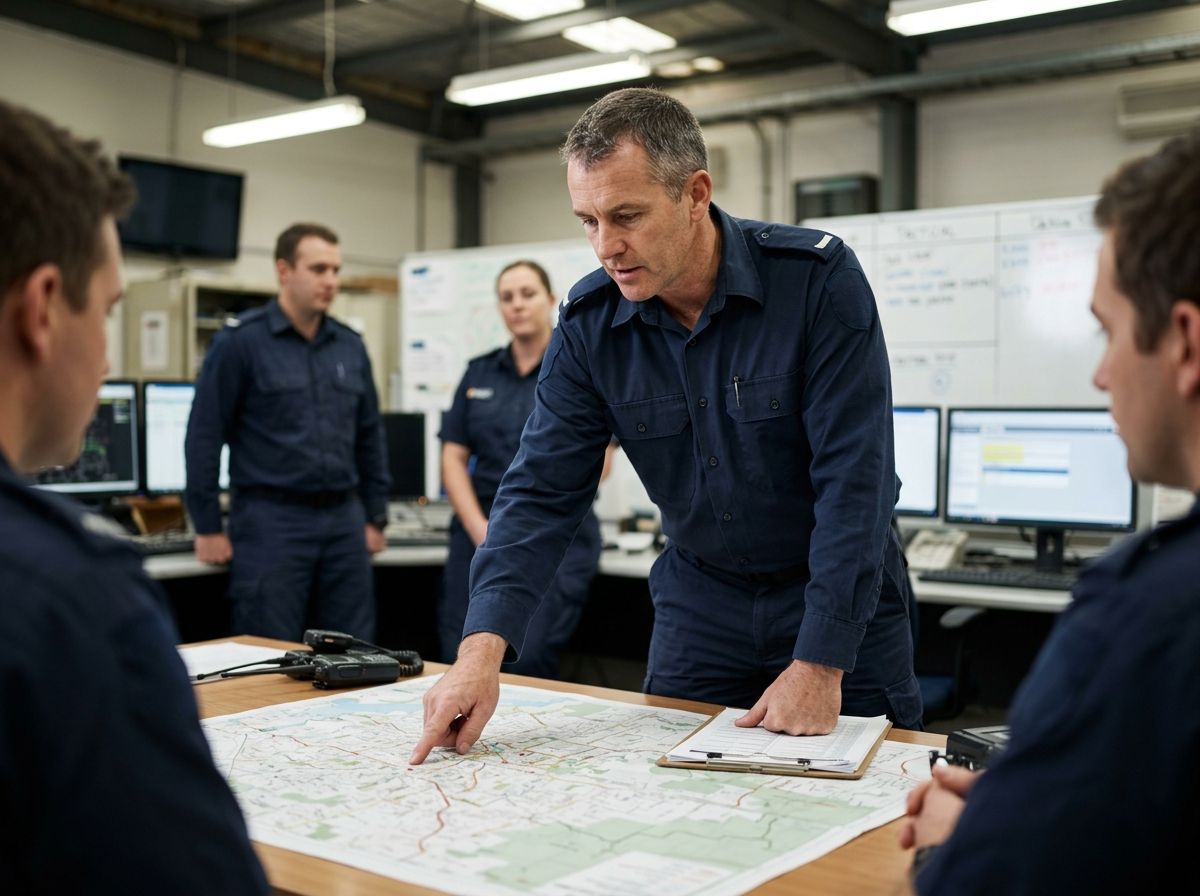
You have been placed in a higher duties arrangement, covering a senior role, performing senior functions, and carrying senior responsibility. You have done this for weeks or months. You have delivered, and both your supervisors and your team know it.
Yet when the substantive promotion is considered, the qualification gap remains. Higher duties experience demonstrates operational capability, but it does not constitute formal assessment against the qualification standard. These two things are not interchangeable.
Australian public sector enterprise agreements, including those governing public safety agencies, define higher duties arrangements in terms of payment thresholds rather than career conversion pathways. For example, the AFP Enterprise Agreement 2024-2027 specifies that a higher duties allowance is payable only after defined minimum periods: at least 10 consecutive calendar days for operational roles, or an aggregate of more than 20 working days in a financial year. The allowance compensates for the additional responsibility; it does not convert the arrangement into a substantive promotion.
Across the public sector, higher duties arrangements can involve salary progression at the acting level, but the substantive classification and the formal requirements attached to it remain unchanged. Acting at a higher level is not the same as being formally qualified for it.
This is the higher duties trap. You have been doing the job, and the system acknowledges that by paying you accordingly. But without the formal qualification, the promotion cannot be formalised. Your operational record and your competence are real, but the gap remains in how the system recognises them.
How RPL bridges the gap between operational experience and formal recognition
Can you get the Diploma of Public Safety through RPL? Yes, provided your experience maps to the competency requirements of the relevant stream.
Recognition of Prior Learning is a formal assessment pathway within Australia's vocational education and training system. It allows experienced workers to have their existing skills, knowledge, and experience assessed against the requirements of a qualification, without repeating training they have already demonstrated through their work.
RPL does not mean skipping the assessment. It means the assessment is based on evidence of what you already know and can do, rather than on coursework completed in a classroom. The assessment is conducted by a qualified assessor from a Registered Training Organisation (RTO), and the qualification is issued by the RTO. RPL it guides candidates through this process, helping them gather, organise, and present their evidence effectively.
For public safety personnel, the evidence base is often substantial, and it already exists in the documentation that comes with operational service. The challenge is rarely a lack of evidence. Instead, it lies in knowing what counts, how to present it, and how to map it to the specific competency units of the relevant Diploma of Public Safety stream.
We want to be clear about what RPL involves: it is a rigorous assessment pathway. If gaps are identified between your experience and the qualification requirements, gap training may be required. This is not a failure, but a normal part of how genuine assessment works. An honest RPL process tells you exactly where you stand.
What counts as evidence in a public safety RPL assessment
Experienced public safety personnel often have more usable RPL evidence than they realise. The documentation that comes with operational service, such as records, reports, and formal evaluations of performance, is precisely what RPL assessors work with.
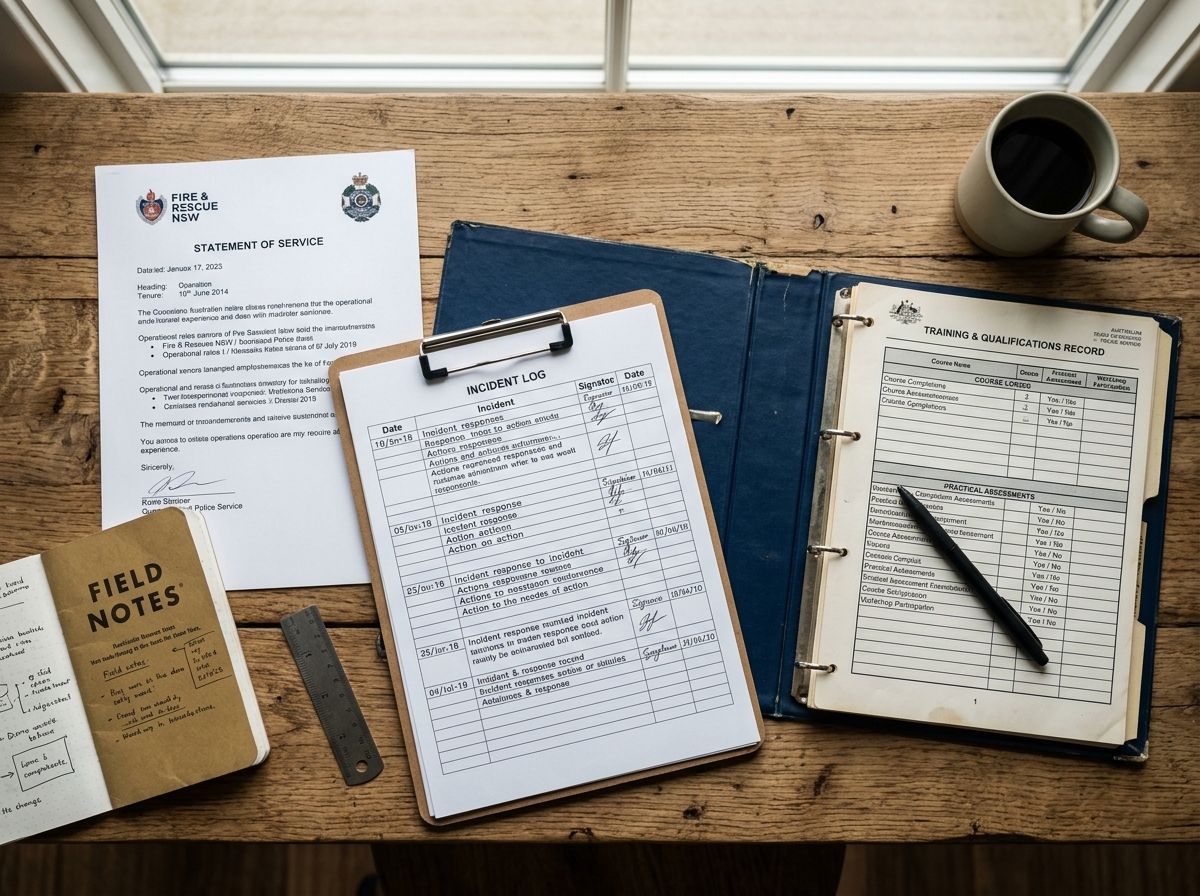
The following types of evidence are commonly relevant in a public safety RPL context. Specific requirements vary by RTO and by the qualification stream being assessed, so you should always confirm details with the delivering RTO.
- Operational logs and incident reports showing incidents you managed, commanded, or contributed to at a senior level
- Statements of service detailing your service history, roles held, and responsibilities carried
- Performance appraisals and supervisor assessments evaluating your performance in operational and leadership roles
- Higher duties documentation recording periods spent acting in senior roles and the functions performed
- Training records and course completions showing training undertaken relevant to the qualification stream
- Operational debriefs and after-action reviews assessing your performance in specific incidents or exercises
- Commendations and formal recognition, including awards, citations, or acknowledgements of operational performance
- Third-party verification, such as statements from supervisors, commanders, or colleagues who can attest to your competency
The goal of evidence gathering is to demonstrate, against each competency unit of the qualification, that you have the skills and knowledge required, and that you have applied them in real operational contexts. Your service record is not just a career history; it is evidence.
Is RPL right for your situation? What to consider before you start
RPL is a genuine assessment pathway, not a rubber stamp, and it is not suitable for everyone. We believe in providing honest guidance and stating this clearly.
RPL for the Diploma of Public Safety is most likely to be suitable if you have substantial, recent operational experience in a role that aligns with the specific stream of the qualification you are pursuing. If your experience is in emergency management, the Emergency Management stream is the relevant one. If your background is in firefighting supervision, the Firefighting Management stream applies. Stream alignment matters; experience in one area of public safety does not automatically satisfy the competency requirements of a different stream.
Recency also matters. RPL assessors look for evidence that your skills and knowledge are current and that you are actively applying them, rather than drawing on experience from many years ago with no recent practice. If there is a significant gap between your most recent relevant experience and the present, we should discuss that honestly before you begin.
Gap training is a normal part of the RPL process. If an assessor identifies areas where your evidence does not fully meet the competency requirements, gap training addresses those specific areas. This does not mean the RPL process has failed; it is simply how rigorous assessment works.
The honest answer to whether you are suitable depends on your specific service history, the stream you are pursuing, and the evidence you can provide. That is exactly what the Free Skills Review is designed to answer, without commitment, cost, or pressure.
Your service record is evidence. Let's find out what it is worth.
You have the experience. Years of operational service, incident command, team leadership, and higher duties performance. This is a substantial body of evidence that, properly presented and assessed, can map directly to the Diploma of Public Safety standard.
Experience can be evidence. The question is whether your specific experience maps to the qualification you need, and that is a question with an honest answer rather than a sales pitch.
RPL it guides public safety and defence personnel through the recognition process. We help you understand what evidence you have, how to present it, and what to expect from a genuine assessment. The qualification is issued by the RTO, while the guidance is ours.
Your skills speak. We help them be heard. The decision is yours.
AIIMS 2017, the current edition endorsed by AFAC's National Council, is the incident control system used by all fire, emergency service, and land management agencies in Australia. It replaced AIIMS-4 and is the national standard for incident management that senior operational roles are expected to meet.
The AFP Enterprise Agreement 2024-2027 sets out the conditions under which higher duties allowances are payable for AFP employees. This illustrates how Australian public safety enterprise agreements define the relationship between acting in a senior role and formal classification.
Explore RPL pathways for public safety and defence qualifications at RPL it Australia.
Ready to Get Recognised?
Start with a free skills review to find out if RPL is right for you.