Why the Community Services Sector Is Losing Its Best Leaders to the 'Study Trap'
Experienced community services workers do not need to re-learn their jobs. Discover how a Diploma of Community Services RPL recognises your existing skills.
By RPL it Australia10 min read

The Sector Is Promoting the Wrong People — Or Not Promoting Anyone at All
You have the experience. You do the work. You mentor newer staff, manage complex cases, and hold the team together when things get hard. And yet, when a team leader or coordinator role opens up, the conversation turns to a piece of paper you don't have.
This is the study trap. It is not a learning opportunity. It is a bureaucratic toll — one that asks experienced community services workers to return to the classroom to formally prove competencies they have been demonstrating in practice for years. The result is a leadership pipeline that stalls, not because capable people don't exist, but because the qualification wall stops them from advancing.
The community services sector faces persistent workforce shortages, particularly in leadership and coordination roles. Recruitment challenges are significant, and the difficulty of finding and retaining qualified staff — especially in senior positions — is well documented across aged care, disability support, and broader community services.
The NDIS alone was projected to need an additional 128,000 workers — representing around 40% workforce growth — in the three years to June 2025. At the same time, annual staff turnover in the sector means hundreds of thousands of workers may cycle out over the same period. The sector cannot afford to lose its most experienced people to a qualification wall.
What the 'Study Trap' Actually Looks Like
Imagine a case manager with eight years of experience. She currently manages a complex portfolio of clients with co-existing needs, coordinates with health professionals, responds to crisis situations, and informally mentors two junior workers. She applies for a team leader role. She is told she needs the Diploma of Community Services first.
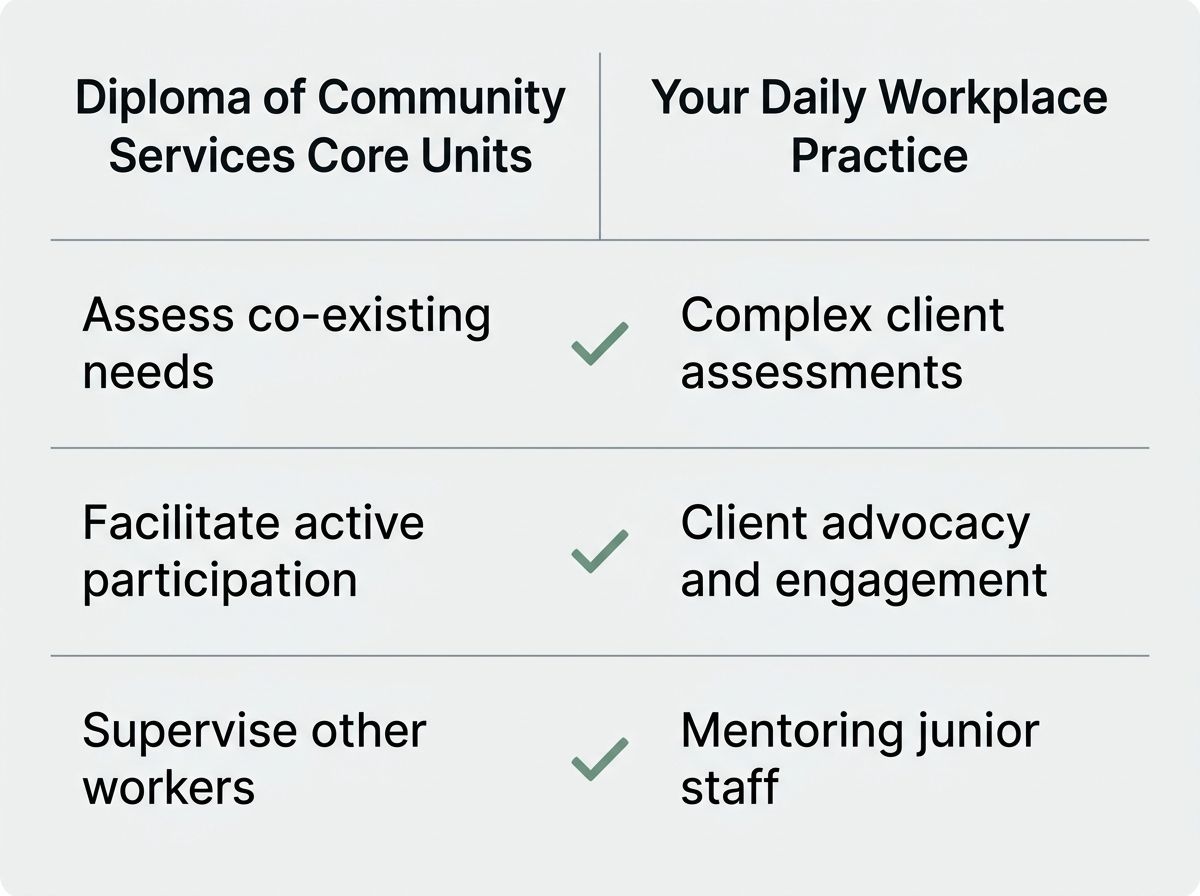
The Diploma of Community Services (now CHC52025, superseding CHC52021) includes 11 core units of competency. According to the official training.gov.au documentation, these include: assessing co-existing needs, facilitating and reviewing case management, recognising and responding to crisis situations, managing legal and ethical compliance, facilitating workplace debriefing and support processes, and reflecting on and improving professional practice — among others.
The qualification's own description states that workers in this role 'support people to make change in their lives to improve personal and social wellbeing', 'may also have responsibility for the supervision of other workers and volunteers', and 'may also undertake case management and program coordination'. This is not a description of what she needs to learn. It is a description of what she already does.
Traditional delivery of the Diploma of Community Services typically takes 12 to 18 months and requires a mandatory work placement component. For a full-time worker, this means months of study on top of a demanding job — studying content she applies every single day. That is the study trap in concrete terms.
The Counterintuitive Truth: Credentialism Is Weakening the Sector, Not Protecting It
The conventional wisdom is that requiring formal qualifications protects service quality. The counterintuitive reality: when qualification requirements ignore demonstrated competence, they don't protect quality — they drive capable people out of the advancement pipeline entirely.
The evidence from the aged care sector — closely related to community services — is instructive. A Senate committee report on aged care workforce challenges identified that a lack of clear career paths and professional development opportunities are cited as disincentives for people to work and stay in the sector. The same report noted that poor reputation and the perception that aged care requires a lower skill set are major barriers to recruiting qualified graduates.
Here is the anomaly: research has found that the vast majority of direct care workers in residential and community aged care already hold post-secondary qualifications. High qualification levels coexist with persistent retention and recruitment problems. This suggests that simply requiring more credentials — credentialism — does not resolve the underlying issues. Other factors, including working conditions, career structures, and recognition of existing competence, matter far more.
When qualification requirements are disconnected from demonstrated competence, they create a different kind of harm: they signal to experienced workers that their years of practice don't count. Workers either leave the sector, remain stuck in frontline roles, or delay advancement for years. The sector loses its best leaders to the study trap — not to a lack of capability.
What Diploma of Community Services RPL Actually Is — and What It Isn't
Diploma of community services RPL is a formal assessment pathway that evaluates whether a candidate can demonstrate the competencies required by the qualification through evidence of their actual work — not a classroom test, not a repeat of what they already know.
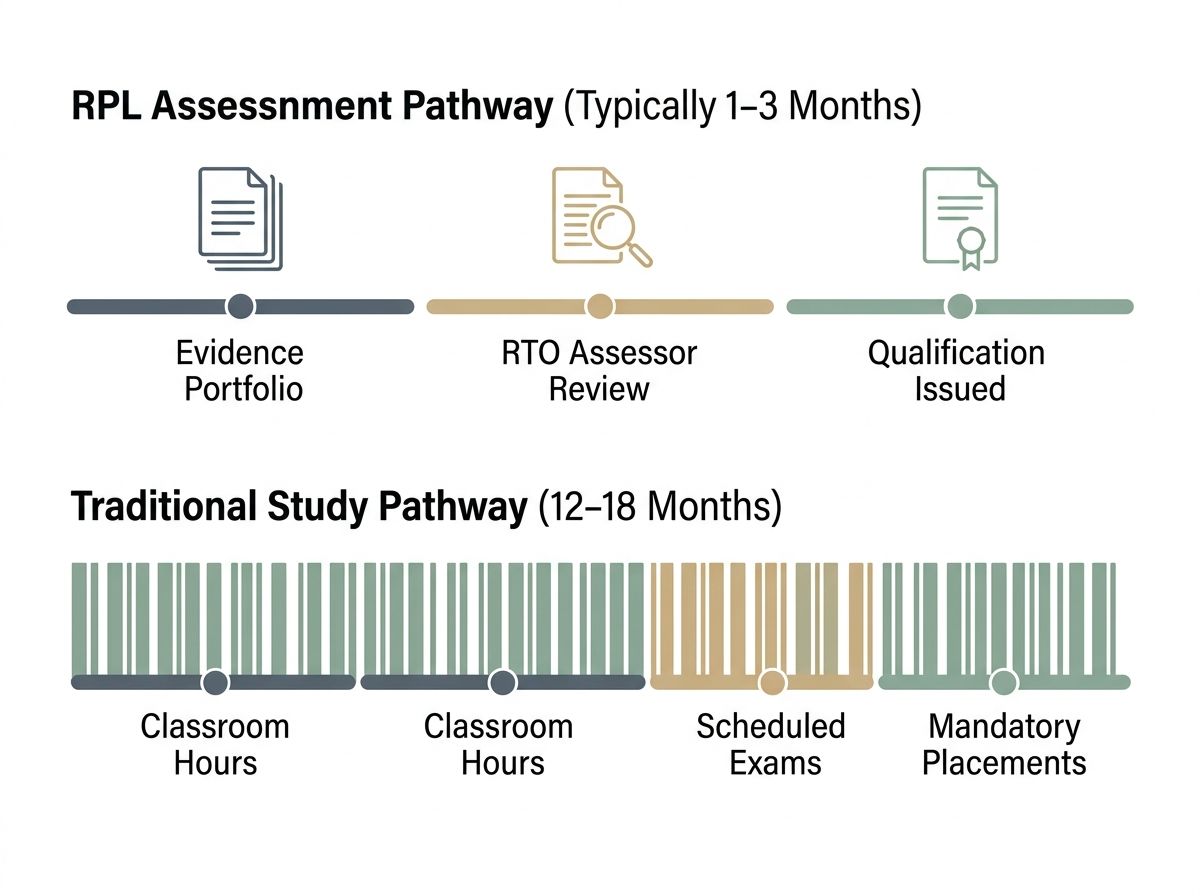
RPL — Recognition of Prior Learning — is a nationally recognised assessment pathway under the Australian Qualifications Framework. It is conducted by a qualified assessor from a registered training organisation (RTO). The qualification issued through a successful RPL assessment is identical to the qualification awarded through traditional study. It carries the same national recognition. It is not a shortcut or a workaround. It is a rigorous, legitimate process designed precisely for workers whose experience already meets the standard.
What RPL is not: it is not a guarantee of qualification. It is not suitable for everyone. And it is not without effort. Gathering and presenting evidence takes time and organisation. A qualified assessor from the delivering RTO evaluates that evidence against the qualification's competency requirements. Where gaps are identified, gap training may be required — and reputable providers typically offer this at no additional cost. The assessment is genuine. That is precisely why the qualification it produces is nationally recognised.
It is also worth noting that the current qualification — CHC52025 — has updated the mandatory work placement hours from 200 (under the superseded CHC52021) to 100 hours. This reflects a recognition that experienced workers may already have substantial documented workplace experience that can be assessed.
Who Is — and Isn't — a Strong Candidate for Community Services RPL
A strong candidate for diploma of community services RPL typically has substantial, verifiable experience in a community services role and can demonstrate the qualification's competencies through documented evidence. RPL is not suitable for everyone, and honest suitability assessment matters — both for the candidate's time and for the integrity of the process.
- You have worked in a community services role — such as case manager, support coordinator, community development worker, aged care coordinator, or team leader — for several years in a paid or formal volunteer capacity.
- Your current or recent role involves responsibilities that directly reflect the qualification's core units: case management, crisis response, legal and ethical compliance, supervision of others, or program coordination.
- You can access documented evidence of your work — such as case notes, supervision records, professional development logs, employer references, or outcome documentation.
- You have at least 100 hours of relevant, verifiable work experience that can be evidenced — this is the minimum work evidence requirement for the current CHC52025 qualification.
- You are prepared to invest time in gathering and organising your evidence, and to engage with a formal assessment process.
RPL is less likely to be suitable if you are new to the community services sector, if your experience is in a significantly different field, or if you cannot access documented evidence of your work. In those situations, traditional study pathways may serve you better — and a reputable provider will tell you so honestly before you commit to anything.
The Evidence You Already Have (And Probably Don't Realise Counts)
Most experienced community services workers are sitting on a portfolio of RPL evidence without knowing it. The challenge is not generating evidence — it is recognising what already exists and organising it into a form that an assessor can evaluate.
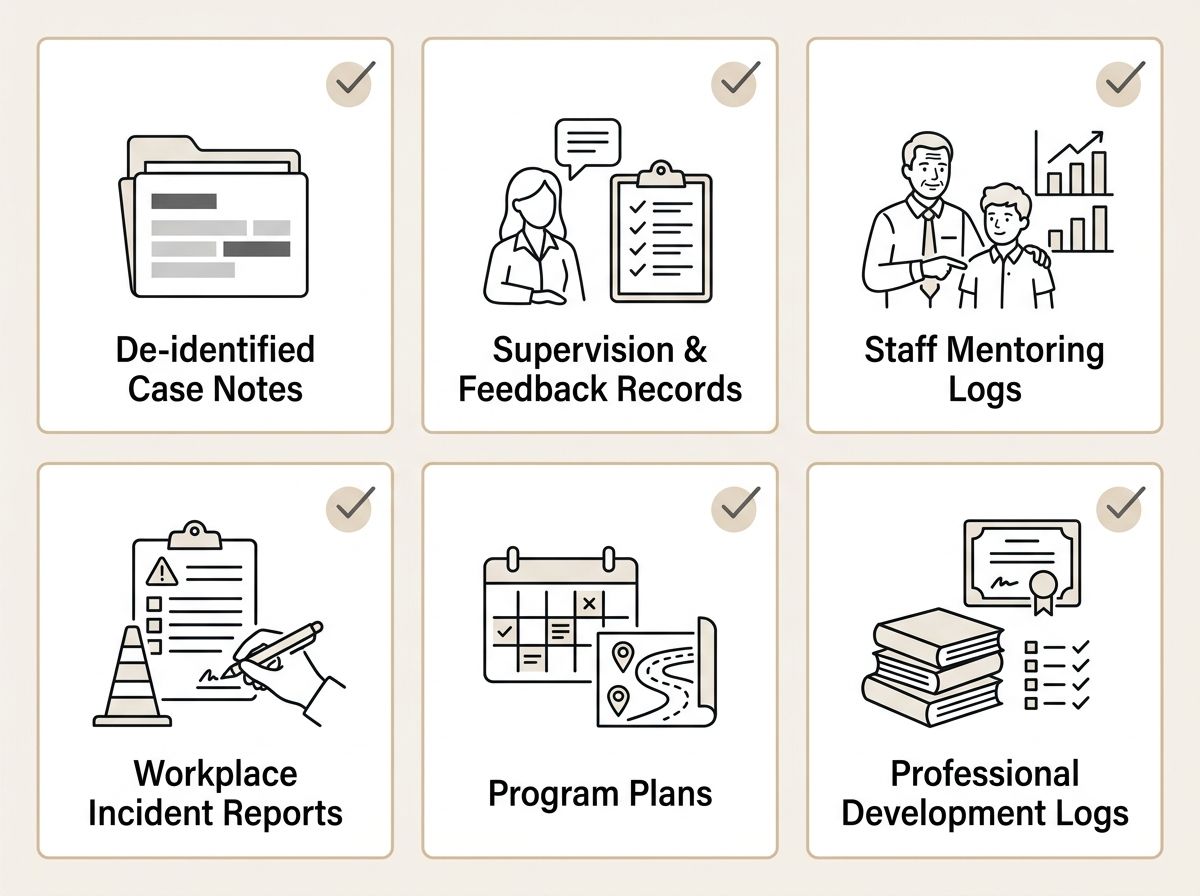
Assessment methods used for the Diploma of Community Services — including portfolio submissions, third-party reports, logbooks, and workplace observations — reflect the types of evidence that RPL assessors typically work with. In practice, this means the documentation you already produce in your role may be directly relevant.
- Case notes and client records (de-identified where required) that demonstrate your assessment and case management practice
- Supervision records — both records of supervision you have received and records of supervision you have provided to others
- Professional development logs, CPD certificates, and records of training you have completed
- Employer or supervisor references that speak to your specific responsibilities and competencies
- Position descriptions and performance reviews that document your role and responsibilities
- Work samples such as care plans, referral documentation, or program reports you have authored
- Evidence of NDIS worker registration or other sector-specific credentials
You likely have more of this than you think. The work of organising and presenting it is real — but it is a different kind of work from sitting in a classroom for 12 to 18 months. A guided RPL process helps you map what you have to what the qualification requires, and identify any genuine gaps early.
What Happens After You Start the RPL Process
The RPL process for the Diploma of Community Services typically follows a structured sequence, though the specific steps and timeframes vary between registered training organisations.
- Initial suitability review: The RTO assesses whether your background and experience suggest you are likely to have the competencies required. This is not a commitment — it is an honest first check.
- Evidence gathering: With guidance, you compile your evidence portfolio — mapping your work history, documentation, and references to the qualification's competency units.
- Formal assessment: A qualified assessor from the RTO evaluates your evidence against the qualification's requirements. This is the assessment that determines competency.
- Gap training (if required): Where the assessment identifies genuine competency gaps, gap training addresses those specific areas. Reputable providers typically include this at no additional cost.
- Qualification issuance: Where competency is demonstrated, the RTO issues the nationally recognised Diploma of Community Services.
In terms of timeframes, one provider states a minimum of 28 days for the RPL application and assessment process for the Diploma of Community Services. More broadly, RPL processes across qualifications typically range from a few weeks to several months, depending on how quickly evidence can be gathered and assessed. Individual timelines vary significantly based on evidence readiness and assessment scheduling — treat any timeframe as indicative, not guaranteed.
The RPL it team guides candidates through this process — helping you understand what evidence you need, how to present it, and what to expect at each stage. The assessment itself is conducted by a qualified assessor from the delivering RTO. RPL it does not assess or award qualifications; RTOs do. What we do is make the pathway navigable.
The Sector Needs Its Leaders. RPL Is How They Get Recognised.
The numbers are clear about where the community services sector is heading. By 2049–50, demand for care and support workers is projected to double, with almost one in 20 jobs expected to be in the care and support workforce. Between 2017 and 2024, Australia's population aged 65 and over grew by 24%, while home care service use more than tripled. In 2023, there were more than 500,000 paid aged care workers alone — and aged care workforce shortages are projected to increase over coming decades.
The sector cannot build the leadership capacity it needs by asking its most experienced workers to repeat what they already know. Recognition, not repetition, is the principle that should guide workforce development in community services — and diploma of community services RPL is the formal, legitimate pathway that makes that principle real.
Your experience is real. The question is whether it can be formally recognised. That question deserves an honest answer — not a sales pitch, not a guarantee, but a clear-eyed assessment of where your experience stands and what the pathway forward looks like.
The RPL qualifications available in community services and health cover a range of roles and experience levels — from case management to aged care coordination.
General information only, current at the date shown. Licensing rules change, so check the current requirements with the relevant regulator before you rely on them. RPL it Australia is a student support service, not a Registered Training Organisation; qualifications are assessed and issued by our partner RTOs.