CPP50619 Explained: What the Diploma of Security Risk Management Actually Covers
CPP50619 in plain English. See what the Diploma of Security Risk Management covers and how your on-the-job experience maps to the formal competencies.
By RPL it Australia10 min read

What CPP50619 actually is — and why the code matters
You've been managing security risk for years. You've written site security plans, led incident response, and run risk assessments that kept people and assets safe. Then someone — an employer, a contract manager, an HR department — asks whether you hold CPP50619. The code means nothing to you, even though the work it describes is exactly what you do every day.
CPP50619 is the national qualification code for the Diploma of Security Risk Management. It sits within the CPP Property Services Training Package — the nationally recognised framework that governs qualifications across security, property, and related industries in Australia. The code is what appears on job advertisements, government tender requirements, and compliance registers. It is the formal credential that organisations increasingly require their security managers to hold.
The qualification is a Diploma-level credential under the Australian Qualifications Framework (AQF). That places it at a level that recognises complex, specialised knowledge and the ability to apply it across professional contexts — which is precisely what experienced security managers do. The code is not a mystery. It is a formal label for work that many practitioners have been performing without the piece of paper to prove it.
If you're reading this because an employer or contract has flagged the requirement, it helps to understand why experienced security managers are increasingly required to hold CPP50619 — and what that compliance gap looks like from the employer's side.
The core competency areas — in language you'll recognise
CPP50619 is built around a set of core and elective units that cover the full scope of professional security risk management. The formal unit language can feel abstract on first reading. What follows is a plain-English translation of the key competency areas — mapped to the work that experienced security managers actually perform.
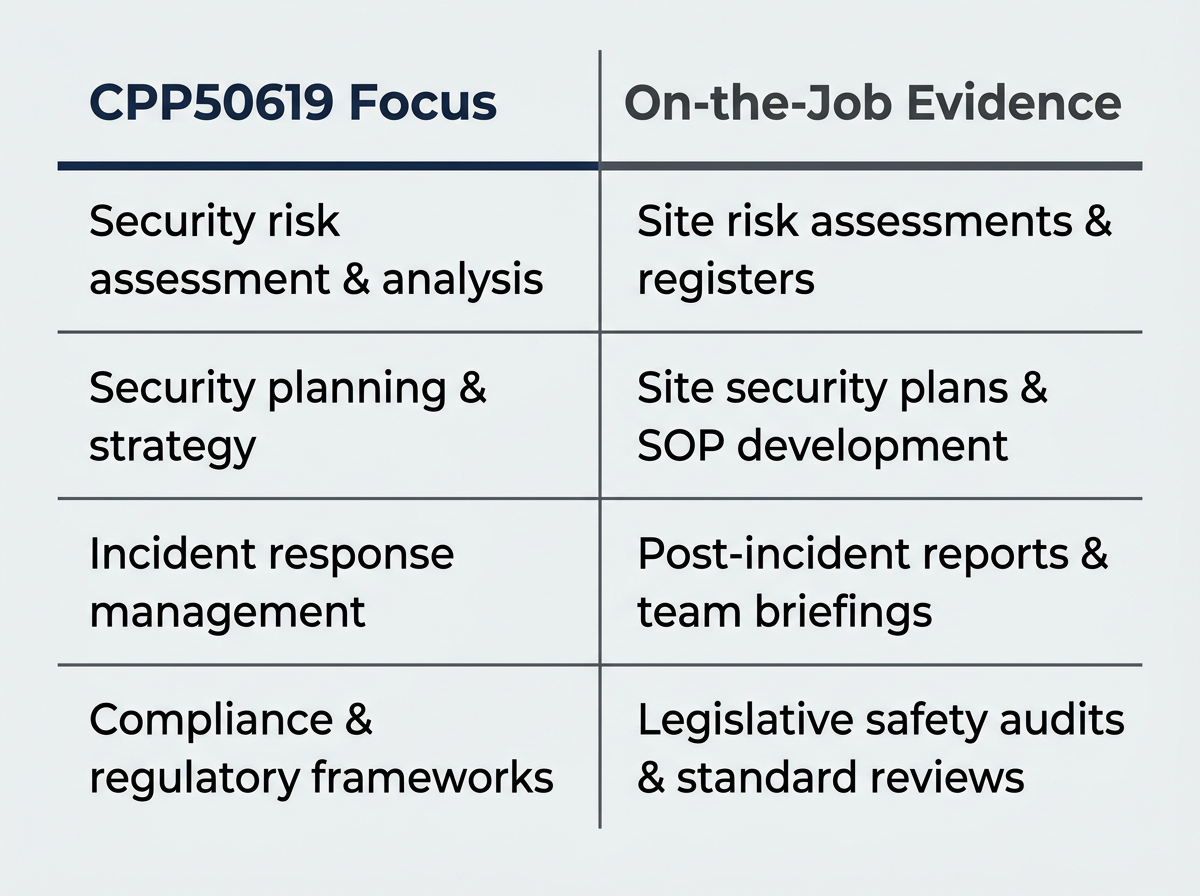
Security risk assessment and analysis. This unit cluster covers identifying, evaluating, and prioritising security threats and vulnerabilities. On the job, this is the work of conducting site risk assessments, reviewing threat intelligence, and producing risk registers. If you've assessed the security risk profile of a facility, a site, or an operation — and documented your findings — this is the work the qualification is measuring.
Security planning and strategy. This cluster covers the development of security management plans, emergency response frameworks, and protective security strategies. In practice, this means writing and maintaining site security plans, developing standard operating procedures for security operations, and advising on security design. If you've produced a security management plan that was reviewed, approved, and implemented, your experience speaks directly to these units.
Incident response and management. This covers coordinating responses to security incidents — from initial notification through to post-incident review. The work includes activating response protocols, coordinating with emergency services, managing the immediate response, and conducting after-action reviews. If you've led or coordinated a significant security incident response, that experience is directly assessable.
Security operations management. This cluster addresses the management of security personnel, resources, and systems. It includes rostering, performance management, briefing and debriefing security teams, and overseeing security technology. If you've managed a security team — even informally — and been responsible for the operational performance of a security function, this is the work the qualification recognises.
Stakeholder communication and reporting. Security managers at diploma level are expected to communicate risk findings and security recommendations to a range of stakeholders — from site managers to executive leadership. This includes written reports, briefings, and formal presentations. If you've regularly reported on security risk to management or clients, that communication work is part of the competency picture.
Compliance and legislative frameworks. This area covers knowledge of the legal and regulatory environment within which security operations are conducted — including relevant legislation, standards, and codes of practice. This is not about memorising legislation; it is about demonstrating that your professional decisions are informed by the applicable legal framework. If you've ensured your security operations comply with relevant laws and standards, that knowledge is assessable.
Note: The specific unit titles, unit codes, and performance criteria for CPP50619 are published on training.gov.au, the official Australian government training package database. Before starting any RPL process, it is worth reviewing the current unit list directly to confirm the qualification's current structure, as training packages are periodically updated.
The work you're already doing that counts
Most experienced security managers are already performing work that corresponds directly to CPP50619 competencies. The gap is not in the work — it is in the documentation. Formal assessment requires evidence that the work was performed to a defined standard. That evidence already exists in most practitioners' professional history; it simply needs to be identified and organised.
Consider what you've produced in the course of your work. Security risk assessments — whether formal documents or working files — are direct evidence of risk assessment competency. Site security plans, emergency response procedures, and standard operating procedures are evidence of security planning competency. Incident reports, after-action reviews, and post-incident recommendations are evidence of incident response competency. Briefing notes, management reports, and stakeholder presentations are evidence of communication competency.
The work you've done on the job is the evidence. The RPL process is the mechanism for presenting that evidence to a qualified assessor in a structured way. You are not being asked to re-learn what you already know. You are being asked to demonstrate that you know it — using the record of work you've already produced.
Roles that commonly perform CPP50619-level work include security operations managers, site security coordinators, risk and compliance officers in security-intensive industries, and senior security consultants. If your role has involved managing security risk across a site, a portfolio, or an organisation — rather than purely operational security duties — your experience is likely relevant.
What CPP50619 does not cover — and why that matters
CPP50619 is a management-level qualification. It is not an operational security licence, and it does not replace or satisfy the state-based licensing requirements that apply to security guards, crowd controllers, or other operational security roles.
In Australia, the right to work as a security guard, crowd controller, or bodyguard is governed by state and territory licensing legislation — not by a nationally recognised training qualification. Each state has its own licensing authority and its own requirements. Holding CPP50619 does not automatically satisfy those operational licensing requirements, and it is not designed to.
CPP50619 is designed for practitioners who manage security risk at an organisational or strategic level — people who plan, direct, and oversee security operations rather than perform them directly. If you are looking for an operational security licence, you will need to check the requirements of the relevant state or territory licensing authority. If you are looking for a formal credential that recognises your security risk management expertise, CPP50619 is the appropriate qualification.
CPP50619 is also not a substitute for professional membership of industry bodies, nor does it automatically satisfy the requirements of every tender or contract. Requirements vary by jurisdiction and by the specific terms of each contract. If a contract or employer requirement specifies CPP50619, that is the qualification they are asking for. If the requirement is less specific, it is worth confirming what they actually need before proceeding.
How RPL works for CPP50619 — the short version
Recognition of Prior Learning — RPL — is a formal assessment pathway under the Australian Qualifications Framework. It allows a qualified assessor to evaluate your existing knowledge, skills, and experience against the competency requirements of a qualification, without requiring you to complete training you've already effectively done.
For CPP50619, the RPL process typically involves a skills review to determine whether your experience is likely to be assessable, followed by the preparation of an evidence portfolio — a structured collection of workplace documents, records, and third-party verification that demonstrates your competency against the qualification's units. A qualified assessor from a Registered Training Organisation (RTO) then reviews that evidence and makes a determination. If gaps are identified, gap training is provided to address them. The qualification itself is issued by the RTO, not by RPL it — RPL it guides you through the process.
Gap training may be required. This is not a failure — it is a normal part of the assessment process when a candidate's experience covers most but not all of the required competencies. Not every candidate's experience will map perfectly to every unit, and a rigorous assessment process will identify where gaps exist. What matters is that the process is designed to recognise what you know, not to test what you don't.
If you're managing a security function and wondering whether your experience is enough to pursue CPP50619 through RPL, the most useful first step is a structured skills review — not a commitment to enrol.
Is your experience enough? A quick self-check
This is not a gatekeeping test. It is a recognition tool — a way to help you identify whether your professional history is likely to align with CPP50619 competency requirements before you take any further steps.
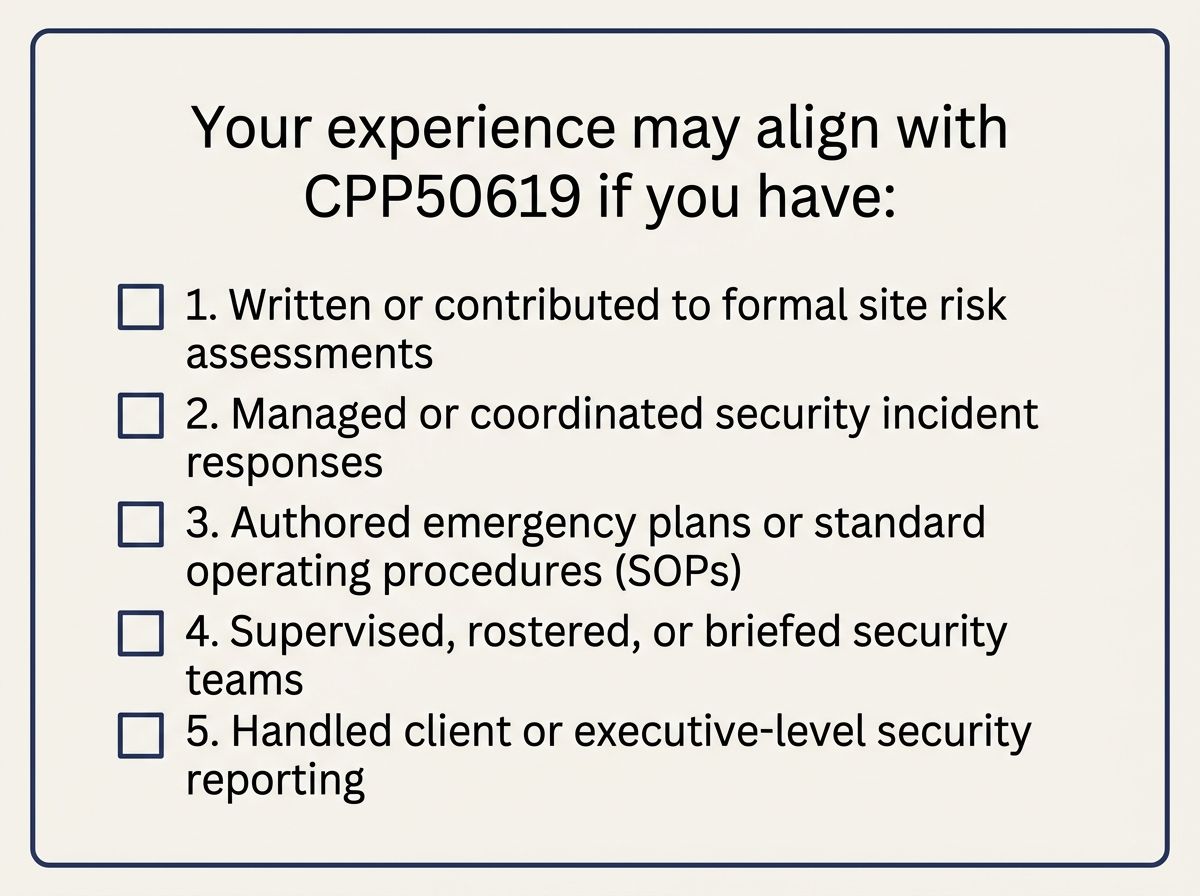
Your experience may align with CPP50619 if you have been working in a security management role — not purely an operational role — for a sustained period. If you have written or contributed to security risk assessments, site security plans, or emergency response procedures. If you have managed or supervised security personnel, even informally. If you have led or coordinated the response to a significant security incident and documented the outcome. If you have reported on security risk to management, clients, or other stakeholders in writing. If your work has required you to apply knowledge of relevant legislation, standards, or codes of practice to security decisions.
If most of those descriptions match your professional history, your experience is likely worth exploring through a formal skills review. If only one or two apply, it may be worth considering whether additional experience or targeted study would better prepare you for the assessment process.
One important note: CPP50619 has no formal entry prerequisites listed on training.gov.au at the time of writing, but individual RTOs may set their own entry requirements. It is worth confirming current requirements directly. Some practitioners hold the Certificate IV in Security Risk Analysis (CPP41519) before pursuing the Diploma, but this is not a universal requirement — it is a pathway choice that some candidates make.
What happens after you start the RPL process
The process is structured, not open-ended. It moves through defined stages, and you are supported at each one.
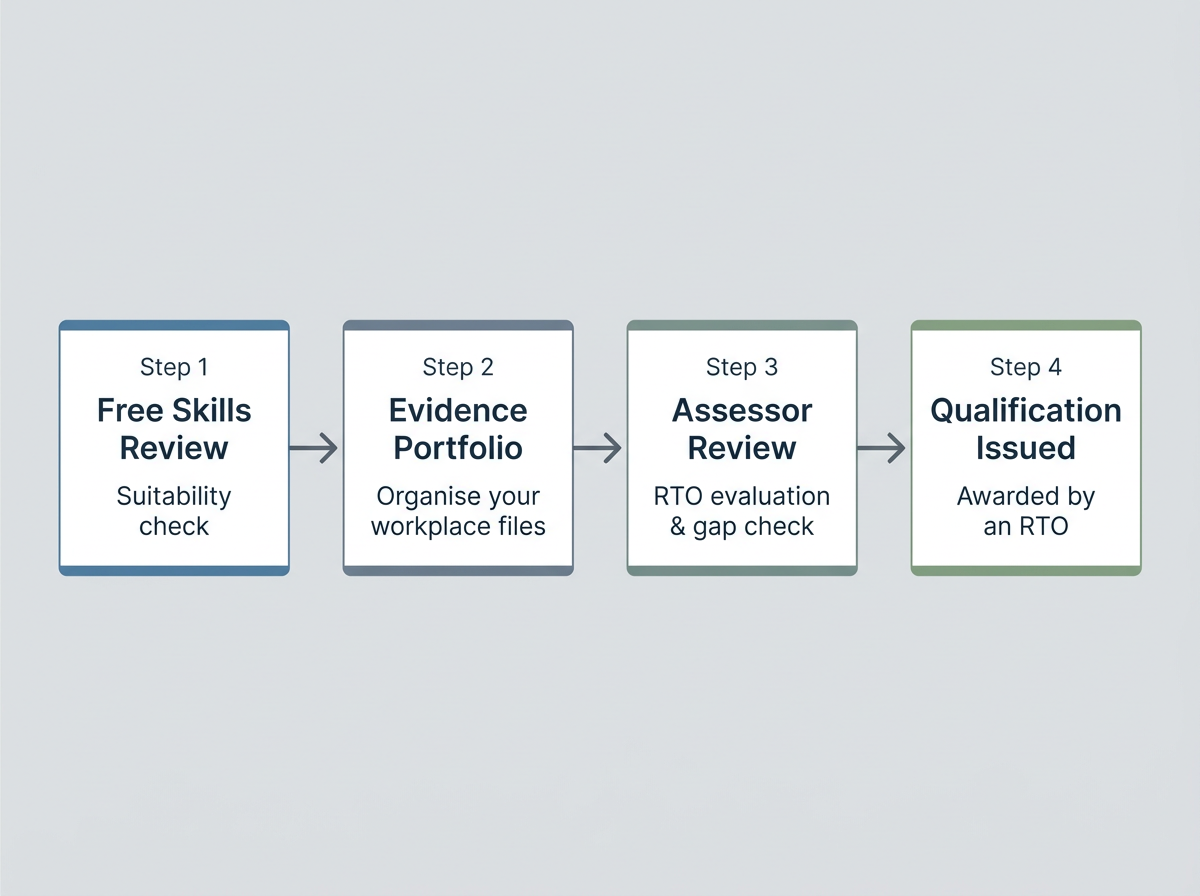
It begins with a Free Skills Review — a structured conversation about your professional background, the roles you've held, and the work you've performed. This is not an assessment. It is a suitability check, designed to give you an honest picture of whether RPL is the right pathway for your situation before you invest any further time or money.
If the skills review indicates that your experience is likely assessable, the next stage is evidence gathering. You will work with a guide to identify and organise the workplace documents, records, and third-party verification that demonstrate your competency against CPP50619 units. This is where your existing work — the reports, plans, assessments, and records you've already produced — becomes the foundation of your assessment portfolio.
The portfolio is then reviewed by a qualified assessor from a Registered Training Organisation. The assessor determines which units you have demonstrated competency in, and identifies any gaps. Where gaps exist, gap training is provided to address them — this is included in the process and does not require you to re-enrol in a full course. Once all units are assessed as competent, the RTO issues the qualification.
Your time is respected throughout. Your existing work is the evidence. The process is designed to recognise what you've already achieved — not to require you to repeat it.
The decision is yours. If your experience aligns with what CPP50619 covers, the most useful next step is a free, no-obligation skills review. It costs nothing and commits you to nothing. It simply tells you honestly whether the pathway is worth pursuing.
General information only, current at the date shown. Licensing rules change, so check the current requirements with the relevant regulator before you rely on them. RPL it Australia is a student support service, not a Registered Training Organisation; qualifications are assessed and issued by our partner RTOs.