Running a salon is already diploma-level work. Here is how to prove it.
If you manage a salon, you may already meet the Diploma of Salon Management standard. Map your daily responsibilities here to see where you stand.
By RPL it Australia9 min read

The qualification that describes your job
You manage a salon. You hire, train, schedule, and sell. You handle complaints, manage cash flow, and keep clients coming back. You run a business, and you do it every day without a piece of paper that says you can.
The Diploma of Salon Management (SHB50216) is not designed to teach experienced salon managers how to do their jobs. It is designed to formally recognise the competencies you already demonstrate daily. This is an important distinction. It is the reason Recognition of Prior Learning exists as a legitimate assessment pathway in Australia's vocational education system.
Your experience is real. The question is whether it is visible to the systems that matter. This article is a self-diagnostic tool. Work through it. By the end, you will have a clearer picture of where your daily work already aligns with the qualification and what a formal assessment pathway looks like for you.
The Diploma of Salon Management (SHB50216) is a nationally recognised qualification delivered by registered training organisations across Australia.
What the Diploma of Salon Management actually covers
The Diploma of Salon Management is a vocational qualification at the Diploma level of the Australian Qualifications Framework. It is structured around the core competencies required to manage a salon as a business. The focus is not on performing technical services, but on running the operation behind those services.
In plain terms, the qualification covers five broad areas of competency. These are the areas a qualified assessor will examine when determining whether your daily experience meets the national standard.
- Business operations and salon management: the daily operation of the salon as a functioning business.
- People management: hiring, training, supervising, and developing staff.
- Financial management: budgeting, tracking performance, and managing costs and revenue.
- Client services and experience: maintaining service standards, handling complaints, and building client relationships.
- Marketing and business development: promoting the salon, managing its reputation, and supporting business growth.
These are not abstract academic categories. They are the practical tasks you are already doing. The diagnostic below maps them directly to the specific tasks that make up your working week.
The self-diagnostic: does your daily work cover this?
Work through each competency area below. For each one, ask yourself: is this something I do regularly? If the answer is yes, you are already demonstrating that competency in practice. That practical experience forms the foundation of an RPL assessment.
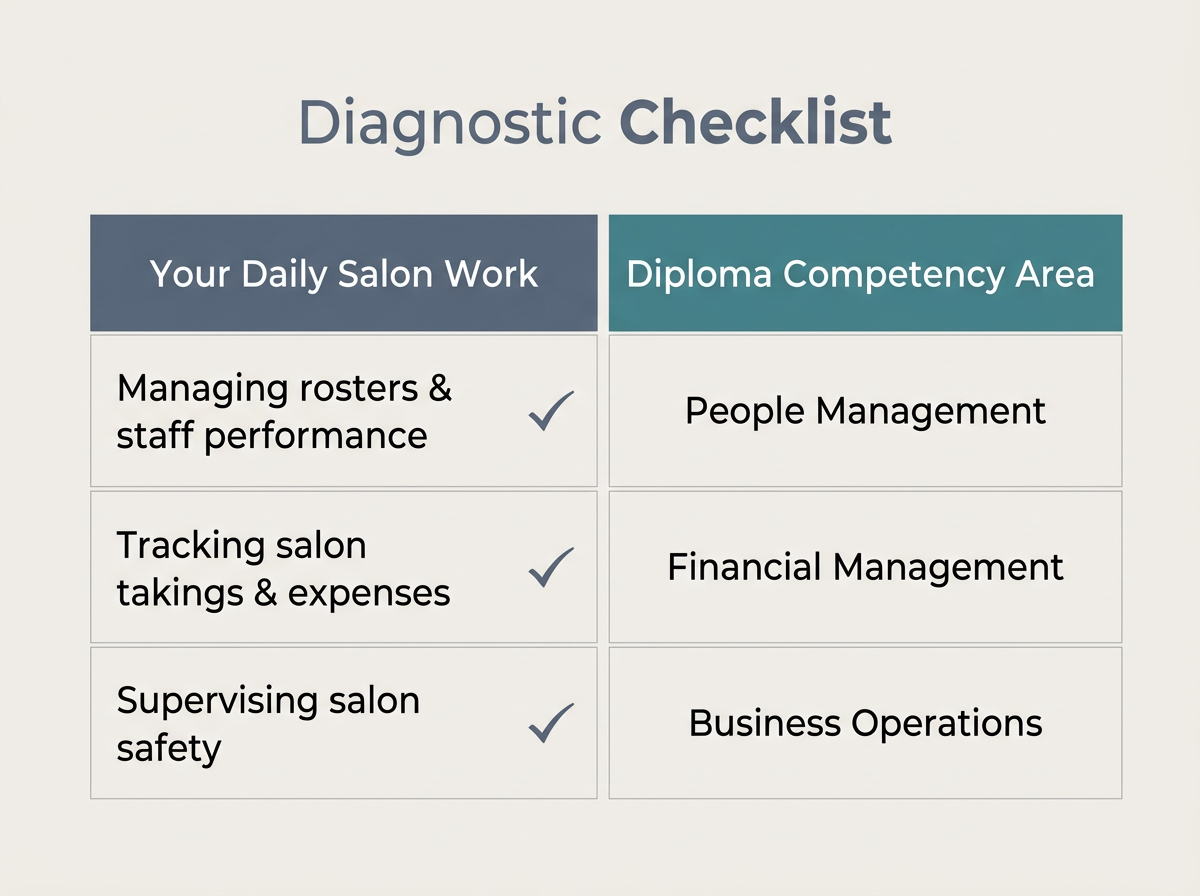
1. Business operations and salon management
What the qualification requires: managing salon operations to meet business goals, maintaining compliance with workplace health and safety, and overseeing the salon's physical environment.
What it looks like in your salon: Do you open and close the salon? Do you manage the appointment book and ensure the floor runs on time? Do you handle supplier relationships, manage stock levels, and make sure the salon meets hygiene and safety standards? Do you deal with equipment maintenance, lease obligations, or council compliance? If you are the person who keeps the salon operational, rather than just performing the services, you are demonstrating this competency.
2. People management
What the qualification requires: recruiting, inducting, and managing staff performance; providing training and coaching; and resolving workplace conflict.
What it looks like in your salon: Do you interview and hire staff? Do you run inductions for new team members? Do you have performance conversations, both positive and difficult? Do you manage rosters, approve leave, and handle the Fair Work obligations that come with employing staff? Do you coach junior staff or mentor apprentices? If you are responsible for the people in your salon, rather than just working alongside them, you are demonstrating this competency.
3. Financial management
What the qualification requires: monitoring financial performance, managing budgets, controlling costs, and interpreting financial reports to make business decisions.
What it looks like in your salon: Do you review your weekly or monthly takings? Do you track retail sales and service revenue separately? Do you work with a bookkeeper or accountant to understand your profit and loss? Do you make decisions about pricing, staffing levels, or stock orders based on financial performance? Do you manage the salon's cash handling procedures? If you are the person who watches the numbers and makes decisions based on them, even informally, you are demonstrating this competency.
4. Client services and experience
What the qualification requires: establishing and maintaining service standards, managing feedback and complaints, and implementing systems to ensure a consistent customer experience.
What it looks like in your salon: Do you set the standard for how clients are greeted, consulted, and farewelled? Do you handle complaints personally when they escalate beyond the stylist? Do you review client retention data or rebooking rates? Do you make decisions about the salon's service menu, pricing structure, or client communication approach? If you are the person who runs the client experience, rather than just delivering it, you are demonstrating this competency.
5. Marketing and business development
What the qualification requires: developing and executing marketing activities, managing the salon's brand and online presence, and identifying opportunities for growth.
What it looks like in your salon: Do you manage the salon's social media accounts or oversee someone who does? Do you run promotions, loyalty programmes, or seasonal campaigns? Do you make decisions about the salon's branding, signage, or website? Do you monitor online reviews and respond to them? Do you think about how to attract new clients and retain existing ones? If you are the person who plans for the salon's reputation and growth, rather than just daily operations, you are demonstrating this competency.
If most of those descriptions match your working week, your experience is likely to be relevant to a formal assessment. The next step is to find out whether your work meets the required standard.
What counts as evidence (you probably have more than you think)
RPL is not about sitting an exam or completing coursework. It is an evidence-based assessment. An assessor reviews documentation of your existing competency to determine whether it meets the qualification standard. The evidence does not need to be formal or specially prepared; it just needs to be genuine.
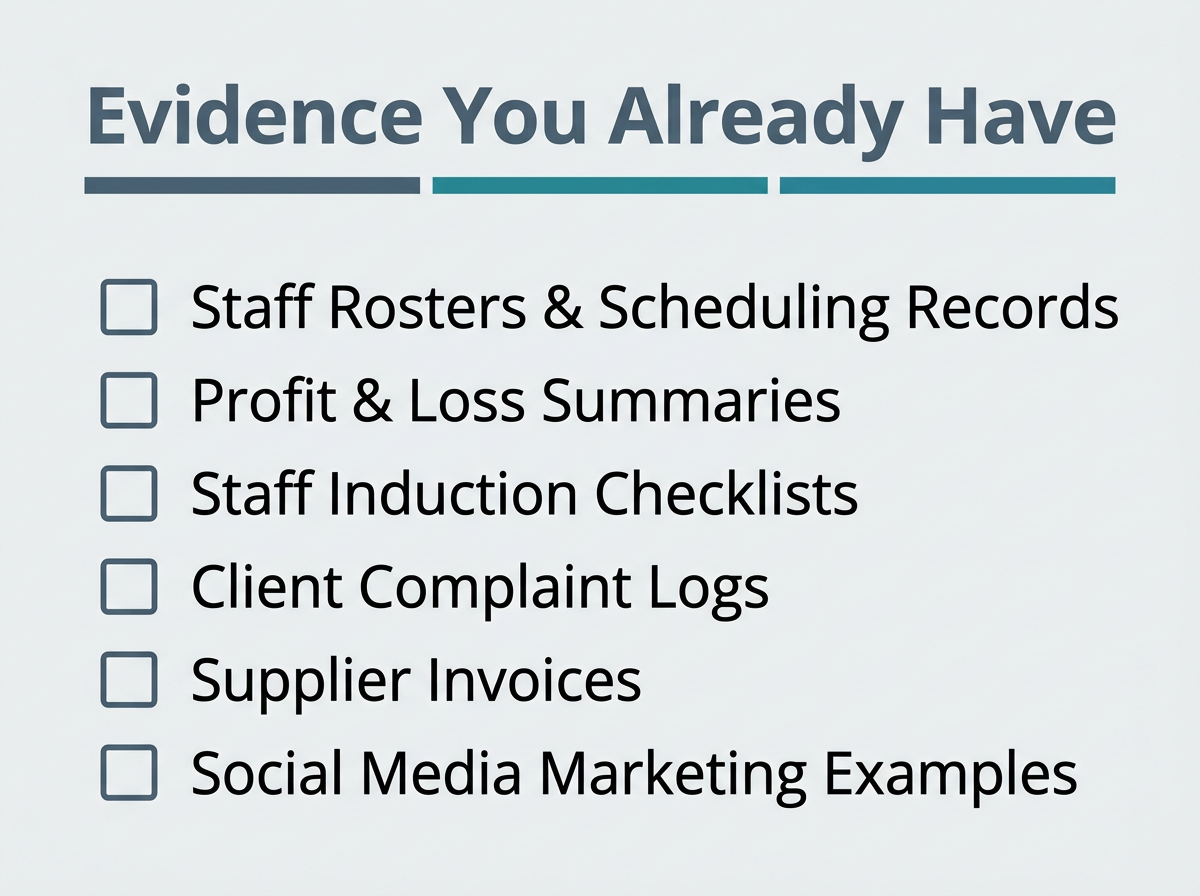
Here is the evidence typically used by a salon manager:
- Staff rosters and scheduling records: evidence of people management and operational oversight.
- Profit and loss statements or financial summaries: evidence of financial management.
- Training records or induction checklists you have created or used: evidence of staff development.
- Client complaint records and how they were resolved: evidence of client services management.
- Supplier invoices and stock management records: evidence of business operations.
- Marketing materials, social media content, or campaign records: evidence of marketing activity.
- Employment contracts or position descriptions you have written: evidence of HR management.
- Your ABN registration and any business licences: evidence of business ownership or management responsibility.
Your staff roster from last month, the profit and loss statement you reviewed with your accountant, and the training session you ran for your new junior are not just records. They are evidence. Most salon managers have years of this material sitting in their files, their phones, and their systems. The RPL process is simply about presenting it in a structured way.
The credential gap that affects salon hiring is a well-documented pattern in the industry. Experienced managers are routinely passed over for formal recognition, not because their skills are insufficient, but because those skills have never been assessed against a national standard.
The pattern of experienced salon workers being blocked by credential requirements, despite their proven competency, is explored in more detail in our piece on the credential gap that affects salon hiring.
What happens when experience alone is not enough
RPL is a genuine assessment. Not everyone who applies will meet every competency on the first review. This is not a failure; it is the process working as it should.
If an assessor identifies gaps where your documented experience does not yet meet the standard, gap training is typically available through the delivering registered training organisation. This is targeted training that addresses only the specific gaps identified, rather than a full course from scratch. The assessment determines what you need, and the gap training fills only those specific areas.
To be clear about how this works: RPL it guides candidates through the recognition process. The assessment itself is conducted by a qualified assessor from a registered training organisation, and the qualification is issued by that RTO. RPL it does not assess or award qualifications. That is the RTO's role. RPL it helps you present your experience as evidence, navigate the process, and understand what to expect at each stage.
If you are unsure whether your experience meets the standard, the Free Skills Review is the right first step. It is designed to give you an honest answer before you commit to anything.
Why the Diploma of Salon Management matters beyond the certificate
The qualification has practical value beyond personal validation. There are specific situations where the Diploma of Salon Management, or an equivalent formal credential, becomes a requirement rather than a preference.
Franchise agreements are one of the most common triggers. Many salon franchise groups require franchise owners or managers to hold formal qualifications as a condition of the franchise agreement. If you are considering purchasing a franchise, or if your existing franchise agreement is up for renewal, this qualification may be a requirement you need to address.
Business sales are another factor. When a salon changes hands, the buyer's due diligence will often include a review of the management team's qualifications. A formally qualified manager adds clear value to the business and can affect the sale price or the buyer's confidence during the transition.
Insurance and industry association membership can also depend on formal qualifications. Some professional indemnity or business insurance policies, and some industry body membership tiers, are structured around the qualifications held by the business owner or manager.
Corporate accounts and tender eligibility are increasingly relevant as salons pursue contracts with hotels, spas, or corporate wellness programmes. Procurement processes for these contracts often require evidence of management qualifications as part of the supplier assessment.
The qualification does not change what you know. It changes what you can prove, and to whom you can prove it.
The next step: a free skills review with no commitment
If the diagnostic above matches your working week, and you recognised yourself in most of those competency descriptions, the next step is a Free Skills Review.
The Free Skills Review is designed to give you an honest assessment of whether your experience is likely to meet the Diploma of Salon Management standard. It costs nothing and commits you to nothing. It is not a sales call, but a genuine suitability check conducted before any enrolment decision is made.
You have the experience. The question is whether it can be presented as evidence. This is exactly what the Free Skills Review is designed to answer.
You can also review the full qualification details, including the units covered and the RPL pathway, on the Diploma of Salon Management qualification page.
General information only, current at the date shown. Licensing rules change, so check the current requirements with the relevant regulator before you rely on them. RPL it Australia is a student support service, not a Registered Training Organisation; qualifications are assessed and issued by our partner RTOs.