Why your years of site experience won't help you without a concrete licence in Victoria
Experienced Victoria concreters lose commercial work because they lack a VBA licence. Learn how to convert your site experience into a formal qualification.
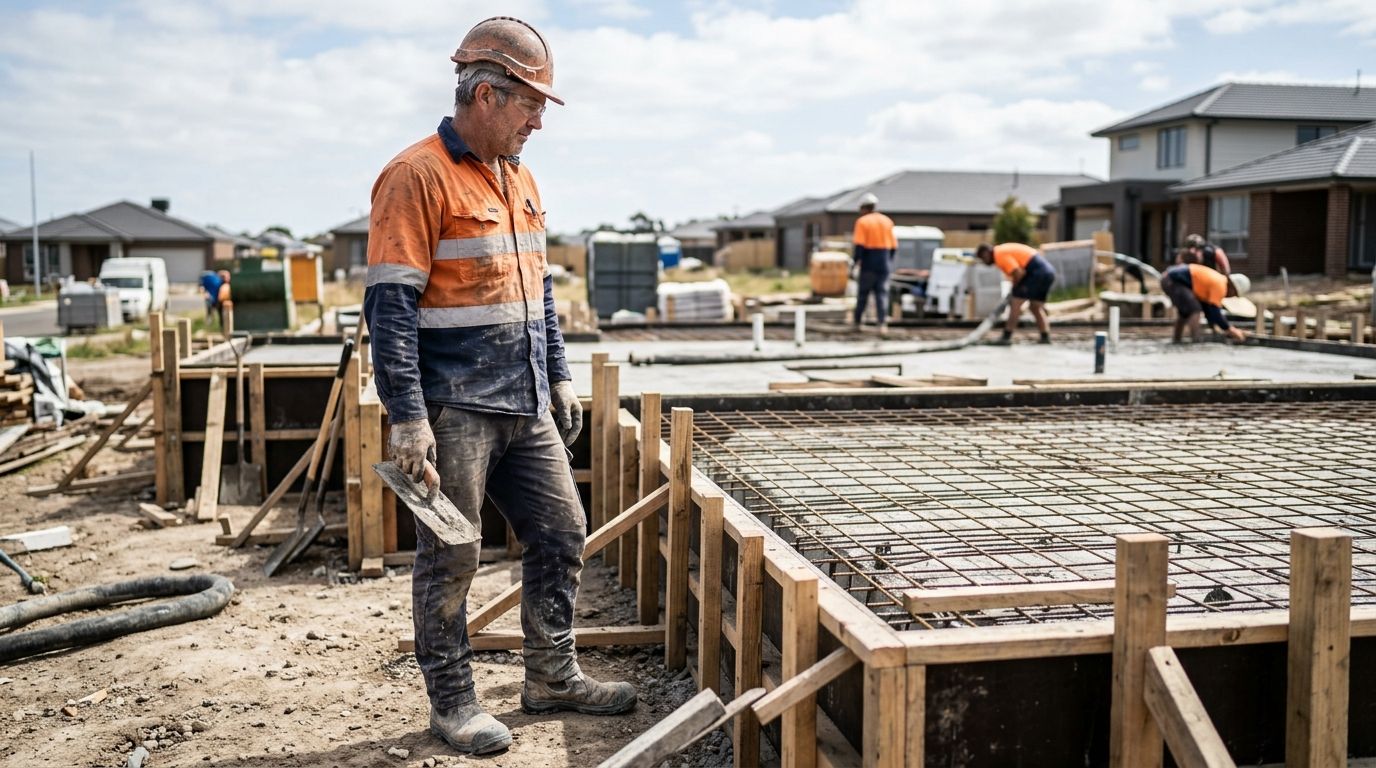
The pattern every experienced concreter in Victoria recognises
You know how to pour and finish. You can read a slab before the screed hits it, and you have fixed other people's mistakes more times than you can count. The work itself is not the problem. It has never been the problem.
And yet, the tender comes back rejected, the site induction flags a gap, or the commercial contract goes to someone else. This is not because their pours are better than yours, but because they have a registration card and you do not.
This is not a one-off. It is a pattern that repeats for experienced concreters across Victoria, and it has a clear cause. In Victoria, certain concreting work requires formal registration with the relevant building authority. Site experience, however deep or long-standing, does not substitute for that credential in the eyes of a site manager, a principal contractor, or an insurer.
The frustrating part is that the experience you have built over years is highly relevant. Indeed, it is the raw material the formal recognition system is designed to assess. However, the system requires that experience to be presented in a specific form. Until you present it that way, the pattern continues.
Is concreting actually a licensed trade in Victoria?
This is one of the most common questions experienced concreters ask, and the answer is important. In Victoria, building work above certain thresholds is regulated, and concreting that forms part of domestic building work falls within that regulatory framework. The Victorian Building Authority (VBA) is the body responsible for registering practitioners who carry out this work.
Whether a specific concreting job requires the person doing it to hold formal registration depends on the nature and scope of the work involved. Structural concreting, including slabs, footings, and similar elements that form part of a building, is generally considered regulated building work in Victoria when it meets the relevant threshold criteria under the Building Act 1993 and associated regulations.
The short answer to 'is concreting a trade that needs a licence in Victoria?' is simple: for a significant portion of the commercial and residential work that experienced concreters actually want to do, formal registration is required. The specific registration category, its exact scope, and the threshold at which it applies are details that should be confirmed directly with the VBA at vba.vic.gov.au, as these requirements can change and vary by work type.
On the terminology question that many people search: 'concretor' and 'concreter' refer to the same trade. Both spellings are used in Australia, with 'concreter' being the more common form in everyday use. The regulatory system uses its own defined terminology, so you should check the VBA's current registration categories for the precise language used.
The three moments when the licence gap becomes visible
The licence gap typically becomes visible at three predictable points. Experienced concreters encounter at least one of these, and often all three, before they resolve the underlying credential issue.
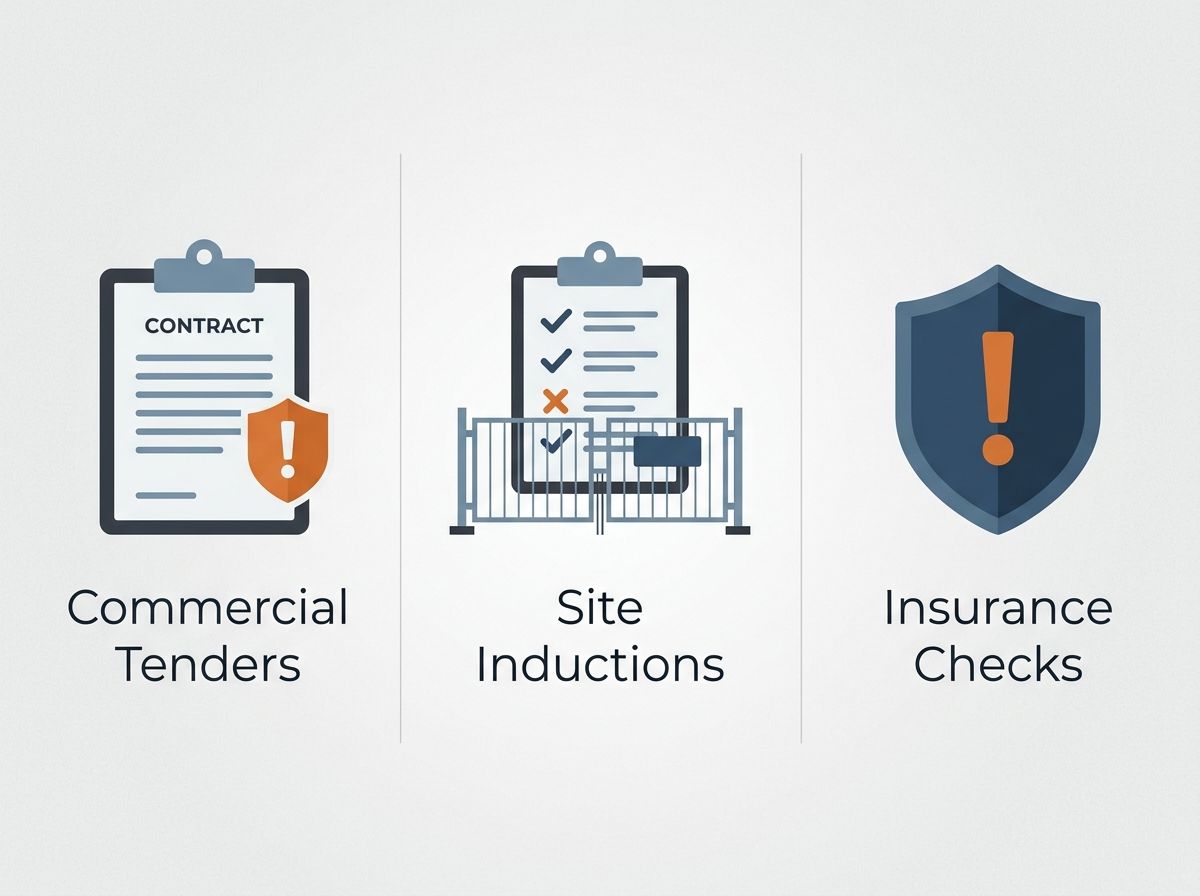
- Tendering for commercial or government work. When a principal contractor or government body issues a tender, subcontractor compliance requirements are listed as conditions. Formal registration is commonly required. Without it, the tender is rejected before the quality of your work is ever considered. Your skill is never evaluated if your paperwork does not clear the first hurdle.
- Site induction compliance checks. Major construction sites, particularly those run by larger builders, conduct subcontractor compliance checks during induction. If you cannot produce the required registration, access to the site is denied. This is not a negotiation; it is a straightforward commercial rule.
- Insurance and liability coverage. Public liability insurance for building-related trades is often linked to your registration status. Insurers and brokers assess risk partly on whether you hold the relevant formal credentials for the work you perform. Operating without the required registration can affect your coverage. It is vital to confirm these details directly with your insurer.
Your practical skill was not the issue at any of these points; the lack of a credential was. Because this gap remains unresolved, the pattern repeats itself at the next tender, the next site induction, and the next insurance renewal.
Why experience alone does not satisfy the regulatory system
Here is why this pattern persists: the regulatory system in Victoria does not assess your capability on site. It assesses documented evidence of formal recognition.
A site manager checking subcontractor compliance is not there to evaluate whether your pours are technically sound. They are checking a database. The VBA registration system is designed to verify quality through documented credentials rather than on-the-job observation. This is not a judgment on your competence, but simply how the compliance framework operates.
The implication is clear: no matter how many years you have spent on the tools or how many slabs you have poured, your experience will not show up on the VBA register until it is formally recognised through an approved pathway. The experience is real, but the formal recognition is still missing.
The VBA registration requirements for concreting work include accepted qualifications as part of the evidence pathway. The specific qualifications accepted, and whether recognition of prior learning (RPL) assessed qualifications are included, must be confirmed directly with the VBA. What remains clear is that the pathway to registration requires formal documentation of your competency, which is what the RPL process is designed to produce.
What the system actually looks for, and why you probably already have it
Your experience can count as evidence. This is the core principle of the Recognition of Prior Learning process, and it is directly relevant to experienced Victorian concreters.
RPL is an assessment pathway where a registered training organisation (RTO) evaluates whether your existing skills and knowledge meet the standards of a national qualification. For concreters, the target qualification is the Certificate III in Concreting (CPC30320), which covers the core competencies of the trade.
An RPL assessment does not require you to sit in a classroom or repeat work you already master. Instead, it requires you to prove with evidence that you meet the standard. The evidence typically includes records of completed work, site photographs, references from employers or supervisors, logbooks, and sometimes a practical observation or structured conversation with an assessor.
If you have been working as a concreter for years, you have already been generating this evidence. The photos on your phone, the jobs your employer can verify, and the projects you can describe in detail are the exact materials the assessment uses.
We should be clear about what RPL is and is not. It is a rigorous assessment, not a rubber-stamp exercise. An assessor from the delivering RTO will evaluate your evidence against the qualification requirements. If they identify any gaps, gap training is typically provided. The final outcome is determined by the assessor, not by RPL it. Our role is to guide you through the process, helping you compile and present your evidence so your experience is accurately represented.
Whether a Certificate III in Concreting (CPC30320) obtained via RPL is accepted by the VBA for your registration pathway must be confirmed directly with the VBA before you proceed. This is an important step, and we will help you make that confirmation as part of our initial process.
Breaking the pattern: The pathway to a concrete licence in Victoria
Resolving the licence gap involves three broad steps. This is not a guarantee of a specific outcome, but a description of how the process works for eligible candidates.
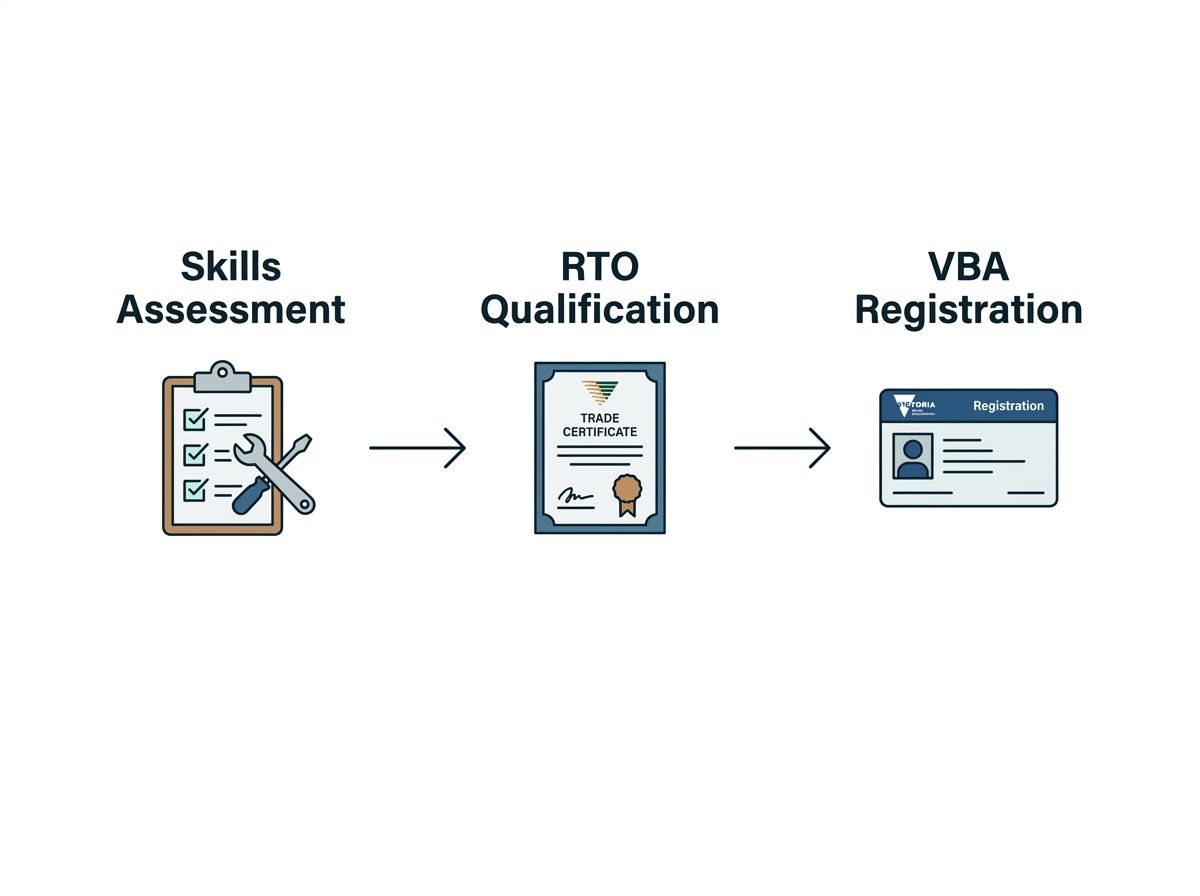
- Step 1: RPL assessment for the Certificate III in Concreting. An RTO assesses your existing skills and knowledge against the standards of the CPC30320 qualification. You provide evidence of your experience, and the assessor determines what has been demonstrated and whether you need any gap training. If you meet all requirements, the RTO issues the qualification.
- Step 2: Qualification issued by the RTO. The Certificate III in Concreting is a nationally recognised qualification issued directly by the RTO. RPL it is not an RTO and does not award qualifications. The qualification is issued solely by the registered training organisation conducting your assessment.
- Step 3: VBA registration application. Once you hold the qualification, you can apply to the VBA for the appropriate registration category for Victorian concreting work. You should confirm the VBA's application process, documentation requirements, fees, and processing times directly at vba.vic.gov.au before starting, as these details can change.
The decision to pursue this pathway is entirely yours. The process involves a genuine assessment and a real commitment to gathering evidence. What it does not require is starting your training from scratch or sitting through classes on skills you already use every day.
The free skills review: Find out where you stand before you commit
Before you make any commitments, find out where you stand. Our free skills review gives you an honest assessment of whether your concreting experience aligns with the RPL pathway requirements before you take any further steps.
Not everyone is a suitable candidate for RPL, and our review is designed to tell you that plainly. If your experience aligns well with the qualification, we will outline the next steps. If there are clear gaps or if a different path suits you better, we will explain that too. The review costs nothing and carries no obligation to proceed.
Your skills are real and your experience is extensive. The only question is whether that experience has been formally recognised. Finding out where you stand costs nothing.
Ready to Get Recognised?
Start with a free skills review to find out if RPL is right for you.