The Hidden Cost of Unlicensed Concreting Crews in Victoria
Operating without a concreting licence in Victoria can void insurance and halt work on site. Learn the real compliance risks for your crew.
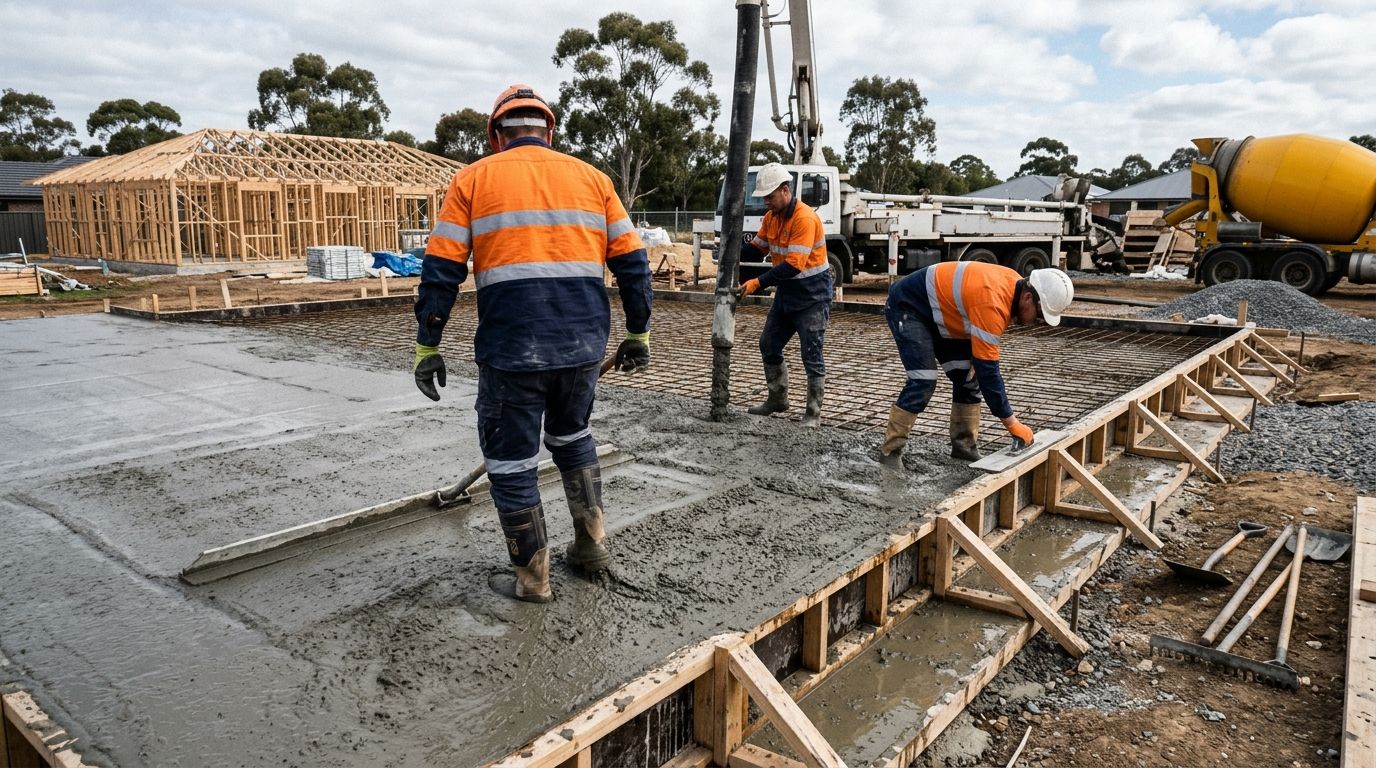
The Assumption That Puts Contractors At Risk
You have been pouring concrete for years. The slabs are level, the finishes are clean, and the clients are happy. When someone brings up the subject of a concreting licence, it can feel like bureaucratic paperwork. It seems like a formality that has nothing to do with the actual quality of the work your crew delivers.
That assumption is where the hidden costs begin.
In Victoria, the legal and financial risk of operating without a required licence exists regardless of work quality. The slab can be structurally sound, the pour can be perfect, and the client can be satisfied. None of those factors change what happens if an insurance claim is made, a regulator arrives on site, or a principal contractor's legal team begins asking questions.
Your skills are real, but the formal record is what the system enforces. This article looks at the gap between what your crew can do on site and what the regulatory framework officially recognises.
What 'Unlicensed' Means in Victoria
In Victoria, certain types of building work require the person doing or supervising the work to hold a registration from the Victorian Building Authority (VBA). The specific registration classes and the thresholds that trigger these requirements, including contract value limits and work definitions, are set out under the Building Act 1993 (Vic) and its associated regulations.
Whether a particular concreting job requires a licence depends on the nature of the work, the contract value, and whether it is classified as domestic building work under Victorian law. You should confirm the exact registration category for your concreting work and its conditions directly with the VBA or a qualified legal adviser, as the rules are specific and the thresholds matter.
What unlicensed means in this context is simple: the formal system has no record of assessed competence for the person performing or supervising the work. It does not mean incompetent. It means invisible to the regulatory framework, and that invisibility is what creates the risk.
Your crew's skills are not in question, but their formal status is. The VBA, insurers, and principal contractors all operate on formal paperwork rather than the quality of the pour.
The Insurance Issue: Why a Good Job Is Not Enough
Construction insurance policies, including public liability and domestic building insurance, commonly contain exclusion clauses. These clauses can limit or void coverage when work is done by unlicensed or unregistered practitioners. The exact language varies between policies and insurers, and how any exclusion clause applies to a specific claim depends on the policy terms and the circumstances.
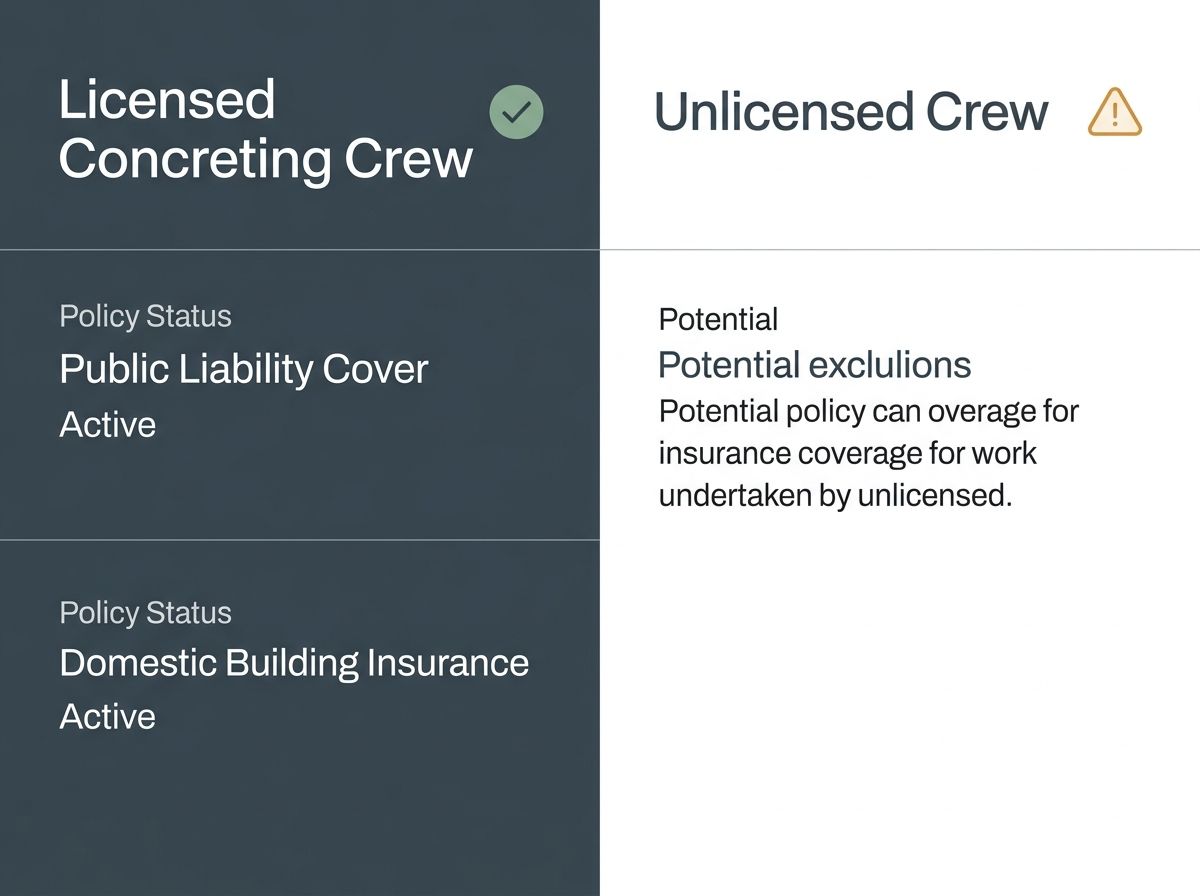
The baseline is clear: policies are written to cover licensed work. When unlicensed work is performed, the insurer may argue that the exclusion applies, and the business owner may find themselves without the coverage they assumed they had.
This is not a theoretical risk; it is how construction insurance operates in practice. Most business owners do not discover these exclusion clauses until they need to make a claim. By then, the options are limited.
We are not saying every insurer will deny every claim from unlicensed work. We are saying that these exclusion clauses exist in many standard construction policies, and most business owners have not read them. It is worth checking your policy before the next pour.
VBA Enforcement: What Penalties and Site Shutdowns Mean in Practice
The Victorian Building Authority has enforcement powers under the Building Act 1993 (Vic). These powers allow them to issue infringement notices, direct that work stop, and prosecute unlicensed practitioners. The specific penalty provisions, including the number of penalty units for unlicensed building work and their current dollar value, are set out in the Act and should be verified directly with the VBA or a legal adviser.
What is clear is the operational impact. The VBA can stop work on site. This is not a theoretical threat; it is an enforcement power the authority actively uses. A site shutdown mid-pour goes beyond regulatory inconvenience. It means lost labour, equipment rental costs, rescheduling delays, and a difficult conversation with the principal contractor.
The VBA also maintains public records of enforcement actions. A disciplinary record is visible to your current clients and future partners. The damage to your reputation from an enforcement action can easily outlast the fine.
The cost of getting licensed is predictable and capped. The cost of enforcement is not.
The Principal Contractor's Risk: Why Your Subcontractor's Licence Is Your Problem
In Victoria, principal contractors carry obligations for the building work performed on their sites. The extent of these obligations, including verifying that subcontractors hold the required licences or registrations, depends on specific provisions under the Building Act 1993 (Vic) and the Occupational Health and Safety Act 2004 (Vic). You should confirm these obligations with a legal adviser familiar with Victorian building law.
The practical reality is clear. If an unlicensed concreting subcontractor causes a defect, an injury, or an insurance claim, the principal contractor is usually drawn into the fallout. This can impact their own insurance, damage their relationship with the client, and limit their ability to bid on future projects.
Your subcontractor's licence is central to your due diligence. Their registration affects your liability and your insurance. If you are a site manager or compliance officer, the main concern is whether you can prove that the crew performing the work was appropriately licensed if an inspector asks.
Most business owners assume they are covered, but many have not checked.
Comparing the Costs: Compliance vs. Consequence
The push to get your crew licensed is about managing risk, not just dealing with bureaucracy.
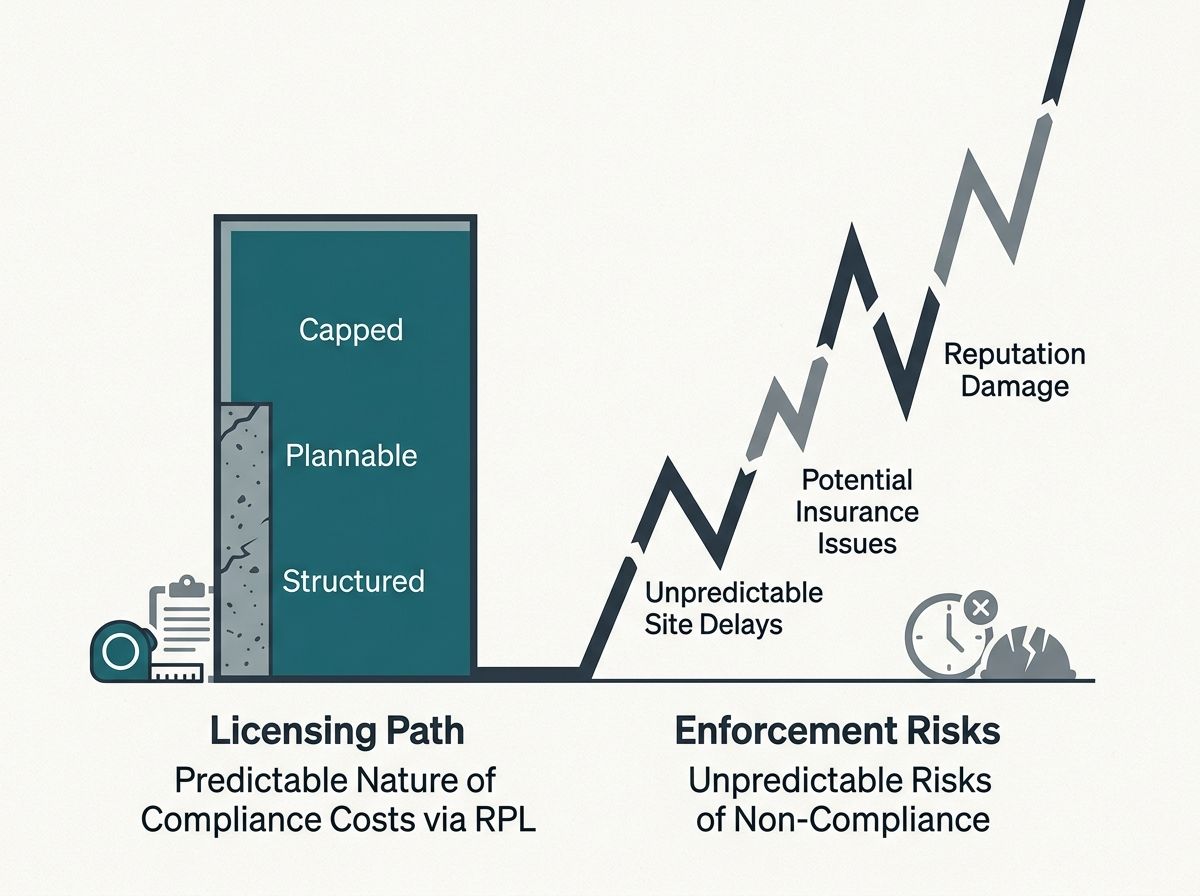
The cost of obtaining a licence or registration in Victoria, which includes application fees, assessment costs, and qualification requirements, is a known and capped figure. You can plan and budget for it, and it never arrives without warning.
The costs of enforcement are highly unpredictable. Fines, voided insurance, site shutdowns, and reputational damage do not follow a schedule. They hit when a claim is made, when an inspector visits, or when a principal contractor reviews subcontractor compliance. At that stage, your options are limited and the financial damage is uncapped.
We cannot quote specific dollar figures for VBA penalties or site shutdown costs, as these depend on your circumstances, current penalty unit values in Victoria, and the severity of the enforcement action. However, the cost of compliance is predictable and capped, while the cost of non-compliance is unpredictable and highly damaging. The maths is simple.
To find the exact penalty provisions for unlicensed building work in Victoria, consult the VBA directly or review the Building Act 1993 (Vic) with a qualified legal adviser.
Your Crew Has the Experience. They Just Need the Licence.
For experienced concreters, the barrier to formal registration is rarely their skill. It is having the paperwork to prove it.
Recognition of Prior Learning (RPL) is an assessment process that converts years of on-site concreting experience into the evidence needed for a nationally recognised qualification. Instead of repeating training they already know, experienced workers present proof of their skills, such as site records, references, photos of completed work, and logbooks. A qualified assessor from a registered training organisation (RTO) then evaluates this evidence against the official competency standards.
The Certificate III in Concreting (CPC30320) is the national qualification for concreting work in Australia. You should confirm directly with the VBA whether this qualification meets their registration requirements for your specific class of work, as the link between qualifications and licensing is direct and can change over time.
RPL translates existing experience into formal proof. The crew does not need to sit in a classroom. They simply present their knowledge in a format that the assessment system recognizes. It is about proving skills, not repeating training.
Next Steps: The Free Skills Review
The process begins with an honest assessment of whether RPL fits the worker's actual experience, rather than rushing into enrolment.
RPL is not for everyone. The assessment is a genuine process requiring real evidence of competence. A Free Skills Review is the starting point. It is an honest, no-obligation discussion about your crew's experience, available evidence, and the most practical route to formal recognition.
If RPL is the right option, the process moves forward. If there are skill gaps to address first, we will identify them before you make any commitment. We focus on giving clear guidance before you enrol.
For definitive details on Victorian concreting licence requirements, consult the VBA directly.
You can find more details about Victorian concreting licence requirements and the RPL route on our Trade Licence VIC Concreting page.
Your crew has the experience. See if they are ready to get licensed.
Ready to Get Recognised?
Start with a free skills review to find out if RPL is right for you.