You learned beauty therapy the old way: SHB40121 is how that finally gets recognised
Trained before SHB40121 or overseas? Your experience may already meet the standard. Learn how RPL helps you get your skills recognised.
By RPL it Australia7 min read
The qualification code that did not exist when you trained
You have been doing this work for years. Facials, body treatments, skin analysis, client consultations: you manage the full scope of what a beauty therapist does every day. Then someone asks for your SHB40121, and you realise you do not have it. This is not because you lack the skill. When you trained, that code did not exist. It may have existed under a different name, in a different system, or in a different country entirely.
This is an administrative gap, not a skills gap. It is a hurdle that many experienced beauty therapists in Australia are navigating right now.
SHB40121 is the current national qualification code for the Certificate IV in Beauty Therapy in Australia. It is the code that appears on job advertisements, employer requirements, and insurance applications. If you trained before the current qualification framework was in place, or if you trained overseas, your experience may be equivalent to what SHB40121 requires. The problem is that the system has no automatic way of seeing your capability. Recognition of Prior Learning (RPL) is the formal pathway that makes it visible.
What SHB40121 is, and why it keeps coming up
SHB40121 is the Certificate IV in Beauty Therapy, a nationally recognised Australian qualification. It covers the competencies expected of a professional beauty therapist working across skin treatments, body treatments, client consultation, and the business skills required to operate in a salon environment. It sits within the Hairdressing and Beauty Services (SHB) training package, which is the national framework governing vocational qualifications in this industry.
The reason this code keeps appearing is straightforward. Employers, professional indemnity insurers, and salon networks now use SHB40121, or an equivalent Certificate IV in Beauty Therapy, as a baseline credential. It is the qualification that signals to the formal system that a therapist has been assessed against a nationally consistent standard.
If you hold a qualification from a different era or a different country, the formal system does not automatically translate your credential into SHB40121 terms. RPL provides that translation.
The generational gap: Trained before the code, qualified in everything but name
Australia's vocational education system has changed substantially over the decades. The national training package framework that underpins qualifications like SHB40121 was not always in place. Beauty therapy training in earlier decades operated through a patchwork of state-based TAFE programs, private college certificates, and salon apprenticeship arrangements. Each had its own standards, terminology, and paperwork.
If you trained in the 1980s, 1990s, or early 2000s, you may have completed a beauty therapy program that covered everything SHB40121 now requires, but under a different qualification code, a different framework, or a certificate issued by an institution that no longer exists. The skills are identical. Only the code is different.
This gap is administrative, not competency-based. The formal system changed around you. Your expertise did not diminish. What changed was the language used to describe it, alongside the code required to prove it.
This is precisely the situation RPL was designed to address. It does not require you to relearn what you already know. It asks you to show what you already know using evidence drawn from your actual working life, so a qualified assessor can formally confirm that your experience meets the current standard.
Trained overseas? The gap is even more pronounced
For beauty therapists who trained outside Australia, such as in the United Kingdom, New Zealand, Southeast Asia, or elsewhere, the gap is compounded by an additional layer of administrative invisibility. Overseas beauty therapy qualifications, regardless of how rigorous or comprehensive they are, are not automatically recognised within the Australian qualification framework.
There is no blanket mutual recognition arrangement that converts an overseas beauty therapy credential into an Australian SHB40121. The Australian system requires assessment against its own national standard. This does not mean your overseas training is irrelevant; it means the formal system has no built-in mechanism to see it.
RPL changes that. The evidence you gather for an RPL assessment can include documentation of your overseas training alongside your Australian work history. An assessor from a registered training organisation (RTO) considers the full picture of your experience, including where you trained, what you have done since, and what you can demonstrate now, rather than simply checking whether you hold an Australian-issued certificate.
How RPL addresses the recognition gap
Recognition of Prior Learning (RPL) is a formal assessment pathway within the Australian vocational education system. It allows your existing skills, knowledge, and experience to be assessed against the requirements of a qualification, in this case, SHB40121, without requiring you to repeat training you have already completed.
The assessment is conducted by a qualified assessor from a registered training organisation (RTO). RPL it does not conduct assessments or issue qualifications; that is the RTO's role. What RPL it does is guide you through the process. We help you understand what evidence is needed, how to gather and present it, and what to expect at each stage.
The assessor's job is to determine how much of SHB40121 your existing experience already covers. In many cases, experienced therapists meet the majority of the qualification's requirements through their work history alone. Where gaps are identified, meaning areas of the qualification not sufficiently covered by your existing experience, gap training is provided at no additional cost. This is a normal part of the RPL process, not a failure.
The outcome, when competency is confirmed, is a nationally recognised Certificate IV in Beauty Therapy. It is the same qualification as someone who completed a full training program. The difference is that yours reflects what you have already achieved, rather than requiring you to start from the beginning.
What counts as evidence for SHB40121 RPL
The evidence used in an RPL assessment is drawn from your actual working life. It does not need to be formal or polished; it just needs to be genuine. The assessor looks for documentation that demonstrates your competency across the areas SHB40121 covers.
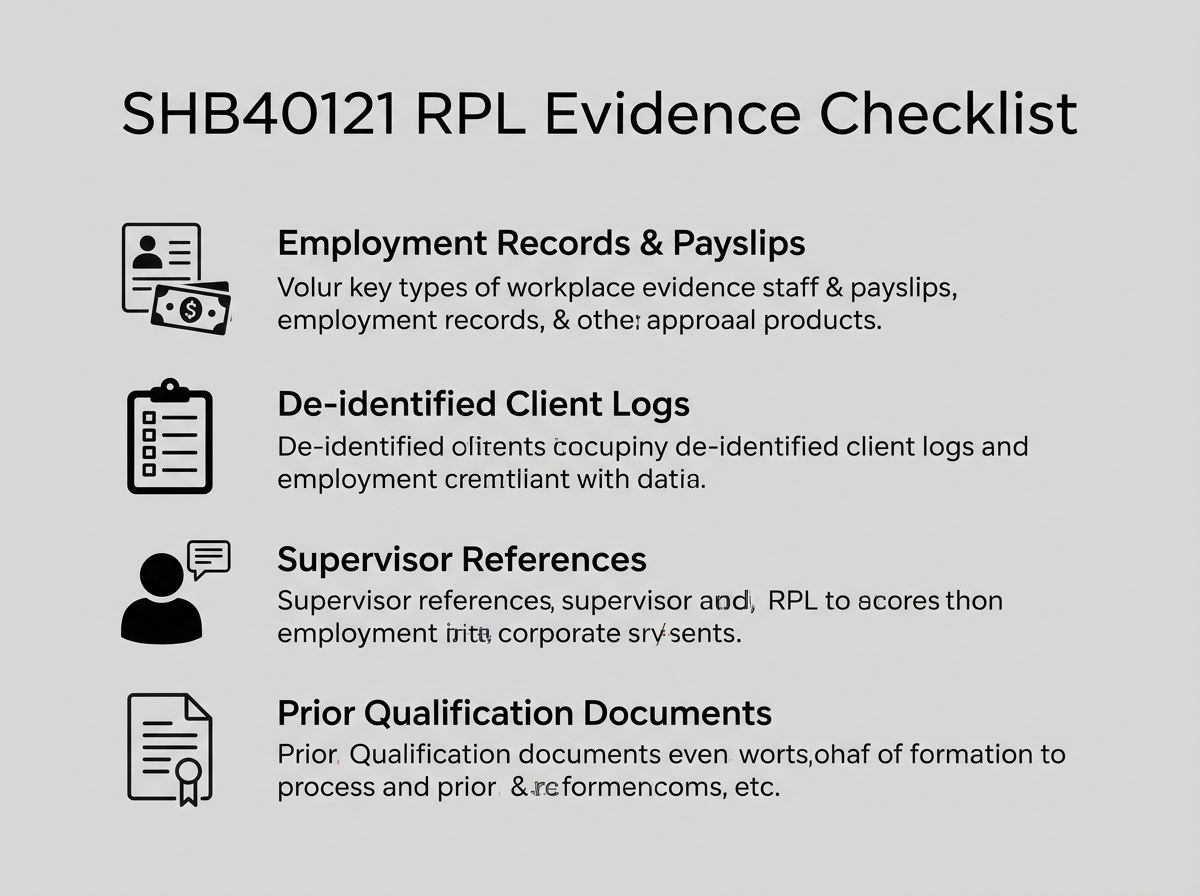
Evidence that is commonly relevant to a beauty therapy RPL assessment includes:
- Employment records and payslips showing your work history in the industry
- Client consultation records or treatment logs (de-identified where required for privacy)
- Employer or supervisor references confirming the scope and standard of your work
- Prior training certificates, including certificates from predecessor qualification codes, private colleges, or overseas institutions
- Photographs of your work environment, treatment setup, or product knowledge
- Any continuing professional development records, workshop attendance, or product training certificates
Overseas training certificates, even where they are not directly recognised as equivalent to SHB40121, can be submitted as supporting evidence. They contribute to the overall picture of your experience and training history. They do not need to be formally equivalent; they simply need to be genuine.
If you have completed any Australian training in the past, your USI transcript can also surface past Australian training records that you may have forgotten about or lost documentation for.
Is RPL right for every experienced beauty therapist?
RPL is not automatically suitable for everyone. The suitability of this pathway depends on the depth and breadth of your experience relative to the full requirements of SHB40121.
The Certificate IV in Beauty Therapy covers a range of competency areas, including skin treatments, body treatments, client consultation, and business skills. Therapists with broad, varied client-facing experience across these areas are strong RPL candidates. Therapists whose experience is concentrated in a narrower range, such as primarily waxing or nail services, may find that RPL covers some units but not all. Gap training is then required for the remainder. This is not a disqualifying situation, but an honest picture of where your experience sits relative to the full qualification.
The right starting point is not enrolment. It is an honest conversation about your experience and whether it aligns with what SHB40121 requires. That is exactly what a Free Skills Review provides: a clear, no-pressure picture of where you stand, before any commitment is made.
The code changed: your skills didn't
SHB40121 is a code, not a measure of whether you are a capable beauty therapist. The qualification framework exists to create a common language for competency. However, that language changes over time, and it does not automatically translate the years of skill that existed before it was written.
If you trained before the current framework was in place, or if you trained in a system that uses different terminology, your experience did not become less real when the code changed. What changed was the administrative requirement. RPL is the mechanism that bridges the two.
Your skills are real, and the pathway to having them formally recognised exists. The decision about whether to take it is yours.
Understanding why salons rely on experienced unqualified staff but can't formally advance them is part of the same picture, and it matters for your career.
General information only, current at the date shown. Licensing rules change, so check the current requirements with the relevant regulator before you rely on them. RPL it Australia is a student support service, not a Registered Training Organisation; qualifications are assessed and issued by our partner RTOs.