You Don't Need to Start as an Apprentice if You Already Have Pastry Experience
If you have professional pastry experience, you can get the Cert IV in Patisserie without an apprenticeship. Learn how the RPL process works.

The assumption that keeps experienced pastry chefs starting over
Someone probably told you that you must start as an apprentice. They likely said that to hold the Cert IV in Patisserie in Australia, you have to complete a formal training pathway. This usually requires years of structured study, classroom hours, and entry-level placements, regardless of your current skills and knowledge.
That assumption is incorrect. For skilled pastry professionals, especially those who trained overseas or built their skills through years of high-level professional practice, this misconception is costing you real career opportunities.
An apprenticeship is not the only pathway to the Cert IV in Patisserie. For experienced pastry professionals, it is often not even the right choice.
The Certificate IV in Patisserie (SIT40721) is a nationally recognised qualification under the Australian Qualifications Framework. Like all nationally recognised qualifications, it can be achieved through Recognition of Prior Learning. This is an official, ASQA-recognised assessment pathway that evaluates your existing skills and knowledge, regardless of how or where you originally acquired them.
If you have been producing complex pastry work at a professional level in a hotel, restaurant, patisserie, or commercial kitchen, your existing skills may already meet the required competency standards. The challenge is not whether you are capable, but whether your capability can be clearly demonstrated as evidence.
What the Cert IV in Patisserie actually assesses
The Cert IV in Patisserie is not a course, but a set of competency standards. SIT40721 includes 32 competency units (26 core and 6 elective) that define what a supervisory-level pastry professional must do.
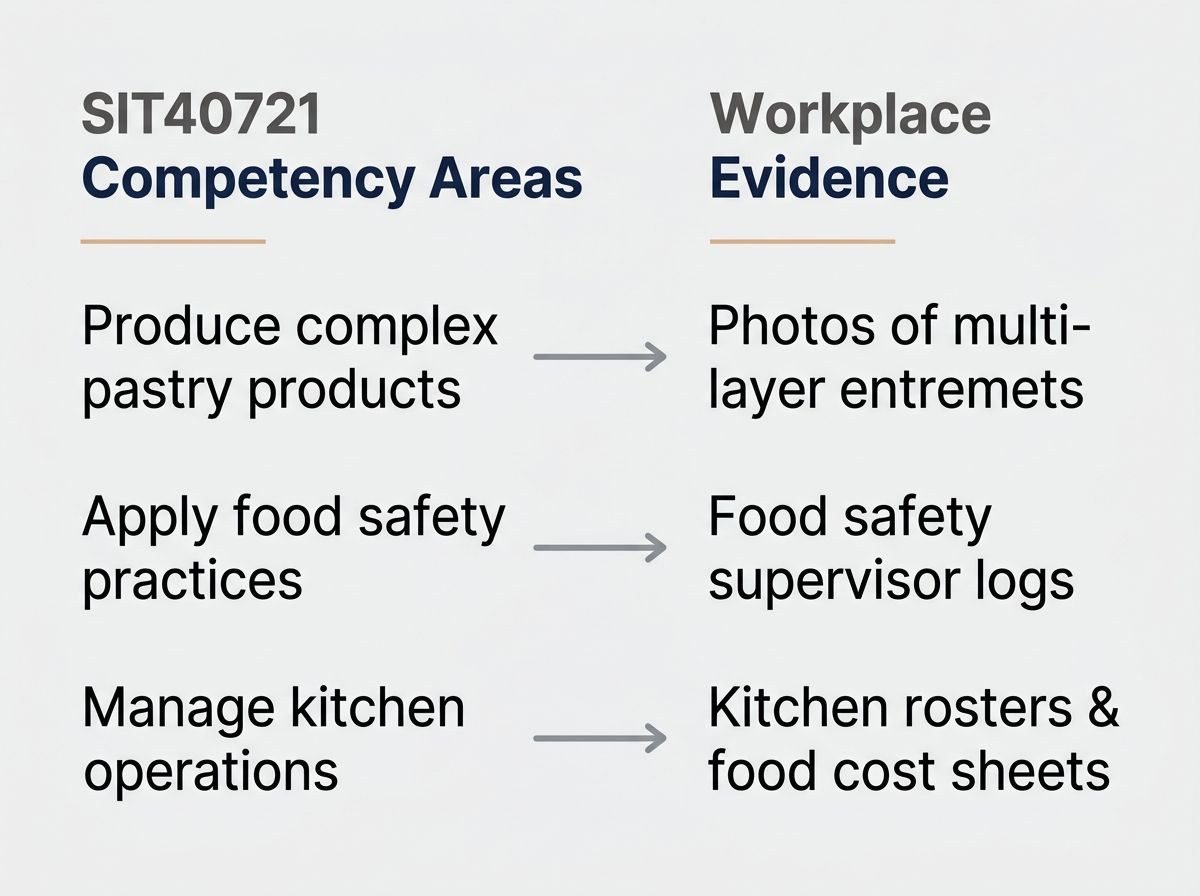
Some of these competency areas are familiar to any experienced pastry professional. They include producing complex pastry products, managing food safety in a commercial kitchen, applying advanced patisserie techniques, and supervising kitchen operations. These are not entry-level tasks; they make up the daily routine of a professional kitchen.
This distinction changes how you view the qualification. The Cert IV in Patisserie does not require you to learn new skills. It asks you to prove what you already do. This is the foundation of the RPL pathway.
Why international and self-taught pastry professionals are particularly affected
This belief that you need an apprenticeship affects two groups.
The first group includes skilled migrants who trained in high-end international kitchens. You might have worked under a Michelin-starred chef in France, completed a formal patisserie qualification in Japan, or spent a decade producing complex pastry work in a five-star hotel in the Middle East. When you arrive in Australia, that experience is real, but the local training system cannot easily verify it without an Australian qualification.
Overseas patisserie qualifications are not automatically recognised in Australia. Trades Recognition Australia (TRA) assesses qualifications for migration, but that process is separate from achieving an Australian qualification through RPL. These two pathways serve different purposes. RPL through a registered training organisation is the process used to translate your existing skills into a nationally recognised Australian qualification.
The second group consists of self-taught professionals who built their skills through workplace practice rather than formal education. You might not hold any formal qualification, but you have produced technically complex pastry work for years. The Australian Qualifications Framework explicitly recognises that you can acquire skills in many ways, and RPL is designed for exactly this situation.
In both cases, the barrier is recognition rather than capability. Your skills are genuine. The difficulty is that the training system does not automatically see them, and RPL is the mechanism designed to bridge that gap.
What RPL actually involves for a pastry chef
RPL is not a shortcut. It is a rigorous, evidence-based assessment process conducted by a qualified assessor from a registered training organisation. The assessor determines whether your existing skills and knowledge meet the competency standards of the qualification. RPL it guides you through the process, but the assessment is conducted and the qualification is issued by the partner RTO.
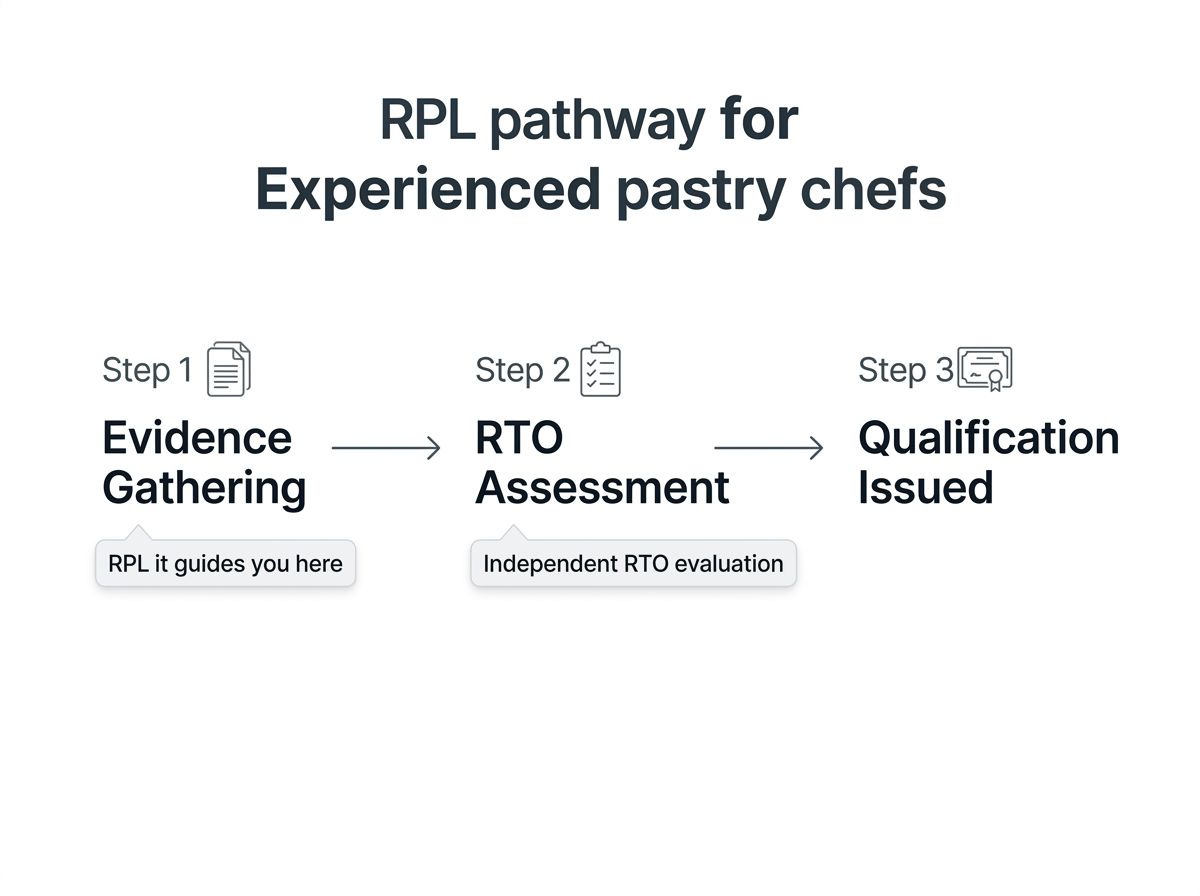
For a pastry professional, collecting evidence typically involves a combination of several items. These include a documented work history, employer references, photographs or videos of complex pastry work you have produced, recipes, production records, third-party observations, and a structured interview with the assessor.
The practical demonstration component is highly relevant for patisserie RPL. Because the qualification assesses hands-on technical skills, assessors often need to observe your work directly rather than just reviewing paperwork. This is a practical way to show your skills. For an experienced pastry chef, demonstrating complex techniques in a kitchen is where your competence is easiest to verify.
You should also note that gap training may be required. If the assessment identifies areas where your evidence does not fully meet a specific competency standard, you can complete gap training to address those areas. This is a standard part of the RPL process and is provided at no additional cost.
The difference between experience and evidence
This distinction is often the most counterintuitive part of the process for experienced professionals.
Knowing how to construct a 12-layer entremet is experience. A photo series documenting the process, mapped against the relevant competency standard, is evidence. Assessors can only evaluate what they can see. Your skills exist in the kitchen, but evidence makes those skills visible on paper.
This distinction explains why some RPL applications are unsuccessful. It is rarely because the candidate lacks the skills, but rather because the evidence is insufficient, poorly documented, or not clearly aligned to the specific competency standards. A generic work history does not replace targeted evidence. A reference letter stating you are an excellent chef does not carry the same weight as one that details specific technical competencies.
The guided documentation process bridges this gap. The goal is not to manufacture evidence that does not exist, but to present your actual experience in a format that an assessor can evaluate against national standards. This is the support RPL it provides.
This challenge, where real capability goes unrecognised because it is not formatted correctly, is common across the hospitality industry. Read more about how experienced chefs hit qualification walls and how the RPL pathway works for them.
Is the Cert IV in Patisserie the right qualification for your experience?
Not every pastry professional is suited for RPL at the Cert IV level, and honest suitability guidance matters more than registration numbers.
The Cert IV in Patisserie RPL pathway is designed for professionals who have worked at a complex, supervisory level for a sustained period. This means producing technically advanced pastry products rather than entry-level baking, while also having experience with kitchen supervision, food safety management, and production planning. If your work includes multi-component desserts, advanced chocolate or sugar work, or managing a pastry section, you likely have Cert IV-level experience.
If you are earlier in your career, or if your experience is primarily in a support role rather than a lead or supervisory capacity, the Certificate III in Patisserie (SIT31021) may be more appropriate. It covers foundational patisserie skills and is also available through RPL for candidates with relevant experience.
Whether RPL is right for you depends entirely on your specific work profile. This is exactly what a Free Skills Review assesses. It is not an enrolment commitment, but an honest evaluation of how your experience maps to the qualification, conducted at no cost.
Your experience has already earned this. The question is whether you can demonstrate it.
You have the experience. The task is to present it as valid evidence.
This is simply how formal recognition operates, not a criticism of your abilities. The Cert IV in Patisserie does not require you to repeat what you already know. Instead, you must show your skills in a format that a qualified assessor can evaluate against national standards.
The RPL pathway offers recognition instead of repetition. For pastry professionals who have spent years building their expertise, whether in Australian or overseas kitchens, through formal training or workplace practice, this is the pathway that respects the work you have already completed.
The choice is yours. If you want to know whether your experience qualifies before making any commitments, the Free Skills Review is the practical starting point.
Ready to Get Recognised?
Start with a free skills review to find out if RPL is right for you.