Years of Casework Won't Automatically Get You a PI Licence: Here's What Will
Think years of casework qualifies you for a PI licence? State licensing divisions assess ASQA-compliant evidence, not reputation. Here is what counts.

The assumption that trips up experienced investigators
You have the experience. You have done the casework, including surveillance, interviews, report writing, and evidence handling. You have worked cases that newer investigators would struggle to navigate. When the question of a PI licence comes up, it feels like a formality. A box to tick. Something the licensing system should recognise once you show up with your history behind you.
That assumption is understandable. It is also, in most Australian states, incorrect.
State licensing divisions are not assessing whether you are a good investigator. They are assessing whether your application meets a compliance checklist. Those are two very different tasks. Your reputation, your years of service, and your employer's confidence do not equal the documented evidence of competency that a licensing body requires. The gap between what you have and what the system needs is what catches experienced investigators off guard.
This article is not about whether your experience counts. It does. It is about the form that experience needs to take before a licensing division can act on it.
What state licensing divisions actually assess
Across Australian states, private investigator licensing is administered by different bodies, such as consumer affairs agencies, police licensing divisions, or regulatory offices depending on the jurisdiction. The specific requirements vary by state, but the same pattern holds: licensing applications require evidence of formal qualification in investigative services, not simply a record of having done the work.
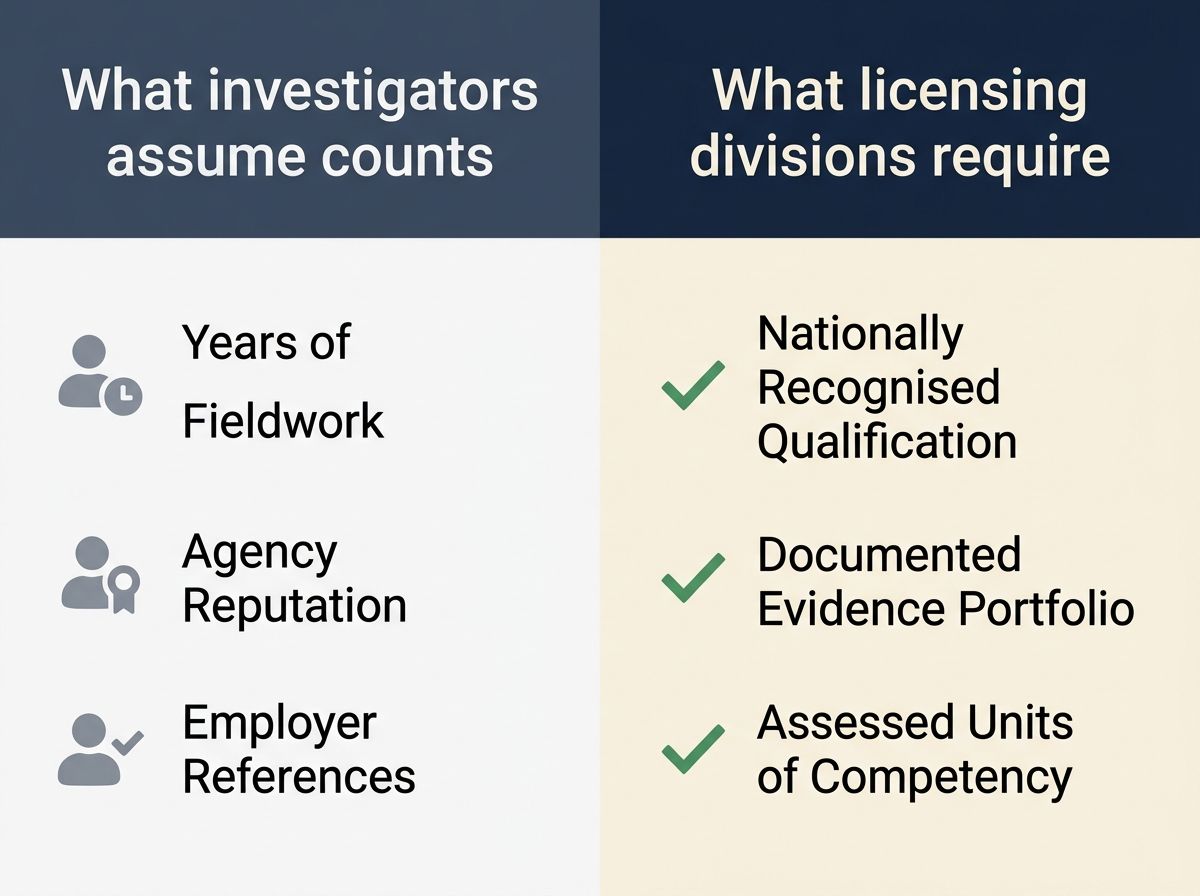
What licensing bodies look for is not a portfolio of your best cases. They look for documentation that you have been assessed against a nationally recognised standard. In practice, this typically means holding a qualification issued by a registered training organisation (RTO) operating under the Australian Skills Quality Authority (ASQA) framework, or meeting an equivalent standard defined by the relevant state legislation.
This distinction matters because it shifts the question entirely. The question is not whether you have done the work, but whether your competency has been formally assessed and documented against a recognised standard. A licensing officer reviewing your application cannot verify your fieldwork history the way a colleague or employer can. They can only verify whether you hold a qualification that meets their specific requirements.
The Certificate III in Investigative Services (CPP30619) is the core qualification for this pathway. It is the qualification most commonly referenced for PI licensing across Australian states, though specific requirements vary by jurisdiction and should be confirmed with the relevant licensing body in your state.
The difference between competence and compliant evidence
Competence and compliant evidence are different. One is what you can do; the other is what a licensing division can verify.
An investigator can be genuinely skilled, demonstrating excellence in surveillance, evidence handling, and report writing, yet still fail to satisfy a licensing application. This is not due to a lack of ability, but because their experience exists in a form the licensing system cannot process.
Consider what non-compliant evidence typically looks like in this context: years of service with an agency, a reference letter from a senior investigator, a record of cases handled, or informal on-the-job training. These documents show genuine capability, but they are not the same as evidence assessed against national competency standards by a qualified assessor from an ASQA-registered RTO.
In the vocational education and training (VET) system, evidence of competency has a specific meaning. It refers to documented proof that you have been assessed by a qualified assessor, using defined assessment methods, as competent against each unit within a qualification. That process has strict rules, and the evidence must meet them. An employer's confidence in you, however genuine, does not constitute assessed evidence in this context.
If you have years of casework behind you but no formal qualification, you are caught in a gap. Your competence is real, but your evidence, in the form the system requires, does not exist yet. This is a common issue for experienced investigators. It does not reflect on your ability; it is simply how formal recognition systems operate.
Why years of casework are necessary but not sufficient
Your casework is real, and your skills are genuine. Nothing here suggests otherwise.
The distinction is precise: experience is the raw material. The licensing system requires that material to be structured into a specific format before it can be recognised. Years of casework are necessary because they form the foundation of any credible RPL application, but they are not sufficient on their own.
This is where the Certificate III in Investigative Services becomes relevant. The qualification covers the core competencies of professional investigation work, mapping directly to what experienced investigators do every day. This includes surveillance operations, evidence collection, report writing, interviewing, and navigating legal frameworks. If you do this work, you already demonstrate these competencies. The question is whether that work has been documented so an assessor can evaluate it against the qualification's standards.
Recognition of Prior Learning (RPL) exists for this exact situation. It is the formal pathway where your existing experience and skills are assessed against qualification standards, saving you from repeating training for things you already know how to do. Your casework becomes your evidence. An assessor reviews this documentation against each unit of competency. Where you demonstrate competency, it is recognised. Where gaps exist, they are identified and addressed.
For investigators from security or military backgrounds, translating prior experience to investigative competencies is often direct. Understanding how prior investigation experience maps to the qualification is a practical starting point.
RPL is not a shortcut; it is a rigorous assessment pathway. The difference is that it starts from your current level of experience rather than from zero.
What the RPL pathway looks like for investigators
The RPL process for the Certificate III in Investigative Services follows a structured pathway. It begins with a skills review, which is an honest assessment of your existing experience against the qualification's requirements. This is a suitability check, not a commitment to enrol.
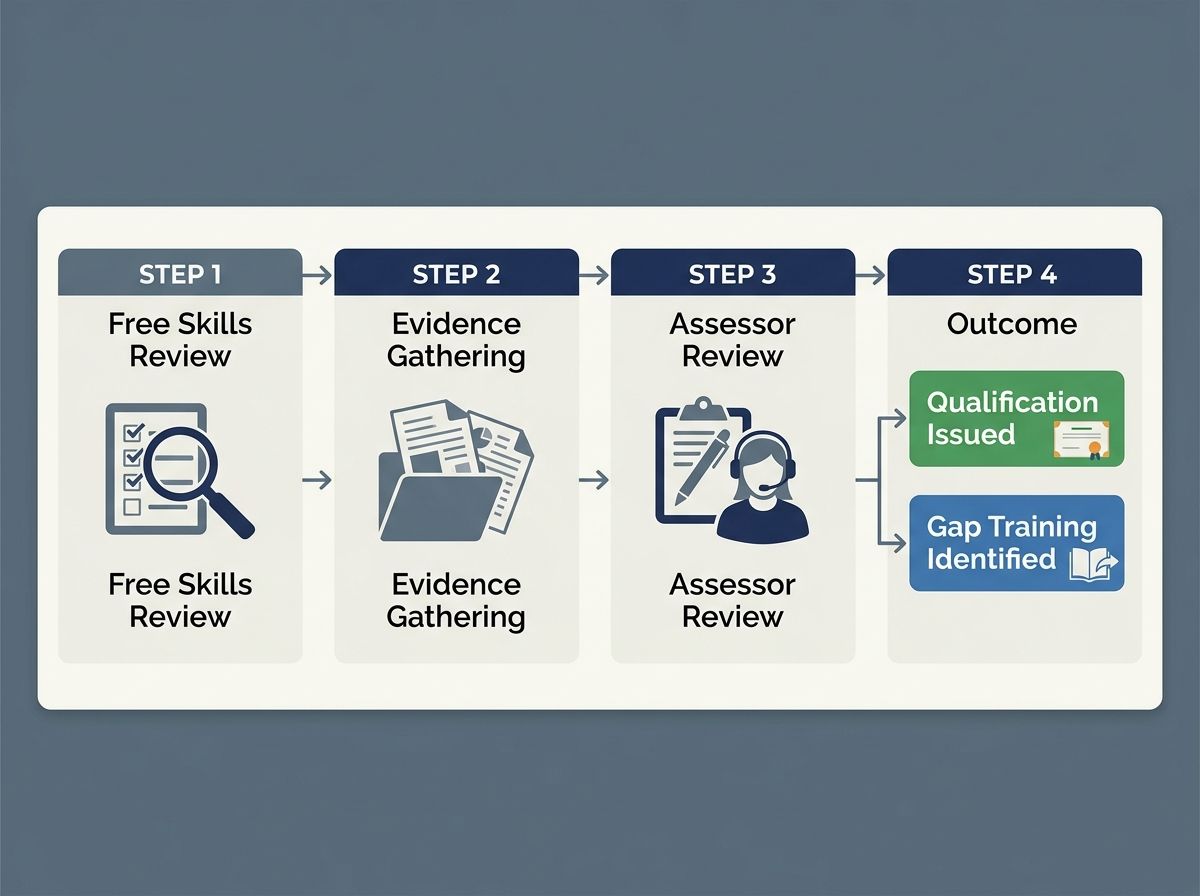
If the skills review shows that RPL is a viable pathway for you, the next stage involves gathering evidence. This typically includes documentation of your work history, examples of your professional practice, and third-party verification from supervisors or colleagues who can verify your competency. The specific evidence types accepted depend on the RTO conducting the assessment, and you should confirm this directly with your chosen RTO.
A qualified assessor from an ASQA-registered RTO then reviews that evidence against each unit within the qualification. Where your evidence demonstrates competency, it is recognised. Where gaps are identified, gap training is usually provided at no additional cost in most RPL arrangements. The process is designed to accurately assess where you stand and help you reach the required standard.
To be direct, this process takes effort. Gathering evidence, organising documentation, and working with an assessor requires your time and attention. What it does not require is sitting through training on content you already know, or starting a beginner-level course from scratch.
RPL availability for CPP30619 is subject to a suitability assessment. Not every applicant will qualify, and an honest skills review will tell you that before you invest further. That transparency is essential.
The first step: Finding out where you stand
You have the experience. The question is whether it is documented in the correct format.
You do not need to figure this out alone, and finding the answer requires no initial commitment. A Free Skills Review provides an honest assessment of how your experience aligns with the qualification's requirements. It tells you whether RPL is a viable pathway, what evidence you need to gather, and whether there are gaps you need to address.
It does not commit you to enrolment or lock you into a process. It simply gives you the information you need to make a decision based on your actual situation, rather than guessing what the system will recognise.
If you are still considering what formal recognition means for your career, it is worth reading about reframing what it means to get qualified. The distinction between being unqualified and being undocumented is one that many experienced professionals find clarifying.
The decision is yours, but it starts with knowing where you stand.
Ready to Get Recognised?
Start with a free skills review to find out if RPL is right for you.