Are You Already Doing the Work of a Cert 3 Education Support Worker? (Checklist)
Already working as a teacher's aide or classroom assistant? This checklist maps your daily tasks against the Cert 3 Education Support requirements. Score 8/10? You may not need to study.

The Cert 3 Education Support requirement that catches experienced workers off guard
You have been doing this work for years. Supporting students. Coordinating with teachers. Adapting resources, managing behaviour, building relationships with kids who need someone in their corner. And now someone — a principal, an HR coordinator, a payroll system — has told you that you need the Cert 3 Education Support qualification to keep doing it, or to get paid properly for it.
That is a frustrating place to be. Not because the qualification does not matter — it does. But because the assumption built into that requirement is that you need to learn what you already know.
The Certificate III in School Based Education Support (CHC30221) is the nationally recognised qualification for education support workers in Australian schools. It is increasingly required for employment classification, pay progression, and ongoing roles across state school systems. Many experienced workers are being told they need it — without anyone mentioning that there is a pathway designed specifically for people who already do the work.
That pathway is Recognition of Prior Learning. The checklist below will help you work out whether it applies to you.
What the Cert 3 Education Support actually covers (in plain language)
Before you work through the checklist, it helps to understand what the CHC30221 actually requires — not in training package language, but in terms of what you do on a Tuesday morning.
The qualification covers five broad areas of competency. In plain terms, these are:
- Working effectively alongside classroom teachers and other education staff — understanding your role, communicating clearly, and following the direction of the supervising teacher
- Supporting students with their learning — helping individual students or small groups with reading, writing, numeracy, and other curriculum tasks
- Assisting students with additional needs — including students with disability, learning difficulties, or English as an additional language
- Supporting student health, safety, and wellbeing — recognising and responding to student welfare concerns, following school procedures
- Communicating with students, families, and colleagues — maintaining appropriate professional relationships and contributing to a positive school environment
If you have been working in a school support role for twelve months or more, these descriptions probably sound like your job description. That is the point. The qualification formalises competency that many education support workers already demonstrate every day.
The checklist: are you already meeting the Cert 3 Education Support competencies?
Work through the statements below. Tick each one that genuinely describes your regular work. Be honest — this is a self-assessment, not a test. The goal is an accurate picture of where you stand.
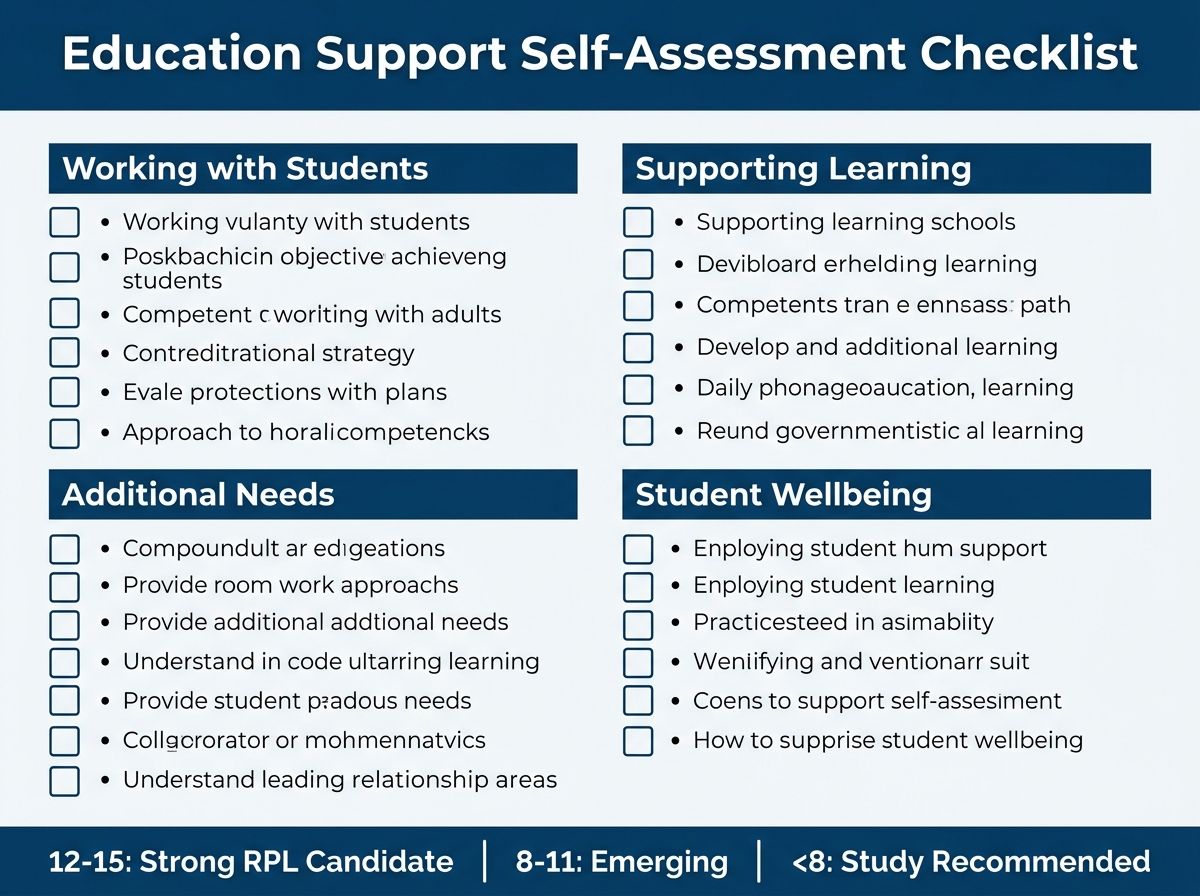
Working with students and teachers
- I support individual students or small groups with learning tasks under the direction of the classroom teacher
- I understand my role in the classroom and work within the boundaries set by the supervising teacher
- I communicate regularly with classroom teachers about student progress, concerns, or changes in behaviour
- I follow school policies and procedures in my daily work, including those related to student safety and welfare
Supporting student learning
- I assist students with reading, writing, or numeracy tasks — adapting my approach based on the student's needs
- I help students understand instructions or complete set tasks when they are struggling
- I use or adapt learning materials to support students at different levels
- I observe and record student responses to learning activities and report these to the teacher
Supporting students with additional needs
- I work with students who have a disability, learning difficulty, or English as an additional language
- I implement support strategies for these students as directed by the classroom teacher or specialist staff
- I am aware of individual student support plans and adjust my approach accordingly
Student wellbeing and safety
- I recognise signs that a student may be experiencing distress, difficulty, or a welfare concern
- I follow the school's procedures for reporting concerns about student wellbeing
- I contribute to a safe, inclusive, and respectful classroom environment
Your score
Count your ticks and use this guide:
- 12–15 ticks: Your experience lines up well with the CHC30221 competency requirements. RPL is likely to be a relevant pathway for your situation — a skills review would help confirm this.
- 8–11 ticks: You are meeting many of the requirements. RPL may still be a strong option, and any gaps can often be addressed through targeted gap training rather than full re-study.
- Below 8 ticks: There may be areas of the qualification you have not yet had the opportunity to demonstrate in your current role. Traditional study or a combination of study and RPL may be more appropriate. A skills review can help clarify the right approach.
What your score means (and what happens next)
A high score does not guarantee an RPL outcome — that determination is made by a qualified assessor from a registered training organisation (RTO). What it does tell you is that your experience is likely to be relevant evidence, and that starting from scratch may not be necessary.
If your score was in the mid-range, gap training is a common part of the RPL process. It addresses specific competency areas where your experience may be limited or where additional evidence is needed. Gap training is typically provided as part of the RPL assessment process — check the specific terms with any RTO you engage.
If your score was low, that is useful information too. It may mean that RPL is not the right pathway for you right now — and an honest assessment of that is more valuable than enrolling in a process that does not fit your situation. The right pathway depends on where you are, not where you want to be.
The decision is yours. But it should be an informed one.
Why education support workers are strong RPL candidates
Education support work is one of the most evidence-rich roles in the Australian workforce. Your daily work generates exactly the kind of documentation that supports an RPL application.

Think about what you produce and participate in on a regular basis: communication logs with classroom teachers, student support plans, observation notes, incident reports, attendance records, and feedback from supervising staff. These are not just administrative records — they are evidence of competency in action.
An RPL assessor is looking for evidence that you can demonstrate the required skills and knowledge in a real work context. In most professional roles, gathering that evidence takes significant effort. In education support, much of it already exists — in your school's systems, in your supervisor's records, and in the daily interactions you have with students and teachers.
This does not mean the RPL process is without effort. Presenting your experience as evidence requires structure, reflection, and guidance. But the raw material is there. Your work speaks. The question is how to help it be heard.
The difference between studying for the Cert 3 and getting RPL for it
Both pathways lead to the same outcome: the CHC30221 Certificate III in School Based Education Support, issued by a registered training organisation and nationally recognised across Australia. The difference is in how you get there.
Traditional study means completing units through coursework — attending classes or working through online modules, submitting assignments, and demonstrating competency through structured learning activities. It is designed for people who are building competency from the ground up. Indicative study durations and costs vary between RTOs; checking directly with providers will give you the most accurate picture for your situation.
RPL is an assessment pathway. Instead of completing coursework, you present evidence of existing competency — workplace documentation, supervisor statements, professional references, and structured reflections on your practice. A qualified assessor from an RTO reviews that evidence against the qualification's requirements and determines whether competency has been demonstrated. RPL it guides you through that process; the RTO conducts the assessment and issues the qualification.
RPL is not a shortcut. It is a rigorous assessment process that takes your existing experience seriously. It is appropriate for people who already have the competency — not for those who are still developing it. If your checklist score suggests you are in the former category, RPL is worth exploring.
If you are in the latter category, traditional study is the more appropriate pathway — and there is no shame in that. The qualification exists to make sure education support workers have the skills students need them to have. The pathway to it should match where you actually are.
How to find out if you're a strong RPL candidate for the CHC30221
Your checklist score is a starting point, not a determination. The next step is a conversation — one that costs nothing and commits you to nothing.
A free skills review gives you an honest assessment of whether RPL is likely to be a suitable pathway for your specific situation. It looks at your work history, the types of evidence you can access, and the qualification requirements — and it tells you clearly whether RPL is worth pursuing, whether gap training is likely to be needed, or whether a different pathway makes more sense.
If RPL is not right for you, the review will say so. That honesty is the point. Enrolling in a process that does not fit your situation wastes your time and your money. A skills review exists to prevent that.
You have the experience. The question is whether it can be presented as evidence — and whether the CHC30221 RPL pathway is the right way to do that. The decision is yours. But it should start with the right information.
Ready to Get Recognised?
Start with a free skills review to find out if RPL is right for you.