Why your A-Grade electrical licence doesn't cover split systems
An A-Grade electrical licence covers complex wiring, but not split system refrigerant handling. This is the regulatory line electricians must understand.
The logic that gets electricians into trouble
You can wire a switchboard, commission a three-phase motor, and sign off on complex commercial electrical installations. Your A-Grade licence represents years of training and proven competence. So when a customer asks you to install a split system, the assumption that you are covered makes complete sense.
It is, however, wrong. The gap between that reasonable assumption and the regulatory reality is where experienced electricians find themselves unexpectedly exposed.
This is not a reflection on your skill. Rather, it shows how poorly the industry communicates a specific regulatory boundary, which sits right in the middle of a job you are technically capable of doing.
What an A-Grade licence actually covers (and what it doesn't)
An A-Grade electrical licence covers electrical work. That means wiring, connections, switchboard installation, testing, and commissioning of electrical equipment. When installing a split system, the A-Grade covers the electrical connections, which includes running the wiring between the indoor and outdoor units, connecting to the power supply, and testing the electrical components.
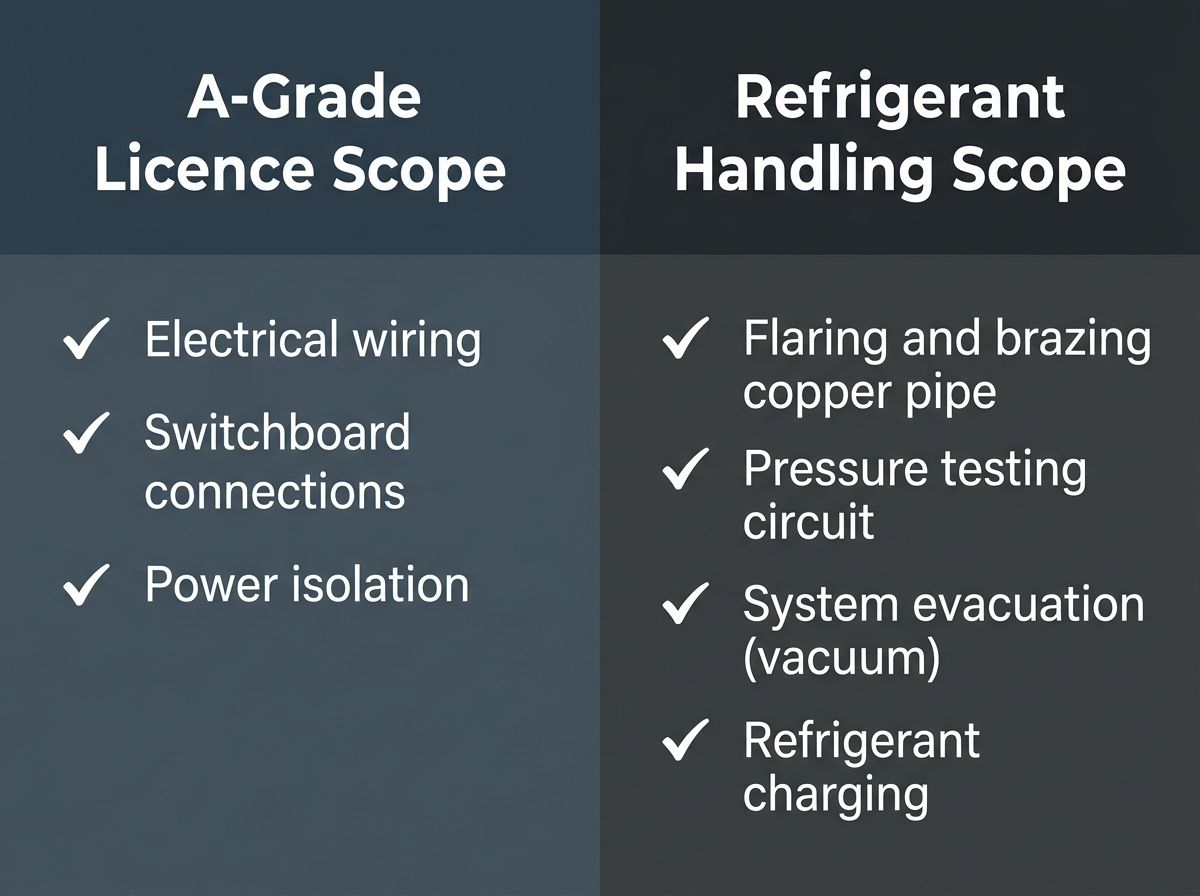
What it does not cover is refrigerant handling. The refrigerant circuit, including the copper lines, brazing, pressure testing, vacuuming, and charging, sits in an entirely separate regulatory domain. This domain is governed by a different licensing framework, administered separately from the electrical licensing system.
A split system installation involves both. The A-Grade covers the first. It does not cover the second.
The refrigerant handling boundary: Where the A-Grade stops
Refrigerant handling in Australia is regulated separately from electrical work. The Australian Refrigeration Council (ARC) administers the licensing framework for refrigerant handling, and you need a separate refrigerant handling licence to legally work on the refrigerant circuit of any air conditioning system, including split systems.
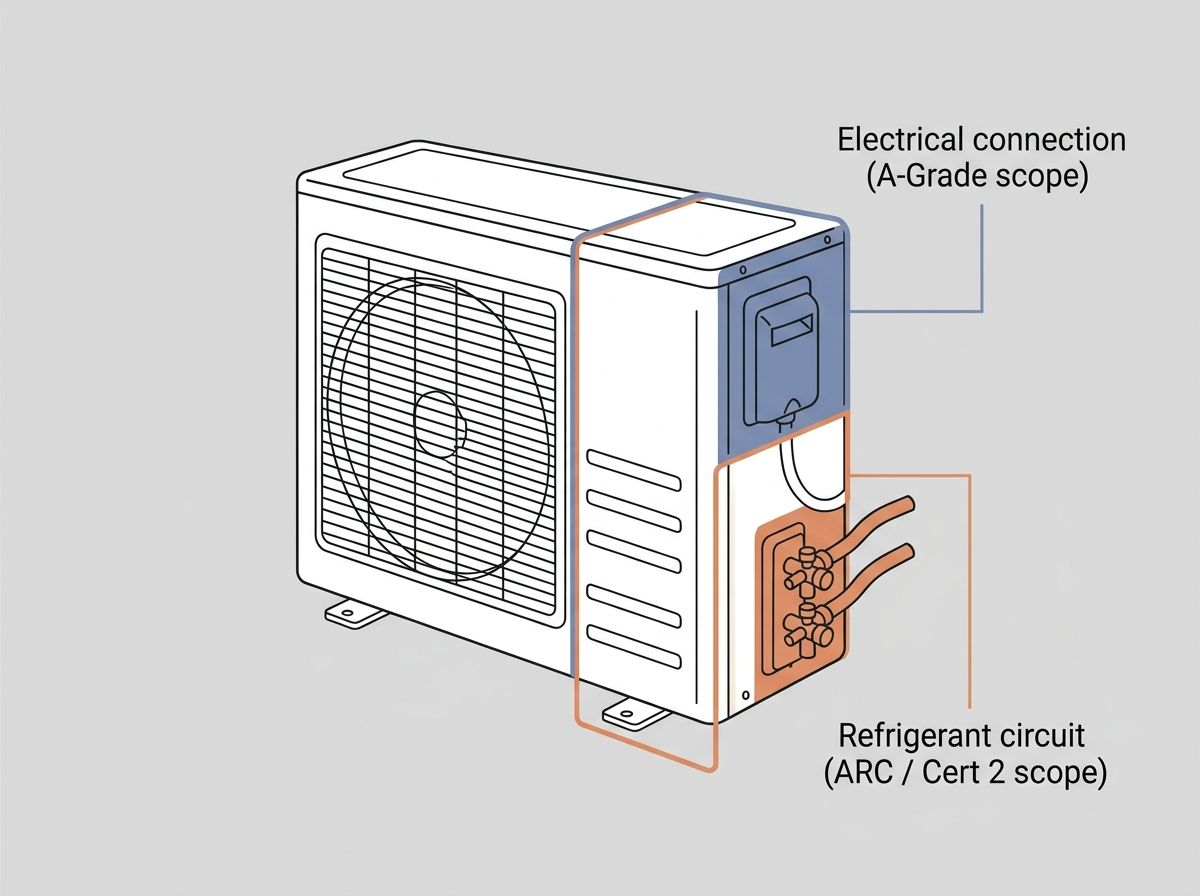
The specific tasks that constitute refrigerant handling include connecting and disconnecting refrigerant lines, brazing copper pipework, pressure testing the refrigerant circuit, evacuating (vacuuming) the system, and charging the system with refrigerant. These are not electrical tasks. They are refrigerant tasks, and they require a separate licence.
This is not a grey area. An A-Grade electrician can legally connect the electrical components of a split system. They cannot legally perform the refrigerant circuit work without the appropriate refrigerant handling licence, regardless of how many split systems they have installed or how competent they are.
The boundary is hard. The enforcement is real.
The penalties for unlicensed refrigerant handling are significant, and they apply regardless of how well the work was done.
Why this misconception is so common (and so costly)
The misconception persists because the electrical and refrigerant work in a split system installation are physically inseparable. You are on the same job site, working on the same unit, at the same time. The copper refrigerant lines run alongside the electrical cables. The indoor and outdoor units are connected by both. From the outside, it looks like one job.
Regulatorily, it is two jobs. And only one of them is covered by your A-Grade.
The system does not make this obvious. Electrical licensing and refrigerant licensing are administered by different bodies, under different frameworks, with different training requirements. An electrician completing their A-Grade training is not routinely told that split system refrigerant work requires a separate licence. The gap in regulatory communication is real.
But enforcement does not care about the communication gap. If you are performing refrigerant handling work without the appropriate licence, you are exposed, regardless of whether anyone told you clearly that you needed it.
There is also an insurance dimension worth considering. Electrical contractor insurance policies are typically scoped to electrical work. Work performed outside the scope of your licence, including unlicensed refrigerant handling, may not be covered by your policy. That is a significant liability exposure on top of the regulatory risk.
The Cert 2 air conditioning: What it covers and why it matters
The Certificate II in Split Air Conditioning and Heat Pump Systems (UEE20120) is the qualification that addresses the refrigerant handling gap. It covers the competencies required to legally install, commission, and service split system air conditioning units, which includes the refrigerant circuit work that sits outside A-Grade scope.
For an A-Grade electrician, this is not a beginner qualification. It is a targeted credential. You already hold a high-level electrical licence. The Cert 2 Air Conditioning adds the specific refrigerant handling competency that your A-Grade does not cover, allowing you to legally complete the full scope of a split system installation without subcontracting the refrigerant work.
The qualification is nationally recognised under the Australian Skills Quality Authority (ASQA) framework. The qualification code is UEE20120. It is the credential that closes this specific gap.
For experienced electricians who have been doing split system work, including the refrigerant circuit, Recognition of Prior Learning (RPL) may be a pathway to the qualification. RPL is an assessment process, not a training program. It assesses whether your existing competence meets the standard required by the qualification. It is rigorous and is not a shortcut. But for an A-Grade electrician with genuine split system experience, the assessment draws on work you have already completed rather than requiring you to sit through classes for skills you already use daily.
How the RPL pathway works for experienced tradespeople approaching the Cert 2 Air Conditioning.
See the Certificate II in Split Air Conditioning and Heat Pump Systems (UEE20120) qualification page for more details.
What this means for A-Grade electricians doing split system work
In practical terms, this regulatory boundary leaves A-Grade electricians who want to offer split system installations with two options.
The first option is to subcontract the refrigerant work. An A-Grade electrician can legally perform the electrical connections. The refrigerant circuit work, such as brazing, pressure testing, vacuuming, and charging, must be completed by a separately licensed HVAC technician. This is a legitimate approach. It adds coordination complexity and cost, but it keeps both parties operating within their licensed scope.
The second option is to obtain the Cert 2 Air Conditioning (UEE20120). This allows you to legally complete the full scope of a split system installation, both electrical and refrigerant, without subcontracting. For electricians who want to offer a complete service, or who are already doing the full installation and want to formalise that work, this is the credential that makes it legal.
Neither option is right for everyone. The decision depends on your business model, the volume of split system work you do, and whether you have the experience to support an RPL assessment. What matters is making the decision with an accurate understanding of what your A-Grade covers and what it does not.
If you have the experience, you have the evidence
For A-Grade electricians who have been doing split system installations, including the refrigerant circuit work, the RPL pathway for UEE20120 is worth understanding. RPL assesses whether your existing competence meets the standard required by the qualification. It is not a training program, and it does not assume you need to learn what you already know.
The evidence required for an RPL assessment typically includes records of the work you have done, such as job records, photographs, logbooks, employer confirmation, and documentation of your working practices. If you have been doing split system installations to industry standard, that work is your evidence. The assessment determines whether it meets the qualification standard.
RPL is not suitable for everyone. Not every applicant will have the required evidence, and not every application will result in a qualification. The assessment is genuine and the standard is real. But for an A-Grade electrician with substantial split system experience, the RPL pathway means the assessment starts from what you have already done, rather than starting from scratch.
You have the experience. The question is whether it meets the assessment standard. That is an honest question, and it deserves an honest answer before you commit to anything.
Ready to Get Recognised?
Start with a free skills review to find out if RPL is right for you.