What WA's builders licence requirements actually ask for (it's not what most people assume)
Most WA builders assume they need formal study to get licensed. They're wrong. Here's what actual evidence requirements ask for and why experience counts.
By RPL it Australia10 min read
The myth: You need to go back to school to get your WA builders licence
Ask around on any WA construction site and you will hear the same thing: to get your builders licence, you must go back to TAFE. Do a course, sit in classes, and get a qualification the conventional way. This advice is repeated so often it is now accepted wisdom. For many experienced builders, it is the sole reason they have put off their licence for years.
The reality is different. WA does not license builders the way most people assume. The state registers them, and this registration system is built around demonstrated competency, not classroom attendance. Your years managing projects, supervising trades, and delivering compliant structures are the exact evidence the system is designed to assess. The problem is not that your experience does not count; it is that most builders do not know how to present it in a format the system recognises.
This article explains what the WA building registration framework actually requires, where the common myths come from, and what your options are if you have been putting this process off.
Where the myth comes from (and why it keeps spreading)
The confusion makes sense. The WA registration framework references qualifications, specifically the Diploma of Building and Construction. When builders see that word, they assume it requires classroom study. Builders who went through a traditional training pathway naturally assume that is the only route, and word-of-mouth on job sites does the rest.
What the framework does not make obvious is that there are multiple registration pathways, and for experienced builders, the route does not have to go through a classroom. An education provider's summary describes Western Australia as having five different registration pathways, each with different qualification and experience requirements. The qualification-based pathway is only one of them.
The system is complex. Registration language is dense, the application process involves multiple forms, and the distinction between a Building Practitioner Registration and a Building Contractor Registration is not always clear from the outside. This complexity leads to the assumption that formal study is the entry point for everyone, but it is not.
What the WA building registration framework actually requires
In Western Australia, the relevant authority is the Department of Energy, Mines, Industry Regulation and Safety (DEMIRS). This department administers building licensing, including registered building contractors and practitioners.
The official term is not "builders licence", but building contractor registration. According to the Australian Government's ABLIS service, registration as a building contractor in WA is required if you intend to contract with clients to provide building services that meet the definition of builder work, be named as a builder on a building permit, or use a prescribed title such as "registered building contractor".
Builder work is defined as building work that requires a building permit, has a value of at least $20,000 (or $50,000 for a Class 10a building such as a private garage, shed, or carport), and is carried out in a designated area of the state.
The WA Government's published scope of work for building practitioners covers managing and supervising construction, erection, assembly, or placement of a building; renovation, alteration, extension, improvement, or repair; assembly or securing of a relocated building; and specified site work.
To be eligible for registration as an individual building contractor, you must not be an ineligible person, you must be a registered building practitioner, you must have sufficient financial capacity to meet your debts, and you must have arrangements in place to ensure builder work is managed and supervised proficiently.
The compliance requirements for building practitioner registration include holding an appropriate qualification or equivalent, having appropriate experience, being a fit and proper person, and complying with the relevant legislation, including the Building Services (Registration) Act 2011.
The phrase "appropriate qualification or equivalent" is where the myth breaks down. The framework does not mandate formal study only. It accepts an equivalent pathway, which is the option most experienced builders do not know exists.
For more detail on the WA builders licence pathway, visit the RPL it Trade Licence WA Builders Licence page.
Why demonstrated project experience counts for more than most builders realise
Demonstrated project experience is the primary evidence the licensing authority assesses. The Building Services Board is not trying to test whether you can pass a written exam. It is trying to establish that you can safely and competently manage building work to the required standards.
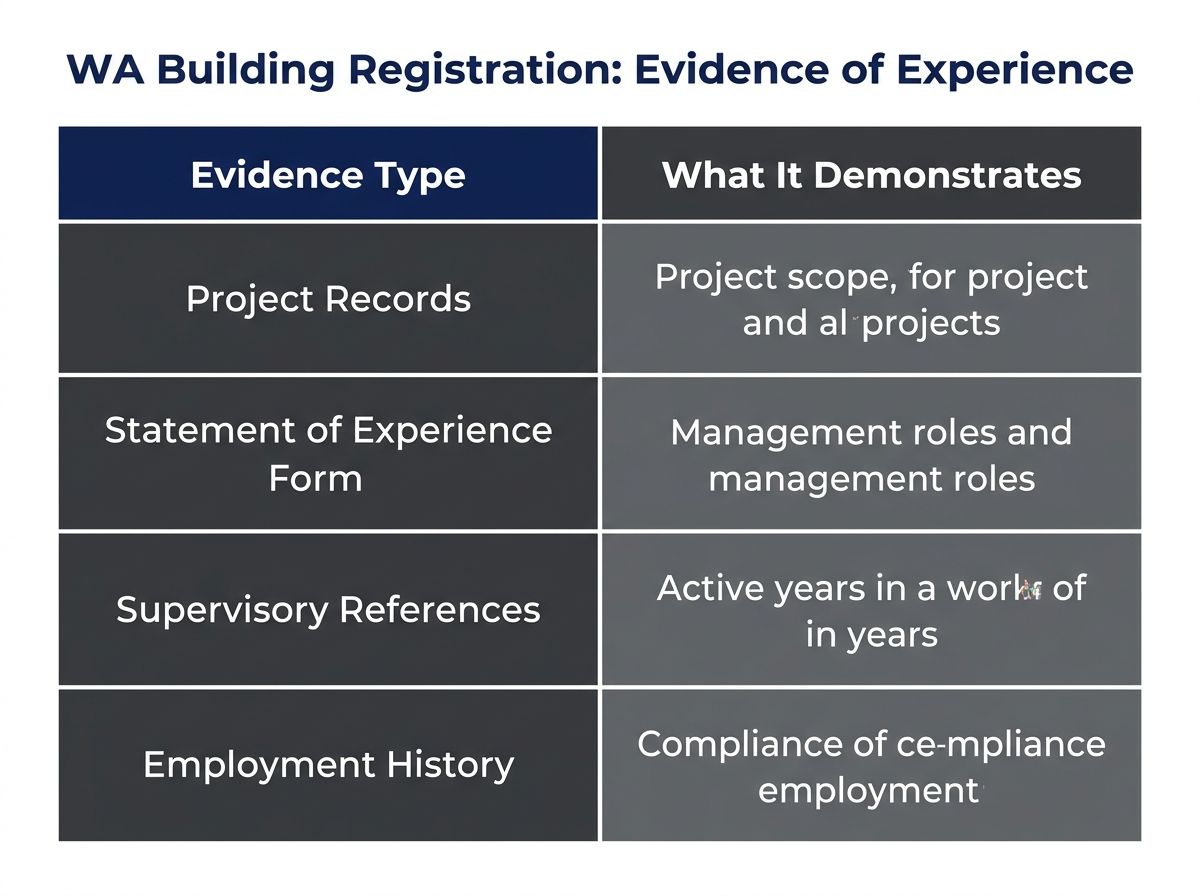
An education provider's summary of the WA framework notes that the Building Services Board expects experience to demonstrate supervision, coordination, and compliance rather than just hands-on trade work. Applicants also typically need to provide a reference from a licensed builder.
Building and Energy publishes a form titled "Statement of Building Experience – Part 1" which applicants use to document their experience. The form references employment type, whether full-time, part-time, or as required, and the percentage of time spent on a project as a manager. This shows the kind of evidence the system is designed to capture: documented work history rather than exam results.
A WA government reforms document proposed that applicants provide evidence of experience, including interpreting plans, documentation, and specifications, and building in accordance with the permit authority. This is the work experienced builders do daily. The same document discussed applicants gathering evidence of experience and references, and suggested using an electronic or hardcopy logbook to record work history and identify supervisors.
The main point is that the system is designed to capture real work. Years of managing projects, coordinating subcontractors, reading plans, and delivering compliant structures represent the exact evidence the framework asks for. The challenge for most experienced builders is not a lack of experience, but knowing how to collect and present it in a format the system recognises.
The part nobody tells you: If a qualification is required, it can often be obtained through RPL
In some WA registration pathways, a formal qualification is listed as a requirement. According to an education provider's summary, Set 1 requires the CPC50220 Diploma of Building and Construction plus seven years of full-time experience. Set 4 describes a pathway where knowledge and skills assessed as equivalent to the Diploma, which RPL can support, plus experience supervising or managing building construction within WA, may satisfy the requirements.
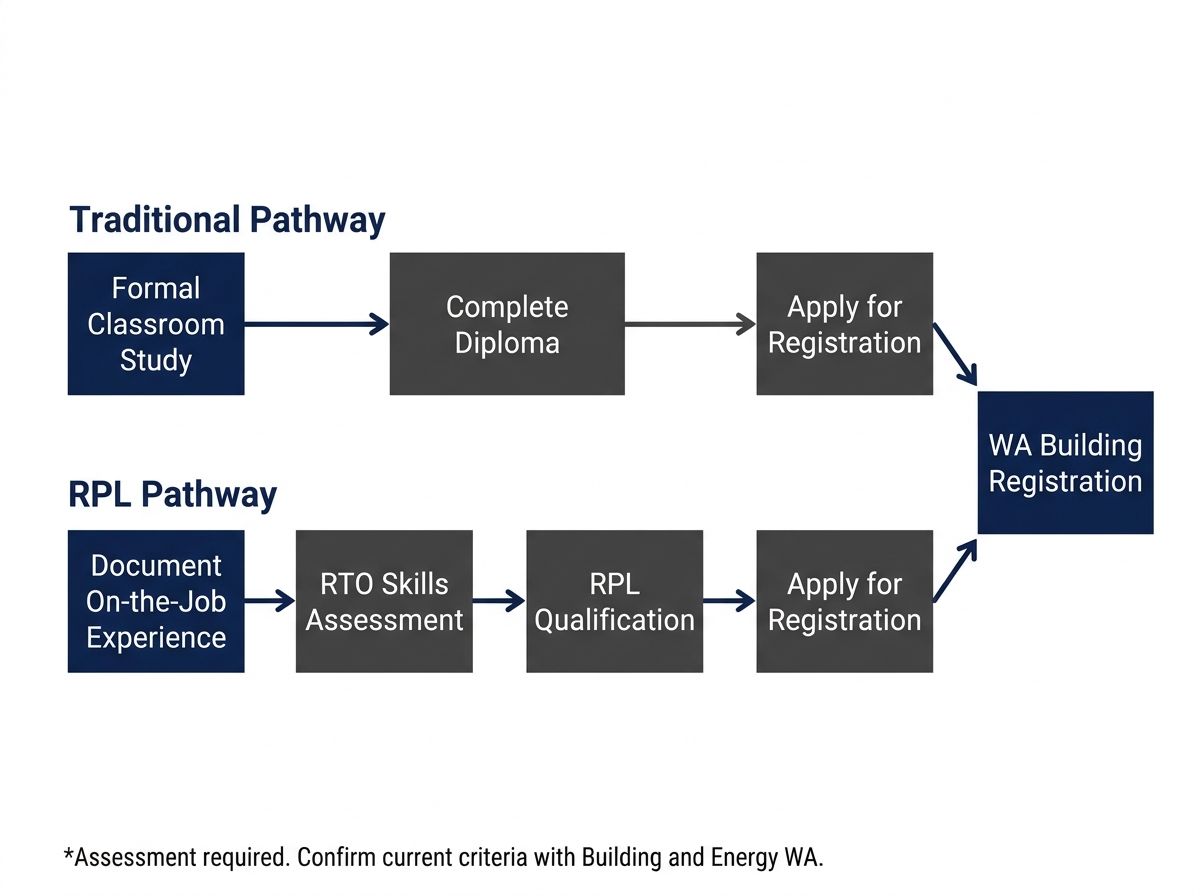
Many builders do not know that when a qualification is required, it can often be obtained through Recognition of Prior Learning (RPL). This is a formal assessment process where your existing experience is mapped against the qualification's competency units. If you can demonstrate competency, you receive the qualification without completing a conventional classroom course.
Multiple registered training organisations list the CPC40120 Certificate IV in Building and Construction as available via RPL. One provider describes RPL as a formal assessment process that recognises skills and knowledge built through real work in the building industry. Another states that RPL applicants must have at least two years of industry experience, while a third lists entry expectations of three to four years of demonstrated experience and at least two work referrals from qualified builders.
It is important to be clear about what RPL is and is not. It is not a shortcut. It is a rigorous assessment process that starts from your existing experience rather than from zero. Providers note that RPL assessment measures existing skills and experience against the qualification's performance criteria. This may reduce the amount of training required rather than eliminating it automatically, and gap training may still be required in some cases.
Obtaining a qualification through RPL is only one step in the process. As one training provider notes, RPL can help you obtain the qualification, but the Building Services Board still independently assesses your experience. The qualification and the registration remain separate assessments.
Builder licensing is administered separately by each Australian state and territory, and qualification requirements differ between jurisdictions. There is no single national builder's licence standard.
One training provider notes that "additional units of competency may be required to meet builder registration requirements in various States and Territories" and directs readers to their local licensing body for confirmation. This is sound advice. Always confirm current requirements with Building and Energy WA before proceeding.
What this means if you have been putting off your licence
If you have been delaying your WA building contractor registration because you assumed you would need to go back to school, the evidence suggests you may be closer to eligibility than you realised. The barrier is not your experience, but knowing how to present it.
The next step is not enrolling in a course. It is a realistic assessment of whether your experience meets the requirements. This means identifying which of the five registration pathways applies to your situation, reviewing the evidence you have of your project history and supervisory experience, and checking whether a qualification is required, and if so, whether it can be obtained through RPL.
Registration as a building contractor in WA is valid for three years, meaning once you are registered, your status is secure for that term.
Your experience is real. The next step is simply formatting it correctly for the assessors.
Frequently asked questions: WA builders licence requirements
Do I need a builders licence to work in WA?
In WA, the correct term is building contractor registration, not a builders licence. Registration is required if you intend to contract with clients for building work valued at $20,000 or more (or $50,000 for Class 10a structures such as sheds, garages, and carports), where a building permit is required, and the work is carried out in a designated area of the state. If any of those three conditions are not met, registration may not be required, but you should confirm this with Building and Energy WA and your local government permit authority.
Does experience count toward a WA builders licence?
Yes. Demonstrated experience is a central component of the WA building registration framework. The compliance requirements demand appropriate experience alongside an appropriate qualification or equivalent. An education provider's summary notes that the Building Services Board expects experience to demonstrate supervision, coordination, and compliance, rather than just hands-on trade work. Building and Energy publishes a Statement of Building Experience form for applicants to document their project history.
Do I need to go to TAFE to get a WA builders licence?
Not necessarily. WA has multiple registration pathways with different qualification and experience requirements. Some pathways require a formal qualification like the Diploma of Building and Construction, while others accept equivalent knowledge and skills demonstrated through experience. Where a qualification is required, you may be able to obtain it through Recognition of Prior Learning (RPL), which formally assesses your existing skills, instead of completing conventional study. Confirm which pathway applies to your situation with Building and Energy WA.
What evidence do I need for a WA builders licence application?
Building and Energy WA publishes a Statement of Building Experience form as part of the application process. Evidence typically relates to your employment history, the type of work performed, and your role on projects. A WA government reforms document proposed that evidence should include interpreting plans, documentation, and specifications, as well as building in accordance with permit authority requirements. References from licensed builders are also typically expected. Confirm current requirements directly with Building and Energy WA before applying.
Can I get a WA builders licence without a formal qualification?
Potentially, depending on which registration pathway applies to you. WA has five registration pathways with different requirements. Some require a specific qualification, while others recognise equivalent competency demonstrated through experience, professional membership, or other means. An education provider's summary describes pathways for architects, engineers, and Australian Institute of Building members that do not require the standard Diploma pathway. Confirm your eligibility with Building and Energy WA.
Can I transfer my builders licence from another state or New Zealand?
If you are registered or licensed as a building contractor in another Australian state or territory or in New Zealand, you may be eligible for mutual recognition. Holders of a current trade licence from New Zealand or interstate may be eligible for recognition in WA under the Mutual Recognition Act 1992 or the Trans-Tasman Mutual Recognition Act 1997. Contact Building and Energy WA directly to confirm your eligibility and the process.
How long does WA building contractor registration last?
Registration as a building contractor in WA is valid for three years. Check current renewal requirements and fees directly with Building and Energy WA.
General information only, current at the date shown. Licensing rules change, so check the current requirements with the relevant regulator before you rely on them. RPL it Australia is a student support service, not a Registered Training Organisation; qualifications are assessed and issued by our partner RTOs.