Do Mechanics Need a Licence in WA? The Rules for Experienced Techs
WA has specific licensing requirements for automotive technicians. Find out if you need a licence and what to do if you are already working in the trade.
By RPL it Australia7 min read
The short answer, and why it is more complicated than you might expect
Do mechanics need a licence in WA? The short answer is that it depends on how you work. Western Australia has licensing requirements for automotive technicians, but they do not apply to every mechanic in every situation. That distinction is what catches many experienced techs off guard.
Many experienced mechanics assume that years of hands-on work, such as diagnosing faults, servicing engines, and managing complex repairs, is sufficient. In some circumstances, that assumption is correct. In others, it is not. The licensing requirement is not a measure of your skill; it is a formal recognition of it. The gap between those two things is where the difficulty lies.
If you have worked in the trade for years without needing to think about this, you are not alone. Most experienced techs only encounter the licensing question when something changes, such as a new employer asking for it, a tender requiring it, or when they decide to go out on their own. By then, the gap between skill and formal recognition can feel like a significant hurdle.
What the WA licensing framework means for automotive technicians
Western Australia operates a trade licensing framework that applies to various occupations, including automotive technicians. The framework is designed to ensure that people working in certain roles hold a recognised qualification. This is not because regulators doubt your ability, but because a formal credential is how the system verifies competency.
For automotive technicians, the standard qualification is typically a Certificate III in a relevant automotive stream, such as light vehicle mechanical technology. This qualification is nationally recognised and forms the basis for the trade licence in WA. The licence itself is administered through the WA regulatory authority, and the requirements can vary depending on your specific work and context.
Licensing requirements in WA are subject to change, and the specific rules that apply to your situation depend on the type of automotive work you do and how you do it. The information in this article is general in nature. For authoritative guidance on your specific circumstances, the WA regulatory authority is the correct source.
The circumstances that catch experienced techs off guard
Most experienced mechanics do not realise that the licensing requirement does not apply equally to everyone in the trade. The difference is not your ability, but rather how you are working.
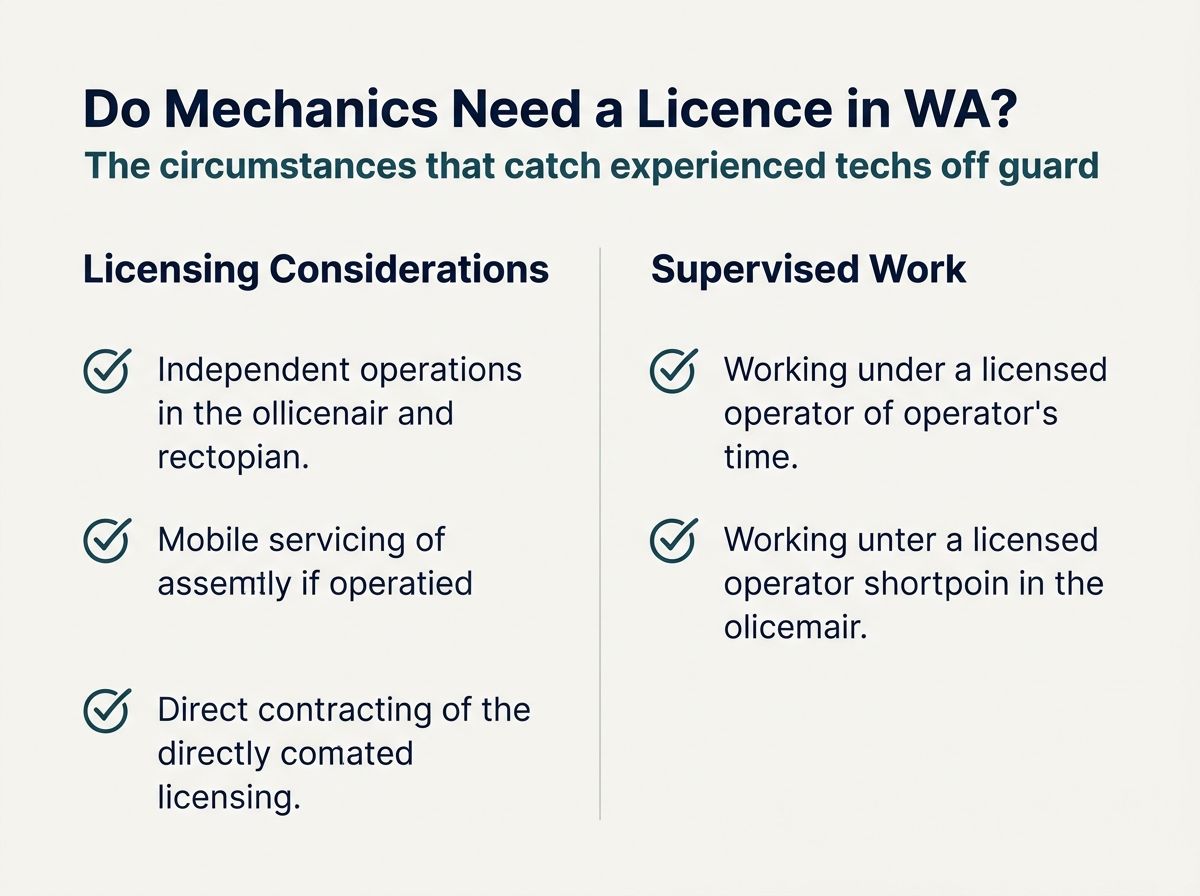
In general terms, mechanics employed by a licensed operator, working under someone else's licence and supervision, may be in a different position than those who operate independently. The licensing requirement tends to become directly relevant when a technician moves into independent work, starts their own workshop, takes on employees, or works in contexts where a formal credential is required by a client, insurer, or regulator.
This explains why some mechanics work without a licence while others face strict requirements. It is not a matter of skill, but rather of working circumstances. When circumstances change, such as a long-term employment relationship ending, an opportunity to go independent, or a tender requiring a formal credential, the licensing question becomes urgent.
Because WA licensing rules are specific and subject to change, you should check directly with the WA regulatory authority to confirm the exact requirements for your situation. Do not rely on informal advice or assumptions based on how things have worked in the past.
Why years of experience do not automatically satisfy the requirement
This is the part that frustrates experienced tradespeople most. You have been doing this work for years. You know the trade. You have solved problems that less experienced techs cannot touch. Yet the licensing system does not automatically recognise any of that experience.
The reason is structural, not personal. The WA licensing framework, like most formal credentialling systems, recognises qualifications rather than years of service. It requires formal evidence that your competency has been assessed against a recognised standard. Your experience is real, but in the system's eyes, it remains invisible until it has been formally assessed and documented.
This is where Recognition of Prior Learning (RPL) becomes relevant. RPL is a nationally recognised assessment pathway that allows your existing skills and experience to be formally measured against qualification standards. It does not ask you to repeat training you have already mastered. Instead, it asks you to demonstrate, through evidence, that you already meet the standard.
For experienced automotive technicians, RPL can be a pathway to the Certificate III qualification that underpins the WA trade licence, using the work you have already done as the basis for assessment. The assessment is conducted by a registered training organisation (RTO), which also issues the qualification. RPL it guides candidates through the process of preparing and presenting their evidence.
What is at stake if you operate without the required credential
The consequences of operating without a required licence vary depending on the specific circumstances and the regulatory framework. In general terms, working without a required trade licence in WA can expose a technician to regulatory action, fines, and the inability to legally perform certain work. It can also affect insurance coverage, as some professional indemnity and public liability policies require the relevant licence as a condition of cover.
Beyond the regulatory risk, there are commercial consequences. Tenders for government or corporate work often require formal credentials as a prerequisite. Employers in some sectors require the licence as a condition of employment. As the industry continues to professionalise, the informal arrangements that worked in the past are becoming harder to sustain.
This is not intended to alarm, but to be clear. The risk is real, but the pathway to resolving it is straightforward. Naming the consequences directly is more useful than pretending they do not exist.
For specific information about the consequences of unlicensed operation in WA, including any applicable penalties, the WA regulatory authority is the authoritative source. We do not publish specific penalty figures in this article because they are subject to change and vary by circumstance.
The RPL pathway: How experienced mechanics get qualified using their existing work
For automotive technicians with substantial hands-on experience, RPL is the assessment pathway that formally recognises existing skills. The process is straightforward: your work history, employment records, employer references, and demonstrated competency are compiled and presented as evidence. A qualified assessor from a registered training organisation then reviews this evidence against the units of the relevant Certificate III qualification.
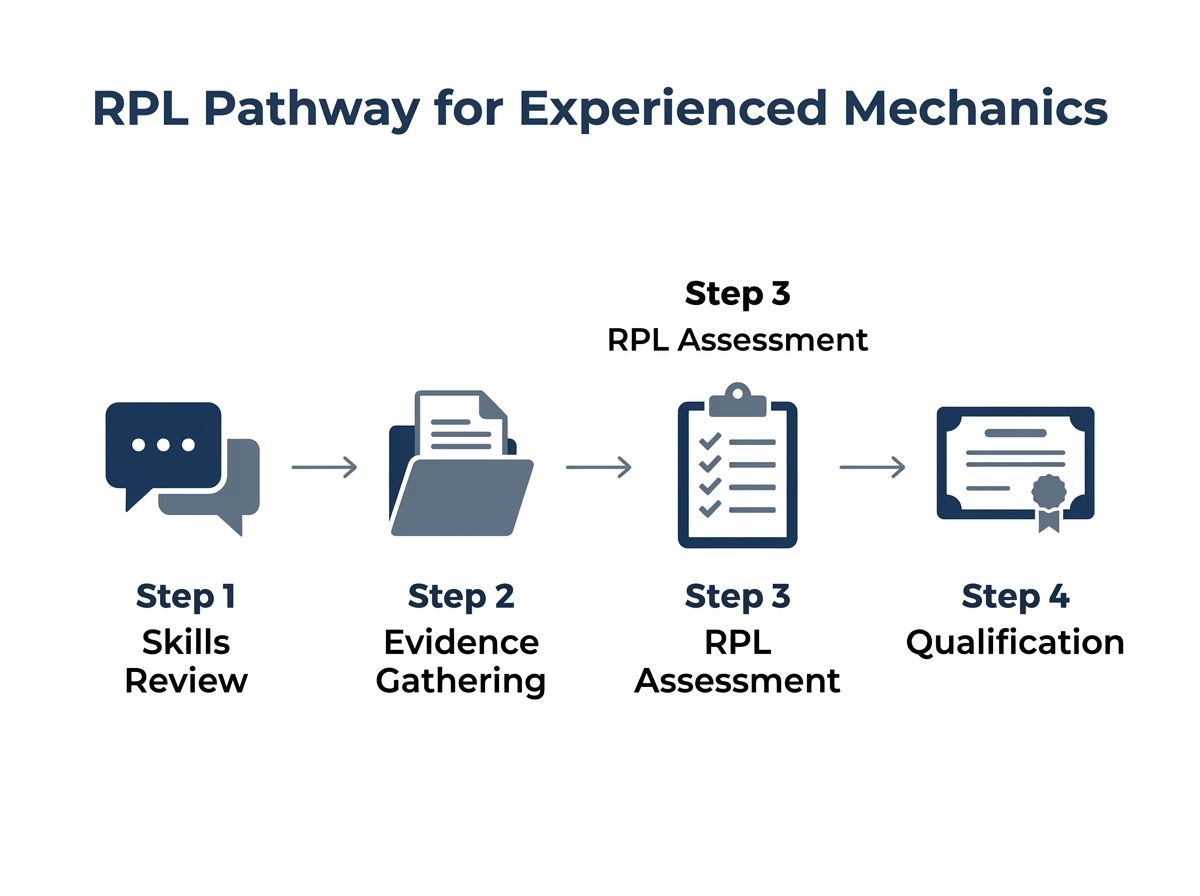
If your evidence demonstrates competency across all required units, the qualification is awarded. If there are gaps, meaning specific units or skills that have not been covered in your work history, gap training is provided to address them. Gap training is typically included in the RPL process at no additional cost.
The evidence that supports an automotive technician RPL application typically includes employment history, payslips, references from employers or supervisors, records of specific jobs or repairs, logbooks, job cards, and in some cases, practical demonstrations of skill. The specific evidence requirements depend on the RTO conducting the assessment.
The timeframe for an RPL assessment varies depending on the RTO, how complete your evidence is, and whether gap training is required. Any timeframes provided by an RTO should be treated as indicative, not guaranteed.
The outcome of a successful RPL assessment is a nationally recognised Certificate III qualification, which is the same qualification awarded to someone who completed a traditional apprenticeship. Because the assessment is genuine, the qualification carries the same weight. That qualification is then the basis for applying for the WA automotive technician trade licence through the relevant regulatory authority.
If you are considering this pathway, the WA Automotive Technician trade licence page has more detail on what the licence involves and how RPL fits into the process.
How to find out if you need the licence, and whether your experience qualifies
The fastest way to understand your position is to start with a Free Skills Review. This is an assessment of whether your existing experience supports an RPL application for the Certificate III. It is not an enrolment or a commitment. It is a direct conversation about where you stand and what your options are.
If RPL is a suitable pathway for you, you will see what the next steps look like. If it is not, whether because gaps make RPL unsuitable or because your circumstances do not require a licence, the review will clarify that. The goal is to provide honest guidance, not to push for enrolment.
You have the experience. The question is whether the system has formally recognised it. A Free Skills Review is where that conversation starts.
General information only, current at the date shown. Licensing rules change, so check the current requirements with the relevant regulator before you rely on them. RPL it Australia is a student support service, not a Registered Training Organisation; qualifications are assessed and issued by our partner RTOs.