The Liability Risks of Uncertified Tourism Staff
Uncertified tour guides cost more than you think in premiums, compliance risk, and client trust. Here is how operators standardise staff certification.

Your Guides Are Exceptional. The Paper Trail Is Not.
You hired your best guides for the right reasons. They know the terrain. They read a group. They turn a difficult day into a story guests retell for years. That is real skill, and you know it when you see it.
But formal systems do not assess for personality or local knowledge. They assess for documentation. In the gap between what your staff can do and what the formal system recognises, there is a liability that most tourism operators never see coming.
This is not about doubting your team. It is about understanding what their lack of formal certification costs your business, in ways that rarely appear on an invoice until something goes wrong.
What tourism certification actually means for your business
When people search for 'tourism certification' in an Australian business context, they are usually asking one of two questions: what certification do my staff need, and what happens if they do not have it?
The nationally recognised benchmark for tourism workers in Australia is the Certificate III in Tourism (SIT30125). According to the national training register, this qualification reflects the role of individuals who use well-developed tourism service, sales or operational skills and sound knowledge of industry operations to coordinate tourism services, working with some independence under limited supervision.
In plain terms: it formally recognises the skills your experienced guides already demonstrate every day. The qualification covers customer service, industry knowledge, cultural sensitivity, safe work practices, and, depending on elective choices, tour delivery, guiding, visitor information, product knowledge, and bookings. It is structured around 15 units: four core units and eleven electives, with the elective mix shaped by the job outcome and industry context.
The qualification is current as of August 2025 (Release 1, SIT30125) and lists no formal entry requirements on the national register. At the time of publication, no licensing, legislative or certification requirements apply to the qualification itself, though specific job roles or operating contexts may carry separate obligations.
The three areas where uncertified staff cost you money
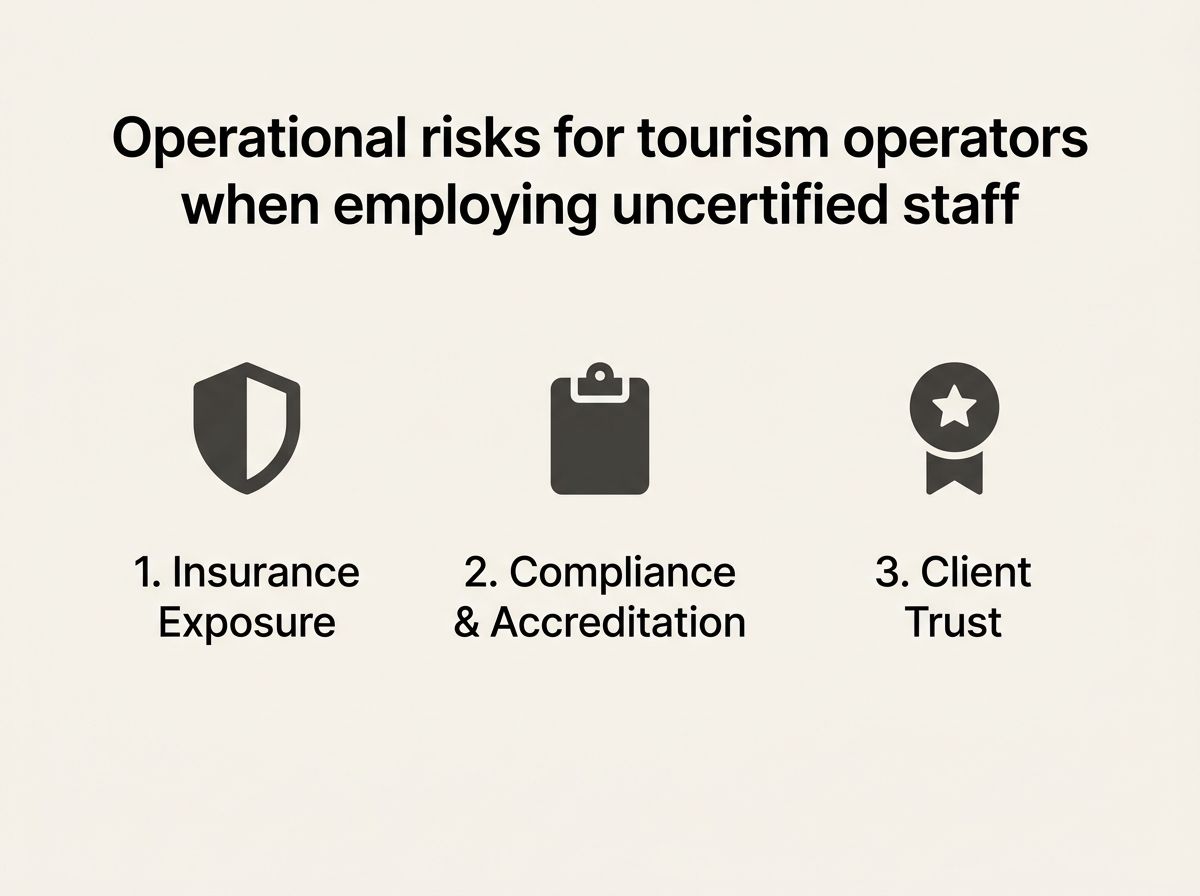
Most tourism operators think of staff certification as a training question. It is actually a business risk question. Here are three areas where the absence of formal certification creates real operational and financial exposure.
1. Insurance exposure
Public liability insurance is the foundation of any tourism operation. What many operators do not realise is that the qualifications and training of your staff can be a factor insurers consider when assessing risk. Staff certification, or the absence of it, can influence how an insurer views your duty of care obligations and your risk profile. If an incident occurs and it emerges that the staff member involved held no formal qualification for the role they were performing, your coverage position may be more complicated than you expect. The prudent approach is to ask your insurer directly how staff certification affects your policy conditions.
2. Compliance and accreditation risk
Tourism accreditation schemes and operator licensing frameworks increasingly reference workforce training standards. In Western Australia, for example, commercial operators working on Department of Biodiversity, Conservation and Attractions managed lands are subject to licensing conditions that include obligations around staff competency and safety. Accreditation bodies across Australia, including those operating in eco-tourism and nature-based tourism, reference staff training as part of their assessment criteria. If your operation depends on accreditation to access national parks, government contracts, or premium booking platforms, uncertified staff can become a compliance gap that puts that access at risk.
3. Client trust and reputational risk
In a market where bookings are driven by reviews and word of mouth, client trust is a commercial asset. Corporate travel buyers, government tourism procurement, and high-value tour operators are increasingly asking companies to demonstrate the credentials of their guides. A certified workforce is a signal clients can see and verify. Uncertified workforces represent a gap that, in the wrong context, becomes a reason to choose a competitor who can demonstrate formal standards.
The seasonal workforce challenge nobody talks about
Tourism operators face a structural challenge that most training systems are not designed for. The workforce is part-time-weighted, seasonally variable, and high-turnover. According to the Australian Bureau of Statistics, in the June quarter 2026, part-time tourism jobs (416,800) substantially outnumbered full-time tourism jobs (309,600), and part-time jobs grew 7.0% over the year, compared with just 0.4% growth in full-time roles.
That workforce structure matters for training. Traditional qualification pathways assume stable employment, classroom availability, and the ability to take staff off the floor for extended periods. In peak season, that is simply not an option for most tourism operators. You cannot send your best guides to TAFE in January.
Tourism Research Australia notes that measuring tourism employment is complex because tourism spans multiple industry classifications, which also means the workforce is spread across many different employment arrangements and training histories. The result is a workforce where experience is real but documentation is patchy.
Recognition of Prior Learning (RPL) is designed for exactly this situation. Rather than requiring staff to start from scratch in a classroom, RPL assesses the skills and knowledge they have already developed through their work. The assessment is conducted by a registered training organisation (RTO). If competency is demonstrated, the qualification is issued. If gaps are identified, targeted gap training is provided, not a full course.
How RPL turns existing experience into formal tourism certification
RPL is a formal assessment process under the Australian Qualifications Framework. It evaluates skills, knowledge, and experience gained through work, and can lead to a nationally recognised qualification without requiring the individual to repeat training they have already completed.
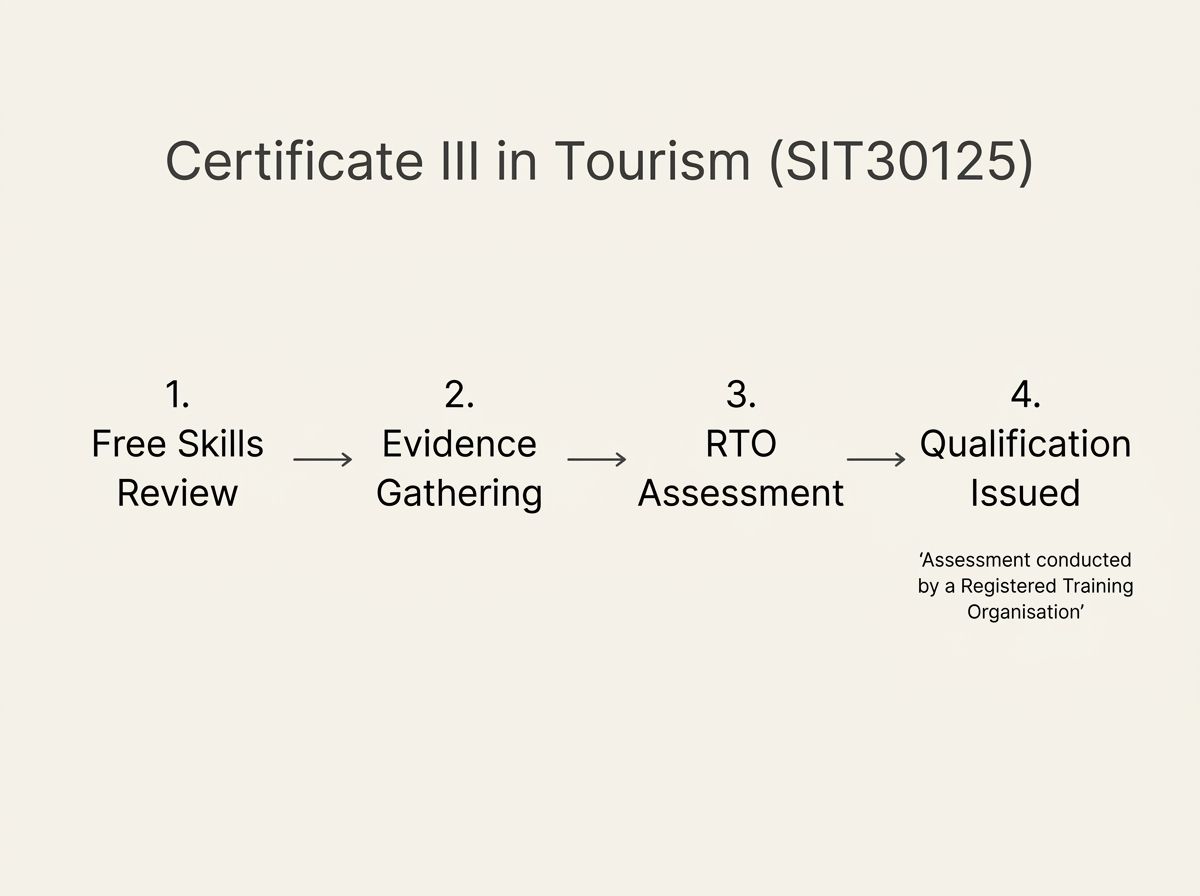
For a tourism operator, the process typically works like this. The staff member's existing experience is mapped against the units of competency in SIT30125. Evidence is gathered, which may include references from employers, job descriptions, work samples, records of past training, and practical demonstrations of skill.
A registered training organisation then conducts the formal assessment. If the assessor determines that competency has been demonstrated across the required units, the Certificate III in Tourism is issued. If gaps are identified in specific units, gap training is provided to address those areas before the qualification is awarded.
Employers can support the RPL process by providing workplace evidence, such as references, confirmation of the staff member's role and responsibilities, and records of on-the-job experience. Some RTOs indicate that employers may also sponsor or initiate the RPL process on behalf of their staff, though arrangements vary between providers. If you are considering this pathway for your team, confirm the specific process with the RTO you engage.
We should be clear about what RPL is and is not. It is a rigorous assessment pathway, not a rubber stamp. The assessor's professional judgement determines the outcome. That rigour is precisely what makes the resulting qualification meaningful to insurers, accreditation bodies, and clients.
The national training register confirms that SIT30125 is a current qualification with no formal entry requirements listed, making it accessible to experienced workers who may not have completed prior formal study.
What standardised certification does for client trust
Compliance is the floor, not the ceiling. Once your team holds formal certification, you gain something beyond risk mitigation: a credential you can communicate to clients.
Tourism accreditation schemes in Australia, including those operating in eco-tourism, nature-based tourism, and national park contexts, reference staff training and competency as part of their assessment criteria. Operators who can demonstrate a certified workforce are better positioned to meet these standards and access the markets that require them.
For corporate travel buyers and government tourism procurement, certified guides are increasingly a baseline expectation rather than a differentiator. A workforce that holds nationally recognised qualifications signals that your operation takes professional standards seriously, and that signal is visible to the clients who matter most.
Certification is more than a compliance cost. It is a client-facing asset. In a market where trust drives bookings, that signal has direct commercial value.
Tourism Research Australia tracks workforce data as part of the THRIVE 2030 strategy, which identifies growing a secure and resilient visitor economy workforce as a policy priority. This priority directly impacts the sector's long-term competitiveness.
The Free Skills Review: how to start without committing
You do not need to commit to a full RPL programme to find out whether your staff are suitable candidates. The starting point is a Free Skills Review. This is an honest assessment of whether your team's existing experience maps to the requirements of the Certificate III in Tourism, before any enrolment decision is made.
This is not a sales funnel. It is a diagnostic. If your staff's experience does not map to the qualification, you will be told that clearly. If it does, you will understand what the pathway looks like and what evidence is required.
Your guides have the experience. The question is whether the formal system can see it. A Free Skills Review is the first step toward finding out.
Ready to Get Recognised?
Start with a free skills review to find out if RPL is right for you.