Stop Starting at the Bottom: Your Tourism Experience Deserves a Certificate III
Years in tourism without a formal qualification? Learn how experienced tourism workers use RPL to get a Certificate III in Tourism without studying.
The hiring manager's blind spot: When experience does not count
You have managed group logistics across multiple destinations. You have rerouted itineraries mid-trip when borders closed without warning. You have handled client expectations that no training manual prepares you for, because those situations were never in a manual. Yet, when you apply for a senior tourism coordinator role, the feedback is always the same: 'We are looking for someone with a Certificate III in Tourism.'
This does not reflect your competence; it reflects how formal hiring systems are built. They look for credentials rather than actual careers. They notice the absence of a certificate instead of your years of real, complex, hands-on tourism work.
The Certificate III in Tourism exists to recognise the work you already do. Unfortunately, many experienced tourism professionals do not know there is a pathway designed to meet them where they are, without forcing them to sit in a classroom to relearn skills they use every day.
What the Certificate III in Tourism actually covers
The Certificate III in Tourism (SIT30125) is a nationally recognised qualification. It covers the core components of tourism operations, including working with tourism products and services, communicating with clients, applying cultural awareness, coordinating tourism services, and operating within industry regulatory and safety frameworks.
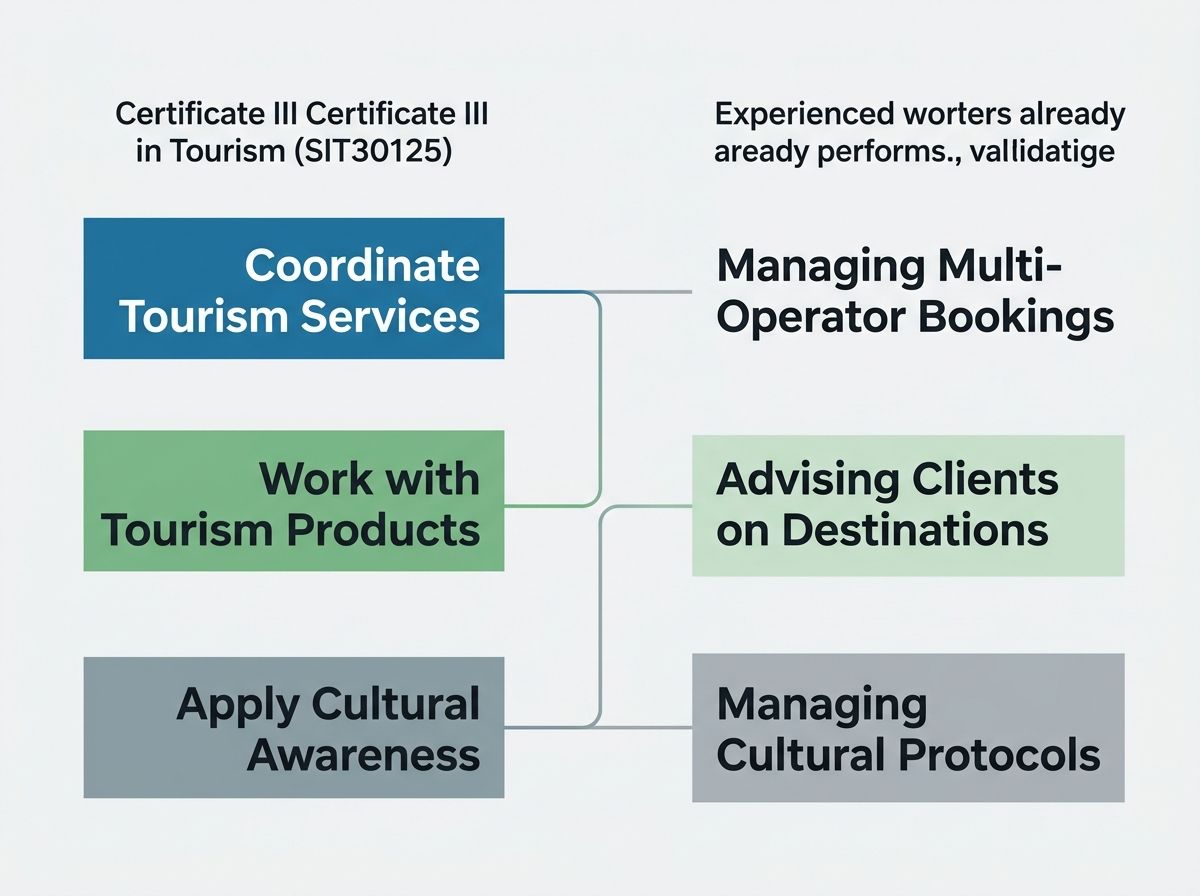
For anyone who has spent years working in tourism, whether in tour operations, travel agencies, cultural tourism, accommodation, or destination management, these are not abstract concepts. They make up the daily substance of your work. The qualification describes what you already do, and the RPL process assesses whether you can demonstrate that you do it.
The qualification code is SIT30125. Registered training organisations (RTOs) across Australia deliver this course, which employers throughout the tourism sector recognise as a standard professional credential.
Five common challenges for experienced tourism professionals
If you have worked in tourism for years without a formal certificate, you have likely faced at least one of these challenges. These are not personal failures; they are the logical result of an industry credential system that does not easily recognise informal learning pathways.
1. Being offered roles below your actual capability
You have trained junior staff, managed complex multi-stop itineraries, and handled operational crises that would challenge a seasoned manager. Without a certificate, however, job listings place you in the same category as school leavers. The job description and the pay rate fail to match your actual experience. This happens when recruitment systems use qualifications as a proxy for competence, especially when that proxy is inaccurate.
2. Having overseas tourism experience dismissed
You might have spent years coordinating inbound tourism in Southeast Asia, managing adventure tours in South America, or working in cultural tourism across the Pacific. That work is real and directly relevant. Yet when you return to Australia, employers often treat it as a gap rather than an asset. The system lacks a clean way to assess international experience, so it defaults to requiring an Australian qualification.
3. Gaps in employment continuity from the pandemic
The tourism industry was hit hard during the COVID-19 border closures. Many experienced professionals lost years of continuous employment records, not because their skills declined, but because the entire sector shut down. When tourism restarted, some found themselves competing against younger candidates with unbroken work histories and recent formal qualifications. The experience was genuine, but the paperwork trail had gaps.
4. Being asked to study topics you already teach
You are the person who onboards new staff, explains tourism products to clients, and manages the cultural protocols that make or break a group experience. You have worked at a professional level for years. Asking you to complete a Certificate III from scratch, including classes on subjects you already teach, is not just inefficient. It shows that the training system fails to recognise your existing expertise.
5. The qualification barrier to career progression
You are ready for a senior role. Your practical experience is strong and your references are solid. However, if the job description lists a Certificate III in Tourism as a mandatory requirement, your application may not survive the initial screening. Here, the qualification acts as a barrier rather than a fair measure of your ability. Employers screen you out based on a lack of paper credentials instead of evaluating what you can actually do.
Why this keeps happening: The credential gap in Australian tourism
The Australian tourism sector has a long history of informal entry pathways. Seasonal work, backpacker jobs, family-run businesses, overseas roles, and on-the-job training have all served as legitimate routes into the industry. Many of Australia's most experienced tourism professionals built their careers through these practical pathways rather than formal vocational study.
The formal training system, including the Certificate III in Tourism, was largely designed for people entering the industry. It was not built for those who have worked in tourism for years. This creates a clear mismatch: the qualification exists to certify competence, but the process for recognising existing skills, known as Recognition of Prior Learning (RPL), is not well understood by most workers or employers.
RPL is neither a shortcut nor a workaround. It is a formal assessment process governed by the same national standards as classroom study. It evaluates whether you can demonstrate the competencies required for the qualification. This pathway exists because the vocational education system acknowledges that you can gain competence through hands-on experience, not just through a classroom. When used properly, it ensures a fair assessment of your skills.
What RPL assessment involves for tourism experience
RPL is an evidence-based process. It does not involve sitting an exam, and it is not just a form you fill out. Instead, it is a structured assessment where a qualified assessor from a registered training organisation evaluates whether the evidence you provide demonstrates the actual competencies required for the Certificate III in Tourism.
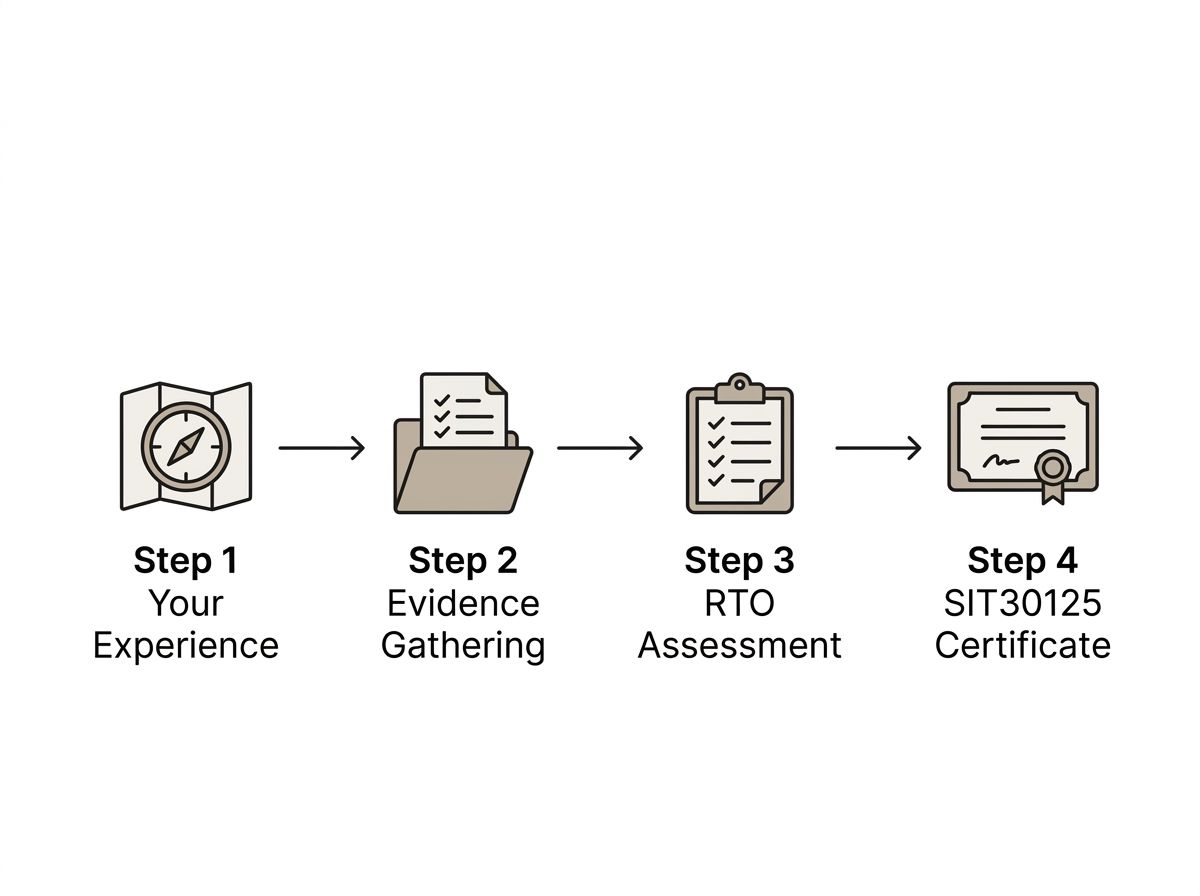
For tourism professionals, the evidence typically draws on the work you have already done. This includes records of itineraries you have coordinated, references from employers or clients, examples of client communications, documentation of cultural protocols you have applied, records of group logistics you have managed, and any training completed along the way. The assessor is looking for evidence that you can do what the qualification requires, not evidence that you studied it.
A qualified assessor from the delivering RTO conducts the actual assessment. RPL it helps candidates navigate this process by identifying what evidence is needed, organising it clearly, and preparing it for evaluation. This guidance is what RPL it provides. We do not assess your work directly, but we assist you in navigating the path to assessment.
We should be upfront about the RPL process. If the assessor finds that your evidence is insufficient for specific units, you may need to complete gap training. The delivering RTO provides this training at no extra cost. The purpose of this step is to make sure your final qualification reflects genuine, assessed competence, rather than finding reasons to reject your application.
To see how informal experience translates into formal evidence in other sectors, you can read our article on formalising supply chain experience, which explains the same assessment principles.
Is your tourism experience enough? What the assessment considers
This is the most critical question, and it deserves a direct, realistic answer rather than general reassurance.
The Certificate III in Tourism covers a range of practical units. Many of these align directly with common industry roles, such as coordinating tourism services, communicating with clients, using product knowledge, and operating within professional frameworks. If you have worked in tour operations, travel agencies, cultural tourism, or destination management, you likely perform these tasks on a regular basis.
Other units might not align as closely with your background, especially those covering niche operational systems, regulatory compliance paperwork, or specific service contexts. Whether your experience provides enough evidence for every unit depends on the specific details of your career history, not simply on how many years you have worked in the tourism sector.
RTO assessors do consider international tourism experience in Australian RPL applications, though verifying and documenting this work often requires careful preparation. You can also use experience from the pandemic period, including roles that ended abruptly or periods with work gaps, as long as you can support it with references, client records, or other documentation.
The plain answer to whether your experience is sufficient is that it depends on your specific background. The only way to find out is to have it evaluated. This is why we offer a Free Skills Review, which provides a straightforward conversation about how your skills align with the qualification before you make any commitment.
Recognition should not mean starting your career over
You already have the necessary skills. You have managed logistics, handled complex situations, and delivered the results that tourism employers look for. The vocational education system has a formal process to recognise your experience, which is an objective assessment of what you can prove you already know.
The Certificate III in Tourism via RPL is a rigorous, nationally recognised assessment pathway. It exists because practical experience is a valid form of proof. RPL it assists you throughout this process, helping you compile and present your professional history in a format that an assessor can easily evaluate.
The choice is yours. If you want to see if your experience meets the standard, you can begin with a free, no-obligation Skills Review.
Read more about the Certificate III in Tourism via RPL and how the assessment works.
Ready to Get Recognised?
Start with a free skills review to find out if RPL is right for you.