Decades of stonework, no certificate: the trade that time forgot to formalise
Trained as a stonemason before formal certification existed? You are not behind, the system is. Learn how RPL recognises decades of real stonework.
By RPL it Australia8 min read
The certificate that did not exist when you learned the trade
You have the experience. Decades of it. Stone selected by hand, mortar mixed to the right consistency, surfaces finished the way your mentor showed you, and his mentor showed him. You know how to read a wall. You know what a structure is telling you before anyone else on site does.
And then someone asks for the certificate.
For many experienced stonemasons working in Australia today, that moment feels like an accusation. It can feel as if the decades of work do not count. It can feel as if the sites completed, the heritage buildings restored, and the apprentices you quietly mentored do not add up to anything the system recognises.
Here is what that moment actually means: the formal qualification system caught up with the trade long after many of you had already mastered it. Stonemasonry in Australia became a nationally recognised VET qualification in recent decades. Many stonemasons who trained in the 1980s and 1990s, and some who trained well into the 2000s, did so through site-based mentorship, family trade succession, or informal apprenticeship arrangements. This was a time when no formal national certificate was required, or in some cases even available, in their region.
Being asked for a qualification now does not mean you lack skill. It simply shows a gap in the system. The trade did not forget to teach you. The system forgot to write it down.
How stonemasonry was actually taught and why that matters now
For generations, stonemasonry was not taught in a classroom. It was taught on site, over years, by someone who had already spent years learning the trade.
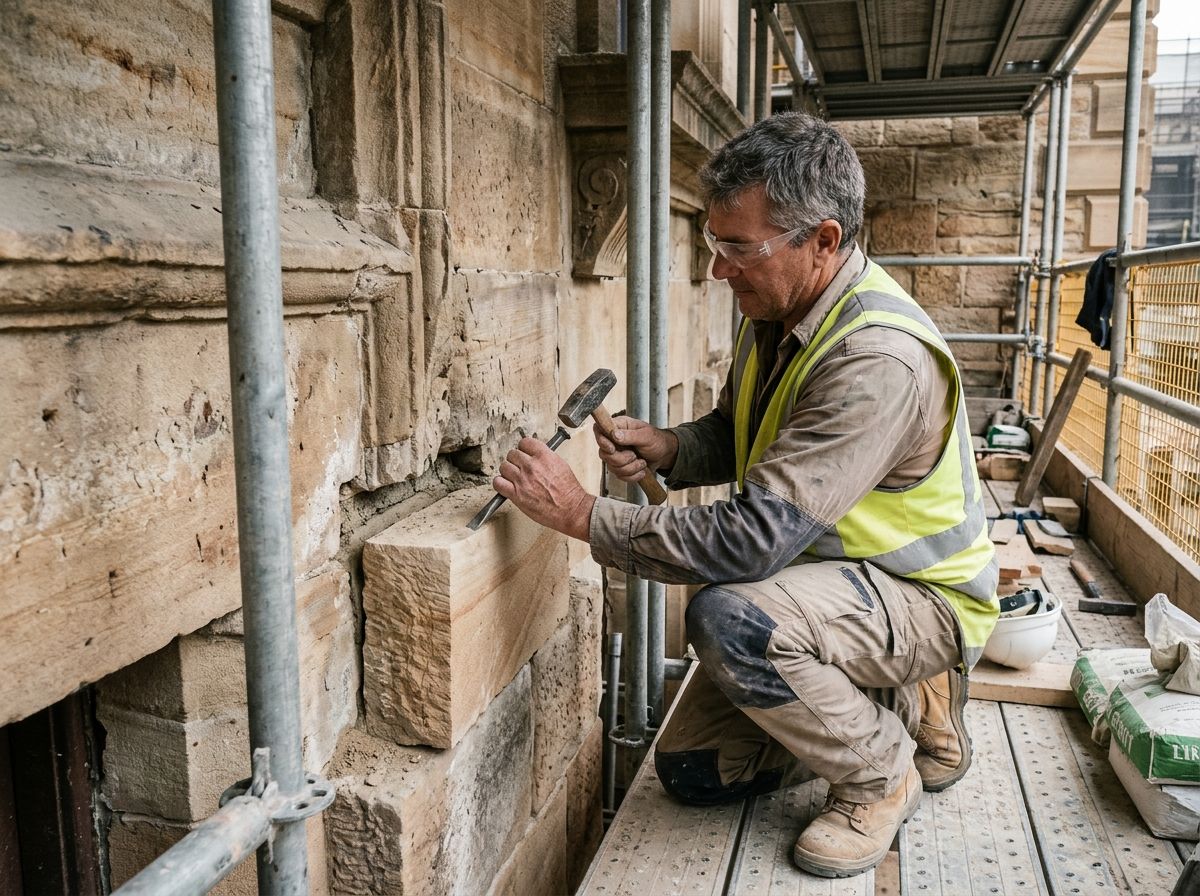
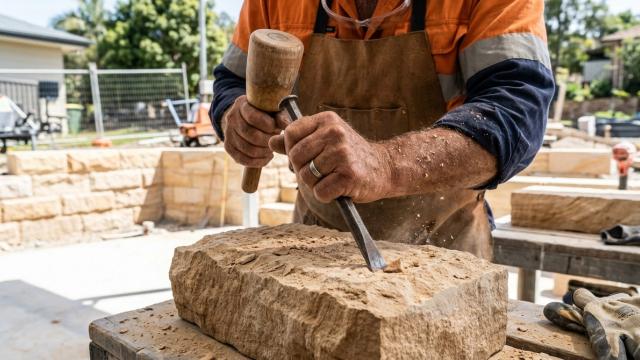
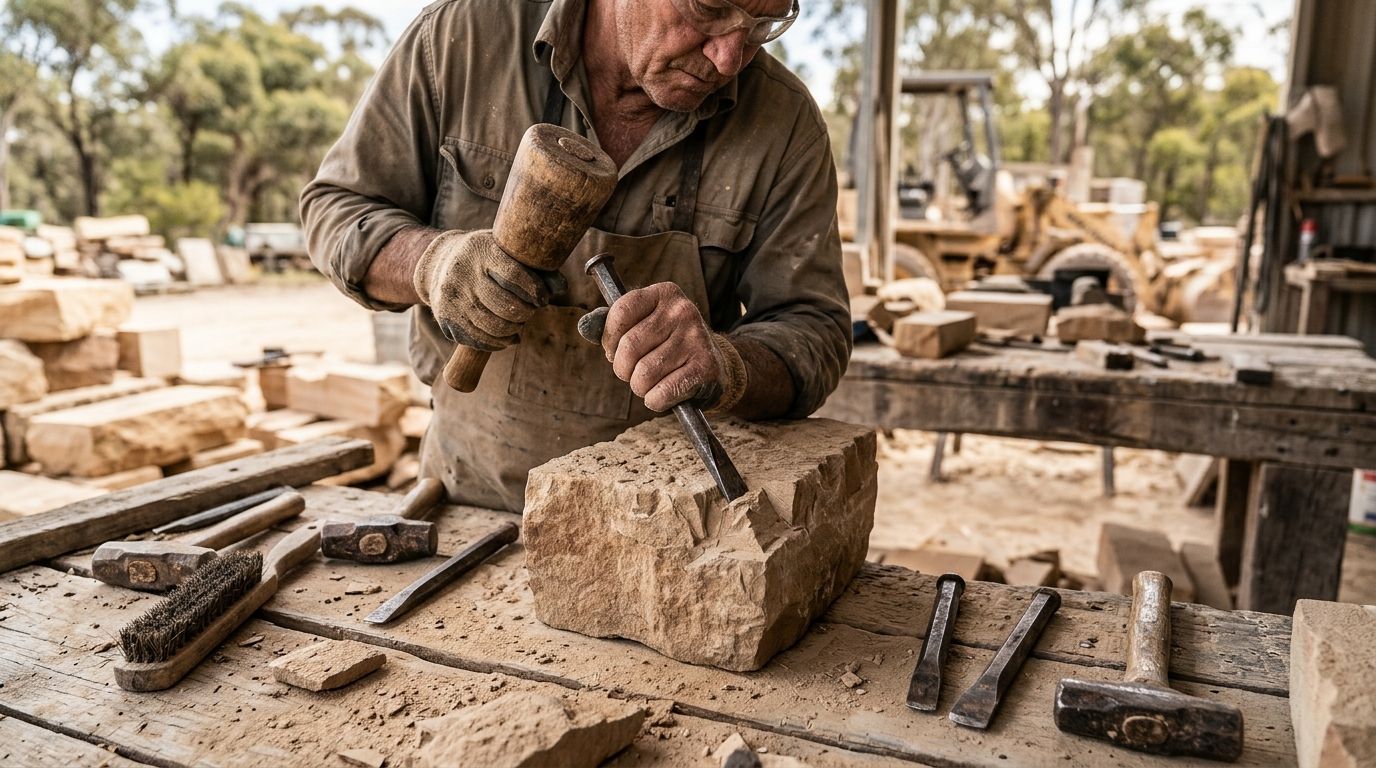
A master stonemason taught by showing, by correcting, and by standing next to you while you selected stone to explain why one piece would work and another would not. You learned to read the grain of sandstone and limestone. You learned how load transfers through a wall and what happens when it does not. You learned mortar composition not from a textbook but from mixing it wrong once and understanding why. You learned surface finishing. You learned the difference between a bush-hammered face and a sawn face, when each is appropriate, and how to achieve consistency across a run of work.
This training was rigorous. It was structured, even when it did not look structured. It produced tradespeople who could work independently on complex projects. This included heritage restoration work that demands a level of precision and material knowledge that no beginner course can replicate in a few months.
The fact that this learning did not produce a certificate does not mean it did not produce competence. It produced exactly the skills that the Certificate III in Stonemasonry (CPC32320) is designed to assess. The qualification describes what a skilled stonemason knows and can do. Many veteran stonemasons already know and can do all of it. They simply have never been formally assessed against those criteria.
That distinction is important. It means the question is not whether you have the skills, but whether your skills have been formally recognised.
Why the system is asking for a certificate you were never offered
The demand for formal qualifications in stonemasonry has intensified in recent years. Licensing requirements, tender eligibility criteria, and workplace compliance frameworks have tightened across Australia. What was once managed by reputation and demonstrated skill is now increasingly managed by paperwork.
Licensing requirements for construction trades vary across Australian states and territories, and the specific requirements for stonemasons differ by jurisdiction. In some states, a formal qualification or trade licence is required to perform certain types of work or to operate as a contractor. In others, the requirements are less prescriptive but are increasingly referenced in commercial and government tender documents. If you have recently been asked for a qualification by a licensing authority, a new employer, or a project requiring documented credentials, you are not alone. This is happening to experienced stonemasons across the country.
The workers most affected are often the most experienced. The stonemasons who have spent the longest on the tools, and who have the deepest knowledge of materials, techniques, and structural principles, are frequently the ones who trained before formal certification was standard practice. They are being asked to prove, in a format that did not exist when they learned, skills they have been demonstrating every working day for decades.
This is the situation that Recognition of Prior Learning was designed to address. It is not a workaround or a shortcut. It is a formal, nationally recognised assessment pathway that acknowledges how skilled trades are actually learned and practised.
What RPL actually means for a veteran stonemason
Recognition of Prior Learning (RPL) is a formal assessment pathway within the Australian VET system. It evaluates whether your existing skills, knowledge, and experience meet the requirements of a qualification, regardless of how that experience was acquired.

For an experienced stonemason, RPL means being assessed against the Certificate III in Stonemasonry (CPC32320) based on what you already know and can demonstrate. It is not about what you studied in a classroom or how long ago you learned it. It is about whether your current skills meet the standard.
The assessment is conducted by a qualified assessor from a registered training organisation (RTO). RPL it does not conduct assessments or award qualifications; that is the RTO's role. RPL it guides you through the process, helping you understand what evidence is needed, how to gather and present it, and what to expect at each stage.
Evidence in an RPL assessment for a trade qualification can take many forms. These include photos of completed work, references from employers or clients, and site records, project documentation, or council approvals. You can also use third-party verification from someone who has worked alongside you and can speak to your skills. In some cases, a practical demonstration may also be part of the assessment. The evidence you need almost certainly already exists in your work history, your professional relationships, and the projects you have completed.
If gaps are identified during the assessment process, such as areas where your experience does not fully meet the current qualification requirements, gap training is typically provided at no additional cost. RPL is not a pass-or-fail gamble. It is a structured process with clear guidance built in.
The difference between a stonemasonry course and an RPL assessment
If you are searching for a stonemasonry course to learn the trade, a course is the right path. A Certificate III in Stonemasonry delivered through a TAFE or registered training organisation is designed for people starting in the trade. It teaches the foundational skills, knowledge, and safety practices that a new stonemason needs.
If you are searching because someone has asked you for a qualification you do not hold, despite your years of experience, an RPL assessment may be the more appropriate pathway. An RPL assessment does not teach you what you already know. It evaluates whether your current skills meet the qualification standard.
The distinction is practical. A standard stonemasonry course requires you to complete all units of the qualification, including content you may have mastered years ago. An RPL assessment focuses on demonstrating your existing skills, which is a very different process for an experienced stonemason.
Neither pathway is a shortcut. Both involve genuine assessment. They are simply designed for different people at different points in their careers. If you have spent years working with stone, you do not need a beginner course. You need a recognition process.
Your experience is evidence, it just needs to be presented that way
The challenge for experienced stonemasons in an RPL process is rarely a lack of skill. The challenge is translating decades of practical knowledge into the documented evidence that formal assessment requires.
This is where guided support makes a practical difference. The evidence already exists in the projects you have completed. For many experienced stonemasons, this includes heritage restoration work that is well-documented through council records, heritage authority approvals, and project photography. The evidence is also in the professional relationships you have built with employers, contractors, and clients who can verify your skill. It is in the techniques you have developed over years of working with different stone types, conditions, and structures.
The RPL process requires that this evidence be organised and presented so an assessor can evaluate it against the specific units of the Certificate III in Stonemasonry. That is not a small task, but it is manageable with structured guidance.
You have done the work. The next step is demonstrating it in the right format. That is what the guided RPL process supports.
Is RPL the right path for you? What to consider before you start
RPL is not suitable for everyone, and clear guidance about suitability is more valuable than a promise of outcomes. For experienced stonemasons considering this pathway, there are a few questions worth asking.
- Does your experience cover the range of skills assessed in the Certificate III in Stonemasonry, including both practical techniques and safety knowledge?
- Can you provide evidence of that experience through project records, employer references, photos of completed work, or other documentation?
- Are there areas of the qualification, especially Work Health and Safety requirements which have updated in recent years, where your formal knowledge has gaps?
- Are you ready to participate in a structured evidence-gathering process with support over a period of time?
If you are uncertain about any of these questions, a Free Skills Review can help. It is a straightforward, no-obligation conversation about whether your experience aligns with the current qualification requirements before you commit to anything.
We would rather tell you if RPL is not the right fit for your situation than guide you into a process that does not serve you. This approach is the foundation of how we work.
If your experience does align, and for many experienced stonemasons it will, the pathway to the Certificate III in Stonemasonry (CPC32320) is open. Your skills are real. Your experience is evidence. It just needs to be presented that way.
General information only, current at the date shown. Licensing rules change, so check the current requirements with the relevant regulator before you rely on them. RPL it Australia is a student support service, not a Registered Training Organisation; qualifications are assessed and issued by our partner RTOs.