You have been fixing steel on major sites for years. Here is the gate you are still stuck behind.
Experienced steelfixers who entered through labouring often hit the same wall: years of real skill, but no Certificate III. Here is the pathway.
By RPL it Australia7 min read
The way most steelfixers actually start
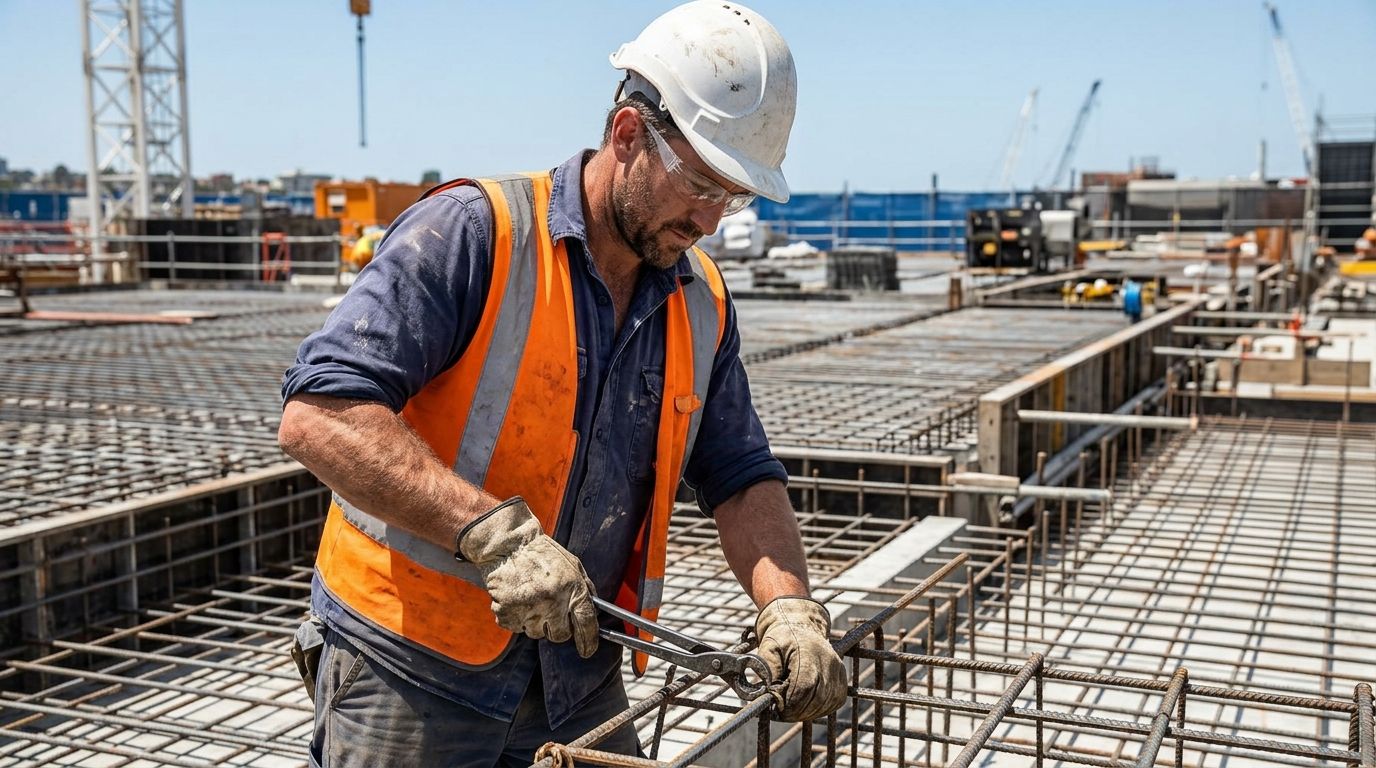
You did not walk into a TAFE office and sign up for an apprenticeship. That is not how most people in this trade got started. You began on site as a labourer. Someone handed you a pair of pliers and a roll of tie wire. You watched, you asked questions, and you got faster. The qualified steelfixer on the crew noticed your work. Before long, you were doing the work yourself: placing bar, reading structural drawings, and tying to specification on pours that could not afford mistakes.
That is a common story. Across Australian construction sites, starting as a labourer is a standard path into specialist trade work. The skill you build is real. The experience is genuine. The problem is that none of it came with a formal qualification.
This article is written for steelfixers who know their trade. You have worked on major sites and been trusted with complex reinforcement work, but you are now running into an unexpected barrier. That barrier has a name.
What the gate actually looks like
The credential gate is not abstract. It shows up at specific, concrete moments. You will likely recognise at least one of these situations.
- A tender document lists the Certificate III in Steelfixing (CPC31120) as a mandatory requirement for all steelfixers on the project. You cannot submit a bid without it.
- A labour hire company tells you they cannot place you on a major infrastructure project because the client requires formal qualifications for all specialist trades.
- A principal contractor's prequalification checklist asks for evidence of formal qualifications. Your years of on-site experience do not fit on that form.
- A direct job application at a larger firm screens you out before you reach an interview because the qualification field is mandatory and you cannot complete it.
- Your current arrangement works because you operate under someone else's licence or supervision. But that arrangement is changing, and you need to stand on your own.
Each of these moments represents the same gate. The required credential is the Certificate III in Steelfixing, qualification code CPC31120. Without this paper, the system cannot recognise your skill. It only registers the absence of the qualification.
Why years of experience does not automatically count
This is the most frustrating part for experienced steelfixers. You have done the work, and you have done it well. You have been trusted with reinforcement on structures that will stand for decades. Why does that not count on its own?
The straightforward answer is that it does count, but not in the format the system requires. Formal qualification systems in Australia are built around evidence. Competency must be demonstrated through documented proof, rather than assumed from your years on the job. An employer, principal contractor, or insurer cannot assess your skill simply by looking at your history. They require a credential issued by a registered training organisation, based on a formal assessment.
This is not a reflection on your actual ability. It is a structural feature of how formal recognition works. Practical experience is not worth less than classroom education, but it is a different form of evidence. The real question is whether your evidence has been gathered, organised, and presented in a format the system can read.
This is exactly what Recognition of Prior Learning (RPL) is designed to do. Under the Australian Qualifications Framework, your experience can be presented as evidence through a structured documentation process, assessed by a qualified assessor from a registered training organisation. Your work history, demonstrated skills, and on-site experience can form the basis of a formal assessment, but they must first be translated into the format the system understands.
The pattern steelfixers keep hitting and why it is not random
Once you see this pattern, you will recognise it across the construction industry. It is the licensing gate, and it almost always unfolds the same way.
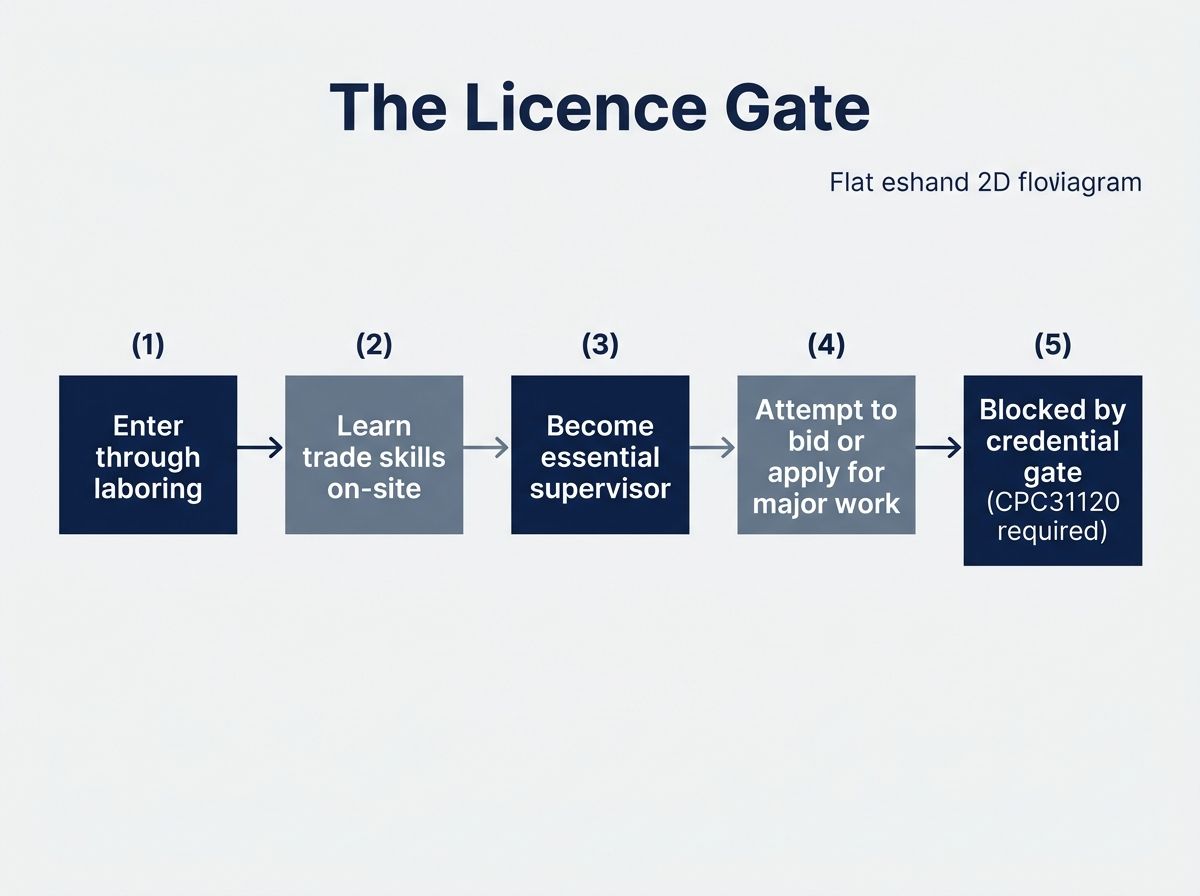
- Enter through labouring. You start on site doing general tasks. You are capable, reliable, and you get noticed.
- Build skill over the years. You learn steelfixing by doing it under supervision on real projects, where mistakes have actual consequences. Your skill is genuine.
- Become essential on site. The qualified steelfixer relies on your work. You are the one who understands the drawings, sets the pace, and guides the apprentices.
- Attempt to advance. You apply for a direct role, try to tender independently, or move to a larger project. You are ready and the work is available.
- Hit the credential gate. The application, the tender, or the prequalification document asks for CPC31120. You do not have it, and the door closes.
- Assume the only option is starting over. You look at the formal apprenticeship pathway and see years of classroom study, reduced apprentice pay, and starting from scratch. That does not make sense for someone who already knows how to do the job.
This is not a personal failure. It is a systematic pattern that plays out across construction trades in Australia. The gate is real, but the pathway through it is also real.
What CPC31120 actually covers and why your work probably already does
The Certificate III in Steelfixing (CPC31120) is the national standard qualification for steelfixers in Australia. It covers key practical competencies: reading and interpreting structural drawings, planning your work, placing and fixing reinforcement steel to precise specifications, site safety, and effective communication within construction teams.
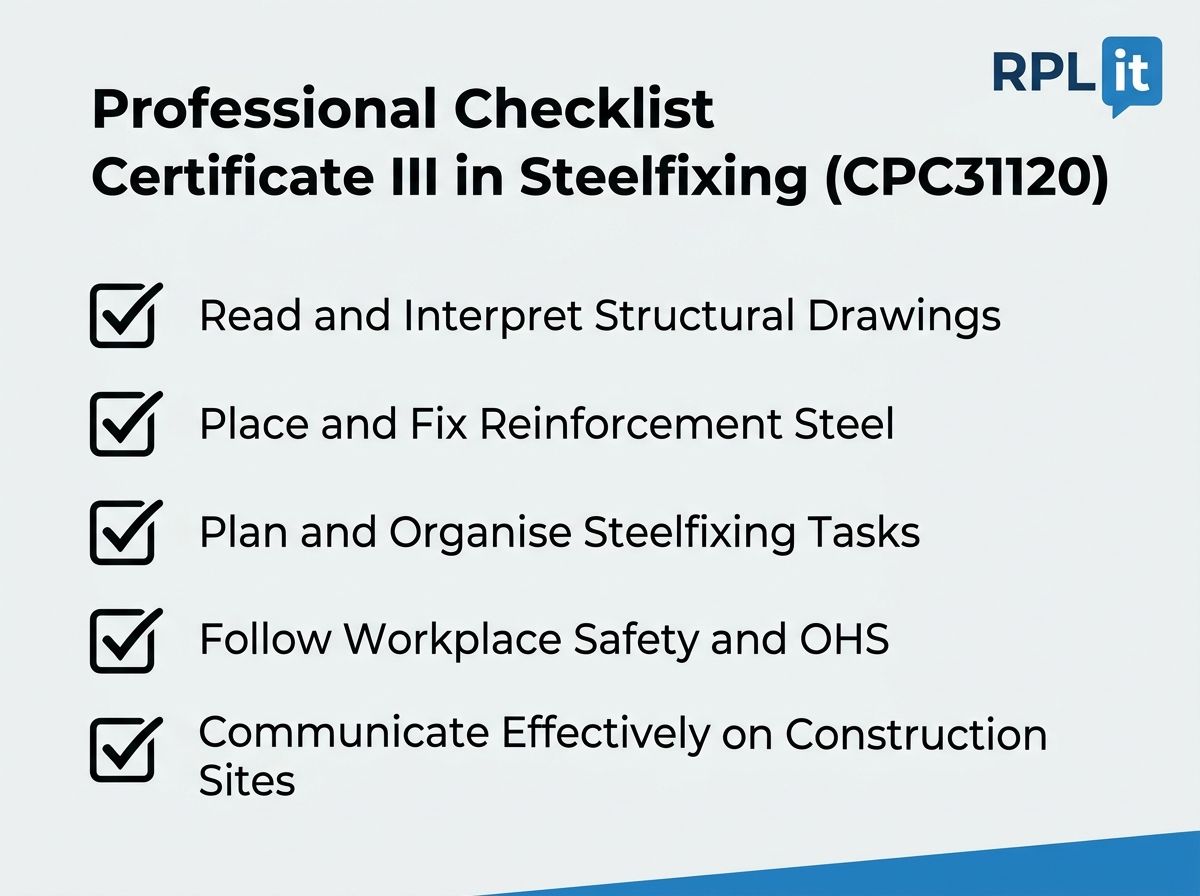
If you have been working as a steelfixer on major sites, much of your daily work maps directly to what this qualification assesses. This includes placing rebar to structural drawings, tying to tolerances, working within a team on complex pours, and managing site safety requirements for reinforcement. These are the practical tasks the qualification is built around.
The gap for most experienced steelfixers is not in their skill, but in their documentation. The qualification requires you to demonstrate competency through clear evidence, which means records, workplace examples, references, and a structured assessment process. That evidence already exists in your work history. It simply has not been gathered yet.
RPL is not a shortcut: it is the pathway built for this situation
Recognition of Prior Learning is a rigorous, nationally recognised assessment pathway. It is not a method to avoid assessment. Instead, it is an alternative form of assessment that uses documented evidence of your existing skills rather than requiring classroom hours or a new apprenticeship.
For steelfixers who have spent years on major sites, the evidence base already exists. It needs to be collected, structured, and presented to a qualified assessor from a registered training organisation. That assessor evaluates whether your documented experience demonstrates the competencies required by CPC31120. If it does, the qualification can be awarded. If gaps are identified, gap training is provided. This is a standard part of the process and does not mean you have to start from scratch.
The process involves working with a guide to document your experience, including site history, references from supervisors or employers, examples of work, and evidence of the tasks you have performed. This is not a quick administrative box-ticking exercise. It requires genuine effort, but it is designed for skilled workers whose expertise simply needs to be translated into formal recognition.
Assessments are conducted by qualified assessors from registered training organisations (RTOs) that meet strict national standards. RPL it guides you through the evidence-gathering and documentation process, but the assessment itself is conducted independently by the RTO. The qualification is fully recognised nationwide because the assessment is genuine.
What happens if you keep waiting
The credential gate does not disappear over time. If anything, it is becoming more strict. Major infrastructure projects, principal contractors, and procurement processes across Australia are increasingly formalising their qualification requirements for specialist trades. Arrangements that work today, such as informal supervision or subcontracting under someone else's licence, may not be available in the future.
Your experience continues to build, but without formal recognition, it remains invisible to the systems that control access to better pay, larger projects, and independent contracting. The same pattern plays out across other construction trades. As our article on experienced roof tilers illustrates, the gate is a permanent feature of the industry, not a temporary hurdle.
The decision about when to act is yours, but the cost of waiting is not zero. Every year without the credential is another year your experience remains invisible to the formal systems that control access to work.
The first step does not require a commitment
You do not need to commit to anything to find out whether your experience is likely to support an RPL pathway. A Free Skills Review is exactly that: a genuine, no-obligation assessment of your current situation. This provides clear guidance about whether RPL is appropriate for your experience before you make any enrolment decisions.
If your experience supports the pathway, you will know. If there are gaps, you will understand exactly what is needed. The decision about what to do next remains entirely yours.
General information only, current at the date shown. Licensing rules change, so check the current requirements with the relevant regulator before you rely on them. RPL it Australia is a student support service, not a Registered Training Organisation; qualifications are assessed and issued by our partner RTOs.