You Can Fix the Leak. You Just Can't Sign Off the Job: The Daily Reality of Skilled Migrant Plumbers in the ACT
You have the skills and do the work. But in the ACT, you still can't sign off the job. Here is what that gap looks like — and how to close it.

You Already Know How to Do the Job
You have been doing this work for years. You know how water moves through a building. You can read a drainage plan, diagnose a pressure fault, and rough in a bathroom faster than most people on site. You have done it in another country, under a different code, in conditions that were harder than anything you have encountered in Canberra. Your hands know the work.
That competence is real. It is not in question. The Australian Parliament has acknowledged that the nation faces large-scale workforce shortages in trades that cannot be filled through domestic supply alone — and that overseas-trained tradespeople are essential to addressing them. You are part of the solution. The system just has not caught up with that fact yet.
Parliamentary inquiries have documented the complex, multi-stage recognition process that overseas-trained tradespeople — including plumbers — face in Australia. The process has been a longstanding policy concern precisely because it is not simple, and because the people navigating it are not beginners. They are experienced professionals in an unfair structural situation.
The Moment Someone Asks for Your Licence Number
You know the moment. A site supervisor, a client, or a contractor turns to you and asks for your licence number. You pause. You explain — again — that you are working under someone else's licence. That you are registered, or that your overseas qualification is being assessed, or that you are in the process of getting recognised. The other person nods. The conversation moves on. But something small and significant has just happened, and you both know it.
In the ACT, completing any plumbing or sanitary drainage work requires a Certificate of Compliance showing the work was undertaken in accordance with regulations. That certificate is the document that makes the job official — the paperwork that says the work is done, done correctly, and done by someone the system recognises. Without the right licence, you cannot issue it. The work you did is real. The sign-off is not yours to give.
The ACT government's licensing framework makes clear that licensed plumbers can certify their own work and issue compliance certificates, while those without a full licence cannot operate independently or sign off on completed work.
Being Supervised by Someone With Less Experience Than You
This is the one nobody says out loud. You are on site, and the licensed plumber supervising you has been in the trade for four years. You have been in it for twelve. You can see the problem before they diagnose it. You know the fix before they reach for the manual. You do not say anything, because that is not how the site works. The licence determines the hierarchy, not the skill.

This is not a criticism of the supervisor. They earned their licence through the system that exists. The issue is the system itself — one where the credential determines authority, regardless of what the person holding it actually knows. Your competence is real and visible to everyone on site. Your legal standing is a different matter entirely.
Watching Colleagues Charge Their Own Rates While You Remain an Assistant
The financial dimension of the paperwork gap is not abstract. A licensed plumber can take on independent residential jobs, set their own rates, and build a client base. You cannot — at least not without working under someone else's licence. The work is the same. The skill is the same. The income is not.
Award rates in Australia reflect this distinction. According to Fair Work Ombudsman pay guides, registered tradespersons earn more than their unregistered counterparts at the same classification level. A 2012 government consultation document estimated the wage differential between tradesperson registration holders and full licence holders at between $2.38 and $10.40 per hour — though the document notes that the extent to which this reflects licensing alone is uncertain, and the data is now dated. What is not uncertain is the direction of the gap: the licence is worth more, financially, than the skill alone.
The median full-time weekly earnings for plumbers across Australia — licensed and unlicensed combined — sits at $1,990 per week. That figure does not separate what a licensed plumber earns from what an unlicensed one does. The gap between those two numbers is the gap you are living.
This is not a skills gap. It is a paperwork gap.
The Professional Regression Nobody Talks About
Back home, you were a tradesperson. Perhaps you ran your own jobs, supervised apprentices, or held a licence that meant something. You were recognised — by your clients, your colleagues, your community — as someone who knew what they were doing. That recognition was not just professional. It was part of who you were.
In Australia, that recognition does not transfer automatically. Government data from the Department of Home Affairs indicates that around one in four skilled migrants is employed in semi-skilled or low-skilled work six months after settlement — work that does not reflect their qualification level. A separate survey found that 20.7 per cent of skilled migrants remained in low or semi-skilled employment at both the six-month and eighteen-month stages, suggesting the situation is not always temporary.
Research on skilled migration outcomes in Australia has consistently found that a significant proportion of migrants work below their qualification level, with older data suggesting the gap is particularly pronounced for those from non-English-speaking backgrounds.
This is not a personal failure. It is a structural situation — one that repeats across thousands of skilled migrants every year, in the same sequence, for the same reason. The skill exists. The formal recognition does not. And in a system that requires the credential, the absence of the credential is the whole problem.
This Is Not a Skills Gap. It Is a Paperwork Gap.
The ACT licensing framework requires a specific credential. That credential is what allows a plumber to issue a Certificate of Compliance, to sign off on their own work, and to operate independently. The credential is not a measure of skill. It is a formal record that the skill has been assessed against a recognised standard.
You have the skill. What you do not have — yet — is the formal record. That is the gap. Not your competence. Not your experience. Not your years on the tools. The gap is a piece of paper that says an Australian assessment body has looked at what you know and confirmed it meets the standard.
That distinction matters, because it changes what the solution looks like. If the gap were a skills gap, you would need to learn something new. Because it is a paperwork gap, what you need is a process that converts your existing competence into formal evidence — and has it assessed against the Australian standard.
Understanding what the ACT plumbing licence process actually assesses — and why years on the tools is the whole point — changes how you think about the pathway.
The Pathway That Closes the Paperwork Gap
Recognition of Prior Learning — RPL — is the formal mechanism that exists to do exactly this. It is not a shortcut. It is not a workaround. It is a rigorous assessment pathway that evaluates your demonstrated competency against the units of the Certificate III in Plumbing, using evidence drawn from your actual work experience: site records, employer references, documentation of completed jobs, and practical demonstration where required.
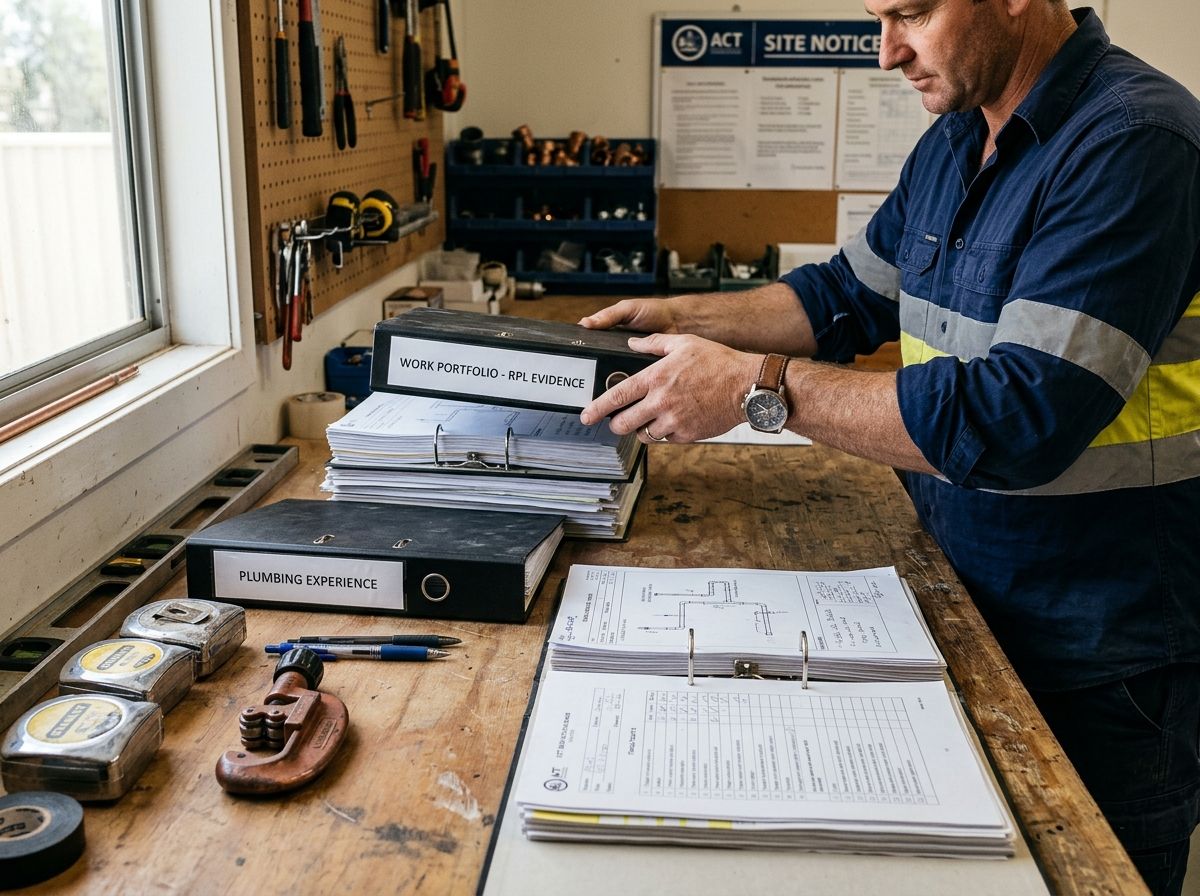
The ACT plumbing trade licence pathway requires a Certificate III in Plumbing as the underlying qualification. RPL is the recognised pathway to that qualification for people who have the competency but not the formal credential. The assessment is genuine — it is conducted by a qualified assessor from a registered training organisation, and it requires real evidence of real competency. Gap training may be required if specific units cannot be evidenced. But the starting point is what you already know, not what you need to learn from scratch.
The ACT requires a Certificate of Compliance upon completion of any plumbing or sanitary drainage work — a requirement that underscores why the formal licence credential matters for anyone doing this work independently.
You do not have to start from scratch. You have to demonstrate what you already know — and have it formally recognised.
The RPL it ACT Plumbing trade licence page is the starting point for understanding whether this pathway is right for your situation. It outlines what the process involves, what evidence is typically required, and what the credential outcome looks like. The assessment is conducted by a registered training organisation — RPL it guides you through the process, but the qualification is issued by the RTO whose assessors determine competency.
See the ACT Plumbing trade licence pathway
Your skills speak. The pathway exists to help them be heard — formally, officially, and on your terms.
Ready to Get Recognised?
Start with a free skills review to find out if RPL is right for you.