The Advice That's Costing ACT Plumbers Years: You Don't Have to Start From Scratch to Get Licensed
Experienced ACT plumber told you need TAFE or an apprenticeship to get licensed? Three job-site myths that are costing tradespeople years — and what's actually true.

The advice circulating on every ACT job site — and why it's wrong
You have the experience. You have been doing the work — sometimes for years, sometimes for decades. And somewhere along the way, someone on a job site told you what it would take to get formally licensed. Maybe it was a supervisor. Maybe it was a colleague who had been through the process themselves, or thought they had. The advice sounded authoritative. It probably went something like this: 'You'll have to do a TAFE course.' Or: 'You'd need to do an apprenticeship.' Or simply: 'There's no fast track to a trade licence.'
The people who gave you that advice were not trying to mislead you. They believed what they were saying. But the advice is wrong — or at least, seriously incomplete. And for experienced ACT plumbers who took it on board, the cost has been real: years of working without formal recognition, years of being passed over for roles that require a licence, years of assuming the pathway was closed.
The pathway is not closed. It exists. And it is specifically designed for people who already have the competency. This article names the three myths and replaces each one with the accurate picture.
Myth 1: 'You'll have to do a TAFE course'
No. You do not have to sit in a classroom and study content you already know how to do. That is the short answer. The longer answer requires understanding what Recognition of Prior Learning — RPL — actually is.
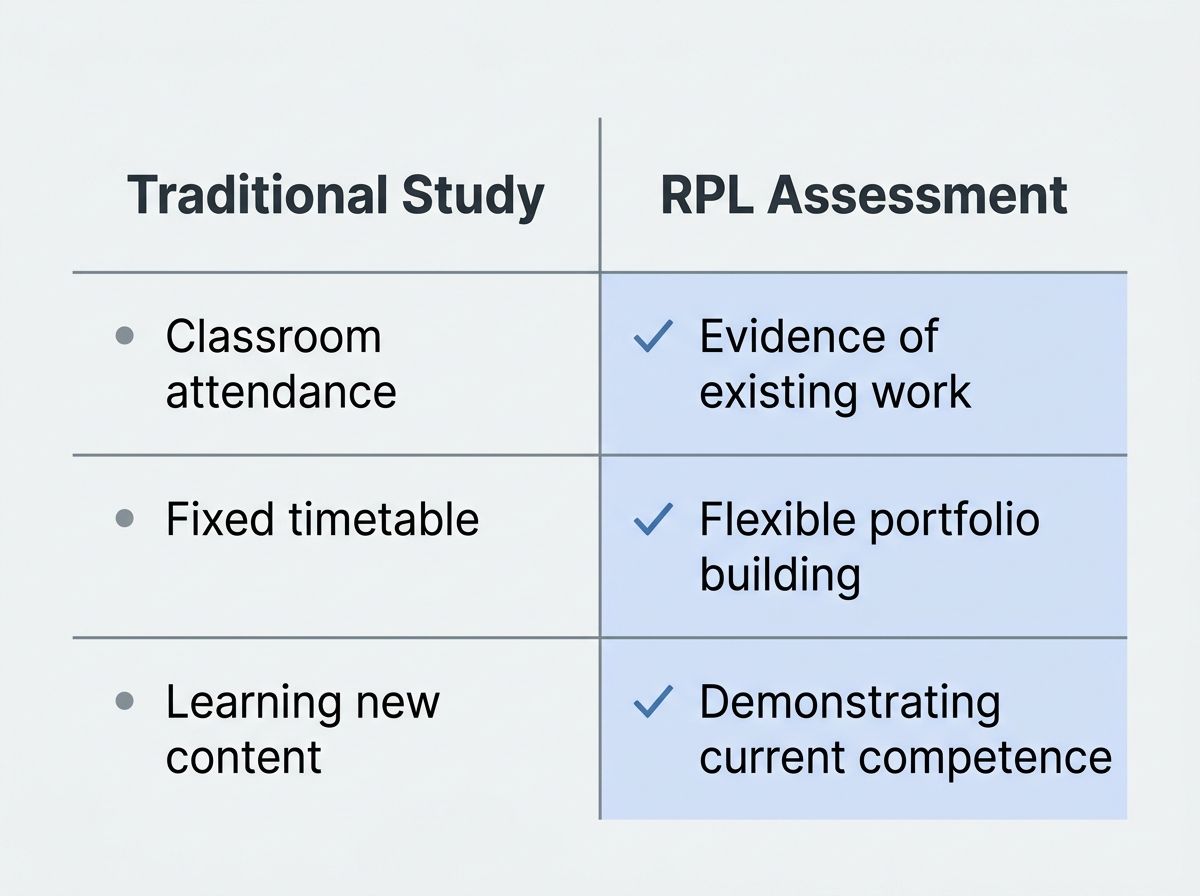
RPL is an assessment pathway, not a study pathway. It exists within Australia's national vocational education and training system specifically to assess the competencies a person has already developed through work experience, prior training, or other means. The national regulator, ASQA, describes RPL as a process where your existing skills and knowledge are assessed against the requirements of a qualification — not a process where you acquire new skills.
The qualification required for an ACT plumbing licence is the Certificate III in Plumbing, currently coded CPC32420 on the national training register. This qualification is available through Registered Training Organisations — RTOs — and some of those RTOs offer RPL as an enrolment pathway for experienced tradespeople.
What does RPL assessment actually involve? Rather than attending classes, you provide evidence of your existing competency. That evidence is then assessed by a qualified assessor from the delivering RTO. According to ASQA's guidance on RPL, evidence commonly includes work samples or portfolios, training records or certificates you already hold, and employer declarations or references. Some RTOs also ask for photographic or video evidence of completed work, and may conduct a competency interview or practical demonstration.
The key distinction: RPL assesses what you already know, not what you need to learn. You still have to demonstrate competency. But you demonstrate it through evidence of what you have already done — not by sitting through content you already know.
This is not a loophole. It is not a workaround. It is a nationally recognised assessment pathway that exists precisely because the vocational education system acknowledges that competency can be developed outside a classroom.
If you want to understand what the ACT plumbing trade licence pathway looks like in practice, the ACT plumbing trade licence page sets out the relevant details.
Myth 2: 'Apprenticeships are only for school leavers'
This myth is not quite right either — but it points to a real confusion worth clearing up. The confusion is between two separate things: gaining experience, and getting recognised for experience you already have.
An apprenticeship is a way to gain experience. It is structured training combined with on-the-job learning, designed for people entering a trade. If you have been working in plumbing for years, you have already done what an apprenticeship is designed to provide. You do not need to repeat that journey.
RPL is a way to get recognised for experience you already have. These are not the same thing. The person who told you 'apprenticeships are only for school leavers' may have been right about apprenticeships — but they were answering the wrong question. The question for an experienced plumber is not 'how do I get experience?' It is 'how do I get my existing experience formally recognised?'
Your years of work are not wasted. They are not irrelevant to the licensing process. They are exactly the evidence that RPL is designed to assess. The work you have already done — the jobs completed, the systems installed, the problems solved — is the foundation of an RPL application. The assessor's job is to evaluate whether that body of work demonstrates the competencies required by the Certificate III in Plumbing.
There is no age restriction on RPL enrolment. There is no requirement to have completed formal study before applying. What RTOs typically look for is sufficient documented work experience in the relevant trade — enough to provide a credible evidence base for assessment. The specifics vary by provider, which is why an honest suitability conversation before enrolment matters.
For a broader picture of how the ACT licensing framework works for experienced plumbers — including those who trained elsewhere — this article on the ACT plumbing licence wall is worth reading.
Myth 3: 'There's no fast track to a trade licence'
This one is technically correct — and that is exactly why it causes so much damage. RPL is not a fast track. It should never be described as one. But the myth misunderstands what RPL is, and that misunderstanding is what keeps experienced plumbers from looking into it.
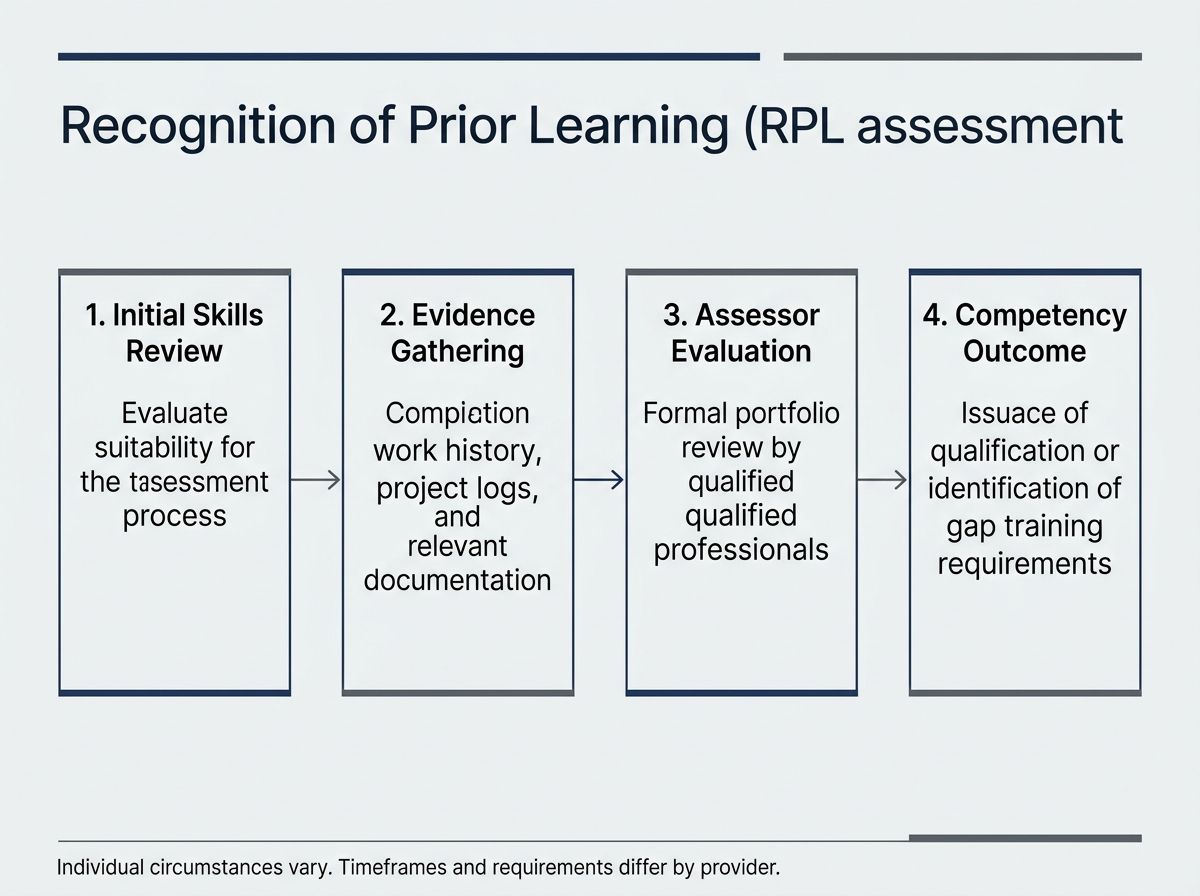
A fast track skips assessment. RPL does not skip assessment. RPL is a full, rigorous assessment conducted by a qualified assessor from a Registered Training Organisation. The assessor evaluates your evidence against the units of competency in the Certificate III in Plumbing. If gaps are identified — areas where your evidence does not demonstrate the required competency — gap training may be required before the qualification can be issued.
What makes RPL more efficient for experienced tradespeople is not that it cuts corners. It is that it does not require repetition of already-demonstrated competency. You are not sitting through content you already know. You are being assessed on what you already know. For someone with years of genuine plumbing experience, that distinction matters.
As for timeframes: they vary. RPL providers describe the general process as taking anywhere from a few weeks to a few months, depending on how quickly evidence is gathered and how the assessment proceeds. The quality and completeness of your evidence, the provider's workload, and whether gap training is required all affect the timeline. No provider can promise a specific duration, and any claim of a guaranteed timeframe should be treated with caution.
What the process typically involves: an initial skills assessment to determine suitability, an evidence-gathering phase where you compile documentation of your work history and competencies, a formal assessment by a qualified assessor, and — if gaps are identified — targeted gap training before the qualification is issued. This is a genuine assessment process. It is not a rubber stamp.
What the ACT licensing framework actually recognises
Plumbing in the ACT is a licensed occupation. The ACT Government regulates plumbing through Access Canberra, and working as a plumber without the appropriate licence is not permitted. The qualification pathway for an ACT plumbing licence requires a nationally recognised qualification — the Certificate III in Plumbing (CPC32420) — along with other conditions including relevant work experience.
The Certificate III in Plumbing is a nationally recognised qualification. It is listed on the national training register at training.gov.au with the code CPC32420, and its status is current. Because it is nationally recognised, the pathway through which it is obtained — whether through traditional study, an apprenticeship, or RPL — does not change the qualification itself. A Certificate III in Plumbing obtained through RPL is the same qualification as one obtained through any other pathway.
The Certificate III in Plumbing (CPC32420) can be verified on the national training register, which confirms its current status and the qualification's suitability for the Australian Apprenticeships pathway — as well as its availability through RTOs who offer RPL.
What this means for experienced ACT plumbers: the pathway to formal licensing exists. It requires demonstrating competency against the units of the Certificate III in Plumbing. For those with sufficient documented experience, RPL is the assessment pathway designed to do exactly that — without requiring you to repeat learning you have already done.
ASQA, the national VET regulator, outlines how RPL works within Australia's training system — including what types of evidence are assessed and what happens if gaps are identified during the process.
If you have the experience, the next step is finding out whether RPL is right for you
You now have the accurate picture. RPL is not a TAFE course. It is not an apprenticeship. It is not a shortcut. It is a rigorous, nationally recognised assessment pathway that evaluates the competency you have already developed — and for experienced ACT plumbers, it may be the most direct route to formal licensing.
Whether it is the right pathway for your specific situation depends on your experience, the evidence you can gather, and whether a qualified assessor determines you can demonstrate the required competencies. That is an honest answer — and it is the only honest answer. RPL suitability is individual. It is not a guarantee.
The decision is yours. But it is worth making that decision with accurate information — not the advice that has been circulating on job sites for years.
Ready to Get Recognised?
Start with a free skills review to find out if RPL is right for you.