The ACT Plumbing Licence Wall: Why Experienced Overseas Plumbers Keep Hitting the Same Dead End
Overseas plumbers in Canberra keep hitting the same invisible barrier. Here's why the pattern repeats — and what the recognition pathway actually looks like.

The same story, playing out again
You arrived in Canberra with a decade of plumbing experience behind you. You have worked on residential builds, commercial fit-outs, drainage systems that would make most apprentices nervous. Back home, you were trusted. You were the one people called when something was difficult.
Then you started looking for work here. And somewhere in that process — in a conversation with a potential employer, or a visit to a licensing office, or a search online — you found out that your qualifications mean nothing in the ACT. Not because your skills are in question. Because the credential you hold does not exist in the right form for this system.
If that moment felt like a wall appearing from nowhere, you are not imagining it. And you are not alone.
The four-stage cycle that keeps repeating
The same sequence plays out for overseas-trained plumbers across Australia, and the ACT is no exception. It has four stages, and most people who live through it do not realise it is a pattern until they are already deep inside it.
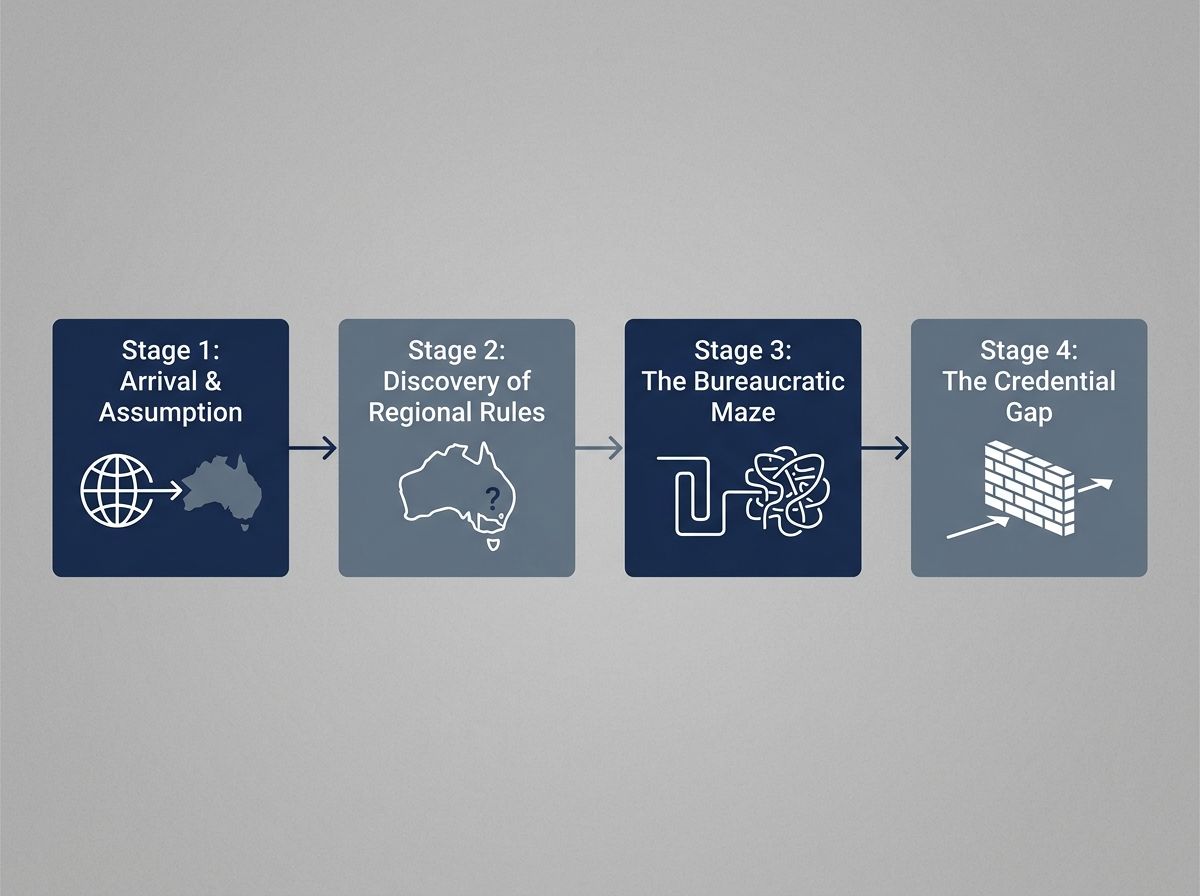
Stage 1 — Arrival and assumption. You arrive with genuine, hard-earned experience. You assume your qualifications will transfer, or at least be assessed fairly. Why wouldn't they? You have done the work.
Stage 2 — Discovery. You find out that Australian trade licensing is jurisdiction-specific. Each state and territory sets its own requirements. The ACT requires a nationally recognised Australian qualification as the foundation for a plumbing trade licence. Your overseas qualification, regardless of its quality, does not satisfy that requirement by default.
Stage 3 — The bureaucratic maze. You start making enquiries. You encounter multiple bodies — licensing authorities, assessment services, training organisations — each pointing in a different direction. The information is fragmented. The pathway is unclear. Some sources suggest a skills assessment through Trades Recognition Australia (TRA) may be relevant, particularly for migration purposes. Others point to Access Canberra as the licensing authority for the ACT. The picture does not resolve cleanly.
Stage 4 — The dead end. Without a clear pathway, and without the right Australian credential, you cannot get licensed. You cannot work as a plumber in the ACT. You are stuck — not because of your ability, but because your experience exists in the wrong form for this system.
Why the ACT licensing framework creates this gap
The ACT plumbing trade licence is administered through Access Canberra. Licensing enquiries are directed there, and the licensing framework sits within the ACT's construction occupations regulatory structure.
The qualification that underpins the ACT plumbing trade licence is the Certificate III in Plumbing — currently coded CPC32420 on the national training register. This is a nationally recognised qualification, and it is the standard entry point for licensed plumbing work across Australian jurisdictions.
The Certificate III in Plumbing (CPC32420) is listed as a current qualification on the national training register, with a note that licensing requirements vary by state and territory jurisdiction.
The gap for overseas-trained plumbers is not a skills gap. It is a credential gap. Your experience may be entirely equivalent to — or exceed — what an Australian-trained plumber has demonstrated. But the system requires evidence in a specific form: a nationally recognised Australian qualification. Overseas credentials do not produce that form automatically.
It is worth noting that requirements can be complex for overseas-trained plumbers, and the specific steps — including whether a skills assessment through a body like TRA is required in addition to the qualification — should be verified directly with Access Canberra before you begin any application process. The information available publicly is not always complete, and requirements can change.
This pattern is not about you — it repeats across thousands of skilled migrants
This is not an individual failure. It is a structural pattern that repeats across the Australian trades system.
A parliamentary inquiry into skills recognition in Australia found that Trades Recognition Australia processed over 12,000 pre-migration skills assessment applications from overseas-trained tradespeople in just eight months during 2005 and 2006 — across all trades, not plumbing alone. That figure, historical as it is, gives some sense of the scale at which overseas-trained tradespeople have sought recognition in Australia.
A parliamentary committee inquiry into skills recognition in Australia documented the volume of overseas-trained tradespeople seeking assessment, noting that international applications significantly outnumbered domestic ones during the period studied.
The pattern has not changed in its essential shape. Skilled workers arrive. They assume their experience will be recognised. They discover the credential gap. They navigate a maze without a clear map. The system is not designed to be hostile — it is designed around a specific form of evidence. But for overseas-trained plumbers, that design creates a predictable dead end.
Recognition should not require starting over. And for many overseas-trained plumbers, it does not have to.
The pathway designed to break the cycle: RPL through Certificate III in Plumbing
Recognition of Prior Learning — RPL — is the assessment pathway within the Australian Qualifications Framework that is specifically designed for people in this situation. It assesses demonstrated competence. It does not require you to re-learn what you already know.
Through RPL, a registered training organisation (RTO) assesses your existing skills and experience against the units of competency in the Certificate III in Plumbing (CPC32420). If your competency is demonstrated across the required units, the RTO issues the qualification. That qualification then satisfies the credential requirement for the ACT plumbing trade licence application.
This is not a shortcut. RPL is a genuine assessment process. The assessor — a qualified professional employed by the RTO — makes the determination of competency. The outcome is not predetermined. But for experienced plumbers whose skills genuinely meet the standard, RPL is the mechanism that makes invisible expertise visible to the formal system.
If you want to understand what the ACT plumbing trade licence recognition pathway looks like in more detail, the RPL it ACT Plumbing Trade Licence page is the place to start.
What RPL actually involves — and whether it might be right for you
RPL for Certificate III in Plumbing involves gathering evidence that demonstrates your competency across the qualification's required units. The Certificate III in Plumbing has a substantial number of core and elective units — the qualification structure is detailed on the national training register.

Evidence typically includes things like logbooks, records of completed work, employer references, photographs of projects you have worked on, and documentation of your training history. The specific evidence required depends on the RTO conducting the assessment and the individual circumstances of the candidate.
Government guidance on assessment standards confirms that RPL evidence must be valid, sufficient, authentic, and current, and must demonstrate competency applied in a real or accurately simulated work context.
If gaps are identified during the assessment — areas where your evidence does not fully demonstrate the required competency — the RTO will identify what additional evidence or training is needed. Gap training, where required, is typically provided as part of the RPL process. The assessor's determination is independent; the outcome reflects what your evidence demonstrates.
There is no fixed timeline for RPL. The duration depends on the complexity of your evidence, how quickly you can gather documentation, and the RTO's processes. Anyone who tells you otherwise is making a promise they cannot keep.
The Certificate III in Plumbing must be delivered by a registered training organisation. Whether any ACT-specific requirements apply to the delivering RTO — such as ACT registration or location — is something you should verify directly with Access Canberra before you begin. The national framework does not mandate ACT-based delivery, but it is worth confirming the current position.
If you want to find out whether your experience is likely to support an RPL assessment before committing to anything, a Free Skills Review is the place to start. It costs nothing and commits you to nothing.
You have the experience. The pathway exists to present it.
The wall you have hit is structural. It is not a reflection of your competence, your training, or the quality of your work. The ACT licensing framework requires evidence in a specific form. Your overseas qualification does not produce that form automatically. That is the gap — and it is a credential gap, not a skills gap.
RPL through Certificate III in Plumbing is the pathway designed to bridge that gap. It assesses what you already know and can demonstrate. If your competency meets the standard, the qualification follows. And the qualification opens the door to the ACT plumbing trade licence.
Your skills are real. The pathway exists to make them legible to the system.
The decision is yours. If you want to understand whether your experience is enough to begin, start with a Free Skills Review — it costs nothing and commits you to nothing.
Ready to Get Recognised?
Start with a free skills review to find out if RPL is right for you.