Insurance, Gyms, and Clients All Want the Certificate IV — Here's the Pathway If You Already Train People
Gyms, insurers, and franchise agreements are asking for SIS40221. If you already train people, here's why RPL may be the pathway — not a full course.
By RPL it Australia10 min read
The moment the certificate stops being optional
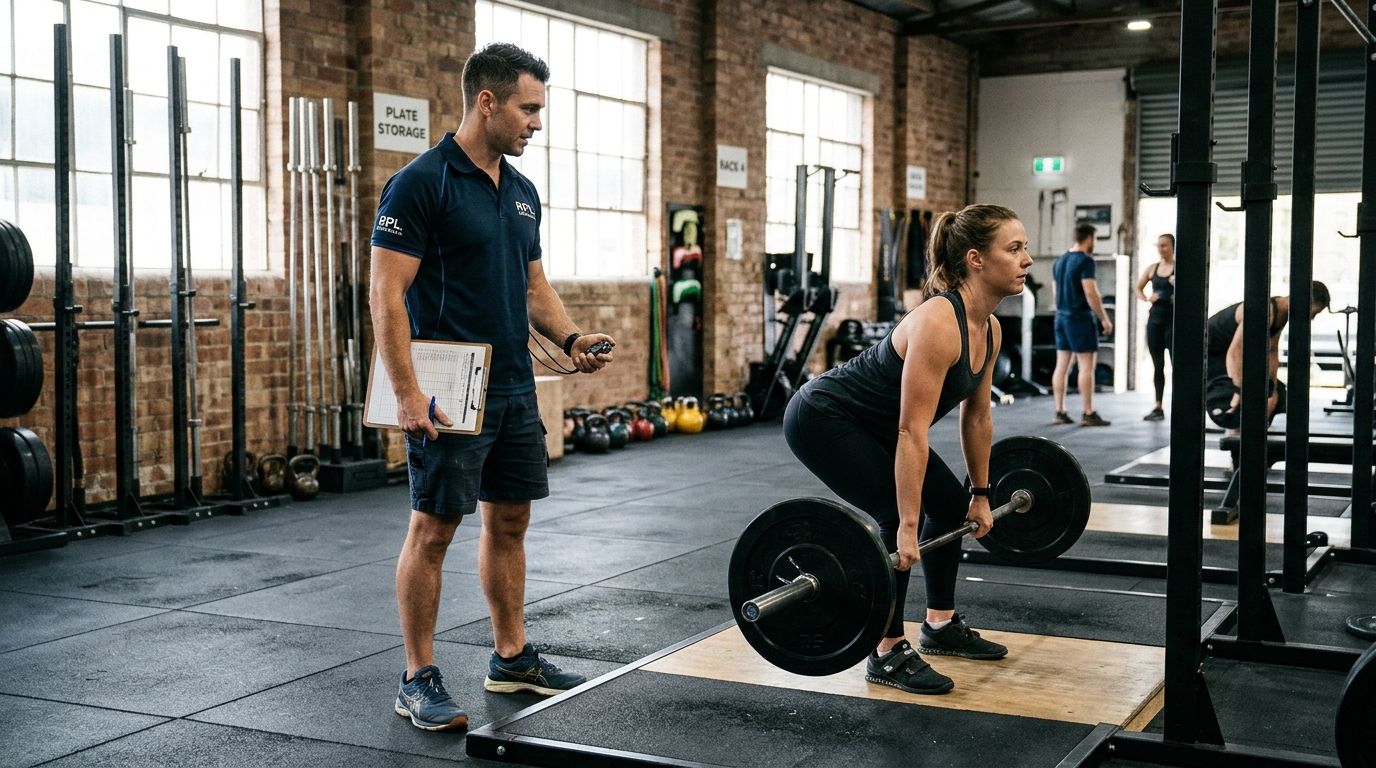
You train people. You design their programs, manage their safety, and get results. You have done this for years — in gyms, outdoors, online, or through sport coaching. And then something changes. An insurer declines to issue professional indemnity cover. A gym says you cannot work on the floor without the cert. A franchise agreement lists it as a compliance condition. A corporate client asks for evidence of formal qualification before signing the contract. Suddenly, the Certificate IV in Fitness (SIS40221) is not a nice-to-have. It is the specific thing standing between you and the work you already do.
This is the moment that brings most experienced trainers to this question. Not curiosity about qualifications. A concrete wall. The frustration that comes with it is real: you are not a beginner. You have the competence. What you do not have is the piece of paper that formal systems require before they will acknowledge it.
This article is for the person who already knows the wall exists. It names the specific walls precisely, explains why they exist, and describes the pathway that may be available if your experience is already there.
Why gyms and insurers specifically ask for SIS40221
SIS40221 is the Certificate IV in Fitness — the current nationally recognised qualification for personal trainers in Australia, listed on the national training register. It covers the role of personal trainers who develop, instruct, and evaluate personalised exercise programs for generally healthy and low-risk clients, referring higher-risk clients to medical or allied health professionals.
The national training register notes that at the time of publication, no occupational licensing, certification, or specific legislative requirements apply to SIS40221. There is no law that says every personal trainer in Australia must hold this qualification. But that is not the same as saying gyms, insurers, and franchise operators cannot impose their own requirements — and many do.
The institutional logic is straightforward. When a gym employs or contracts a personal trainer, they carry liability for what happens on their floor. When an insurer issues professional indemnity cover, they are pricing the risk of a claim arising from that trainer's advice or instruction. When a franchise grants floor access, they are extending their brand and their compliance obligations. In each case, a nationally recognised qualification signals that the holder has been formally assessed against national competency standards. It is not about doubting your skill. It is about formal accountability — and the paper trail that comes with it.
AUSactive, the national registration body for fitness professionals in Australia, describes a voluntary registration framework that requires a relevant qualification, current First Aid and CPR certification, and valid insurance cover. The Personal Trainer category is one of the professional categories covered by this framework.
Training providers commonly map SIS40221 to the personal training role. One training provider describes SIS40221 as the qualification that makes someone a Personal Trainer, distinct from the Certificate III in Fitness which qualifies as a Group Fitness Instructor or Gym Instructor. AUSactive's registration framework does not name SIS40221 by code in publicly available materials, but it requires a relevant qualification — and the Certificate IV in Fitness is the nationally recognised standard for the personal training role.
The national training register entry for SIS40221 describes the qualification as providing a pathway to work as an employed or self-employed personal trainer in settings such as fitness facilities, gyms, leisure and community centres, client workplaces and homes, and outdoor locations.
The four walls informal trainers hit first
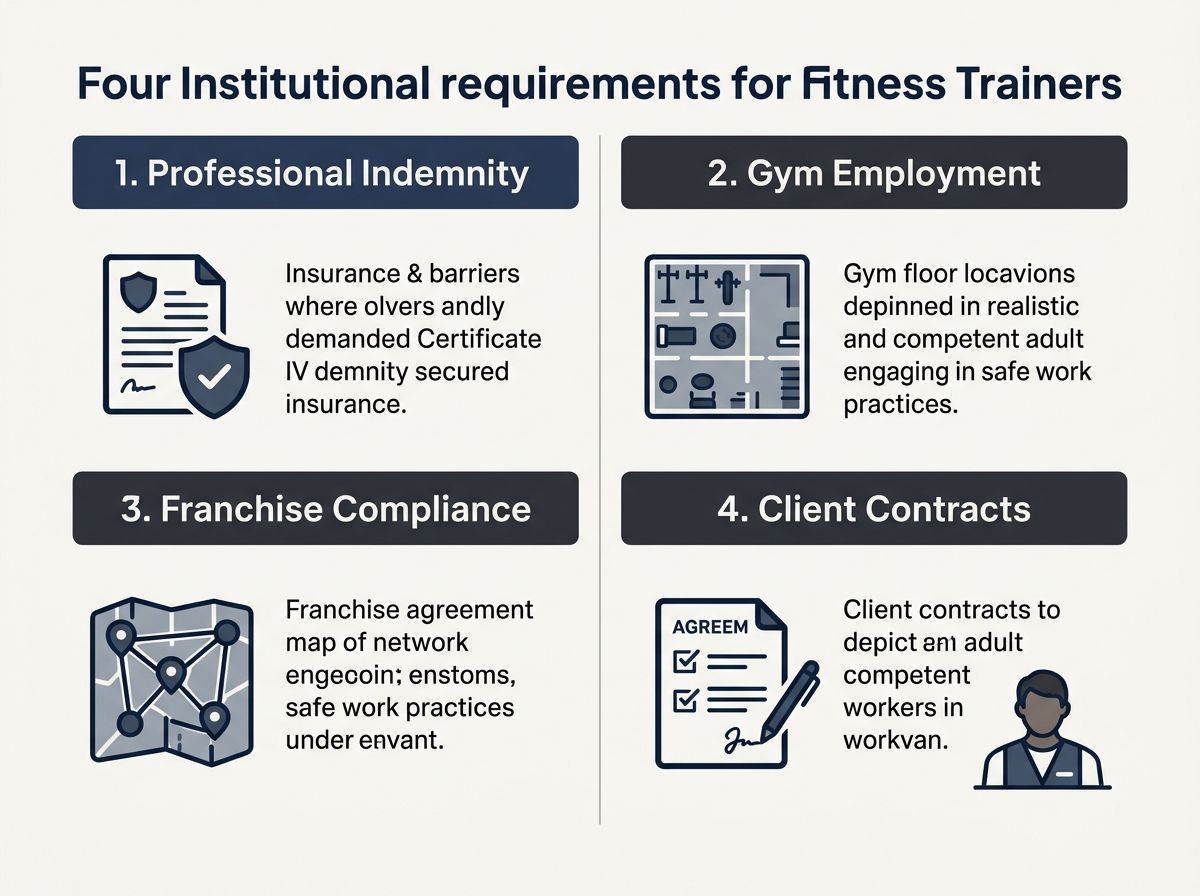
These crisis moments are distinct. Each involves a different institutional actor, a different mechanism, and a different urgency. Knowing which wall you have hit matters — because the response is the same, but the timeline may not be.
The insurance wall
Professional indemnity insurance for personal trainers in Australia commonly includes public liability and professional indemnity cover, with additional options depending on how and where the trainer works. Some education providers note that professional indemnity eligibility may be linked to professional registration status, and that registration pathways commonly reference the Certificate IV in Fitness as a baseline. Requirements vary by insurer and policy — the specific conditions of any policy should be confirmed with the insurer directly, and current policy wording should be reviewed before any assumptions are made.
What is consistent across the industry is this: if you are working with clients and carrying liability for your advice and instruction, professional indemnity cover is strongly recommended — and the pathway to that cover often runs through formal qualification and professional registration. If an insurer has told you that your current situation does not meet their requirements, the Certificate IV in Fitness is the qualification most likely to resolve that.
The gym employment wall
One training provider states that the Certificate IV in Fitness (SIS40221) is the minimum qualification required to work independently as a personal trainer in most gyms and studios. Another notes that the Certificate III in Fitness alone does not qualify a person to provide one-on-one personal training sessions. These are training-provider descriptions, not official employer mandates — specific requirements vary by chain, franchise, role, and contract type, and should be verified with each employer or facility.
The practical reality is that if a gym or fitness facility has told you that you cannot work on their floor as a personal trainer without the Certificate IV, the Certificate IV is what they require. The national training register confirms that SIS40221 is the current qualification for this role. The question is not whether the requirement is reasonable — it is how you meet it.
The franchise wall
Fitness franchise agreements are private contractual arrangements, and their specific qualification requirements are not publicly documented in a way that allows named franchises to be cited here. Franchise operators set their own compliance conditions for trainers working under their brand — and those conditions commonly reference national qualification standards. If a franchise agreement you are reviewing lists the Certificate IV in Fitness as a condition of engagement, that requirement should be verified directly with the franchisor. The national training register confirms that SIS40221 is the current nationally recognised qualification for the personal training role.
The client contract wall
Corporate wellness clients, schools, sporting clubs, and community organisations increasingly ask for evidence of formal qualification before signing contracts with personal trainers. This is a procurement and liability consideration — the organisation is managing its own risk by ensuring the trainer it engages holds a nationally recognised credential. If a client or prospective client has asked for this evidence, the Certificate IV in Fitness (SIS40221) is the qualification that satisfies that request.
What RPL means for someone who already trains people
Recognition of Prior Learning — RPL — is a formal assessment pathway under the Australian Qualifications Framework. It is not a shortcut or a workaround. It is a genuine assessment process that evaluates whether your existing experience and knowledge meets the competency standards of a qualification. If the assessment determines that it does, a Registered Training Organisation (RTO) issues the qualification. The qualification is nationally recognised because the assessment is genuine.
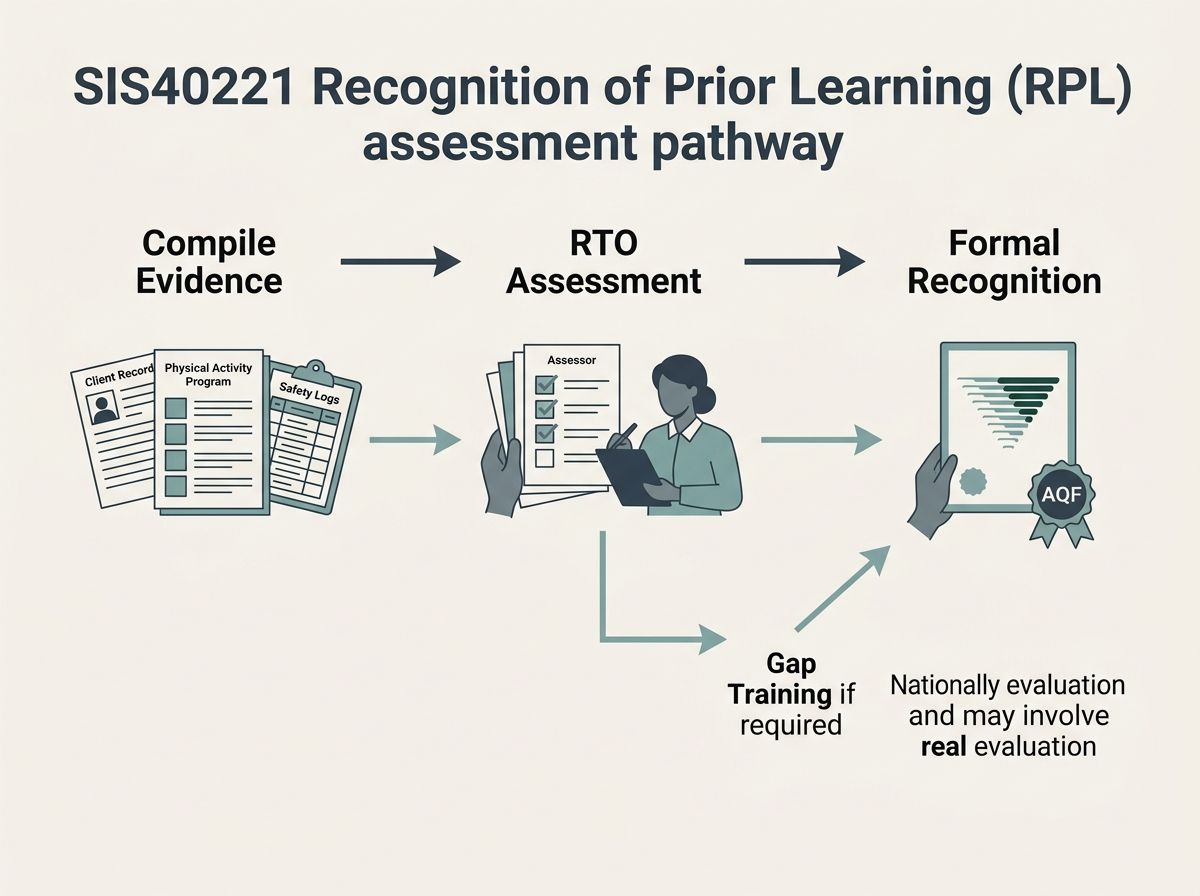
For someone who already trains clients, designs programs, conducts fitness assessments, and manages client safety, the evidence an RPL assessor needs may already exist in your working life. The assessment process evaluates whether that evidence demonstrates competency against the standards of SIS40221. It does not ask you to re-learn what you already know. It asks you to demonstrate that you know it.
RPL assessment for SIS40221 is conducted by a qualified assessor from the delivering RTO. The types of evidence typically considered include client records, program designs, fitness assessment documentation, video evidence of sessions, employer or client references, logbooks, and professional development records. Specific evidence requirements vary by RTO and assessor. If gaps are identified during the assessment — areas where your evidence does not yet demonstrate the required competency — gap training is available and is typically provided at no additional cost.
Indicative timeframes for RPL assessment vary by RTO and by the complexity of the evidence provided. Some providers indicate a process of several weeks from evidence submission to outcome. These timeframes are indicative only and should be confirmed with the delivering RTO.
What experience counts toward SIS40221
SIS40221 requires completion of 17 units of competency — 10 core units and 7 elective units. The core units cover areas including client communication, exercise program development, exercise instruction, fitness assessment, and client safety management. The elective units allow for specialisation in areas such as business operations, group exercise instruction, and coaching.
RPL assessors look at demonstrated competency, not job titles. What matters is whether your experience — however it was acquired — provides evidence that you can perform the work the qualification covers. Relevant experience for SIS40221 RPL assessment may include delivering personal training sessions, designing and implementing client exercise programs, conducting fitness assessments, managing client safety and referral, coaching sport or group fitness, delivering corporate wellness programs, or working in gym or fitness environments in a training capacity.
Online coaching, sport coaching, and group fitness instruction may also be relevant, depending on how the experience maps to the specific competency units. The assessment determines this — not a general description of your background. Evidence needs to be valid, authentic, current, and sufficient to meet the requirements of each unit being assessed.
If your experience sounds relevant, the next honest step is to find out whether your specific situation maps to the competency standards of SIS40221. That is what the Free Skills Review is for.
The honest answer to 'Is RPL right for me?'
RPL is not suitable for everyone. Someone whose experience does not map to the SIS40221 competency standards — or whose evidence is limited, undocumented, or from a context that does not demonstrate the required competencies — may not be a strong RPL candidate. The assessment is genuine, and the assessor's determination is independent. RPL it guides candidates through the process; the RTO assessor determines competency.
Our commitment is to honest suitability guidance before enrolment. We would rather guide someone to the right pathway than enrol them in the wrong one. If RPL is not the right pathway for your situation, that is worth knowing before you invest time and money in the process.
The Free Skills Review exists precisely for this reason. It is free. It carries no obligation to proceed. It gives you an honest assessment of whether your experience is likely to support an RPL pathway for SIS40221 — before any commitment is made.
What happens after the certificate: the doors that open
SIS40221 is a nationally recognised qualification issued by a Registered Training Organisation under the Australian Qualifications Framework. Once formally recognised, it is recognised across Australia — in every state and territory, for employment, contracting, registration, and insurance purposes.
The walls named at the opening of this article become passable. Professional indemnity insurers who require a relevant qualification have a clear basis for cover. Gyms and fitness facilities that require the Certificate IV for floor access have the credential they need. Franchise compliance conditions that list the Certificate IV are met. Corporate clients and organisations that ask for evidence of formal qualification have the documentation they require.
AUSactive registration — which requires a relevant qualification, current First Aid and CPR, and valid insurance — becomes available to Personal Trainers holding SIS40221. AUSactive describes its registration framework as voluntary, but notes it evolved in response to concerns about consumer protection, safety, and quality in the fitness industry. Accredited Professionals within the AUSactive framework may also be eligible for private health fund insurance rebates.
The qualification opens doors. What you do with those doors is your own. If you have the experience and the evidence exists, the RPL pathway may be the most direct route to formal recognition of what you already know.
To learn more about the Certificate IV in Fitness (SIS40221) and the RPL pathway, visit the qualification page.
General information only, current at the date shown. Licensing rules change, so check the current requirements with the relevant regulator before you rely on them. RPL it Australia is a student support service, not a Registered Training Organisation; qualifications are assessed and issued by our partner RTOs.