What happens when the builder you subcontract for can no longer vouch for you
Tilers working under a builder's licence face a hidden risk. Discover what happens when that arrangement ends, and how RPL protects your livelihood.
By RPL it Australia8 min read

The arrangement that works—until it doesn't
You have been tiling for years. You know the trade. You understand the materials, the substrates, the weather, and the clients. The builder you work with holds the licence, and that has always been enough. The arrangement works, and nobody has asked questions.
Most experienced tilers in this position do not see themselves as exposed. In practical terms, they are right. The work gets done, the invoices are paid, and the professional relationship holds. But underneath this arrangement lies a qualification gap that remains invisible until the partnership ends. When it does, that gap is the only thing that matters.
This is not a question of your competence; you have the skills. It is about the formal credential required to operate independently, and what happens when the person whose licence you rely on is no longer there.
What working under a builder actually means for your licence status
There is a clear legal distinction between working under someone else's licence and holding your own qualification. Most tilers in informal subcontracting arrangements understand the practical reality, but the formal regulatory rules are often less clear.
In Australia, licensing requirements for tiling work vary by state and territory. In Queensland, you must hold a licence to perform wall and floor tiling work valued at more than $3,300. In New South Wales, a contractor licence is required for residential tiling work exceeding $5,000 in labour and materials. Performing unlicensed work there can attract a fine of up to $22,000 for an individual under the Home Building Act 1989. Requirements differ across other states and territories, and the relevant licensing body in your state is the correct authority to confirm what applies to your situation.
The nationally recognised qualification for roof tiling is the Certificate III in Roof Tiling (CPC30820). Training.gov.au states that state and territory jurisdictions may have different licensing, legislative, regulatory, or certification requirements, meaning you must consult the relevant regulatory authorities. In practice, the builder's licence covers the builder's business. It does not extend to your own independent operations.
If you want to formalise your tiling credentials, the Certificate III in Roof Tiling (CPC30820) is the nationally recognised trade qualification for this work.
In Queensland, if an applicant does not meet the technical qualifications for a wall and floor tiling licence, they may obtain the qualification through Recognition of Prior Learning (RPL) with a registered training organisation. Because requirements vary, confirming this pathway with the relevant licensing body and an RTO is the correct first step.
Five ways the arrangement ends—and none of them are your choice
The end of this arrangement is not a remote risk. Over a long career, it is almost certain to happen. These are the five most common triggers, and none of them require you to make a mistake or do anything wrong.
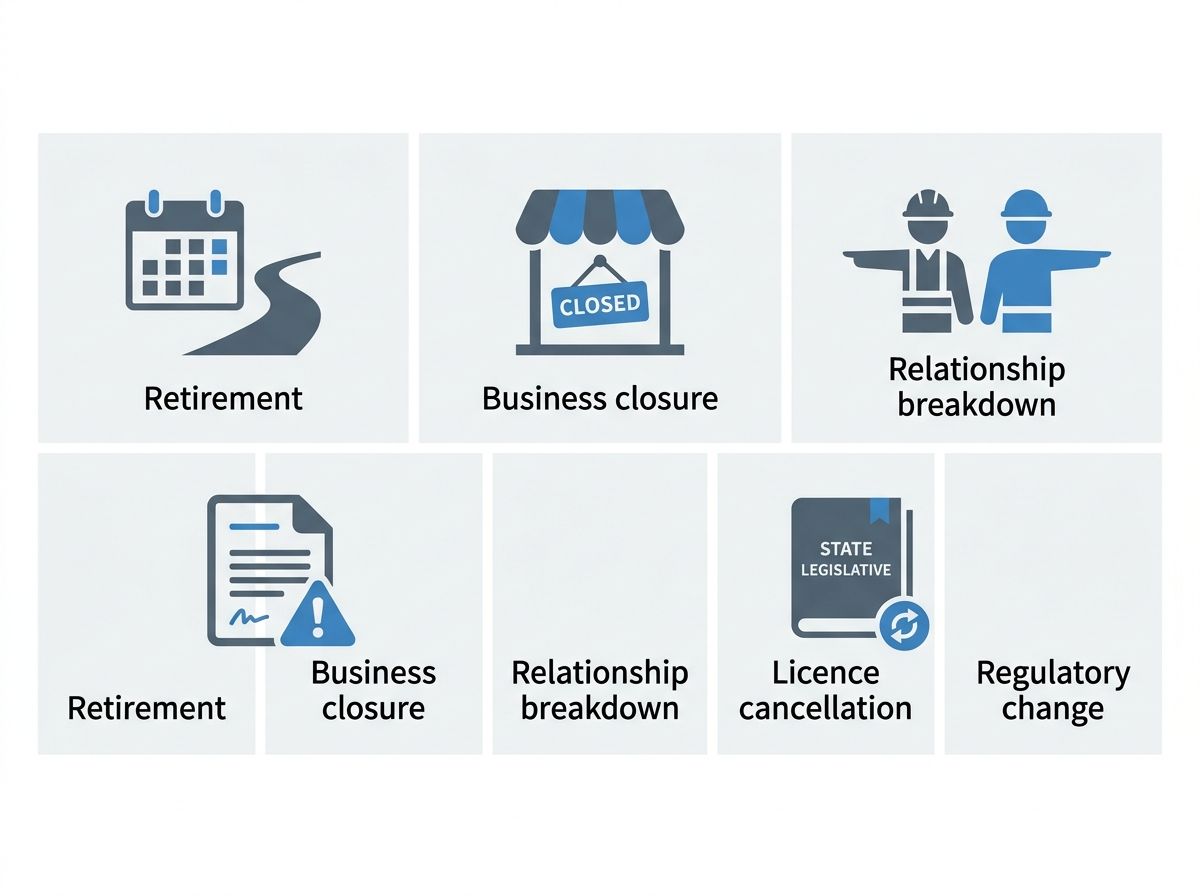
- The builder retires. After decades in the trade, they wind up the business and their licence goes with them.
- The business closes. Financial pressure, a bad project, or a client dispute can cause construction businesses to exit the market. When the business closes, the arrangement ends.
- The relationship breaks down. Disagreements over payment, changes in direction, or a new partner bringing in their own subcontractors can end partnerships for reasons unrelated to your work quality.
- The builder's licence is suspended or cancelled. Queensland's building regulator, the QBCC, suspended or cancelled hundreds of licences in 2023–24 for financial non-compliance and unpaid debts. A suspended licence cannot cover your work.
- Regulatory requirements change. Licensing thresholds, qualification requirements, and compliance obligations shift over time. What met the old rules may not meet the new ones.
None of these scenarios are your fault. Yet all of them leave you in the exact same position: highly experienced, fully capable, but without a formal qualification to fall back on.
A submission to the Productivity Commission describes the builder-subcontractor relationship in residential construction as typically short-term and project-by-project, starting at the tender stage and ending with final payment. Subcontractors frequently work across several projects with different builders simultaneously. The arrangement is transactional rather than permanent.
The QBCC Annual Report 2023–24 records the grounds and frequency of licence suspensions and cancellations in Queensland, including actions for financial non-compliance and failure to maintain a nominee. These events can disrupt subcontracting arrangements without warning.
What happens the day after: the immediate practical consequences
When the arrangement ends, the gap between being an experienced tiler and a formally qualified tiler becomes visible immediately. This is how that gap affects your daily work.
- You cannot legally quote or invoice for independent work above the licensing threshold in your state.
- You cannot access commercial or government sites that require direct proof of your own qualification or licence.
- Your ability to get public liability insurance as an independent operator can be affected. Most sites and builders require tilers to hold a current policy, and insurers will ask about your licence. You must confirm these specifics with your insurer.
- You cannot take on work in your own name without the trade credential that proves your qualifications.
This does not reflect your actual skill. It is about the physical credential that proves it. The formal licensing system cannot recognize your experience without that documentation.
The tiler's paradox: years of skill, zero formal evidence
Here is the paradox: you have the on-the-job experience. You may have more practical knowledge than many formally qualified tradespeople. But the formal licensing system cannot see your skill because it is not documented in the correct format.
Your skill is real and your experience is valuable. The licensing system simply has not been shown the proof in a way it accepts.
Recognition of Prior Learning (RPL) is the formal assessment pathway designed to bridge this exact gap. It is not a shortcut. It is a rigorous, nationally regulated process that evaluates your current skills, knowledge, and experience against the requirements of a specific Australian qualification. For this trade, that is the Certificate III in Roof Tiling (CPC30820). If your experience demonstrates competency against those standards, the qualification is awarded. If any gaps are identified, the assessor may recommend targeted gap training.
Your daily work experience can serve as formal evidence. The RPL process is the mechanism that translates your on-the-job skills into a recognized certificate.
How RPL converts your tiling experience into a formal Certificate III
RPL involves genuine assessment and is not a rubber stamp. This is what the practical process looks like for an experienced tiler.
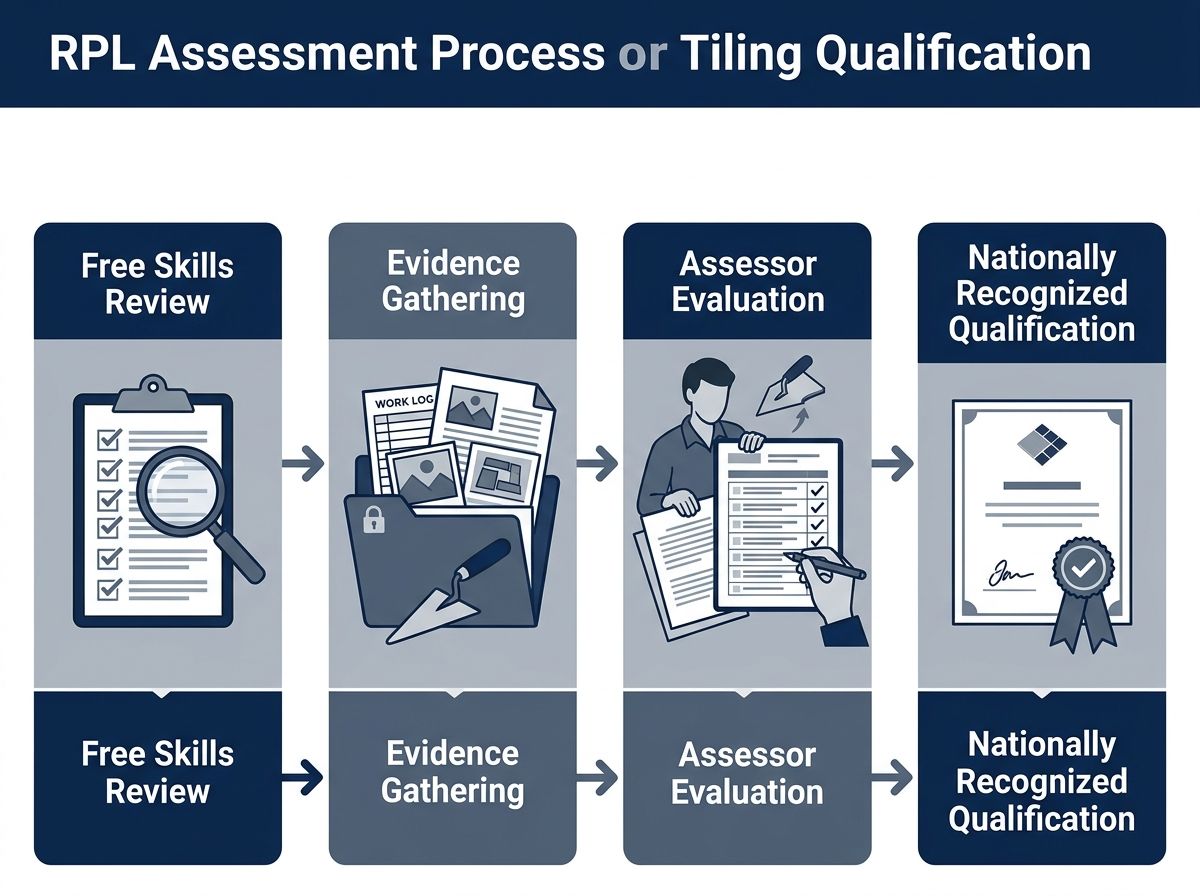
The process starts with a skills review. This is an honest conversation about your work history, the specific types of tiling work you have completed, and whether your experience aligns with the requirements of the qualification. Your suitability is assessed here before you make any commitment.
If the initial review indicates RPL is a viable pathway, you begin gathering evidence. One registered training organisation offering CPC30820 RPL states that applicants must provide sufficient, valid, authentic, and current evidence that they meet the requirements of the relevant units of competency. This evidence can include employment history, reference letters from builders or site supervisors, current qualifications, workplace documents, photos of your completed work, videos, logbooks, and other relevant trade records.
Assessment methods include portfolios of evidence, third-party reports, practical demonstrations, oral questioning, and written knowledge assessments, depending on the unit. Each application is reviewed individually by a qualified assessor. Granting RPL is not automatic; it depends entirely on whether your evidence demonstrates competency under the national Training Package.
If gaps are identified during your assessment, the assessor may recommend gap training. This is a normal part of the process and does not mean your application has failed; it simply shows the assessment is working as intended. Many RTOs provide this gap training at no additional cost.
You can complete the RPL process while continuing to work. The Master Builders Association of NSW states that you can gain a Certificate III trade qualification through RPL while working, and that many RPL programs can be completed online or on-site. Confirming these specific arrangements, including worksite access for evidence and assessment, is part of your initial skills review.
The Master Builders Association of NSW outlines how RPL works for building trades, including suitability, the evidence required, and how gap training is managed in some cases.
For context on what RPL evidence looks like across Australian qualifications, the METS Training Services guide outlines common evidence categories including resumes, employer references, photos or videos of work, job descriptions, work samples, and certificates of prior training.
The case for acting before the arrangement ends
The best time to convert your experience into a formal qualification is before you face a crisis, not during it. When a subcontracting arrangement ends, you must immediately find new work, re-establish client relationships, and navigate licensing requirements. That is not the ideal time to start an RPL application.
The reason to act early is straightforward: your skills are real and your experience is current today. The evidence you need for an RPL assessment—including your work history, builder references, and site records—is easily accessible right now. Waiting does not make this process easier; it makes it more difficult.
Getting recognized should not require starting over. RPL exists so that experienced tilers do not have to repeat training they have already completed through years of hands-on practice. The qualification formally documents what you already know how to do.
Your trade skills are real, your experience is valuable, and your qualification is earned. Taking this step is up to you.
General information only, current at the date shown. Licensing rules change, so check the current requirements with the relevant regulator before you rely on them. RPL it Australia is a student support service, not a Registered Training Organisation; qualifications are assessed and issued by our partner RTOs.