Stop pouring for someone else: The RPL path to your Cert 3 in Concreting
Already pouring concrete? Get your Cert 3 in Concreting (CPC30320) without the classroom. Turn your site experience into a formal qualification via RPL.

The licensing wall every experienced concreter hits
You have poured concrete for years. You know the mix ratios, curing times, and varying site conditions. You have prepped slabs in residential subdivisions, footings in commercial builds, and decorative finishes other concreters avoid. But the regulator does not see that hands-on experience. They only see a missing qualification.
In Australia, contractor licensing requirements for concreting work vary by state and territory. Each state's licensing authority sets its own rules. What remains consistent across most jurisdictions is this: formal qualifications matter. The Certificate III in Concreting (CPC30320) is the national standard licensing bodies and principal contractors look for when checking if a concreter can operate independently.
Without it, you work under someone else's licence, capped at their rates and dependent on their schedule. Every day without this qualification is a day you are not building your own independent business. That is the licensing wall. It is not a question of your competence. It is about having the credential that lets the formal licensing systems recognise your skills.
What the Cert 3 in Concreting actually is (and what it is not)
The Certificate III in Concreting (CPC30320) is a nationally recognised qualification under the Australian Qualifications Framework. It defines the competency standards for professional concreters in Australia and is required for contractor licensing in several states. You can earn it through a traditional training course, a structured apprenticeship, or Recognition of Prior Learning (RPL).
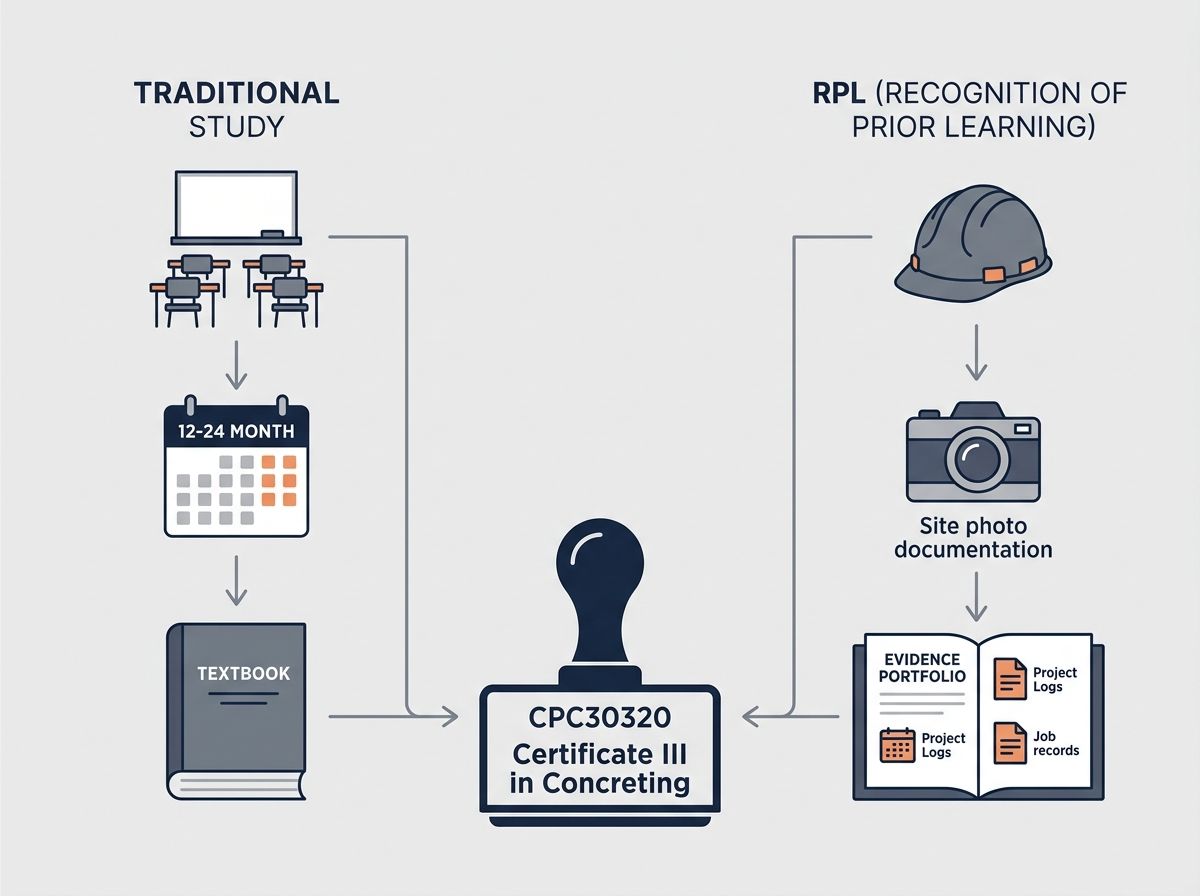
That last option is the one most experienced concreters overlook. The qualification describes what you can actually do on site, not how you learned to do it. CPC30320 covers core competencies such as placing and finishing concrete, handling concreting materials, calculating supply requirements, and working safely on construction sites.
The qualification is a standard, not a classroom sentence. There is more than one path to reach it. For someone who has spent years on site, the traditional classroom route, which is built for beginners entering the trade, makes little sense. RPL exists for this exact scenario.
Why your site experience is already evidence
Recognition of Prior Learning (RPL) is a formal assessment process. A registered training organisation evaluates whether your existing skills and workplace experience meet the competency standards of the Certificate III in Concreting. This means you do not have to repeat training or classes you have already completed through your actual work.
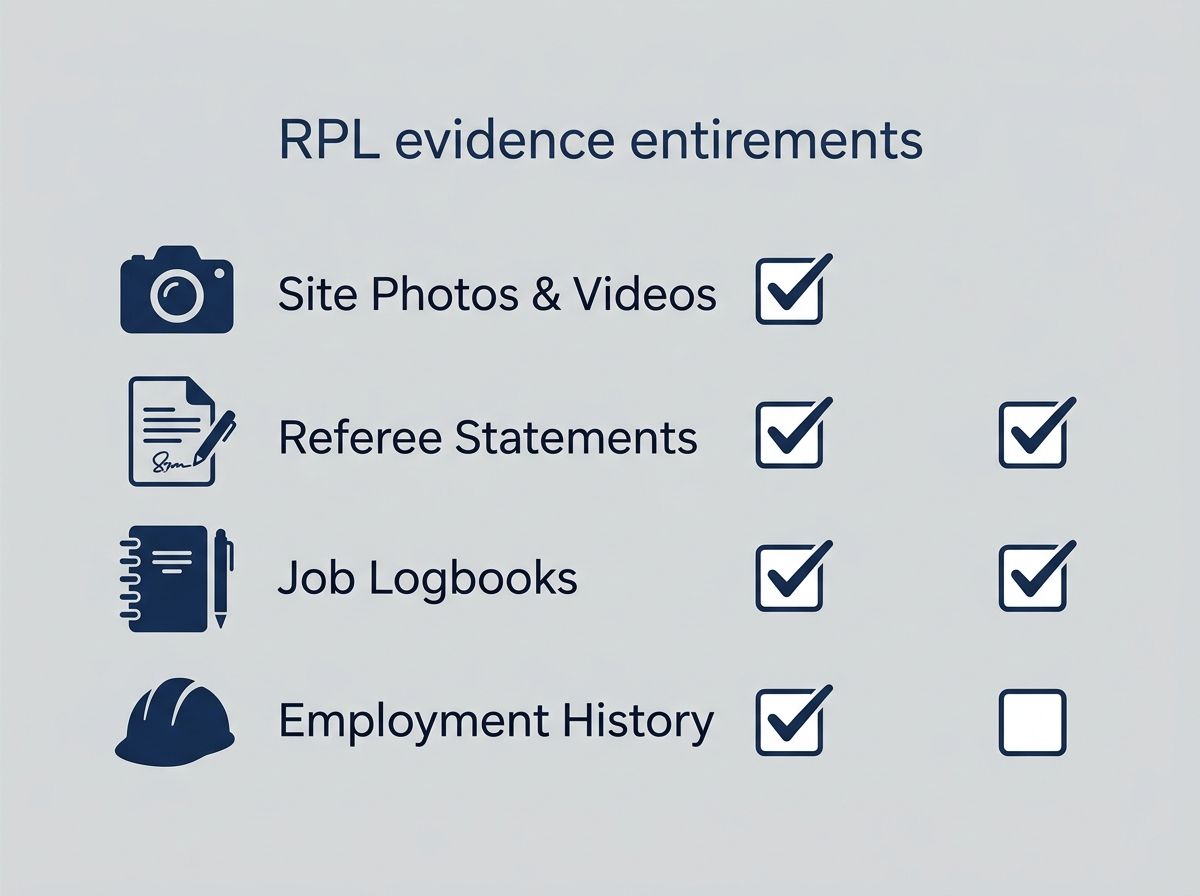
For an experienced concreter, the evidence is on the job, not in a classroom. The Master Builders Association of NSW describes RPL as an assessment-only process that formalises years of practical experience and knowledge. This typically involves answering technical questions, completing practical projects, providing employer references, and undergoing gap training if any gaps are identified.
What does that evidence look like in practice? For a concreting RPL assessment, it typically includes:
- Site photographs of you performing concreting work, such as formwork, reinforcement, placement, and finishing.
- Referee statements or third-party reports from site supervisors, managers, or principal contractors.
- Job records, logbooks, or timesheets documenting the scope and volume of work completed.
- Employer declarations confirming your daily role and responsibilities on site.
- Payslips or contracts demonstrating sustained employment in the trade.
These are not just casual notes. They are concrete proof of your competency. A photo of a reinforced slab you poured, or a formal reference from a site supervisor who has watched you work for three years, forms the raw materials of your RPL assessment. You have likely been gathering this practical evidence for years without realising it.
To understand what this pathway looks like before you start, the Certificate III in Concreting (CPC30320) page explains the qualification details and how RPL applies to it.
The classroom assumption: Why it keeps experienced concreters stuck
The default assumption, built on standard course advertising and general expectation, is that getting qualified requires going back to school. For an experienced concreter, this assumption is more than inconvenient. It actively stalls your career.
A traditional apprenticeship pathway for CPC30320 can take one to two years, combining work with structured training. One registered training organisation lists its on-site delivery as 12 to 14 months. That is a heavy time commitment, and for anyone working full-time in the trade, it means months of disruption to your income and daily routine.
By contrast, RPL is based entirely on existing evidence rather than new learning. Some RTOs indicate an RPL assessment can be completed in a matter of weeks for candidates with sufficient documented experience. Actual timeframes depend on your evidence, the RTO's assessment process, and whether you need to complete any gap training.
Recognition should not require starting over. Forcing an experienced concreter to sit through units covering skills they have demonstrated hundreds of times on site is not a rigorous test. It is a repetition of what you already know. RPL is the process that prevents this.
The Master Builders Association of NSW notes that the construction industry needs more skilled and qualified tradespeople, and highlights RPL as a practical way to translate experience into a nationally recognised trade qualification.
The same pattern plays out across other trades. Experienced workers in different fields face the identical wall, where years of practical competency are blocked by a missing credential. The process for solving this is the same.
What the RPL process looks like for a concreter
RPL is not a shortcut. It is a rigorous, structured assessment conducted by a qualified assessor from a registered training organisation. The qualification is issued directly by the RTO, not by an RPL advice service. What an RPL specialist provides is support throughout the process: helping you understand what evidence is needed, how to gather it, and how to present it clearly.
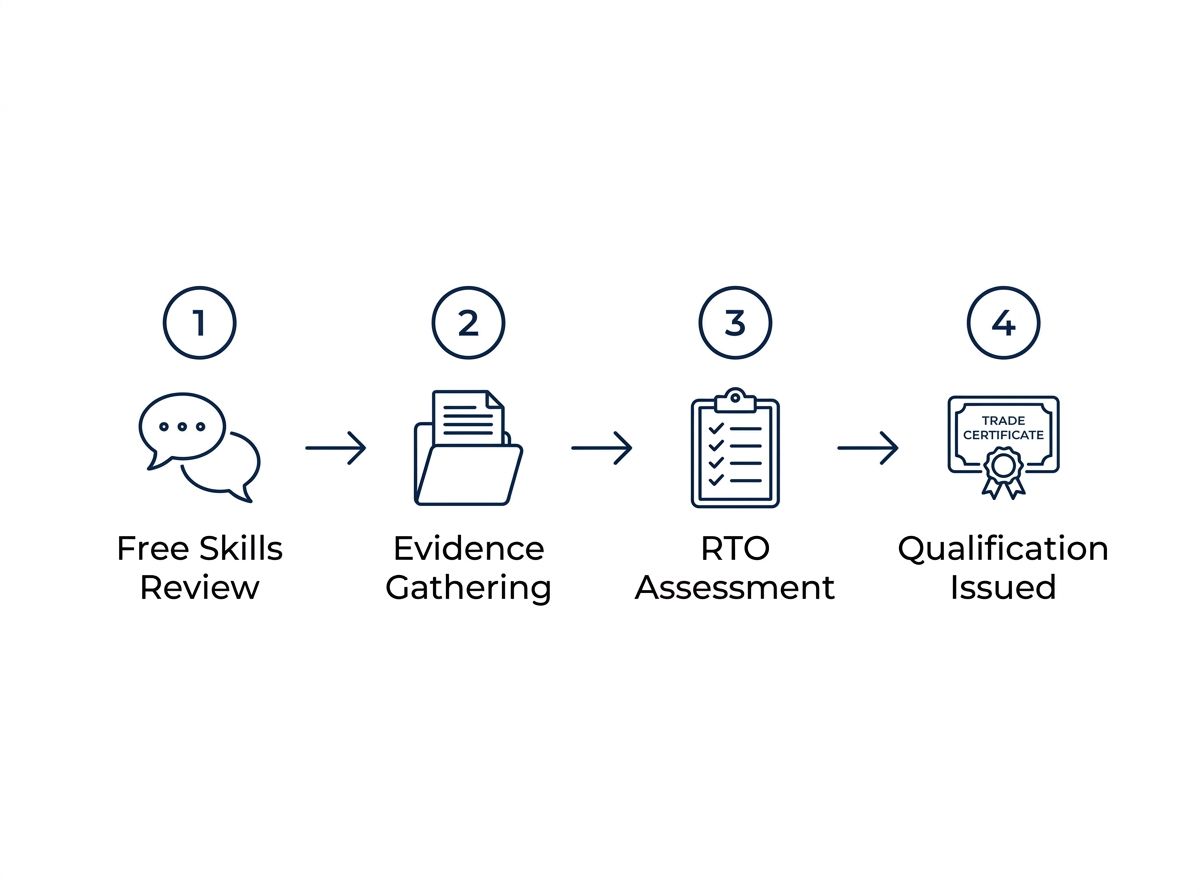
For a concreter, the process typically follows these steps:
- Free Skills Review: A straightforward, no-obligation discussion about whether your experience matches the competency standards of CPC30320.
- Evidence gathering: Identifying and organising the paperwork and photos that demonstrate your skills across the core units.
- RTO assessment: A qualified assessor from a registered training organisation reviews your portfolio against national industry standards.
- Qualification issued: Once your competency is confirmed, the RTO issues your formal Certificate III in Concreting (CPC30320).
You do not have to figure out what evidence to gather on your own. The process is fully guided from start to finish. If the assessment identifies areas where your experience does not quite meet the standard, you may need to complete gap training. This is a normal part of a professional process, ensuring your qualification remains respected and valid across the construction industry.
The Master Builders Association of NSW advises checking that any provider you choose is a registered training organisation listed on training.gov.au. You should also review their contracts, refund policies, and support structures. Programs promising fast-tracked results with minimal evidence are a clear warning sign.
ASQA, the Australian Skills Quality Authority, is the national regulator for the vocational education sector, ensuring that registered training organisations deliver training and assessment that meets national standards.
Is RPL right for every concreter?
The honest answer is no. RPL is not suitable for everyone, and any provider who tells you otherwise is not being straight with you.
RPL works when your experience covers the full scope of the qualification. CPC30320 requires broad competency, rather than experience in just one type of pour. If your experience spans formwork, reinforcement, placement, finishing, and curing across various project types, you are in a strong position to demonstrate competency across the core units.
If your experience is limited to one specific area, such as decorative finishes or residential slabs only, you may have gaps in other units. That does not disqualify you from RPL, but it does mean gap training will likely form a part of your pathway. The Free Skills Review is designed to identify these areas clearly before you commit to the process.
The Master Builders Association of NSW notes that RPL is suitable for people who have worked in the industry for years but lack the paperwork to prove their skills. The key task is proof. RPL is about demonstrating what you already know, not learning new skills from scratch.
The construction sector in Australia is facing substantial workforce pressure. Master Builders Australia has projected that the industry needs almost half a million new workers to maintain current building activity, with more required to meet housing targets. Experienced tradespeople who can prove their existing competency through RPL are part of the solution, provided the assessment is genuine.
Your experience has already done the work. Let's make it count.
You have the experience. The qualification exists to recognise it. The task now is to show that your documented experience matches the competency standards of CPC30320.
You do not need to figure this out alone. The Free Skills Review is where the process begins. This is a straightforward, practical assessment of whether RPL fits your personal situation. It costs nothing, there is absolutely no obligation to proceed, and if RPL is not the right option for you, we will tell you directly.
Your skills are already proven on site. Let's get them recognised.
For full details on the Certificate III in Concreting (CPC30320) and how RPL applies to it, visit our qualification page.
Ready to Get Recognised?
Start with a free skills review to find out if RPL is right for you.