The Friday afternoon ultimatum: Getting qualified quickly when your boss demands it
Your employer just told you to get qualified. Traditional study won't work on a deadline. Here is how RPL turns your experience into a formal qualification.

The meeting you didn't see coming
It might have been a Friday afternoon pull-aside, an email from HR, or a site manager reading from a new contract clause. However it arrived, the message was the same: you need to get qualified, and you need to do it before a deadline that is already uncomfortably close.
You have been doing this work for years. You know the job well. You have trained people who now hold the very qualification being demanded of you. Yet here you are, being told that what you know is no longer enough, and that the system needs a piece of paper to confirm what your colleagues already take for granted.
That frustration is completely legitimate, the resentment is understandable, and the pressure is real.
This is not a personal failing; it is a compliance requirement. Industries across Australia, including construction, mining, utilities, aged care, and oil and gas, are tightening their qualification requirements in response to regulatory changes, new contracts, and shifting licensing standards. The directive your employer issued is almost certainly not about you specifically, but about the organisation managing its regulatory obligations.
Knowing that does not make the deadline feel less urgent. But it does change the question. The question is no longer why this is happening to you, but rather what is the most practical pathway forward.
Why enrolling in a standard course rarely works for full-time workers
The standard advice to enrol in a course, complete the units, and get the qualification was designed for a different kind of learner. It assumes you have free time. It assumes you can easily attend classes, submit assignments, and step back from your current role while you study. It assumes the timeline is yours to manage.
None of those assumptions apply when your employer has set a strict deadline.
A Certificate III or Certificate IV in a regulated trade typically carries hundreds of nominal training hours. Delivered part-time around a full working week, that translates to months of study, which is often well beyond the window your employer has given you. That is before accounting for the practical components, the assessment submissions, and the scheduling constraints of registered training organisations running group intakes.
The traditional vocational study pathway was built for school leavers entering an industry for the first time. It was not built for someone who has been doing the job for a decade and simply needs the formal recognition to match.
If you are a full-time worker with a compliance deadline, enrolling in a standard course is not a solution. It is a different problem. The pathway that actually fits your situation is one that starts with what you already know, rather than what you still need to learn.
What RPL qualifications actually are (and what they are not)
Recognition of Prior Learning (RPL) is a formal assessment pathway through which a registered training organisation (RTO) evaluates your existing competency against the requirements of a nationally recognised qualification. If the assessment confirms you meet the standard, the RTO issues the qualification. The qualification is exactly the same as one earned through traditional study. It carries the same national recognition, appears on your USI transcript, and satisfies the same employer and licensing requirements.
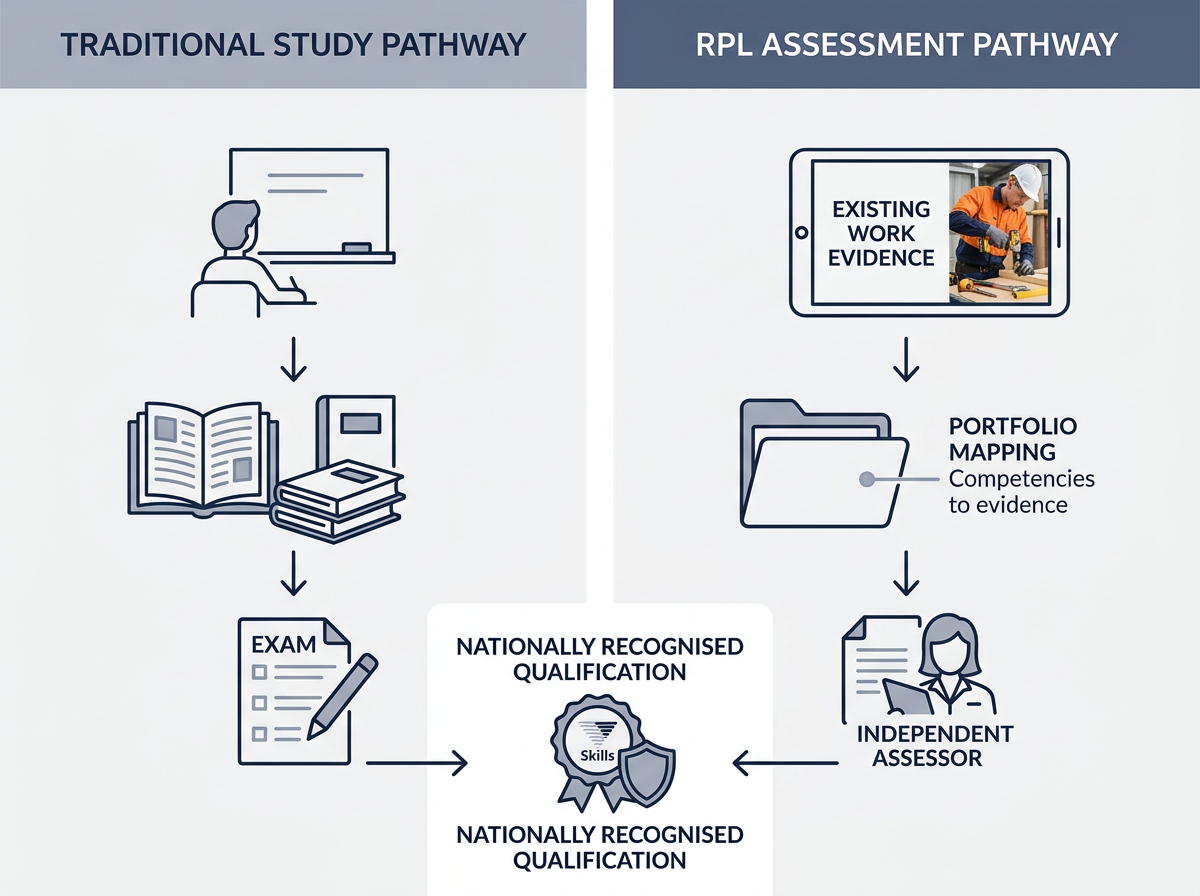
RPL qualifications are not a shortcut, a workaround, or a purchased certificate. The assessment is conducted by a qualified assessor employed by the RTO, and the standard being assessed against is the same standard applied to every other candidate for that qualification. The outcome is nationally recognised because the process is genuine.
What RPL does differently is straightforward: instead of asking you to demonstrate competency by completing training, it asks you to demonstrate competency by presenting evidence of what you already do. The assessor is not testing whether you can do the job; they are verifying that you already do it.
RPL it does not conduct assessments or award qualifications. That is the RTO's role. What RPL it does is guide candidates through the recognition process, helping you understand what evidence is needed, how to present it, and what to expect at each stage. The assessor's professional judgement is independent. Our role is to support you in reaching that assessment as well-prepared as possible.
How the RPL assessment process works: Evidence, not exams
The RPL assessment process is built entirely around evidence of existing competency. Your assessor will map the units of competency in your target qualification against the evidence you can provide from your working life. The goal is to establish, through documented proof, that you already perform the work to the required standard.
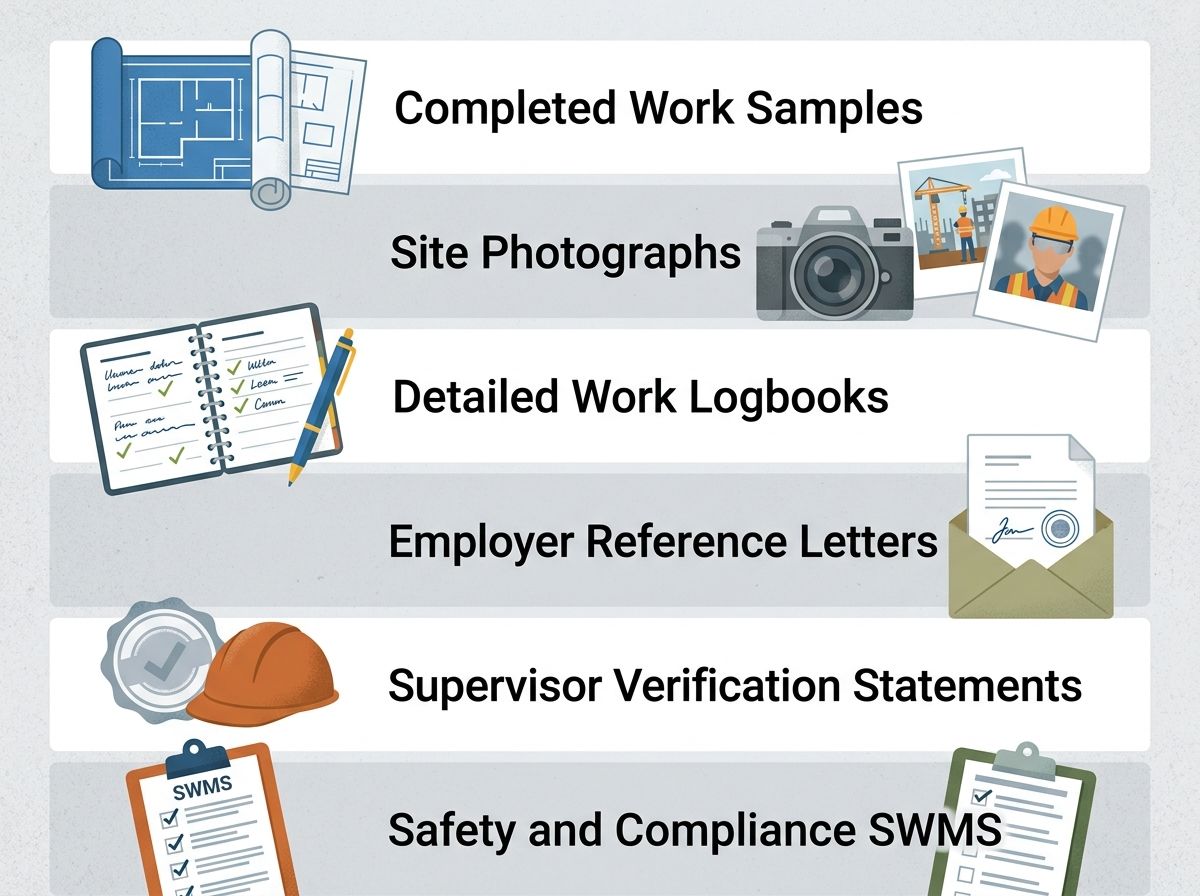
Evidence types commonly used in RPL assessments include:
- Work samples and project documentation: records of work you have completed that demonstrate the required skills
- Site photographs: visual evidence of tasks performed to industry standard
- Logbooks and job records: documented history of work activities over time
- Supervisor or employer statements: written confirmation from people who have observed your work
- Third-party reports: accounts from clients, colleagues, or other professionals who can verify your competency
- Professional references: formal statements from qualified individuals who can speak to your capability
- Trade tests: where required by the qualification, a practical demonstration conducted by the assessor
Most of this evidence already exists in your professional life. It is in your job records, your site files, and your employer's documentation. The process is not about creating new evidence; it is about organising what you already have into a format the assessor can evaluate.
The process is structured and guided. It is not simple in the sense of requiring no effort, as gathering and presenting evidence takes time and attention. However, it is navigable and is built around your existing work rather than requiring you to step away from it.
What happens if gaps are found
Honest guidance requires stating this clearly: not every candidate will have evidence for every unit of competency in their target qualification. Gaps are a normal part of the assessment process, not a sign of failure.
When an assessor identifies a gap, such as a unit where the evidence does not yet meet the required standard, gap training is provided through our partner RTOs. The specifics of how gap training is delivered and what it involves will be confirmed at your Free Skills Review, where you can ask questions and understand exactly what applies to your situation before making any commitment.
This matters because the qualification is nationally recognised precisely because the assessment is genuine. An RPL qualification that bypassed legitimate gaps would not carry the same standing. The rigour of the process is what makes the outcome credible to your employer, to licensing bodies, and to any future employer who sees it on your record.
Our position on this is straightforward: we would rather guide someone to the right pathway than enrol them in the wrong one. If RPL is not suitable for your situation, we will tell you. That honesty is not a limitation; it is the foundation of a process you can trust.
The compliance timeline: What to expect
The timeline for an RPL assessment depends on the qualification, the industry, and, most significantly, the evidence you already have available. A candidate with well-organised work records, accessible employer references, and a clear history of relevant work will move through the process differently from someone who needs to locate and compile evidence from multiple sources.
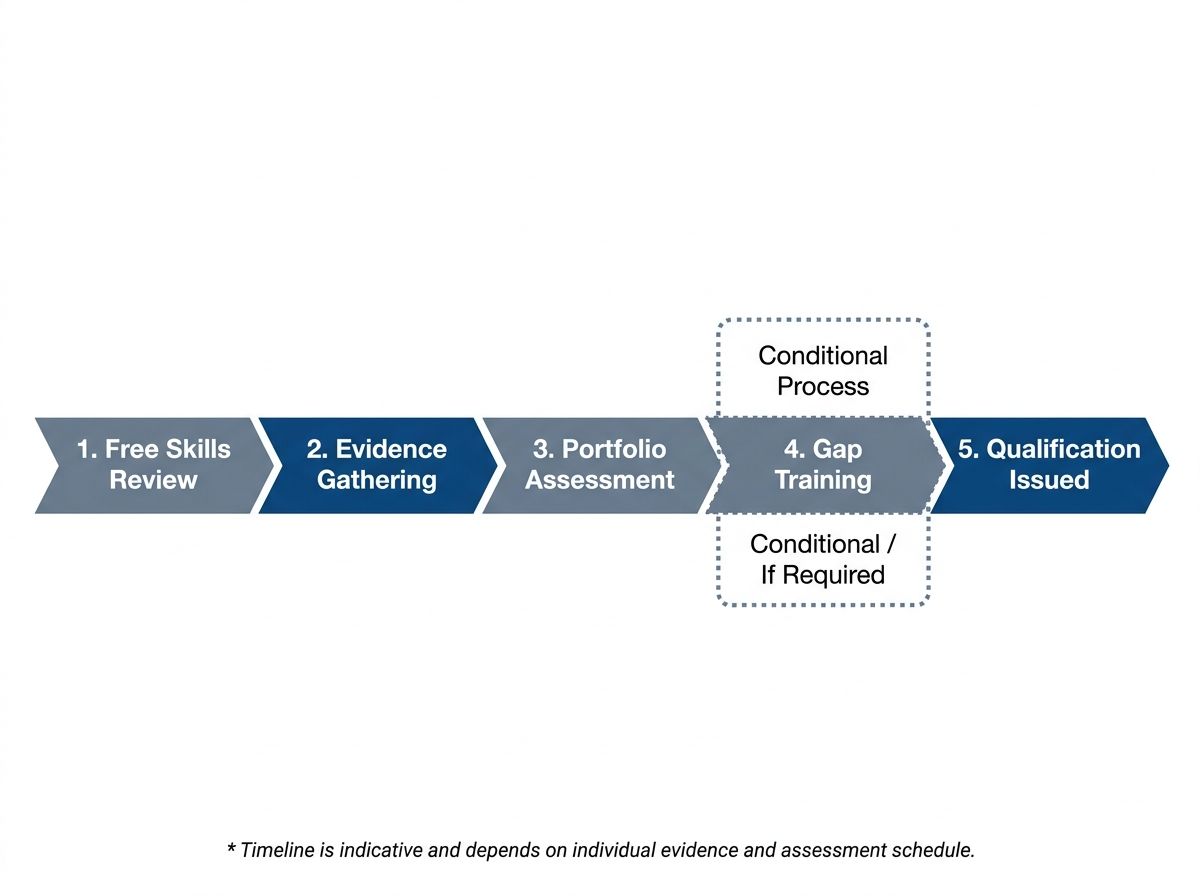
The process follows a consistent sequence:
- Free Skills Review: an honest assessment of your existing experience and whether RPL is a suitable pathway for your situation, with no cost, no commitment, and no obligation.
- Evidence gathering: working with your RPL it guide to identify, organise, and present the evidence that maps to your qualification's units of competency.
- RPL assessment: the qualified assessor from the delivering RTO evaluates your evidence against the qualification standard.
- Gap training (if required): where gaps are identified, targeted training addresses the specific units not yet evidenced.
- Qualification issued: the RTO issues the nationally recognised qualification upon successful completion of the assessment.
Duration estimates are indicative rather than promised. The timeline is shaped by your evidence, your responsiveness, and the RTO's assessment schedule. What a Free Skills Review will give you is a clearer, honest picture of where you stand and what the process is likely to involve for your specific situation, before you make any commitment.
If your employer has set a deadline, the most useful thing you can do right now is find out whether RPL is viable for your situation. That is what the Free Skills Review is for.
Your experience has always been the qualification
The employer ultimatum feels like a threat, but it is worth reframing.
You have been doing this work and you have the experience. What the formal system is now asking for is the documented evidence of what you already know, which is proof that you already do it, rather than proof that you can learn something new.
You are not unqualified; you are simply undocumented.
The distinction matters, and it changes how you approach the process entirely.
RPL qualifications exist because the formal system recognised, decades ago, that competence earned through work is as legitimate as competence earned through study. The pathway was designed for people in exactly your situation: experienced, capable, and facing a system that needs evidence before it can formally acknowledge what your colleagues already know.
Your skills are real, and the RPL process helps them be formally recognised.
Explore the RPL qualifications available through RPL it and see which ones align with your industry and experience.
The decision is yours. The first step costs nothing and commits you to nothing.
Ready to Get Recognised?
Start with a free skills review to find out if RPL is right for you.