What running a business day-to-day actually has in common with a Diploma of Business
Running a business involves budgeting, staff management, and supplier negotiation. See how those tasks map to Diploma of Business competencies.
By RPL it Australia8 min read

The gap between what you do and what the qualification says you should do
You have the experience. The question is whether the formal system can see it.
Most people who run a small business, managing staff, controlling budgets, negotiating with suppliers, and handling compliance, are performing work that sits squarely at Diploma level. The gap is rarely competence. It is language. The Diploma of Business uses formal academic terms for tasks you already complete under different names. 'Manage financial performance' is what you call reviewing your monthly figures. 'Lead and manage team effectiveness' is simply running your team. The work is identical. The vocabulary is different.
This article is a practical mapping exercise. It takes the key competency groups in the Diploma of Business (BSB50120) and translates them into the tasks a working business operator actually performs. Work through each section and ask yourself honestly: does this look familiar? If it does, your experience could serve as evidence, and a formal assessment can determine whether it meets the standard.
How the Diploma of Business is actually structured
The Diploma of Business (BSB50120) is a nationally recognised qualification at AQF Level 5. It is assessed against a combination of core units and elective units, with RTOs typically grouping electives into clusters that reflect real business functions.
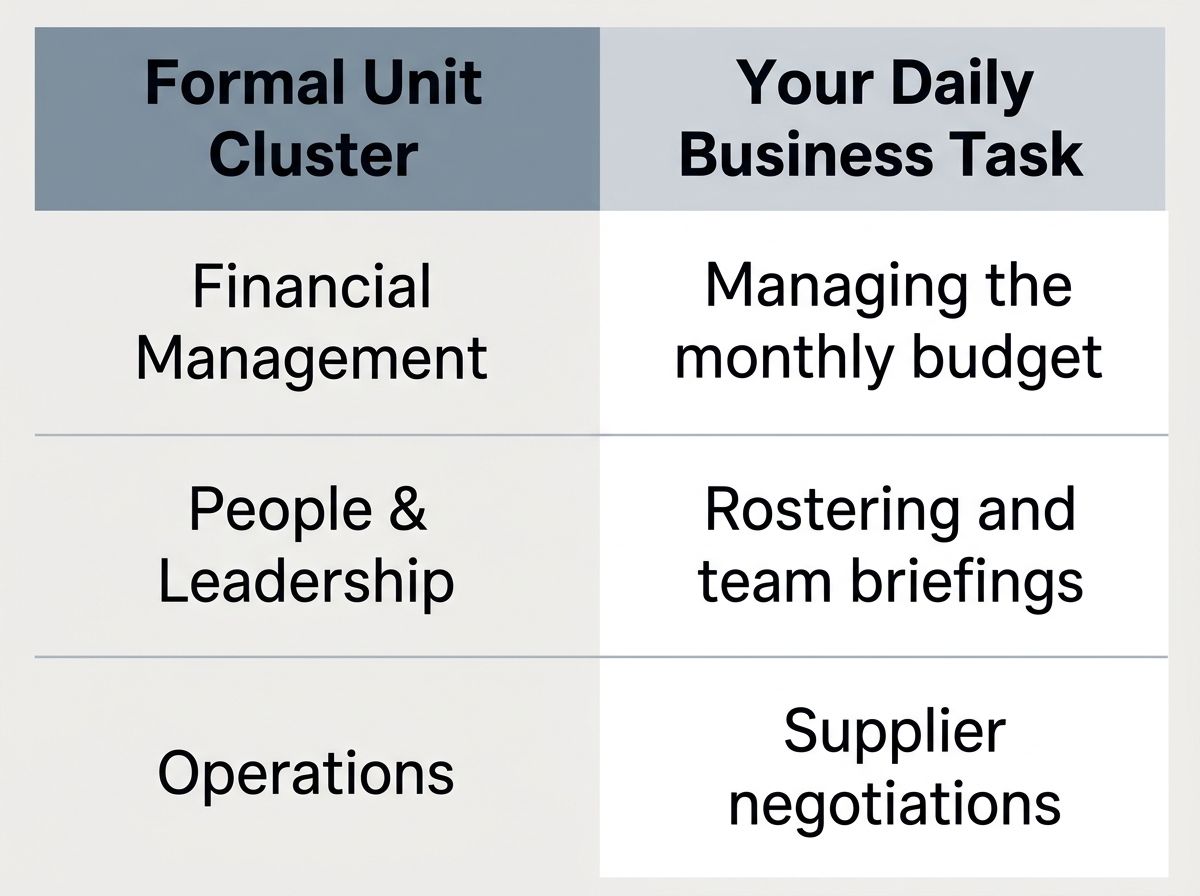
The core units cover the foundational skills expected of anyone operating at a diploma level, including critical thinking, professional communication, and managing personal work priorities. The elective clusters contain the specific business tasks. Most RTOs offering BSB50120 build these elective clusters around the following business functions:
- Financial management: budgeting, monitoring performance, and financial reporting
- People and leadership: leading teams, managing performance, and supporting staff development
- Operations and procurement: managing suppliers and coordinating business operations
- Risk and compliance: identifying and managing risk, and ensuring regulatory compliance
- Business planning and strategy: developing plans, monitoring outcomes, and continuous improvement
The sections below map each of these clusters to the tasks a small business operator is likely to perform every day. Note that specific unit codes and performance criteria are drawn from the BSB Training Package. Always verify current unit status on training.gov.au before relying on any specific code, as training packages are updated periodically.
Managing money: Do you already do what the finance units require?
The financial management units in the Diploma of Business assess your ability to manage budgets, monitor financial performance, and report on financial outcomes. This is not about being an accountant. It is about demonstrating that you understand your numbers and make decisions based on them.
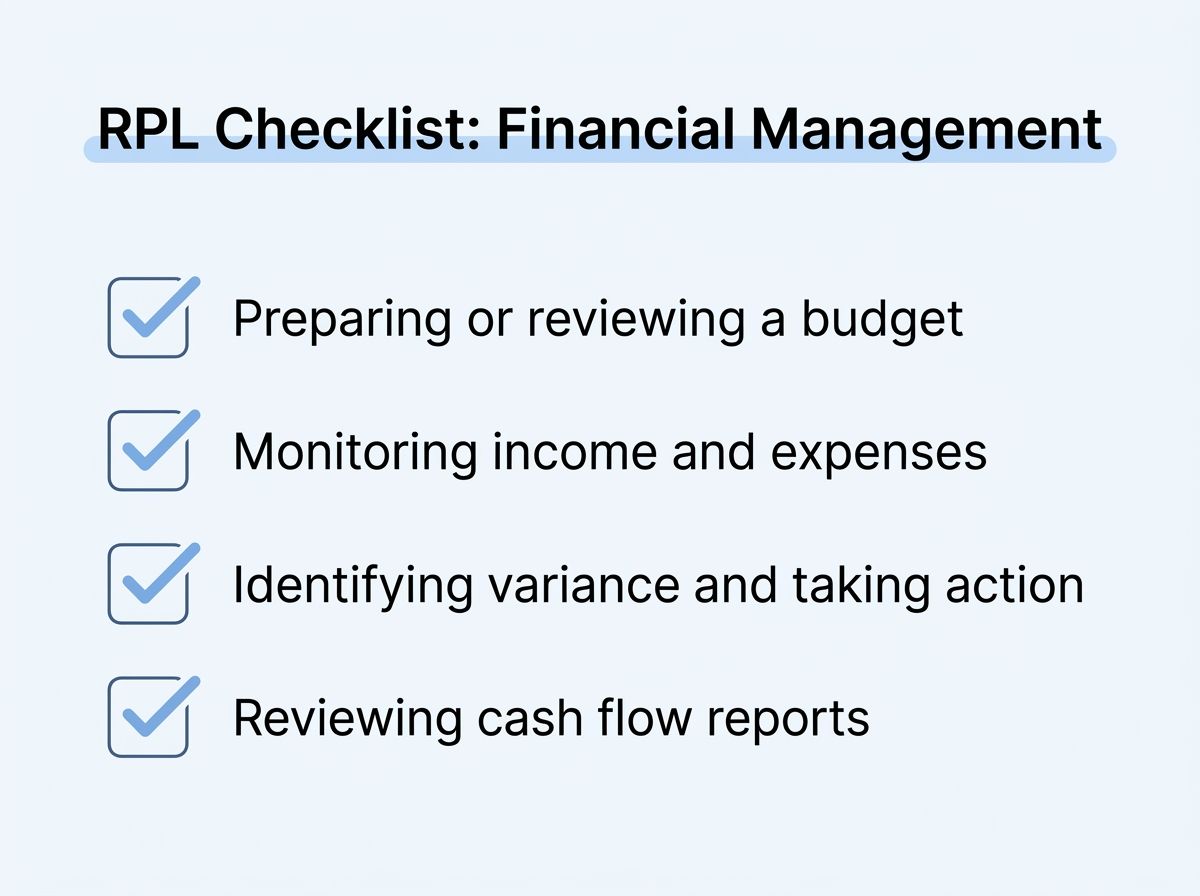
Ask yourself whether you perform any of the following tasks:
- Prepare or review a budget for your business, even a simple spreadsheet
- Monitor your actual income and expenses against what you planned
- Identify when you are over or under budget and take corrective action
- Prepare or review financial reports, such as a P&L, a cash flow statement, or a BAS
- Make purchasing or investment decisions based on your financial position
- Report on financial performance to a bank, accountant, or business partner
If you do most of these things, even informally, you are demonstrating the financial management competencies the Diploma of Business assesses. Evidence for these units typically includes financial records, budget documents, bank statements, BAS lodgements, and any correspondence with your accountant or financial adviser.
An honest note: if your financial management has been entirely handled by an accountant with minimal involvement from you, this cluster may require some gap training. That is useful to know now, before you commit to anything.
Managing people: What the qualification calls leadership and what you call Tuesday
The people management and leadership units in the Diploma of Business assess your ability to lead a team, manage individual performance, and support the development of your staff. You do not need a formal HR background. You need to have managed people, and most business operators do.
Ask yourself whether you do any of the following:
- Set expectations with your staff, whether through job descriptions, inductions, or direct conversation
- Address underperformance, whether through a formal process or a direct conversation
- Run team meetings or briefings, even informally
- Recognise when a staff member needs support and provide it
- Make decisions about hiring, rostering, or restructuring your team
- Support a staff member's development, through training, mentoring, or expanded responsibilities
Informal management still counts as evidence when it is documented. Employment records, rosters, performance notes, training records, and even text message threads can serve as evidence in an RPL assessment. The assessor is looking for demonstrated competency, not a formal corporate HR system.
An honest note: if you are a sole trader with no staff, the people management units may require gap training or a different elective selection. This is worth discussing with an assessor before you proceed.
Supplier negotiation, procurement, and operations: The units covering unglamorous work
The operational units in the Diploma of Business cover the day-to-day work of keeping a business running, including managing suppliers, coordinating procurement, and overseeing business operations. This is often the least glamorous part of running a business, but it is also the most consistently performed.
Ask yourself whether you do any of the following:
- Negotiate terms with suppliers regarding price, delivery, payment terms, or quality standards
- Review supplier performance and make decisions about continuing or changing suppliers
- Manage purchasing processes, even informally, through purchase orders or verbal agreements
- Coordinate the operational activities of your business, including scheduling, logistics, or workflow
- Monitor the quality of goods or services your business receives
- Manage contracts or service agreements with external providers
Evidence for these units typically includes supplier contracts, purchase orders, correspondence with suppliers, invoices, and any documentation of supplier reviews or negotiations. Even email threads negotiating a price or delivery schedule can serve as evidence.
Risk, compliance, and planning: The units most business owners are surprised they already cover
This is the section where most business operators are surprised. Risk management and business planning sound formal. In practice, they describe tasks you have almost certainly completed, often without calling them by those names.
Ask yourself whether you do any of the following:
- Identify risks to your business and take steps to manage them, such as insurance, contingency plans, or supplier diversification
- Deal with a compliance requirement, such as a licence, registration, workplace health and safety obligation, or food safety standard
- Write or review a business plan, even a simple one for a bank loan or a lease application
- Set goals for your business and monitor progress against them
- Respond to an unexpected event that threatened your operations, and adapted
- Review your business processes and make changes to improve efficiency or reduce risk
Evidence for these units can include business plans, insurance records, risk registers (even informal ones), compliance certificates, correspondence with regulators, and any documentation of business reviews or planning processes. A business plan you wrote for a bank three years ago is evidence. A lease renewal that required you to demonstrate business viability is also evidence.
An honest note: the depth of your evidence matters. A one-page business plan may not be sufficient on its own. An assessor will look at the quality and specificity of your evidence, not just its existence.
What the self-assessment actually tells you, and what it does not
If you have worked through the sections above and recognised your own work in most of them, that is a clear indicator. It suggests your experience is likely to align with the competencies the Diploma of Business assesses.
What the self-assessment cannot tell you:
- Whether your specific evidence is sufficient; this is determined by a qualified assessor from a registered RTO, not by this article
- Whether gap training will be required; some units may require additional evidence or structured learning, depending on your specific situation
- What the formal assessment process will involve; this varies between RTOs and depends on the evidence you provide
- Whether BSB50120 is the right qualification for your specific career goals; there may be other qualifications worth considering
Recognition of Prior Learning is a genuine assessment pathway, not a shortcut. A qualified assessor reviews your evidence against the unit requirements and makes a professional judgement about competency. If gaps are identified, gap training is provided through the RTO. The qualification is nationally recognised because the assessment is rigorous.
The self-assessment above is a starting point. It is designed to help you recognise whether your experience is worth presenting for formal assessment, rather than to replace that assessment.
The next step if the mapping looks familiar
If you have worked through this article and found yourself thinking 'yes, I do that' more often than not, the logical next step is a conversation with someone who can assess your specific situation.
A Free Skills Review is exactly that: a no-obligation review of your experience against the requirements of the Diploma of Business (BSB50120). It costs nothing and does not commit you to anything. It gives you an honest picture of whether your experience is likely to support an RPL application before you make any decisions.
The decision is yours. Your experience is real. Whether it meets the formal bar is what the assessment determines.
General information only, current at the date shown. Licensing rules change, so check the current requirements with the relevant regulator before you rely on them. RPL it Australia is a student support service, not a Registered Training Organisation; qualifications are assessed and issued by our partner RTOs.