Running a food truck isn't 'just a hobby': Why your kitchen experience counts
Think your food truck or catering side-hustle doesn't count toward a chef qualification? RPL assesses what you can do, not where you did it.
The word 'unofficial' does a lot of damage
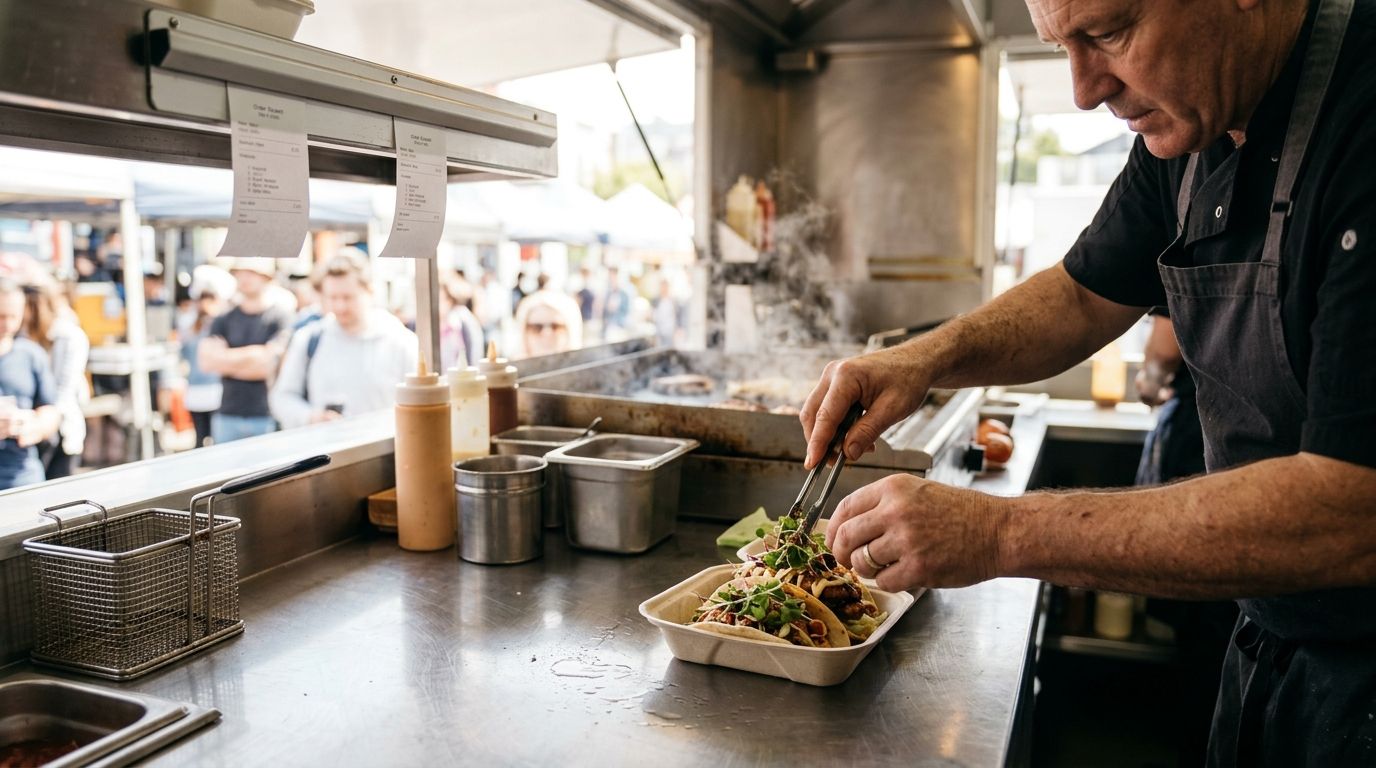
You have spent years cooking. It may not have been in a hatted restaurant or under a head chef who signed an apprenticeship logbook. Instead, you worked at a food truck window at 1:00 PM on a Saturday, serving a queue of forty customers with a two-burner setup you learned to run like a machine. Or you worked in a community kitchen, preparing meals for hundreds of people every week. Or you catered events out of a hired commercial space, building menus from scratch, costing every dish, and managing supplier relationships on your own.
When someone asks if you have considered formalising your qualifications, you might dismiss the idea. You might say it was just a food truck, or that you did not work in a real kitchen.
That word, 'unofficial,' does a lot of damage. The underlying truth of RPL for chefs is that the assessment does not measure where you cooked, but what you can do. If you can prove your competencies, your experience is valid, whether you gained those skills in a fine-dining establishment or a mobile food trailer on a busy market strip.
If you have been cooking for years outside the formal qualification system, this guide explains how your work translates.
What RPL actually assesses (and what it doesn't)
Recognition of Prior Learning is a national assessment pathway under the Australian Qualifications Framework. It operates on a practical principle: competency is competency, regardless of where or how you learned it. An assessor reviewing your application for a commercial cookery qualification does not focus on your employment history or the prestige of your previous kitchens. They evaluate whether you can demonstrate the specific skills and technical knowledge required by the qualification.
For a qualification like the Certificate III in Commercial Cookery, you must show you can handle food safely, prepare and cook dishes using diverse techniques, manage mise en place, cost recipes, control stock, and maintain kitchen hygiene. These are practical tasks. They are not tied to a specific employer, a traditional venue, or a standard employment contract.
RPL does not assess whether your kitchen had accolades, whether you worked full-time or casually, whether your business was a registered corporation or a sole-trader venture, or what job titles you held. The assessment focuses entirely on demonstrated ability. The label you place on your past roles does not change your technical competence.
This is the shift in perspective you need. The term 'unofficial' is just a label you have used, not a criterion an assessor will use to judge you.
What a food truck operator actually does (mapped to the qualification)
Here is where the practical details become clear. A food truck operator running a busy service does not do less work than an employee in a standard restaurant kitchen. Often, they handle a broader scope of responsibilities because they work without the support staff, heavy infrastructure, or established systems of a large commercial venue.
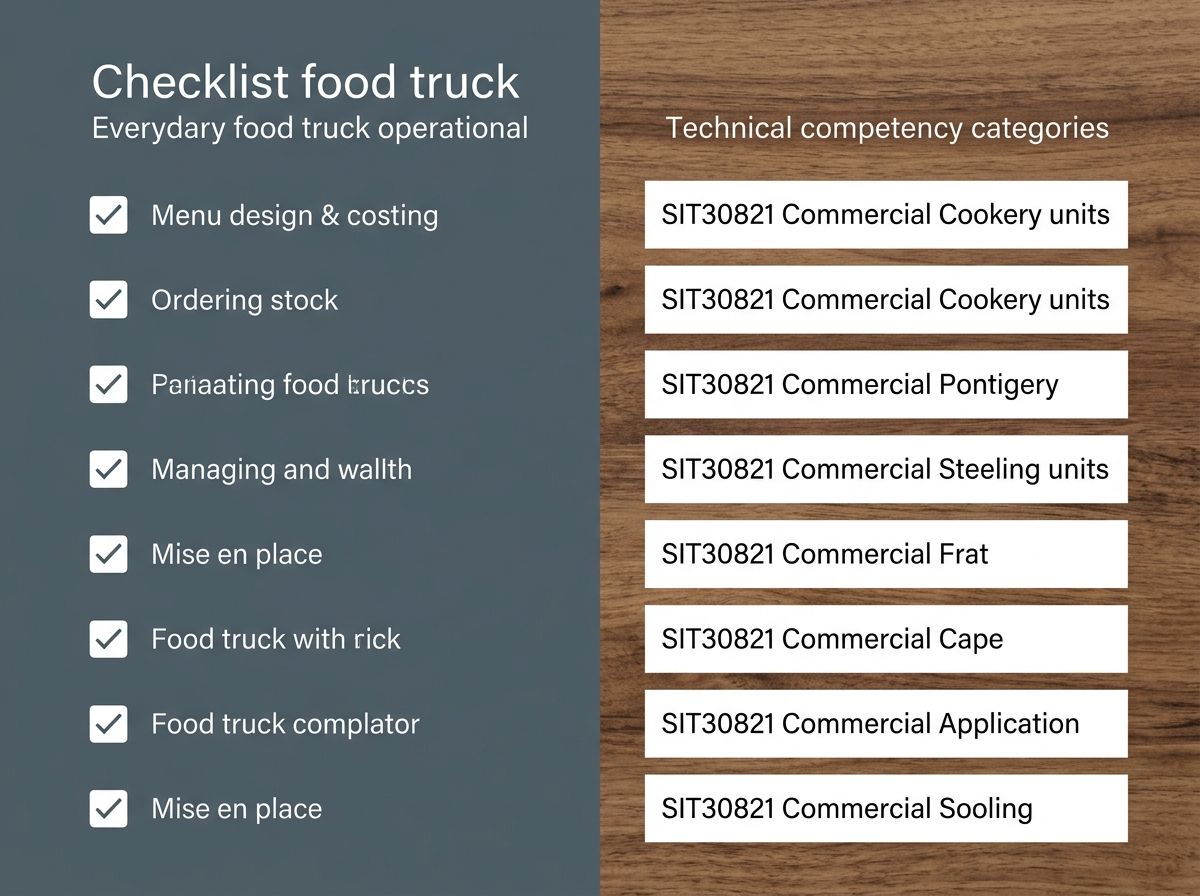
Consider the daily tasks of running a food truck, and how they map directly to the competency standards within a commercial cookery qualification:
- Planning menus and pricing dishes → Recipe development and food costing units
- Ordering stock, managing suppliers, and reducing waste → Stock control and purchasing units
- Preparing ingredients before service begins → Food preparation and mise en place units
- Cooking to order under time pressure with consistent quality → Cookery methods and food quality units
- Maintaining food safety compliance for council permits → Food safety and hygiene units
- Supervising casual staff or assistants in the kitchen → Workplace communication and team coordination units
- Cleaning and sanitising tools and workstations → Kitchen hygiene and equipment maintenance units
The same assessment mapping applies to catering businesses and community kitchens. If you plan event menus, manage food safety protocols for high-volume service, or coordinate kitchen workflows, you are performing the core duties of a commercial cook. You do not need a traditional employer to prove you can do this work.
The training framework does not discount your skills because you cooked in a mobile trailer. It requires proof that you executed the work safely and correctly.
The evidence you already have (and might not know counts)
A common concern for food truck operators and independent caterers is that they have nothing to show an assessor. This is rarely the case. RPL relies on practical evidence, and running a mobile food business generates a continuous paper trail.
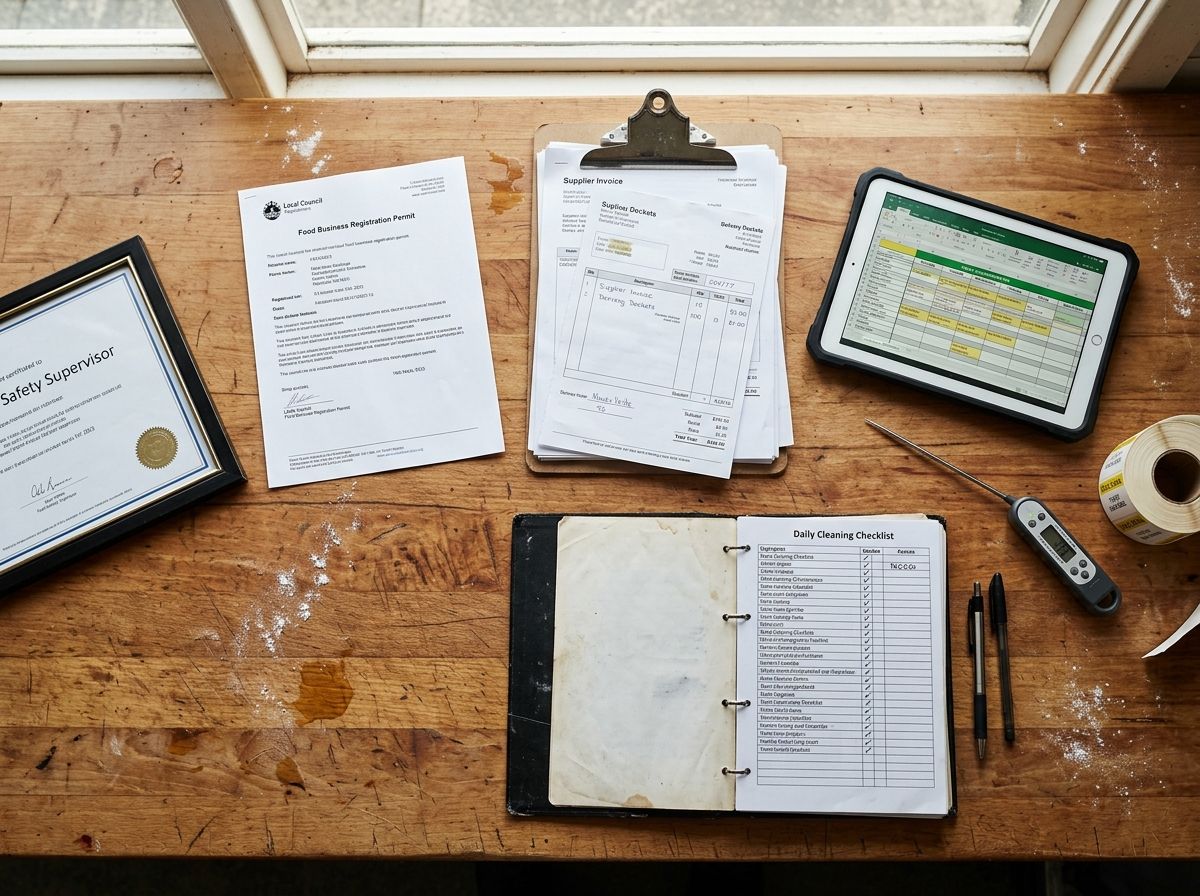
Look at the documents and records you probably already possess:
- Council food business registrations or mobile food vendor permits that show you run a regulated food service
- A current Food Safety Supervisor certificate, which directly aligns with national food safety requirements
- Printed or digital menus showing your recipe development and menu structures
- Supplier invoices, receipts, and order sheets showing active stock management and purchasing
- Event contracts, booking confirmations, or calendars showing the frequency and volume of your service
- Social media video or photos showing active food prep, cooking, and service operations
- Client feedback, reviews, or formal testimonials confirming food quality and consistency
- Photos or video walkthroughs of your kitchen layout, prep stations, and clean-down routines
Specific evidence requirements vary between Registered Training Organisations (RTOs), and an assessor will clarify what your application requires. The key point is that your day-to-day operations leave a trace. Every time you file a permit, purchase bulk ingredients, or document your prep work, you generate potential evidence for your portfolio.
Because training providers assess evidence under their own internal policies, requirements are not completely uniform. A preliminary skills review helps you understand how your specific files will be received before you commit to the formal process.
The RPL process for a chef qualification
RPL is not a shortcut or a quick fix. It is a structured assessment pathway. This rigor ensures your final qualification carries the same weight as one earned through a traditional apprenticeship. Understanding the steps helps you determine if this pathway suits your schedule and experience.
The standard RPL pathway for a commercial cookery qualification includes:
- An initial skills review to map your experience against course requirements and confirm if RPL is your best option
- An evidence compilation stage where you gather your business records, photos, and files into a structured portfolio
- An official assessor review where an educator from the partner RTO evaluates your portfolio against the units of competency
- Targeted gap training if your portfolio shows strong skills overall but misses specific technical areas required by the qualification
- The formal issuance of your qualification by the RTO once all course units are successfully met
The processing time depends on your background, the chosen RTO, and how quickly you can compile your files. RPL it supports you through this process, helping you organize your evidence and understand the criteria. The final qualification is awarded by the partner RTO, not by RPL it.
You do not have to navigate this pathway alone. There is no need to guess which units match your background or how to format your files. Experienced guides help structure your submission.
Is your experience enough? A direct answer
Not every mobile vendor has the breadth of experience needed for a full RPL qualification. This is an important distinction to make clear.
Your eligibility for a commercial cookery qualification depends on several factors. Assessors look at the range of cooking techniques you use, your practical application of food safety protocols, your experience managing daily kitchen systems, and the quality of the documentation you can provide to verify these skills.
An operator who has run a food truck for three years, prepared a diverse menu, managed suppliers, and held a Food Safety Supervisor certificate generally has a very strong case for RPL. Conversely, someone who has sold a single specialty product at a weekend market for six months might not yet cover the broad range of techniques required by the qualification.
The only way to clarify your standing is to have your background assessed before spending money. That is why we offer the Free Skills Review. This is not a sales pitch. It is a technical check to compare your practical background with the national training standards to see if an RPL application is viable for you.
Your hands-on skills are valuable. The task is ensuring you have the right documentation to prove those skills to an RTO. Answering this question early saves you time and financial investment later.
Ready to Get Recognised?
Start with a free skills review to find out if RPL is right for you.