You don't need to go back to school: you just need your experience translated
If you have spent years solving real IT problems, RPL frameworks can map your experience to a national qualification. Here is how the process works.

The assumption that is costing you years
You have the experience. A decade or more of it. You have kept systems running, solved problems that stumped your colleagues, and quietly become the person everyone turns to when things break. Yet every time a senior role opens up, the same question appears on the application form or in the recruiter's first email: 'What formal qualifications do you hold?'
Most experienced IT professionals hold an unexamined belief: that getting qualified means going back to a classroom. It means sitting through lectures on things you already do, submitting assignments on concepts you have applied for years, and essentially starting over at the beginning of a formal pathway you never took.
That belief is the real barrier, not the qualification itself.
The assumption that formal recognition requires formal study is so deeply embedded that many skilled professionals never question it. They write off qualifications as something for younger workers or recent graduates. They tell themselves their experience speaks for itself, and then they watch someone with a certificate and less experience get the role they were built for.
This article is about dismantling that assumption. For most experienced IT professionals, the task is not learning new skills. It is translating the ones you already have.
What getting qualified actually means under RPL Australia frameworks
Recognition of Prior Learning (RPL) is a formal assessment pathway through which your existing skills, knowledge, and experience are evaluated against the standards of a nationally recognised qualification. The assessor's job is not to teach you. Their job is to determine whether what you already know and can do meets the required standard.
RPL is not a workaround or a shortcut. It is a legitimate, rigorous assessment method within the Australian Qualifications Framework, the national policy governing all recognised qualifications in Australia. Every nationally recognised qualification must accommodate RPL as a valid pathway to recognition. The assessment is genuine. The qualification, if awarded, is identical to the one issued to someone who completed the training in a classroom.
In practice, the pathway you took to acquire your competence, whether through formal study, an apprenticeship, or fifteen years of solving real problems in live environments, is not what the assessment measures. The assessment measures the competence itself. Your daily work is already the evidence. It simply has not been presented in the format the system reads.
Shifting your perspective from being unqualified to being undocumented is worth considering.
The translation problem: why your experience is in the wrong format
The core concept is straightforward: your daily work is the source language, national qualification standards are the target language, and RPL is the translation process.
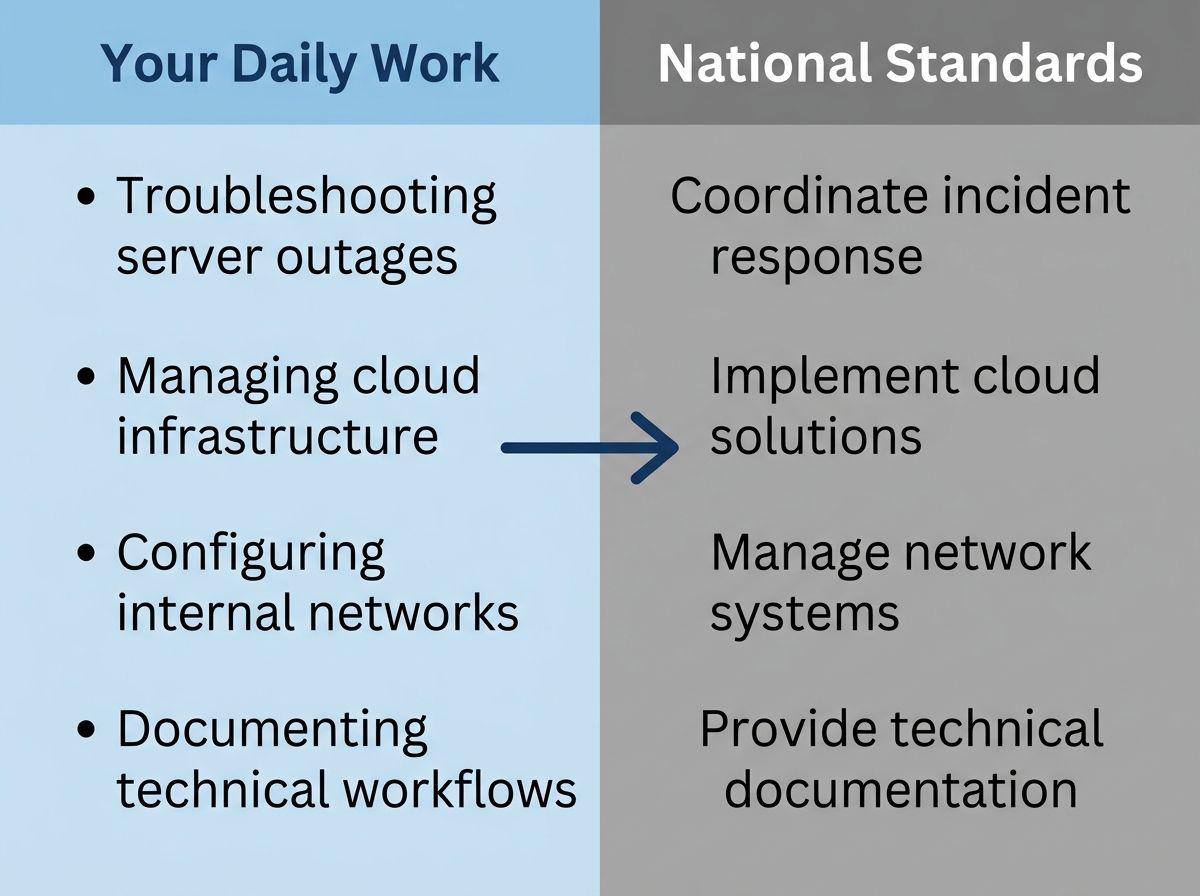
Formal qualification systems speak a specific language. They describe competence in terms of units, which are discrete, assessable blocks of knowledge and skill. Each unit has performance criteria that show what a competent person can do, alongside knowledge evidence requirements that support that performance.
Your experience in resolving production incidents, designing infrastructure, remediating security vulnerabilities, and mentoring junior staff represents the same knowledge and skill expressed in a different format. The problem is not a lack of competence. The issue is that your competence has never been translated into the language an assessor reads.
Consider a network engineer troubleshooting a complex routing failure at 2am. They diagnose the issue systematically, apply protocol knowledge, isolate variables, and implement a fix under pressure. Rather than just doing their job, they are demonstrating specific technical competencies that appear directly in ICT qualification standards. They simply have not written it down in the format the system requires.
Or consider a developer who has spent three years building and maintaining a cloud-based application, where they manage deployments, write documentation, collaborate with stakeholders, and iterate based on user feedback. Every one of those activities maps to assessable competencies within ICT qualifications. The work and the evidence exist. They simply have not been organised and presented as evidence.
That is the translation problem, and it is entirely solvable.
What RPL Australia frameworks actually map: real IT work to national standards
ICT qualifications in Australia are built around competency units that describe what a skilled IT professional can do, rather than what they studied. Qualifications such as the Diploma of Information Technology, the Certificate IV in Information Technology, and the Diploma of Information Technology Networking are structured around units covering network design, administration, systems analysis, cybersecurity, project management, and technical support.
For a system administrator with a decade of experience, the mapping is often direct. Managing server environments, implementing backup and recovery procedures, configuring access controls, and maintaining system documentation all correspond to assessable competencies within ICT qualifications. The administrator performs these tasks daily, but they have not yet been documented as evidence.
For a developer, the picture is similar. Writing and reviewing code, testing software, collaborating with stakeholders to define requirements, and deploying applications to production environments all map to units within ICT qualifications. The work itself is the evidence, and the RPL process is the mechanism for presenting it.
For an IT manager or team lead, the mapping extends to units covering project planning, team leadership, risk management, and stakeholder communication. Rather than soft skills bolted onto a technical qualification, these are core competencies within ICT qualifications that experienced IT managers demonstrate every week.
The evidence supporting an RPL assessment in IT contexts typically includes things you already have or can readily gather. This includes employer statements confirming your role and responsibilities, project documentation, technical reports you have authored, records of systems you have built or maintained, performance reviews, and your own account of how you applied specific skills. An assessor reviews this evidence against the qualification standards to determine whether the competence has been demonstrated.
The guided translation process: what actually happens in an RPL assessment
The RPL process is a genuine assessment. It involves practical work to gather, organise, and present evidence in a structured way. While it is not a rubber stamp, it is completely navigable with proper guidance.
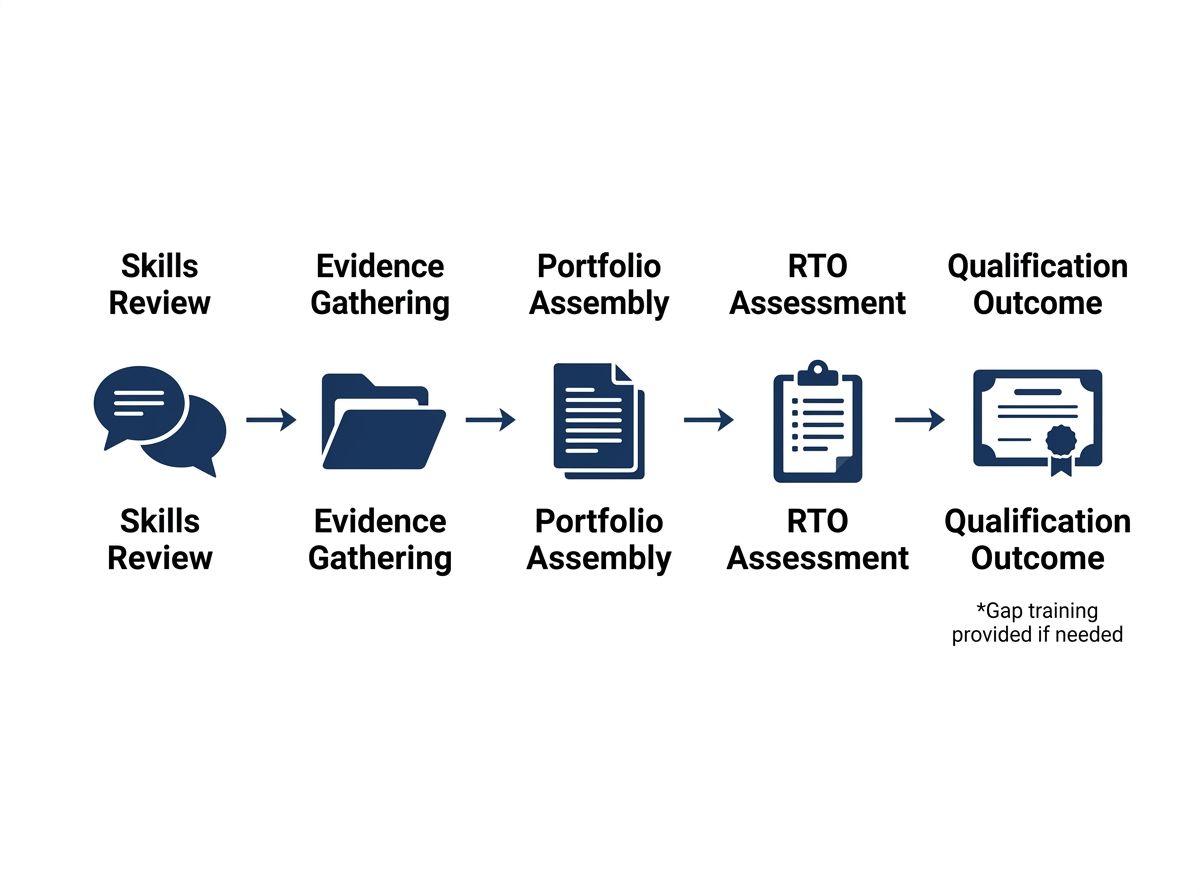
The process typically moves through five stages:
- A skills review: an initial conversation to map your experience against the qualification requirements and identify whether RPL is a suitable pathway. This is the starting point, occurring before any commitment is made.
- Evidence identification: reviewing what documentation and records you already have, and what you may need to gather or create to begin the translation work.
- Portfolio preparation: organising your evidence into a structured format that an assessor can evaluate against the competency standards. This is guided work, rather than something you must do alone.
- RTO assessment: a qualified assessor from a registered training organisation reviews your evidence to judge whether the competency standards are met. The RTO issues the qualification, while RPL IT guides you through the preparation.
- An outcome: if the assessor determines your evidence meets the requirements, the qualification is awarded. If gaps are identified, specific training is provided to address them. This is a normal part of the process, showing where additional evidence or learning is needed to meet the full standard.
The duration varies depending on the qualification, the complexity of your experience, and how readily your evidence can be compiled. It does not happen overnight, and any provider suggesting otherwise should be approached with caution. For most experienced IT professionals, it takes significantly less time than traditional study because your competence already exists.
Why self-taught IT professionals are well-positioned for RPL
A specific form of imposter syndrome often affects self-taught IT professionals. It suggests that because you did not undergo formal training, your knowledge might have unrecognised gaps, or the qualification might measure concepts you have not learned.
While that doubt is understandable, in most cases it is entirely unfounded.
Competency-based assessment measures what you can do, rather than how you learned to do it. Under the Australian qualification system, the assessment focuses on the competence itself, not the pathway you took to acquire it. A self-taught developer who has built production applications for eight years has operated in real environments, solved real problems, and iterated based on real feedback. This is often a more demanding proving ground than a structured classroom.
Experience is not inferior to formal education; it is simply a different form of evidence. The RPL process exists to recognise this difference, offering a mechanism to assess and formally acknowledge competence acquired outside of traditional study.
Your skills are real, your experience is valuable, and your recognition is earned.
The formal system requires evidence in a specific format, and RPL is the method you use to provide it.
The first step is a conversation, not a commitment
The translation process begins with a simple question: does your experience map to a formal qualification?
That question has a structured answer, and finding it does not require any commitment. The Free Skills Review is an initial, no-obligation conversation designed to map your experience against qualification requirements and determine whether RPL is a suitable pathway for your situation. If it is not, you will be told directly. Honest suitability guidance before enrolment is a fundamental part of a process you can trust.
If the review indicates that RPL is a viable pathway, the next steps are clear and guided. If it identifies gaps that need to be addressed first, that information remains useful regardless of how you choose to proceed.
The decision is yours. You already have the experience; the only question is whether you want to present it in a format the system can read.
Ready to Get Recognised?
Start with a free skills review to find out if RPL is right for you.