What separates an experienced steelfixer from a certified one (legally, not technically)
Experienced steelfixers know the work. The Certificate III is a legal status, not a skill test. Learn how RPL closes the gap.
By RPL it Australia6 min read

You already know how to fix steel. The system does not know yet.
You have the experience. Years of it. Rebar, formwork, structural steel, reading drawings on site before the concrete crew arrives. You know what a properly tied column looks like and what a poorly tied one will cost. You have worked alongside engineers, under head contractors, in conditions that no classroom replicates.
And yet, somewhere along the way, whether due to a new contract, a tender requirement, or an employer asking for paperwork, you hit a wall. This is not because your skill is in question. It is because the formal system has no record of it.
This is the recognition gap. It is not a skills gap. The two are different, and understanding this difference is the first step toward closing it.
The assumption worth challenging: skill and certification are not the same thing
Most experienced steelfixers assume that if you can do the work, the qualification is just a formality. You might believe your site reputation, your employer's backing, and your years of consistent output should be enough.
That assumption is understandable. However, in the eyes of the formal system, it is incorrect.
The Certificate III in Steelfixing does not simply test whether you can tie rebar correctly. It does not measure how fast you work, how well you read a structural drawing, or how many years you have spent on site. It is a nationally recognised credential and a formal administrative status. It shows employers, regulators, head contractors, and insurers that your competency has been verified by a qualified assessor from a registered training organisation.
Skill and certification work differently. Skill is what you do on site. Certification is what the system can see. You can have one without the other, and many experienced steelfixers do.
The consequences of this gap are concrete. They appear in tender documents requiring qualifications as a condition of engagement, in employment applications where the Certificate III is listed as a prerequisite, and when a head contractor's compliance team asks for paperwork. The gap between being skilled and being certified is administrative, but the effects are real.
What the Certificate III in Steelfixing actually is (and what it isn't)
The Certificate III in Steelfixing, formally coded CPC31120, is a nationally recognised qualification under the Australian Qualifications Framework. Registered training organisations (RTOs) deliver this qualification, assessing it against units of competency that cover the core skills and knowledge required for steelfixing work in the construction industry.
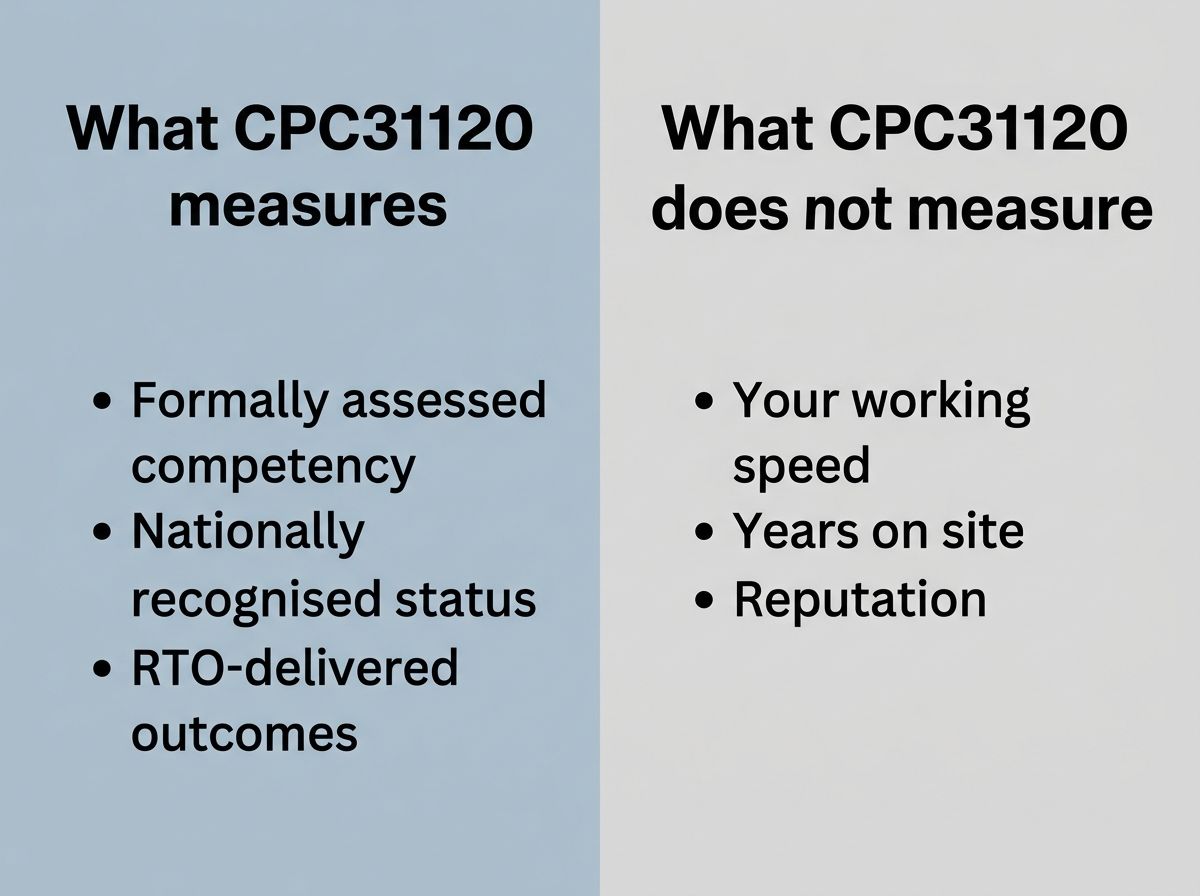
The qualification measures whether a candidate has demonstrated competency against these standard units under assessment. It does not measure how many years you have spent on site, how your skills compare to your peers, or whether you are the fastest worker on the crew.
This qualification is the formal record. It is the document that employers, regulators, insurers, and head contractors can read and verify. Without it, your competency is real but remains invisible to the system. With it, your competency is formally acknowledged.
This distinction matters because it reframes the entire process. Obtaining the qualification is not about learning steelfixing. If you have done this work for years, you already know the trade. It is simply about having your existing competency formally assessed and recorded.
To understand the qualification in more detail, the Certificate III in Steelfixing (CPC31120) page outlines what the credential covers and how the RPL pathway works for experienced tradespeople.
Why the gap exists and why it is not your fault
The formal training system in Australia was designed around a traditional pathway: apprenticeship, classroom learning, assessment, and the final credential. That pathway works well for those who enter the trade at the very beginning and move through it in sequence.
The system was not designed for the way many steelfixers actually enter and develop in the trade. Some learned on site under experienced tradespeople without completing a formal apprenticeship. Others arrived from overseas with years of experience that Australian regulators do not automatically recognise. Some completed part of an apprenticeship and moved into full-time work before finishing their qualification, while others have subcontracted under a head contractor's licence for years without needing to hold the credential themselves.
None of these pathways are unusual, and none reflect a lack of skill or commitment. They show the reality of how trades are actually learned and practised, which is often more experience-driven and practical than the formal system accounts for.
Recognition should not require starting over. The gap between your experience and your formal credential does not reflect a lack of knowledge. It is simply a structural mismatch between how you learned and how the system records learning. That mismatch has a specific solution.
How RPL closes the gap: experience as evidence
Recognition of Prior Learning (RPL) is the formal assessment pathway that uses your work history as the evidence base for a qualification. It is not a shortcut. It is a rigorous process where a qualified assessor from a registered training organisation reviews evidence of your existing competency against the units required for the Certificate III in Steelfixing.
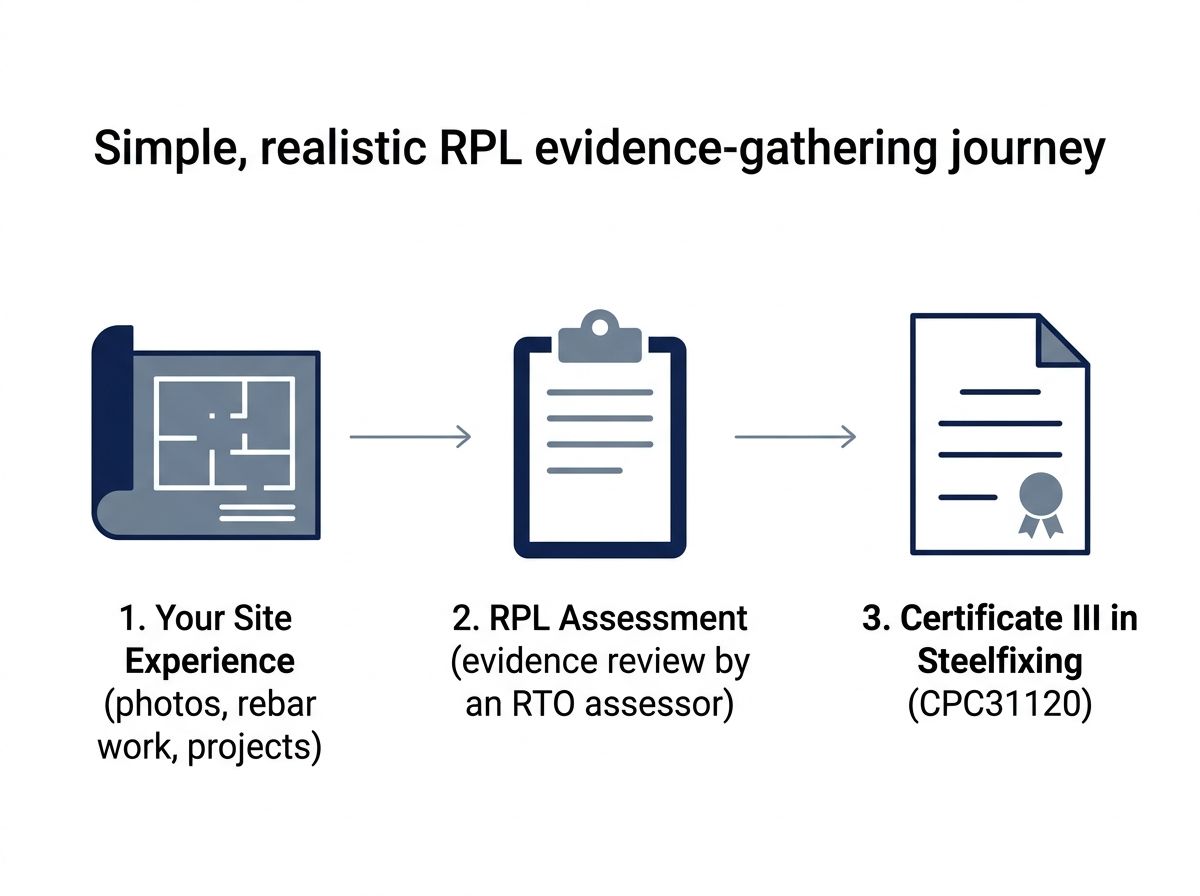
The logic of RPL is straightforward: if the competency exists, the assessment confirms it. The qualification follows from your evidence, rather than from re-learning what you already know.
For an experienced steelfixer, the evidence base draws directly on the work you have already completed. This can include records of past projects, references or statements from supervisors and employers, photographs of completed work, logbooks, site diaries, and any prior training records. The specific evidence required depends on the units being assessed and the RTO conducting the assessment.
Sometimes an RPL assessment identifies gaps where the evidence does not fully cover a required unit of competency. When that happens, gap training is provided to address those specific areas. This is a normal part of the process, not a failure. The assessment remains honest about what the evidence supports.
The assessment is conducted by a qualified assessor from the delivering RTO. RPL it guides candidates through the process, helping you understand what evidence to gather, how to present it, and what to expect at each stage. The qualification itself is issued by the partner RTO, not by RPL it.
Learn more about the RPL pathway for the Certificate III in Steelfixing and the steps involved in the assessment process on the qualification page.
What separates you from a certified steelfixer right now
The answer to the question in this article's title is not skill. It is not knowledge, years of experience, or the quality of your work on site.
What separates an experienced steelfixer from a certified one is simply a formal assessment that has not yet occurred.
This assessment, conducted by a qualified assessor and based on evidence of your actual site work, produces the Certificate III in Steelfixing. It makes your competency visible to the formal system and closes the gap between what you can do and what employers, regulators, and head contractors can verify.
The gap is real, and its effects are real. However, it is also specific and closeable. RPL exists for experienced tradespeople in this position who have the skills and need the formal recognition to match.
The decision to pursue that recognition is yours. We can offer a clear starting point: a free, no-obligation review of your skills and experience to help you understand whether the RPL pathway is suitable for your situation.
General information only, current at the date shown. Licensing rules change, so check the current requirements with the relevant regulator before you rely on them. RPL it Australia is a student support service, not a Registered Training Organisation; qualifications are assessed and issued by our partner RTOs.