Why your best workers are your biggest QBCC risk without a proper trading licence
Your most experienced tradesperson may be your biggest QBCC audit risk. Here is why unlicensed veterans cost businesses the most and how RPL solves it.

The compliance paradox on Queensland job sites
You know who your best worker is. You probably do not know if they are licensed.
Here is the reality that catches Queensland employers off guard: the tradesperson who has been on your books the longest, the one you trust to run the job and mentor apprentices, is often the most likely to be operating without a current, valid QBCC trading licence. It is not because they are incompetent. It is because the licensing system changed around them, and experience is not a substitute for formal documentation.
The Queensland Building and Construction Commission conducts active, ongoing compliance audits across the state. In 2024–25, the QBCC conducted 550 notifiable work audits of plumbers and drainers alone, and 29 per cent of completed audits in that program were found non-compliant. In the same period, the Commission commenced eight investigations into potential breaches related to trust account administration, and conducted 109 unplanned audits triggered by external intelligence identifying operators at financial risk. These are not theoretical enforcement activities; they are funded, risk-targeted, and continuous.
A QBCC audit does not assess how good your worker is. It checks whether the paperwork exists. For many of Queensland's most experienced tradespeople, that paperwork is missing.
Why experience creates the blind spot
Workers who entered the trades before licensing requirements tightened, who moved between states and assumed their interstate licence transferred automatically, or who spent years working under a supervisor's licence without formalising their own often carry a quiet assumption that their experience is their credential. It is not.
The QBCC requires a specific licence class for specific work. The licence class must be current, cover the scope of work being performed, and be held by the individual or the company carrying out the work. Years on the tools do not satisfy that requirement. Neither does a strong reputation, nor does the fact that no one has complained.
Interstate workers face an additional layer of complexity. Mutual recognition provisions allow some interstate licences to be recognised in Queensland, but the process requires a formal application and is not automatic. A worker who moved from Victoria or Western Australia and simply kept working, reasonably assuming their licence transferred, may have been operating without valid Queensland authorisation for years.
This is the cause of the compliance paradox. Newer workers enter the system knowing the rules as they currently stand. Experienced workers entered under different rules and have not always been told when those rules changed. The blind spot belongs to the system as much as to the individual, but in a QBCC audit, the employer carries the exposure.
What a QBCC audit actually looks for
A QBCC audit checks documentation, not competence. That is the reality, and it matters.
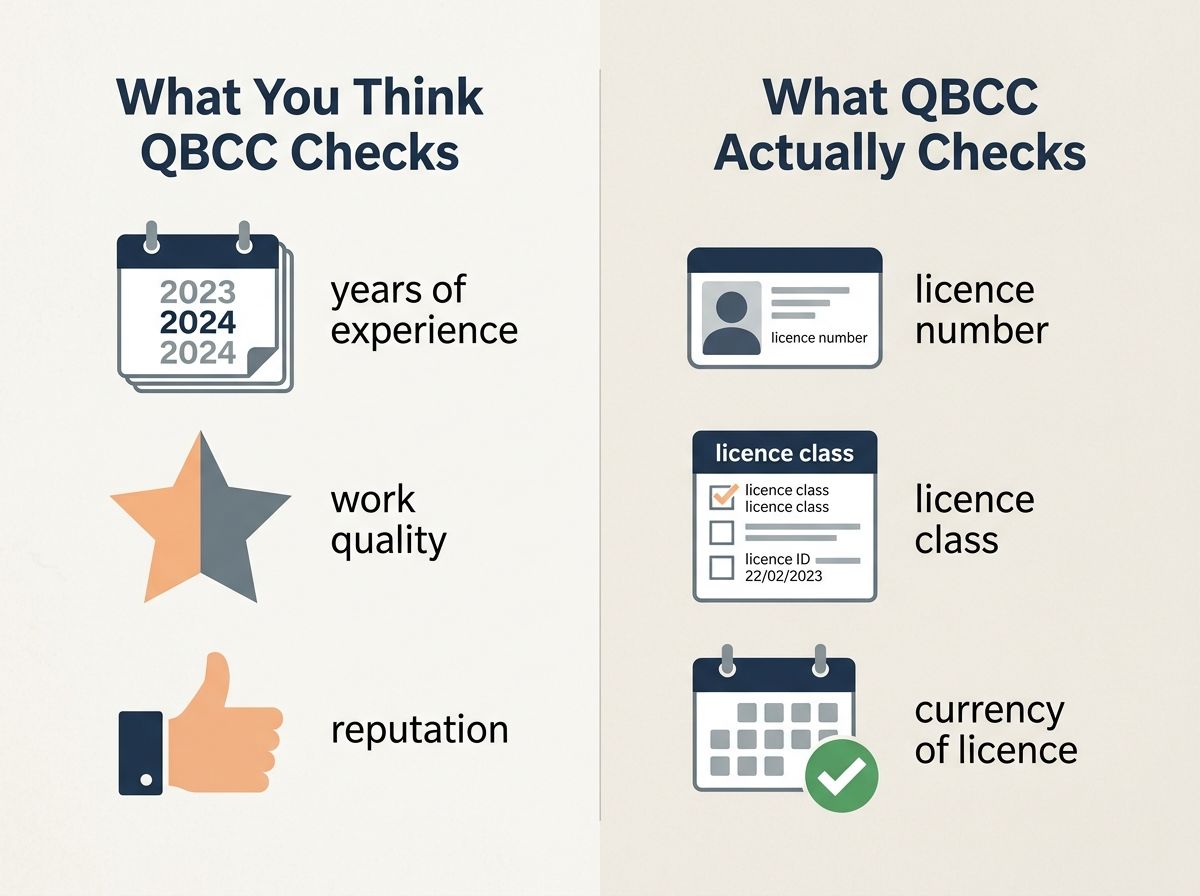
When a QBCC inspector arrives on site or reviews a complaint, they are not assessing the quality of the work, the experience of the worker, or the reputation of the business. They are checking whether the person carrying out the building work holds a current QBCC licence of the appropriate class, and whether that licence covers the work being done. The licence search is public, and the check takes only minutes.
Under Queensland law, carrying out or offering to carry out building work without the appropriate QBCC licence is an offence. The QBCC states it has a zero-tolerance policy toward unlicensed contracting. A person does not need to be completely unlicensed; working outside the scope of an existing licence is also an offence.
Building work valued at more than $3,300 generally requires a QBCC licence. Certain categories, including plumbing and drainage, gas fitting, fire protection, and mechanical services work, require a licence regardless of the project's financial value.
The QBCC sets out the consequences of non-compliance on its website, including the range of penalties that apply when unlicensed work is identified.
The audit is a paperwork exercise, and paperwork is where experienced workers often struggle.
The real cost of an unlicensed veteran on your books
The fine is the smallest part of the problem.
When the QBCC issues an infringement notice for unlicensed or non-compliant work, the recipient must pay in full within 28 days or face action that can affect their licensing status. But the infringement notice is only the beginning. If the QBCC refers an offence to court, the gap between the initial fine and the maximum penalty is substantial. The QBCC points to a contrast between a $3,454 infringement fine and maximum court-imposed penalties of $43,175 for an individual and $215,875 for a company.
For repeat offenders, the consequences escalate further. Certain offences under the QBCC Act attract demerit points, and a licensee who accumulates more than 30 demerit points over three years faces a three-year licence suspension. The QBCC also states that some breaches can result in a court imposing a period of imprisonment.
Beyond the penalties, there are contractual and insurance consequences. Only licensed contractors can take out QBCC home warranty insurance, and the premium must be paid within 10 business days or before work starts, whichever comes first. The QBCC states that unlicensed work is not covered by the Queensland Home Warranty Scheme, and that working with an unlicensed person may void a homeowner's access to Queensland Home Warranty Insurance. These are statutory protections that disappear the moment the work is unlicensed.
If a contractor's licence is suspended or cancelled, they cannot continue to carry out building work. The QBCC advises seeking legal advice about the consequences for contracts already on foot, which means your business may face breach-of-contract exposure on active projects, not just a regulatory fine.
Why traditional training is not the answer
Sending a 20-year veteran back to TAFE to sit alongside apprentices is not a practical compliance solution. It causes unnecessary workforce disruption.
The worker already has the skills. They have been demonstrating those skills on your sites for years. The issue is not a skills gap. The problem is that those skills exist in the wrong form for formal recognition. Traditional training repeats what the worker already knows, costing significant time, money, and productivity.
Recognition, not repetition. This principle makes Recognition of Prior Learning (RPL) the right pathway for experienced workers who need to formalise their credentials without starting from scratch.
How RPL addresses the QBCC trading licence gap
Recognition of Prior Learning (RPL) is the formal pathway that allows experienced workers to present their existing skills as evidence for assessment. For Queensland trade licensing, RPL means the worker documents what they already do, and a qualified assessor from a registered training organisation evaluates whether it meets the standard for the relevant qualification.
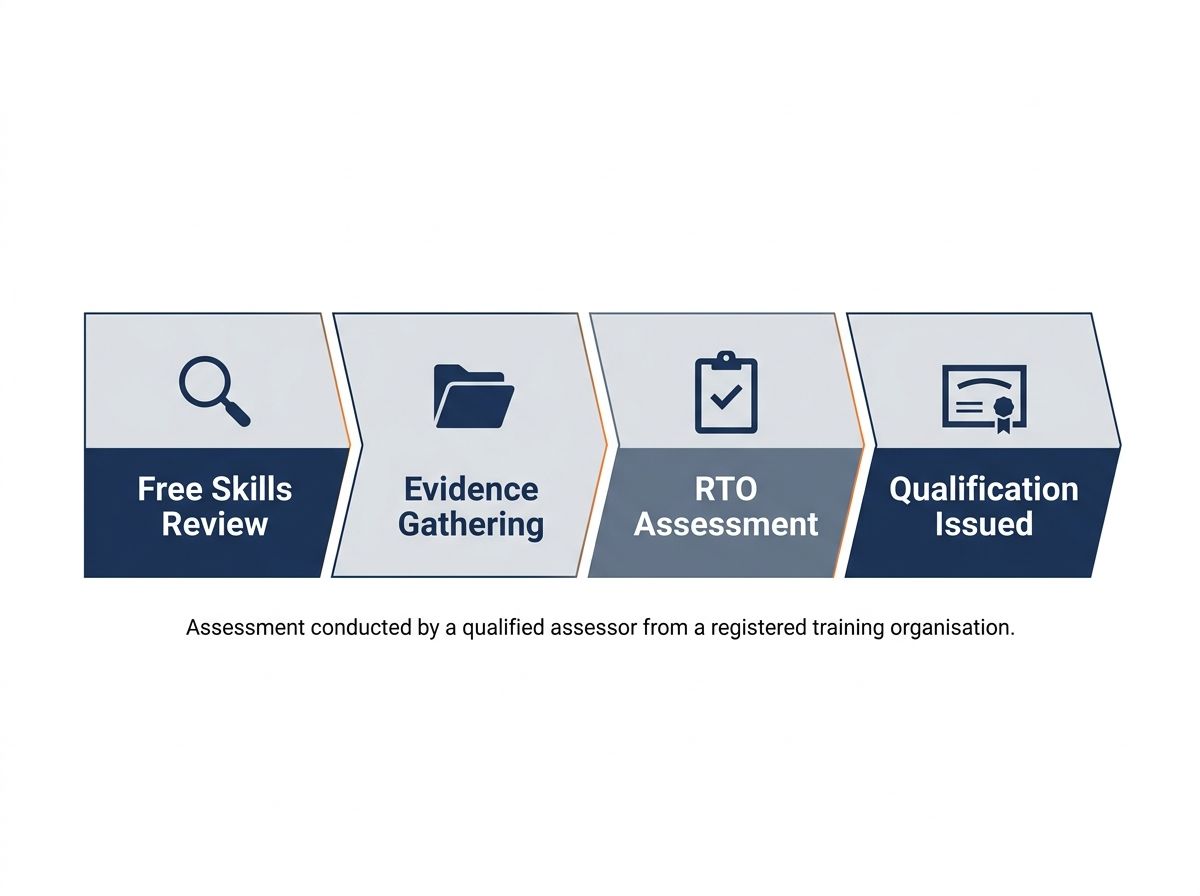
No classroom. No repeating what they already know. The assessment is conducted by a qualified assessor from a delivering registered training organisation (RTO). RTOs conduct assessments and issue qualifications; RPL it guides candidates through the process of gathering and presenting their evidence.
The process typically involves four stages: a skills review to assess suitability, guided evidence gathering, formal assessment by the RTO's assessor, and, where competency is demonstrated, the qualification outcome. If gaps are identified during assessment, gap training is provided at no additional cost. The qualification is nationally recognised because the assessment is genuine.
RPL is not a shortcut or a workaround. It is a rigorous, legitimate assessment pathway that exists because formal systems have not always kept pace with how skilled workers develop their expertise. The worker's experience is real, and RPL is the process for presenting it in the form that formal systems can recognise.
What employers need to do before the next QBCC audit
The most effective compliance audit is the one you conduct yourself, before the QBCC does it for you.
QBCC guidance indicates that, in most cases, a worker does not need their own QBCC licence to carry out building work if they are an employee of a licensed contractor, provided they are lawfully employed and the work falls within the scope of their employer's licence. But that exemption has limits. An employee may need to hold their own licence if they become responsible for supervising or directing building work, ensuring the work is of a competent standard, or ensuring it complies with plans and specifications, such as when employed as a nominee or site supervisor.
Critically, the QBCC states that if an employer's licence is suspended or cancelled, an employee may be committing an offence if they continue to work during that period. The compliance obligation does not sit exclusively with the worker; it can attach to the business as well.
A practical starting point for any Queensland employer: use the QBCC's public licence search tool to verify the current status of every worker whose role may require individual licensing. Check not just whether a licence exists, but whether it covers the class of work being performed and whether it is current. Then identify the gaps.
The QBCC website sets out the licence classes available and the types of work each covers, a useful reference for employers conducting their own workforce compliance review.
For workers who are unlicensed or operating outside their licence scope, the question is not whether to act, but how to act without disrupting the workforce. That is where RPL becomes a practical employer tool, rather than just a personal development pathway.
You have the experience on your team. The question is whether it is in the right form. A Free Skills Review costs nothing and tells you exactly where your workforce stands, before a QBCC audit tells you instead.
Ready to Get Recognised?
Start with a free skills review to find out if RPL is right for you.