Stop Losing Commercial Tenders Over SA Trade Licensing Gaps
Missing SA trade licences don't just create compliance risk — they cost you commercial tenders. Here's how South Australian employers can close the gap fast.
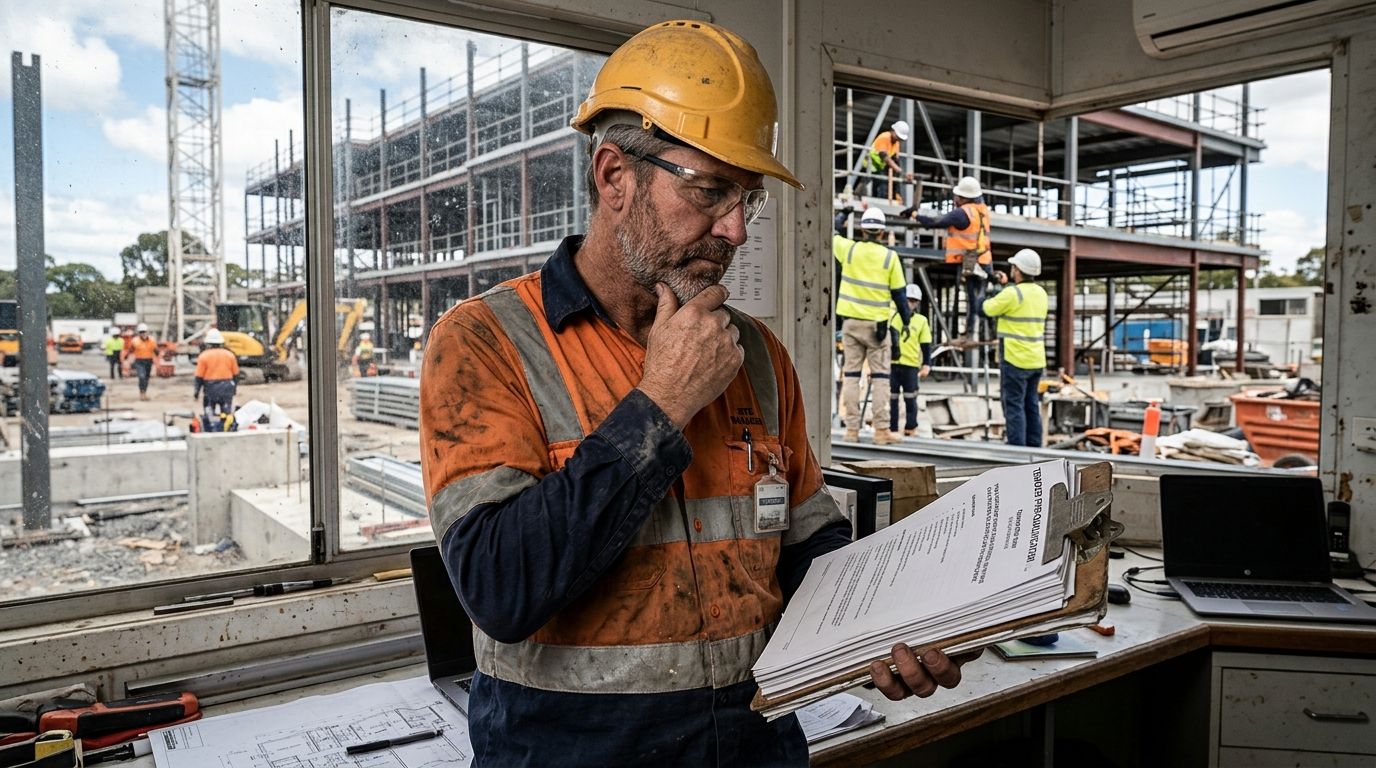
The tender you lost wasn't about price
You have the crew. You have the experience. You have the track record. And yet the tender went to someone else.
Most employers assume they lose commercial work on price or capability. The real disqualifier is often something quieter: a workforce licensing gap that surfaces during pre-qualification, before assessors even look at your methodology or your rates.
Your crew has the skills to do the job. But do they have the paperwork to win the tender?
In South Australia, as across the country, commercial and government contracts increasingly require proof of a licensed workforce as a condition of pre-qualification — not as a nice-to-have, but as a gate. If your tradespeople cannot show a current, valid SA trade licence, your business cannot bid. It is that direct.
This article is not about compliance anxiety. It is about commercial strategy. SA trade licensing is not a cost centre. It is the entry ticket to higher-value work.
What SA trade licensing requires
In South Australia, trade licensing is administered by Consumer and Business Services (CBS SA). Certain trades are regulated under SA legislation, meaning workers must hold a current licence to legally perform that work — and employers must ensure their workforce is appropriately licensed before deploying them on regulated work.
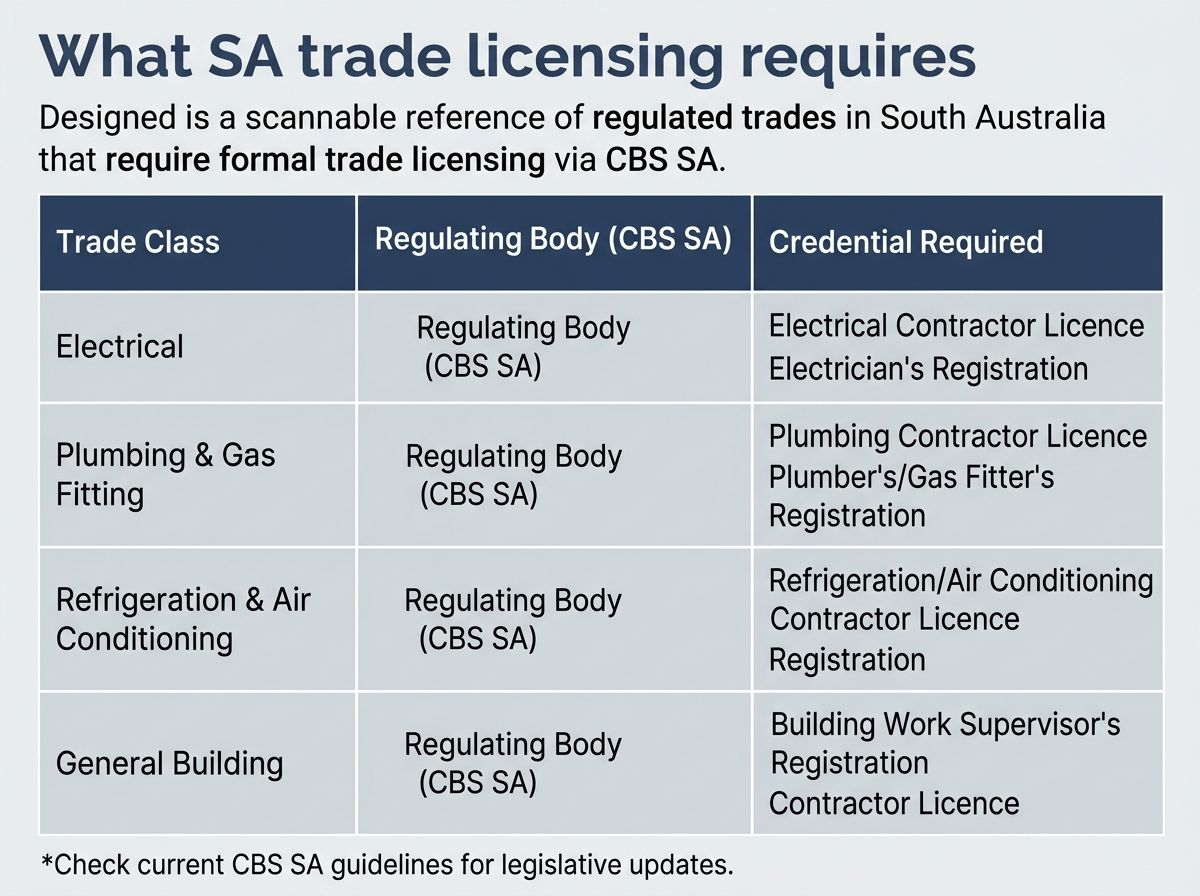
The trades that typically require a licence in South Australia include electrical work, plumbing and gas fitting, refrigeration and air conditioning, and certain categories of building work. The specific legislative instruments governing these trades include the Plumbers, Gas Fitters and Electricians Act 1995 (SA) and the Building Work Contractors Act 1995 (SA), among others. Readers should confirm current requirements directly with CBS SA, as licensing frameworks are subject to legislative change.
There is an important distinction worth understanding: a tradesperson certificate recognises an individual's competency to perform licensed work as an employee or subcontractor. A contractor licence authorises a business to contract for and supervise that work. Both matter to employers — the tradesperson certificates held by your crew, and the contractor licence held by your business.
The qualification pathway to a tradesperson certificate typically requires a nationally recognised vocational qualification — most commonly a Certificate III in the relevant trade — issued by a registered training organisation (RTO). The qualification must meet the requirements set by CBS SA for the specific licence class being applied for.
For a detailed overview of SA trade licence requirements and the qualification pathways that apply, see the RPL it Trade Licence SA page.
The old mental model: licensing is the worker's problem
There is a deeply embedded assumption in many trade businesses: if a worker needs a licence, that is their responsibility to sort out. The employer provides the work. The worker provides the credentials.
This model had logic when licensing was primarily about individual practice rights — the right of a qualified person to perform regulated work. In that frame, the licence belongs to the individual, and the individual is responsible for obtaining and maintaining it.
The model breaks down when commercial contracts require proof of a licensed workforce as a pre-qualification condition. At that point, the consequence of a licensing gap is not the worker's problem. It is the business's problem. The contract is lost before the work begins. The revenue disappears. The crew sits idle.
The employer who thinks 'my workers will sort out their own licences' is operating on an assumption that made sense in a different commercial environment. In today's tender market — particularly for government, infrastructure, and Tier 1 commercial work — the employer bears the commercial consequence of workforce licensing gaps.
This shift from individual to employer responsibility is explored in depth in our article on why principal contractors demand valid trade licences.
The new mental model: licensing is a revenue gate
Reframe the question. Not: 'How do I get my workers compliant?' But: 'Which contracts am I currently unable to bid on because my workforce lacks the right licences?'

Government maintenance contracts. Hospital and aged care facility upgrades. SA Water infrastructure works. Defence and education precinct projects. These categories of commercial work — and many others — routinely require a licensed workforce as a condition of pre-qualification. Businesses without a fully licensed crew cannot access them.
A licensed workforce is not a compliance cost. It is the entry ticket to a tier of commercial work that your unlicensed competitors cannot reach.
You have the experience. You have the crew. The licence is the proof that unlocks the contract.
The commercial logic is straightforward. The cost of formalising one tradesperson's licence is a one-time investment. The value of the contracts that become accessible as a result is ongoing. Employers who proactively manage their workforce's licensing status are not spending money on compliance — they are investing in their tender pipeline.
Why formalising your crew's licences feels slow (and why it doesn't have to be)
The most common objection from employers is operational: 'Getting my crew licensed takes too long and pulls them off the tools.' It is a real concern. Block-release training, TAFE attendance, and extended study periods are genuine disruptions to a working business.
Recognition of Prior Learning — RPL — is a different pathway. Rather than requiring workers to repeat training they have already effectively completed through years of on-the-job experience, RPL assesses existing competence through structured evidence. The worker demonstrates what they already know and can do. The assessor — from a registered RTO — evaluates that evidence against the qualification standard.
For experienced tradespeople who have been performing licensed work for years, RPL can be a more appropriate pathway than classroom training. It recognises what they have already achieved, rather than asking them to start over.
RPL is a rigorous assessment process. It is not a shortcut. Competence must be genuinely demonstrated. But for workers who have the skills, the process is structured around their existing work — not against it. Evidence is gathered from the job site, not the classroom.
Whether RPL-based qualifications are accepted by CBS SA as meeting the educational requirement for a specific SA trade licence class should be confirmed directly with CBS SA or with the delivering RTO before commencing any pathway. Requirements vary by licence class and may change over time.
For a closer look at how employers have qualified experienced workers without disrupting operations, see our article on qualifying your workforce without downtime.
What employer-driven RPL looks like in practice
When an employer sponsors a worker through an RPL pathway, the process typically follows four stages.
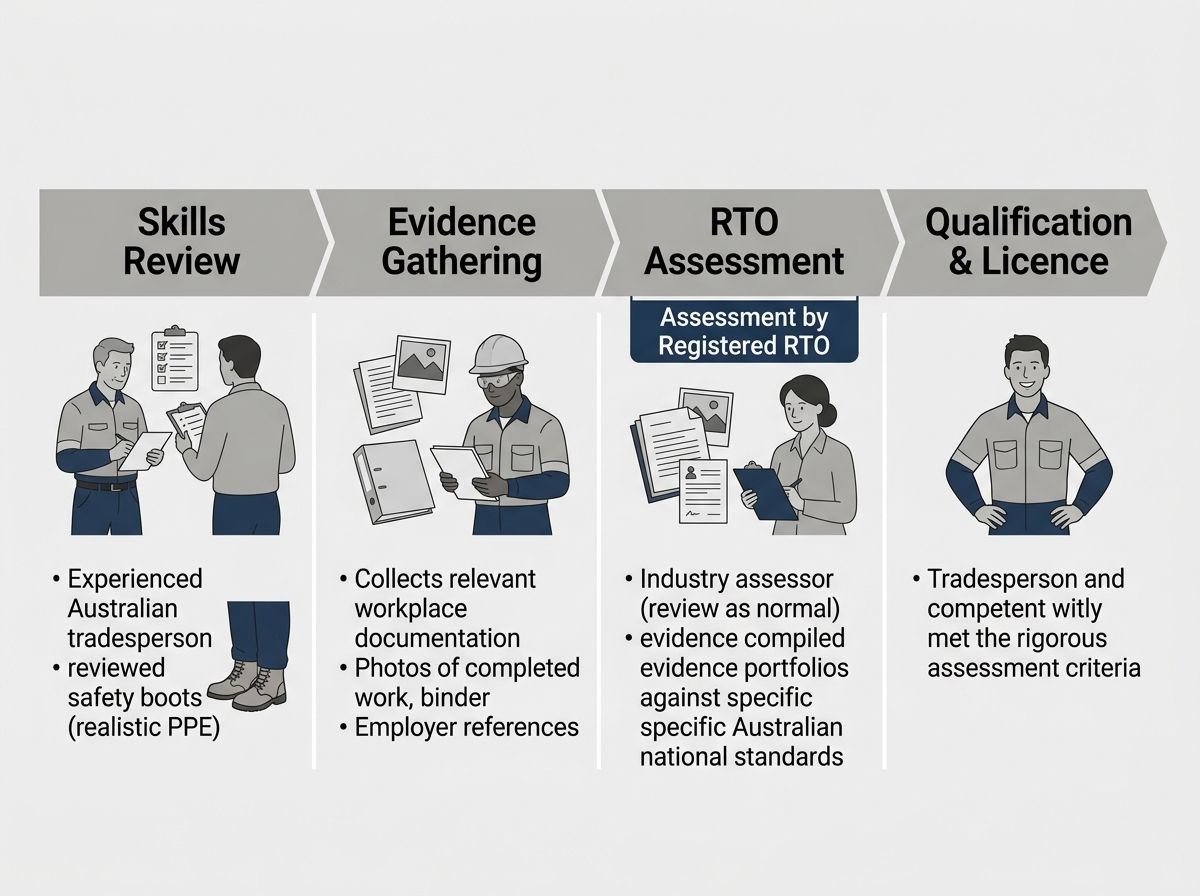
- A skills review establishes whether the worker's experience is likely to meet the qualification standard. This is the honest first step — not every worker will be suitable for RPL, and a straightforward suitability assessment protects everyone's time and investment.
- Evidence gathering documents the worker's existing competence. This includes records of work performed, references from supervisors or clients, photographs of completed work, logbooks, and other materials that demonstrate the worker's skills against the qualification units.
- An assessor from a registered RTO evaluates the evidence. The RTO conducts the assessment and makes the determination of competency. RPL it guides and supports the candidate through this process — the assessment itself is conducted by the RTO.
- If the assessment is successful, the RTO issues the qualification. The worker can then apply to CBS SA for the relevant tradesperson certificate, using the qualification as part of their application. If gaps are identified during assessment, gap training may be required — this is provided at no additional cost by the delivering RTO.
The employer's role in this process is to identify which workers are candidates, support the evidence-gathering process, and allow the structured assessment to proceed. The worker does not need to leave the job site for extended periods. The process works around the business, not against it.
Qualifications are issued by registered RTOs under the Australian Skills Quality Authority (ASQA) framework. RPL it guides, supports, and advocates for candidates throughout the process — we do not assess or award qualifications.
For a practical example of how RPL unlocks the workforce you already have, see our article on RPL plumbing pathways in the NT.
The commercial calculation: what one licence is worth
The commercial case for employer-sponsored RPL does not require precise figures to be compelling. The logic is clear.
The cost of guiding one experienced tradesperson through an RPL pathway is a defined, one-time investment. The value of the commercial contracts that become accessible once that worker holds a current SA trade licence is ongoing — and in many cases, significantly larger than the investment required to obtain it.
Consider the contracts your business has been unable to bid on in the past twelve months because your crew lacked the right licences. Consider the tenders you did not submit, the pre-qualification stages you did not pass, the work that went to a competitor whose workforce was fully licensed. That is the cost of the status quo.
The question is not whether formalising your crew's licences is worth the investment. The question is how many contracts you can afford to keep losing.
Start with a free skills review for your crew
Your crew has the experience. The question is whether that experience can be formally recognised — and whether the pathway to an SA trade licence is open to them.
A Free Skills Review is the starting point. It costs nothing. It commits you to nothing. It is an honest assessment of whether your workers' existing skills are likely to meet the qualification standard — before any enrolment, before any investment, before any disruption to your operations.
Recognition shouldn't require starting over. If your crew already has the competence, the pathway to formal recognition exists. The decision is yours.
Ready to Get Recognised?
Start with a free skills review to find out if RPL is right for you.