The hidden cost of unlicenced techs on your HVAC contracts
Unlicenced HVAC technicians create compliance risks in QLD and can disqualify you from commercial tenders. Here is what licensing really costs.
The tender you lost wasn't about price
You have the technicians and the experience. Your team has been doing this work for years, handling commercial systems, complex installations, and demanding clients. Yet the contract went elsewhere.
Most HVAC business owners assume they lose tenders on price, relationships, or timing. Sometimes that is true. However, there is another reason tenders are lost, and it occurs before anyone reads your quote. Commercial clients, particularly in government and large-scale property management, increasingly require contractors to show that their technicians hold the appropriate licences before a bid is even considered. This disqualification happens at the pre-qualification stage, quietly and without explanation.
If your technicians do not hold the right air conditioning licence for the scope of work, your business may not be eligible to bid, regardless of how capable your team is.
What 'air con licence' actually means in QLD
The term 'air con licence' is used loosely in the industry, but in Queensland it refers to specific licensing requirements across two separate regulatory frameworks. Understanding this distinction is important, because holding the wrong licence class for the work you do is, from a compliance perspective, the same as holding no licence at all.
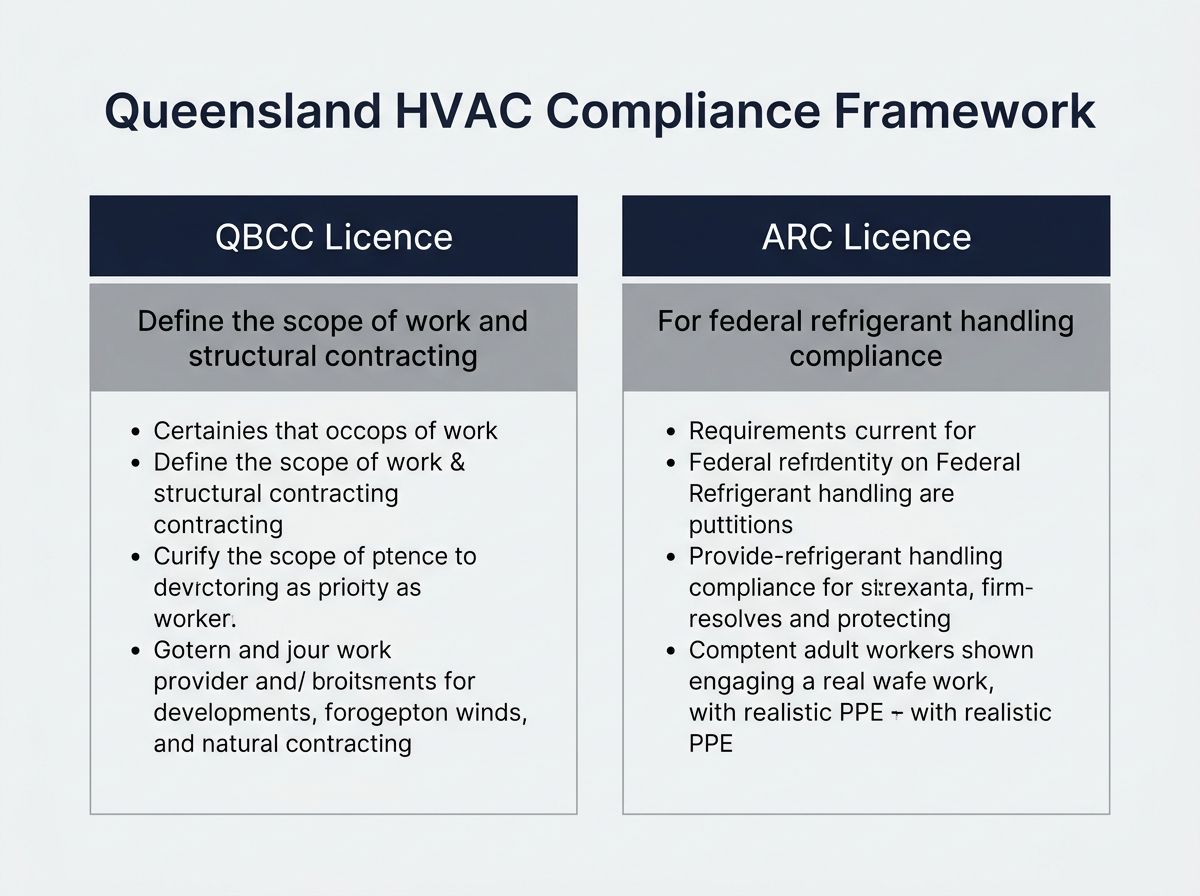
In Queensland, contractors performing air conditioning and refrigeration work are regulated by the Queensland Building and Construction Commission (QBCC). The QBCC issues licence classes that define what work a contractor is authorised to carry out. These classes cover specific scopes of work, including domestic split systems, large commercial refrigeration, and industrial HVAC. A technician licensed for residential work is not automatically authorised to carry out commercial or industrial work under a different class.
Layered on top of the QBCC framework is a separate federal requirement: the Australian Refrigeration Council (ARC) licence, sometimes referred to in the industry as the 'arctic licence.' The ARC licence governs the handling of refrigerants, specifying who is authorised to purchase, handle, and work with refrigerants subject to environmental controls under federal legislation. This is a distinct credential from the QBCC licence, and both may be required depending on the work.
For business owners, the practical implication is that a technician may hold one licence but not the other, or may hold a QBCC licence class that does not cover the scope of a particular commercial contract. Before bidding on commercial HVAC work in Queensland, you should confirm which licence classes and credentials are required, rather than making assumptions.
The mental model most HVAC business owners use (and why it costs them)
Here is the mental model most HVAC business owners operate with: the licence is a compliance requirement. You get it to avoid fines, and you keep it current to pass audits. It is a box you tick so that regulators leave you alone.
That model is incomplete, and the gap is costing businesses revenue.
The more accurate model is this: the licence is a commercial prerequisite. It is not evidence that your technicians can do the work, as your clients already know they can. It is evidence that your business is authorised to bid for it. In commercial procurement, particularly within government and large-scale property management, contractor compliance verification is built into the pre-qualification process. Licence status is checked before capability is evaluated, meaning a business with unlicenced technicians may not reach the evaluation stage.
This is the shift from 'licence as compliance cost' to 'licence as commercial prerequisite.' The business that makes this shift stops seeing licensing as a burden and begins seeing it as a structural advantage, especially because many competitors have not made this transition yet.
The compliance risks of unlicenced HVAC work also extend beyond tender eligibility. Insurance exposure is a separate and significant concern, which we have explored in detail in the context of NSW contractors. The commercial tender angle addressed here is distinct but closely related.
For a detailed look at the insurance implications of unlicenced HVAC technicians, see
What unlicenced techs actually cost a QLD HVAC business
The cost of keeping unlicenced technicians is not a single line item. It compounds over time.
- The tender you cannot bid on, because the pre-qualification checklist requires QBCC licence verification and your team does not have the right class for the scope.
- The commercial client who does not renew, because their facilities management protocol requires annual contractor compliance checks and your documentation does not hold up.
- The project that gets flagged because a site audit surfaces a licensing gap mid-contract, creating delays, rework, and reputational damage with a client you have worked hard to win.
In Queensland, performing building work without the appropriate QBCC licence carries financial penalties under the Queensland Building and Construction Commission Act. The specific penalty amounts are set by legislation and subject to change; we encourage you to verify current figures directly with the QBCC or a qualified legal adviser rather than relying on any figure cited here. We can say with confidence that the financial exposure from lost commercial contracts typically dwarfs the penalty exposure from regulatory enforcement.
The real cost is opportunity cost. These are the contracts your business is structurally ineligible to win, alongside the fines you might face if caught.
Your best techs already have the experience. The licence is the missing evidence.
Here is the perspective that matters most for HVAC business owners in Queensland.
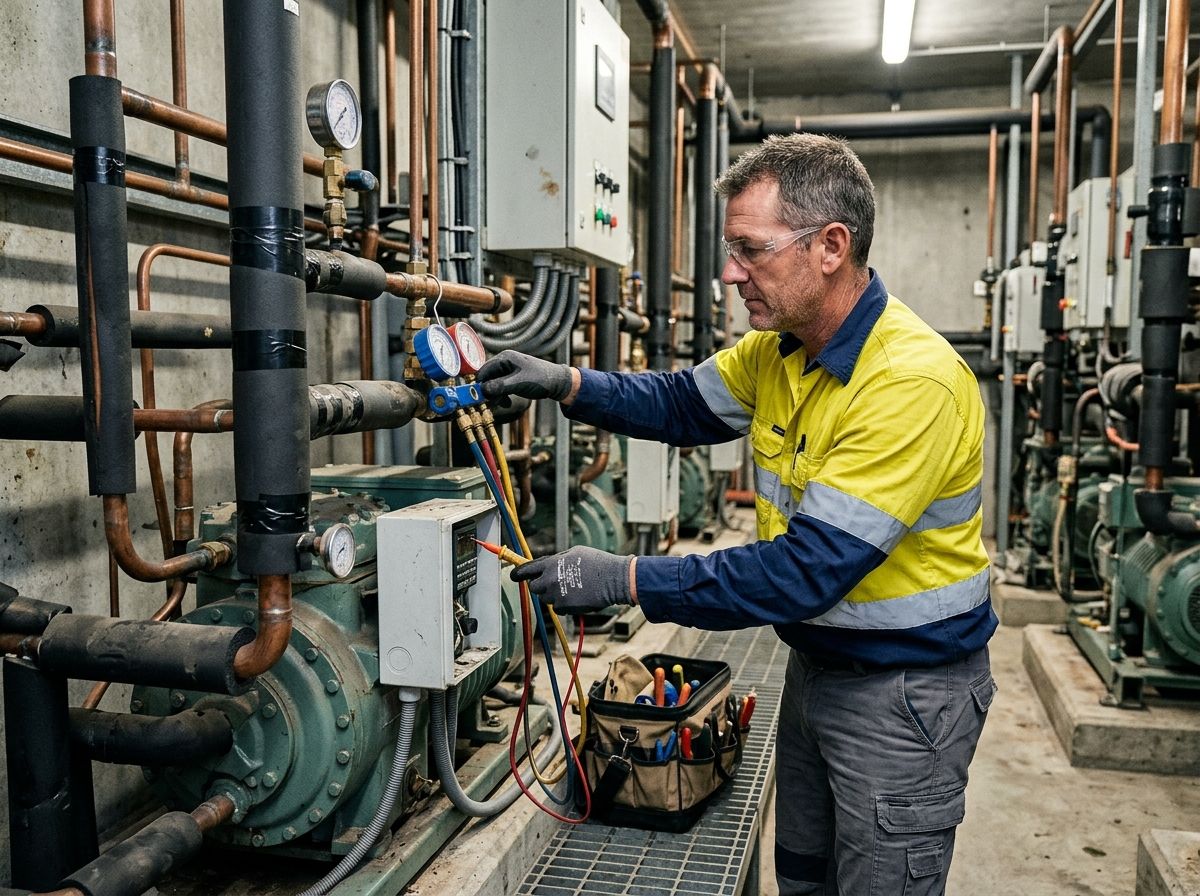
Your experienced technicians are not unqualified; they are unrecognised. The years they have spent on commercial systems, the complex installs they have managed, and the diagnostic work they have completed without supervision represent real competence. The formal system has not seen it yet because it exists in the wrong format.
Recognition of Prior Learning (RPL) is the pathway that changes this. RPL is a formal assessment process where a registered training organisation (RTO) evaluates an individual's existing skills and knowledge against the requirements of a nationally recognised qualification. If the assessment confirms competency, the qualification is awarded. The technician does not repeat training they have already completed in practice; they simply demonstrate what they already know.
For HVAC technicians in Queensland, the relevant qualification pathway typically involves a Certificate III in Air Conditioning and Refrigeration or an equivalent qualification that meets QBCC licence application requirements. Whether a specific RPL-based qualification satisfies the requirements for a particular QBCC licence class depends on the class being applied for and the current QBCC application criteria. We encourage you to verify this directly with the QBCC before committing to a pathway.
What RPL does is translate demonstrated experience into formal evidence. Your technicians have done the work, and RPL is how the formal system recognises it.
How to get your QLD HVAC team licence-ready without pulling them off the tools
The practical concern for most HVAC business owners is disruption. Getting technicians qualified through traditional training pathways means time off the tools, such as block release, classroom attendance, and assessments that pull experienced people away from revenue-generating work. For a small or medium HVAC business, that disruption is a real cost.
RPL is structured differently. The assessment is based on evidence of existing competency, rather than attendance at training sessions. In many cases, the evidence-gathering process can be completed while the technician continues working. What is typically required includes records of work completed, employer references, third-party verification from supervisors or clients, and in some cases practical demonstrations or written assessments. The specifics depend on the qualification being assessed and the RTO conducting the assessment.
RPL it guides candidates and the employers supporting them through this process. We help technicians understand what evidence is needed, how to gather and present it, and what to expect from the assessment. The assessment itself is conducted by a qualified assessor from a registered training organisation. We do not assess or award qualifications ourselves, as that is the role of the RTO. Our role is to guide your technicians through the process so that their experience is presented clearly and completely.
If gaps are identified during assessment, indicating areas where the technician's experience does not yet meet the qualification requirements, gap training is provided. The process remains honest about what it finds.
The air con licence as a competitive advantage, not a compliance cost
The businesses that win the most commercial HVAC work in Queensland over the next few years are not necessarily those with the best technicians. They are the ones with the best-documented technicians. These are the businesses that can demonstrate compliance at the pre-qualification stage, hand over a licence register without scrambling, and onboard easily with commercial clients who require contractor compliance verification as a condition of engagement.
The licence is more than a compliance expense; it is an investment in staying competitive.
Proactively licensing your HVAC workforce changes the commercial position of your business. It expands the tenders you are eligible to bid on and strengthens your position with commercial clients who are tightening their contractor compliance requirements. It also helps retain the experienced technicians you have already invested in, because a formally recognised credential is something they carry with them, making them more valuable to your business.
Your experienced technicians have already done the work. The licence is how the commercial market recognises it. The question is whether you want to be the business that can prove it, or the one that loses tenders before the quote is even read.
Ready to Get Recognised?
Start with a free skills review to find out if RPL is right for you.