Why Running a Business is Worth More Than a Business Degree (If You Know How to Prove It)
Running a business teaches more than a degree — budgets, compliance, hiring, growth. RPL Australia lets you formally prove it. Here's how the pathway works.

The hierarchy nobody questions (but should)
There is a quiet assumption built into most Australian credentialing systems: that formal education is the default proof of competence. If you studied a subject in a classroom, it counts. If you learned it by doing it — by running a company, managing payroll, navigating compliance, hiring and letting people go — it does not count in the same way. Not officially.
This assumption is rarely challenged out loud. But if you have spent years running a business in Australia, you have felt it. You have sat across from a job application form, a tender document, or a professional development requirement that asks for a qualification you do not hold — despite the fact that you practice everything that qualification covers, every week, with real money and real consequences.
The argument here is not that formal education is worthless. It is that the hierarchy is incomplete. A Diploma of Business is designed to assess whether someone can manage financial resources, lead teams, apply compliance frameworks, and develop operational strategies. If you have been running a business for five or more years, you have been doing all of that. The question is not whether you are competent, but whether your competence exists in a format that formal systems can read.
Right now, for most experienced business owners, it does not. That is the problem, and it is a solvable one.
What running a business actually teaches you
Consider what a business qualification is actually designed to assess. At the Diploma and Advanced Diploma level, the core competency areas typically include financial management, human resources, operations, marketing, risk management, compliance, strategic planning, and business development. These are not abstract concepts for experienced business owners. They are Tuesday morning.
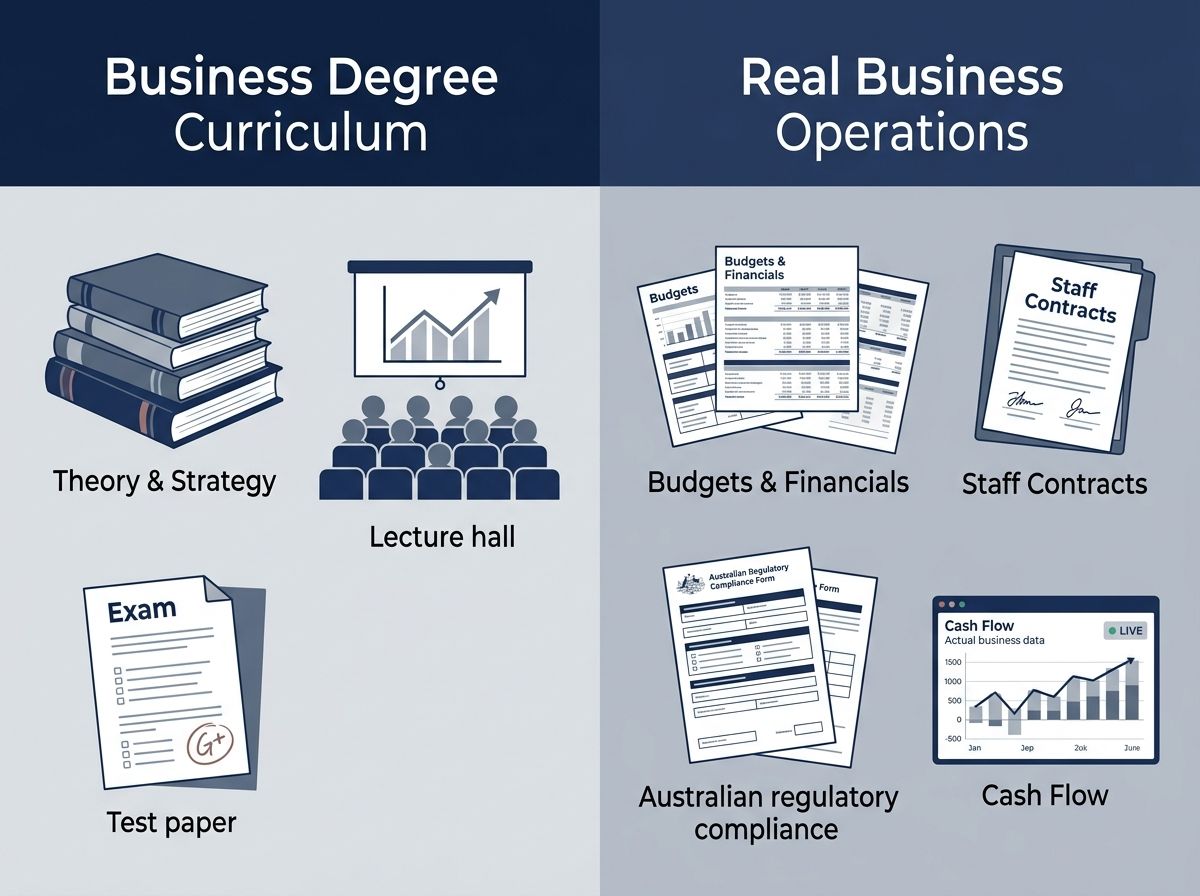
- Financial management — You have prepared budgets, managed cash flow, reconciled accounts, and made decisions with real financial consequences. Not in a simulation, but with your own money, or your clients' money, or both.
- Human resources — You have hired staff, managed performance, handled workplace issues, and navigated Fair Work obligations. You have had the difficult conversations that no textbook prepares you for.
- Compliance and regulatory frameworks — You have dealt with the ATO, WorkSafe, local councils, industry regulators, and whatever specific compliance requirements apply to your sector. You have lived with the consequences of getting it wrong.
- Operations management — You have built systems, fixed broken ones, managed suppliers, and kept a business running when things did not go to plan. That is operational competency in its most direct form.
- Marketing and customer engagement — You have developed a market position, attracted clients, managed your reputation, and adapted when the market changed. You did this in practice, not in a case study.
- Risk management — Every business decision you have made has involved assessing risk. You have done this without a framework document, because the risk was real.
- Strategic planning — You have set direction, made resource allocation decisions, and adjusted strategy when circumstances changed. That is strategic management, applied.
- Business development — You have identified opportunities, built relationships, and grown a business. That is the applied version of what a business programme teaches in theory.
This is not a direct mapping to any specific qualification — unit structures vary, and a formal RPL assessment evaluates your experience against the specific units of competency in the relevant qualification. But the point stands: the operational reality of running a business covers the same intellectual territory as a formal business qualification. The difference is format, not substance.
The problem: experience in the wrong format
Here is the precise issue. Formal systems do not dismiss your experience because it lacks value. They cannot see it because it exists in the wrong format. Your competence lives in your bank statements, your staff contracts, your compliance records, your client agreements, and your operational decisions. It is real and documented, but it is not organised in the way that formal assessment systems are designed to read.
This is the same invisible wall that stops experienced managers from advancing — not a lack of skill, but a lack of the right credential in the right format. The frustration is legitimate. Being told to sit in a classroom and study what you have been practising for a decade is not a reasonable ask. It is a system failure, not a personal one.
The good news is that the Australian VET system has a formal mechanism designed specifically for this situation. It is called Recognition of Prior Learning, and it is a legitimate, nationally recognised assessment pathway.
What RPL in Australia actually is (and what it is not)
Recognition of Prior Learning — RPL — is a formal assessment process conducted by a Registered Training Organisation (RTO) that evaluates whether a candidate can demonstrate competency against national standards, based on their existing skills and experience rather than formal study. The assessment is conducted by a qualified assessor. The qualification, if awarded, is nationally recognised because the assessment is genuine.
RPL is not a shortcut or a rubber stamp. It is not a way to bypass legitimate assessment. An RPL assessment requires you to demonstrate competency through evidence, professional discussion, and practical demonstration where required. If gaps are identified during the assessment process, gap training may be required to address them. This is standard practice, and it is disclosed upfront.
What RPL does is change the starting point. Instead of assuming you know nothing and teaching you from scratch, it starts from the assumption that you may already be competent — and assesses whether that is true. For experienced business owners, this is a direct and respectful approach to qualification.
It is also worth being clear about what RPL it does in this process. RPL it is not an RTO. RPL it does not assess or award qualifications — registered training organisations do that. What RPL it does is guide candidates through the recognition process: helping you understand whether RPL is suitable for your situation, supporting you to gather and organise your evidence, and advocating for you throughout the assessment. The qualification comes from the RTO; the guidance comes from RPL it.
The qualifications a business owner can realistically target
For experienced business owners, the most relevant VET qualifications are typically the Diploma of Business and the Advanced Diploma of Business. These sit at Levels 5 and 6 of the Australian Qualifications Framework (AQF) respectively — the same framework that governs all Australian qualifications from Certificate I through to doctoral degrees.
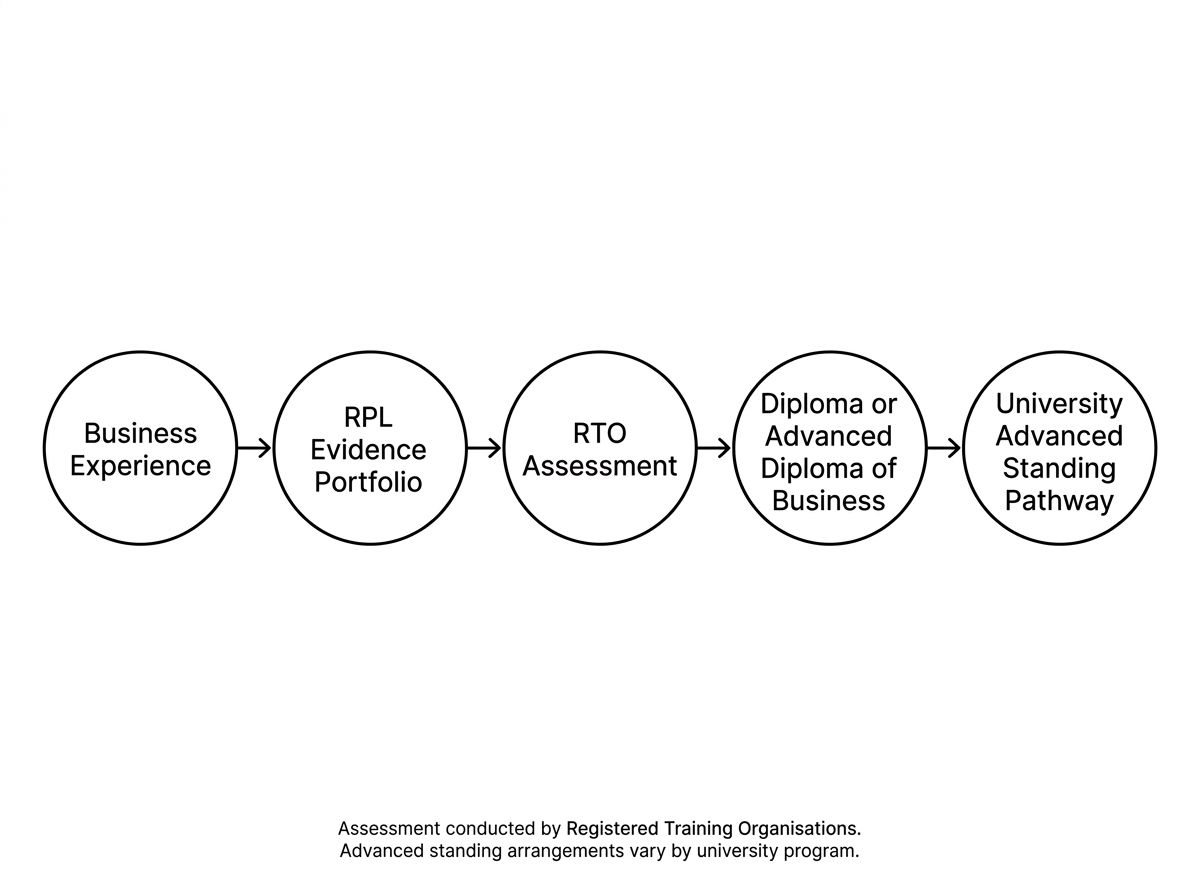
A Diploma of Business (Level 5) is designed for people who apply solutions to a range of complex problems, and who work with autonomy in non-routine situations. An Advanced Diploma of Business (Level 6) is designed for people who apply specialised knowledge and skills in complex situations, with significant autonomy and responsibility for their own work and the work of others. If you have been running a business, both descriptions are likely to sound familiar.
These qualifications matter beyond the credential itself. Within the AQF framework, a Diploma or Advanced Diploma can provide a pathway into university study — including, in some cases, advanced standing in postgraduate programmes. The specific arrangements vary by institution and programme, and no particular outcome can be guaranteed. But the structural framework exists, and for business owners who want to pursue further study without repeating an undergraduate degree, it is worth understanding.
The Fast Track University pathway is specifically designed for experienced professionals who want to explore what a VET qualification through RPL could unlock at university level.
What 'proving it' actually looks like
The documentation burden is the part that stops many experienced business owners from pursuing RPL. It sounds overwhelming to gather evidence, organise records, and present your experience in a format an assessor can evaluate. The reality is more manageable than it sounds, particularly when you have a guide who knows what assessors are looking for.
For a business qualification RPL assessment, the types of evidence that are typically relevant include financial records and reports you have prepared or overseen, employment contracts and HR documentation, compliance records and regulatory correspondence, business plans and strategic documents, client agreements and operational procedures, and professional references from people who can speak to your competency. Most business owners already hold this documentation. The work is in organising it, not creating it.
The assessment itself typically involves a combination of documentary evidence review, professional discussion with the assessor, and in some cases practical demonstration of specific competencies. The assessor is evaluating whether you can demonstrate competency against the specific units of the qualification — not whether you have a perfect record, but whether your experience shows genuine capability.
If gaps are identified where your experience does not clearly demonstrate the required competency, gap training may be required. This is not a failure. It is the assessment working as it should, honestly identifying what you know and what you may need to develop further. Gap training, where required, is part of the process.
RPL it guides this entire process. The role is to help you understand what evidence is needed, support you in organising and presenting it effectively, and work with you through the assessment. You are not doing this alone.
Is this the right pathway for you?
Not every business owner will be suitable for RPL. The assessment requires demonstrable competency against specific units, and some candidates may have experience gaps in particular areas. The honest answer to 'is this right for me?' depends on your specific experience, the qualification you are targeting, and the evidence you can provide.
That is exactly what the Free Skills Review is designed to answer. It is a no-obligation assessment of whether RPL is a credible pathway for your situation, before you commit to anything. The purpose is to give you an honest answer, not to enrol you in something that may not be right for you.
Managing real budgets, hiring staff, and navigating compliance is not a lesser form of education. It is a different, more rigorous form of evidence. RPL in Australia is the formal mechanism that lets you demonstrate that. Whether it is the right pathway for your situation is a question worth asking.
The decision is yours.
Ready to Get Recognised?
Start with a free skills review to find out if RPL is right for you.